

Creativity and business often clash. To be a success, creativity’s endless possibilities must fit within the limited resources of business, from budgets to timelines.
This is where creative project management comes into play, headed by a creative project manager.
Creative project managers play a crucial role in tying together the needs of business with the unique demands of the creative process.
They provide balance, implementing project management structures that gear creative energy towards clear business goals, while keeping resource allocations on time and within budget.
In this guide to creative project managers, you’ll leave with a clear understanding of the role and gain 10 effective project manager strategies.
Key Takeaways:
- Creative Project Managers bridge the gap between creative freedom and business demands, such as budgets, timelines, and resources.
- Unlike a regular project manager, they require an understanding and empathy for the creative process and its unique fluctuations.
- Clear planning, strong communication, and proactive monitoring are essential to prevent scope creep.
- Strong collaboration and resource understanding help keep creative teams motivated and aligned.
- Using the right project management software can streamline the process and add real-time control.
What is a Creative Project Manager?
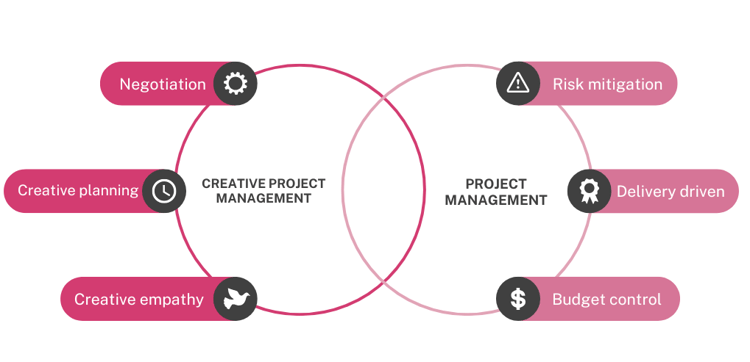 A creative project manager is tasked with aligning creative teams with project goals and demands, typically in a full-time role within an in-house team or creative agency.
They oversee the planning, execution, creative solutions, initiatives, and closure of creative deliverables, working with cross-functional teams and creative stakeholders, such as graphic designers, copywriters, videographers, photographers, and social media teams.
What’s the difference between a Creative Project Manager and a Project Manager?
Unlike a regular project manager role, a creative project manager is expected to have a deeper understanding and empathy for the creative process.
As they’ll be working with various creatives, an appreciation and understanding of the creative industry and concepts like design thinking, ideation, storytelling, and aesthetics sets the creative project manager apart from a more general project management role.
Many regular project managers might approach the role in a more cutthroat manner, which inhibits and demotivates the creative team. Therefore, creative understanding is important, as it enables them to identify areas where creatives can cut back, adjust, or prioritize, allowing them to thrive within business constraints.
Creative Project Manager vs a Creative Director
A creative director is responsible for the actual creative work and direction, such as a project’s ideal and feel. They provide creative visions, making judgments on concepts and ideas, and ensuring brand standards are met.
Creative directors are not the ones responsible for making sure a project gets delivered on time and on budget.
Likewise, a creative project manager is not there to make creative judgments or use their taste; instead of asking questions such as “will this idea connect?”, a creative manager will ask “What’s blocking this? Will we meet the deadline? Do we have the resources for this creative output?”
The Creative Project Manager Job Description
Despite the differences listed above, a creative project manager’s responsibilities very closely resemble a standard project manager's job description, with the following key areas of responsibility:
1. Planning and organization
Creative project managers play a huge part in helping to shape ideas for a project.
They facilitate goal-setting activities for the team, the results of which inform how a creative project manager breaks down tasks and allocates resources. This helps them keep the team on track to meet important milestones and deliverables.
- Read more: 5 Steps to Creative Project Planning
2. Communication
Beyond project execution, creative project managers need to be able to work with various stakeholders, both in-house and externally.
Negotiation and conflict resolution skills are critical for any creative project manager, as they’ll be working with different personalities. These skills can considerably help improve morale and motivation within team collaborations.
3. Monitoring
Creative project managers play a supportive role once the project gets going, mainly by monitoring the status of active tasks.
Monitoring gives them time to address potential roadblocks facing upcoming tasks that will impact the project timeline. Someone in this role is also expected to engage in quality control, making sure that all deliveries satisfy established quality standards.
10 Effective Creative Project Management Strategies
Creativity. Collaboration. Empathy. These values should be the foundation of your creative project management approach.
But principles alone can’t help you manage projects better. You also need proven best practices and tactics, like these:
1. Educate clients about the creative process
Clients who don’t understand the creative process invariably end up derailing projects. They reject suggestions, request too many changes, and have unrealistic expectations.
Problem-solving is achieved by investing in client education. Guide them through the creative process and show them the effort that goes into creating every deliverable.
You’ll solve two issues:
- It erodes the client’s resistance to suggestions
- It helps justify your estimations, for deadlines and for budgets
Make this a part of your onboarding process and reiterate the message at early-stage meetings.
2. Solve scope creep issues
Besides death and taxes, another inevitable thing in life is clients who don't really know what they want from a creative project. They might have a vague idea, but they often fail to communicate it clearly.
The result is endless scope changes, frustrated clients, and delayed projects.
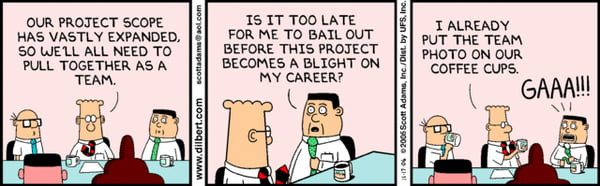
As a creative project manager, you must avoid scope creep. It can derail even the most astutely planned projects. So, solve the issue as early as possible.
To limit the impact of change, while keeping clients happy, you can use these tactics:
- Gather requirements: Collect as much data as possible upfront and fully understand the client's vision before committing to any process. You should know what the client wants, what the end-users need, and how the project will be deployed.
- Understand the project's complexity: Ensuring all stakeholders know the true size of the task will improve your estimations. For example, "Just a website" isn't just a website; it also requires SEO, social integrations, and even some CRO.
- Limit the number of "free" iterations: Make it clear at the start of the project that there is a defined number of iterations (and that after that, the client must charge for extra iterations).
- Get client input early: Instead of sending final designs, send clients low-cost and easy-to-modify mockups and wireframes first. Get them to sign off on these before you build the final iterations.
3. Embrace collaboration throughout your team
To embrace creative collaboration isn’t just to switch to Slack from email; it’s to create a culture that truly values working together. This means cherishing values like transparency, gratitude, and sharing at every level.
You can’t do it single-handedly, of course. Nor will the change be fast. But you can start the fire by embracing collaboration in your creative team.
How? Here are a few tactics:
- Instead of top-down goal setting, collaborate with team members to set targets.
- Involve team members when you assign them roles. Factor in their creative preferences and long-term ambitions (such as graphic design, working digitally, or using AI or not).
- Encourage senior members to reach out and mentor new people on the team. If possible, institute a formal mentorship program.
- Identify the less engaged and non-communicative members of the team. Get them involved in team activities to improve team cohesiveness.
4. Nurture different creative personalities
“Creative people” aren’t a monolith. They have different personalities that are useful in different stages of the project. As a creative project manager, it’s your responsibility to identify and nurture these personalities.
Some of the personalities found within creative teams are:
- Adventurer: Curious, flexible, and likes to experiment with new approaches. Adventurers thrive in a crisis and love to solve tough problems.
- Navigator: Navigators have a more conventional approach to creativity. They build on proven techniques and focus on facts. Navigators are crucial for keeping the team grounded.
- Visionary: The visionary of any team is its “big picture” person, i.e., someone who challenges the team to think outside the box and pick ambitious targets.
- Explorer: The explorer is the person who rises to the visionary’s challenge. He/she is the ideal person, challenging the status quo and forcing the team to think beyond accepted solutions.
- Inventor: The inventor uses proven models and theories to break down complex problems and arrive at solutions. At the same time, he/she develops new models to complement the team’s working style.
- Harmonizer: The harmonizer is the calming influence on the team. He/she is usually a relationship-focused person who smoothes out the team’s dynamics and brings out the best in people.
You’ll find that the best-performing creative teams have a mix of these personalities.
5. Close monitoring is critical
Creative projects can go off track fast! A critical resource goes on leave, a client requests too many changes, and before you know it, you’re off budget and delayed by 3 weeks.
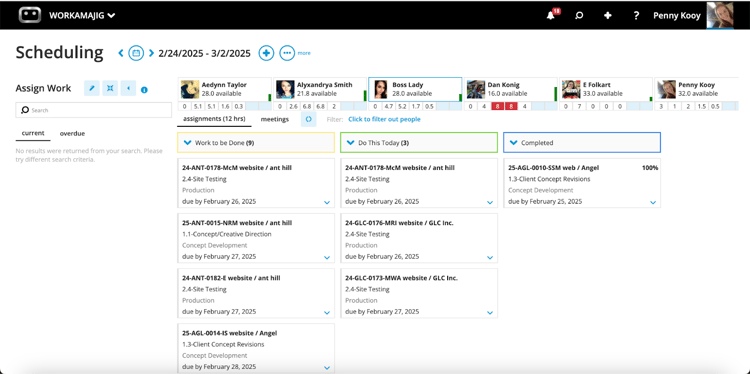
Close monitoring with tools such as Workamajig can prevent projects from going off track and pull back derailed projects.
Close monitoring is one of your most important tools in ensuring the project stays on track. Try the following to monitor the project’s progress:
- Conduct regular team meetings: Meet with your team on a weekly or bi-weekly basis. This helps ensure that you have up-to-date status information and an understanding of all open issues. You can also use meetings to address any concerns and conflicts within the team.
- Conduct regular client status meetings: The takeaways from your team meetings form the basis of your client status meetings. Share the status of the project, open issues, and any tasks that need the client’s attention. Do this as frequently as you run the team meetings, i.e., on a weekly or bi-weekly basis.
- Monitor the budget closely: Projects going off budget are a common cause of creative project failure. Make sure that you monitor spending closely. Update project financials with actual charges every week. If you’re off track, take corrective action immediately by cutting back or improving productivity.
6. Use the right software
A common point of failure is using software that isn’t specifically designed for creative projects. A conventional PM tool simply doesn’t have the features you need to manage creative projects effectively.
Here are some things you should look for in creative project management software:
- The ability to manage resources (in-house and freelance), create schedules, and forecast demand.
- Features to help you develop project estimates, schedules, and creative briefs.
- A platform to address open issues, monitor project budgets, and get client feedback.
- Time tracking, project status reporting, and communication monitoring.
- Task management, document sharing, and the ability to generate online proofs.
Workamajig has all these features and more. Click here to learn more about how Workamajig can help you run better creative projects.
7. Adopt the "5Rs" of project planning
Creative operations are notorious for going off-track, over budget, and stretching in a million different directions.
There are 5 rules you can adopt (we call them the "5Rs") to keep your projects organized and on a budget:
- Right planning: When starting a brand new project, planning goes a long way toward your project's progression and results. The more effort you put into the planning and research-gathering phase, the more you will contribute to the success of your project.
- Right strategy: Strategy is a key component of the planning process. Bringing in the right resources, attributing the right timelines and budget, and setting up the appropriate communications plan can help you with your strategy and with assigning the right resources and tasks to the project, as needed.
- Right communication: In regard to keeping organized, communication is crucial in all aspects of the project. This encompasses both your internal and external communications, and keeping both in sync with one another. A great recommendation is to create a communication plan before work begins to save everyone time.
- Right execution: When the planning, strategy, and communication are solidified and agreed upon between you and the client, it’s time to execute your project deliverables. By bringing in the right resources and having the timelines and communication plan in place, you can better execute your deliverables and deliver your project on time and of great quality.
- Right tools: To balance all of these tips above, the final tip revolves around having the right tools or processes in place to keep your planning, strategy, communication, and execution all in one place. It’s important to find the right tool that fits your business objectives and can help save time for your organization.
Of course, all the right strategies can't help you if you don't have a true passion for the work you're doing, which brings us to the next point.
8. Pursue your passions
Creative projects thrive best when the individuals involved love and believe in what they’re doing.
So, working on solutions that bring out your team’s passion is advised. If the client needs to line up with those passions, you can consider discussing options with the client to align them. In many scenarios, we’ve seen passion in them.
This approach can also help you take the initiative to find creative solutions that go outside the box and may bring better results than initially expected.
9. Be creative at the right time
Forcing creativity is a recipe for paralysis by analysis, especially when you're trying to impress a new client. At moments like these, it is far more important to create agreeable output, even if it doesn't have CLIO-winning creativity.
If you find that you're at a crossroads between your creative side and needing to get the project done, I suggest taking one or more of these three actions:
- Align the team: If your project is in jeopardy in terms of schedule or budget, formulate a plan of action with the team first to take to the client. If you can do so without losing critical time, it’s always better to come to the client with a plan of action or solution rather than just a problem.
- Take it to the client: Next, contact the client and discuss the problem at hand. This step may be first, depending on the situation, the client, or the problem. Do you negotiate some requirements that will take the solution down a notch, but complete it on time? More often than not, the client will be happy to find a middle ground rather than lose out altogether.
- Move forward as is: The third approach is to battle on. For a creative project like an ad campaign, a huge marketing effort, or a product or web design, it’s doubtful that there is much room for change without extensive, costly, and time-consuming changes. So you may have to plug away and burn through critical time and dollars on the project. If so, make sure your end-of-project review includes an analysis of what went wrong to avoid it happening again.
10. Make resource planning a creative advantage
Your team most likely already has all the talent it needs. But is the right talent available when needed?
Strong resource planning shouldn’t be an afterthought, so understand your team’s capacity, skill set, and availability before timelines are committed.
We call this resource visibility. Deploying it will allow you to assign work based on strengths and passions, preventing burnout. Workamajig is perfect for this, as it allows you to see workloads and schedules all in one place.
How do I become an effective creative project manager?
If you’re keen to build the skills to be a creative project manager who shines, here are some suggested options to improve:
Pursue related degrees and courses
Ordinarily, qualifying for a creative project management role is done via degrees like communications, marketing, and management.
Many Project Management Professionals (PMPs) with these degrees start in entry-level positions, such as project coordinator or junior creative project manager, before progressing into full ownership of projects and cross-functional teams.
Engage in the creative process.
Experience is, as always, invaluable, but especially so when it comes to needing a deep understanding and empathy for the work of creatives.
Consider taking up creative roles on the way to a project management role, as the familiarity will help you make faster, more informed decisions when working with team members who specialize in those fields.
- You can read more about creative project management processes here: Creative Workflow Management: Best Practices + Software Tools.
Polish your written and verbal communication skills
Liaising between the creative team and various other stakeholders is an essential part of creative project management. So honing your communication skills is a wise step to take.
Apart from the daily interactions that are required of the project manager, an important step to take in building this skill is to ask for feedback from your team. Each team and every stakeholder is different, and having direct instruction from them on which communication styles work for them is key to building synergy in the project.
One piece of reading we recommend is Dale Carnegie’s How to Win Friends and Influence People, a master class in interpersonal relations, both in and out of the work context.
Use Our Project Management Tool to Help Your Creatives Thrive
To recap, an effective creative project manager is the anchor for any creative team. They balance the limitless passion of creativity with the needs and constraints of business.
Streamlining campaigns is best done with the use of project management tools, like Workamajig.
Workamajig is a premier marketing management software designed specifically for creative agencies.
It provides an all-in-one solution for planning, organizing, and delegating tasks, and easily transitioning between any of the three.
You can easily adjust your schedule or modify task requirements and assignees to ensure efficiency, and use native reporting tools to measure your progress, as well as identify and address roadblocks along the way.
Resource and budget management also becomes a breeze. Making it ideal for agencies working both in-house and externally.
We welcome you to contact us today for a free demo.