


Most agencies will determine a client’s value by looking at revenue. But that only reveals a small piece of the puzzle. To get a full picture, say hello to customer profitability.
Customer profitability is the measure of how much profit a customer generates after all the customer-specific costs have been calculated.
It’s an essential tool for any growing business, as you’ll come across an increasingly diverse range of clients and many will need to be treated differently from others.
In this guide, you’ll learn how to calculate customer profitability, how to optimize your most profitable customers, and act on those less profitable ones.
Key Takeaways From This Blog:
- Customer profitability is a measure of how much profit a customer generates after all costs have been calculated.
- It’s used to provide a quantifiable understanding of how valuable a client is.
- You can then take action, such as increasing or decreasing scope, services, and pricing.
- It should be performed regularly, ready for triggers such as planning, annual reviews, and growth strategies.
- Using an automated software such as Workmajig allows for rapid report generation, which draws directly from your real-time data.
What is Customer Profitability?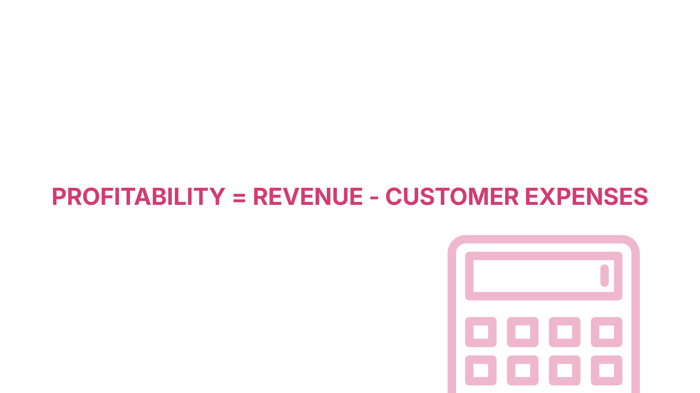
Customer profitability is a measure of the value that a customer brings to your business.
It’s calculated by subtracting all customer-specific costs from the revenue that they generate. This includes the costs of materials, operations, and even taxes.
This calculation can help you understand which clients truly benefit your bottom line and which drain your resources, even if they bring in high revenue.
In an agency setting, you may also want to consider factors such as resource use, revision demands, and the hours spent communicating with the client.
What is an Example of Customer Profitability?
Imagine you have a design and printing poster company.
It has two customers: A and B, who both make bulk orders.
A is a larger business, so they order considerably more posters than B, bringing in far more revenue. At first glance, you might think that A is a more profitable customer, right?
But we haven’t factored in that A’s business is located much further away from your warehouse than B, which means they incur higher costs for delivery.
A also frequently requests more revisions and long conversations with senior staff.
Suddenly, the numbers tell a different story.
While A’s revenue is higher on a per-order basis, that business doesn’t come cheap compared to what it takes to serve B. Following this high-level pattern, B turns out to be the more profitable arrangement.
Why is Customer Profitability Important?
Customer profitability brings all the pros and cons of working with a client together, in a quantifiable form. This then allows you to make informed decisions about your marketing and sales strategy.
Without it, you may only look at revenue and not understand the impact of labor hours, labor costs, and resource demands. But with it, you can directly compare clients based on overall profitability.
You can now make informed decisions, such as shifting your strategy towards focusing more on high-value clients or adjusting your services and pricing for low-value clients.
As a result, you’ll remove inefficiencies and plug those holes in your customer base where cash leaks.
It’s a critical part of any high-functioning business, which is why we include automated client profitability tools within Workamajig.
When to Use Customer Profitability?
Here are some common scenarios when you’ll want to turn to customer profitability reports:
Client Strategy
Customer profitability can be used as part of your strategic decision-making, including for customer acquisition, customer retention, marketing strategies, and pricing strategies.
Knowing the true profit contribution will help you know if targeting an individual customer or customer group is worth the investment.
Operational Triggers
You can also use customer profitability calculations during annual reviews or if your costs have unexpectedly risen.
Its use will reveal if you have unprofitable clients with unsustainably high demands. Following this discovery, you could decide on pricing changes, customer loyalty programs, or ending relationships with less profitable customers.
Growth Decisions
You could also run a customer profitability analysis before acquiring new customers or expanding your services. Whether it’s with market expansion, resource allocation, or upselling premium offerings, you’ll have accurate data to improve your net profit.
What Are the Other Areas of Customer Profitability Analysis?
Customer profitability analysis can also cover other values, such as:
- Customer Lifetime Value (CLV): All-time revenue (though it misses out on retention factors and costs beyond acquisition).
- Average Revenue per User (ARPU): Total revenue / total subscribers.
The specific activities, expenses, and revenue-generating engagements are different for every business, but for starters, here are some simple formulas for computing revenue, which is your initial building block for measuring client profitability:
Customer Lifetime Value
Customer Lifetime Value (known as CLV, CLTV, or simply LTV) is a projection of the total potential value a customer generates for your business throughout the lifespan of your relationship. This is typically computed using the following:
- Revenue or Average Purchase Value: Where revenue can be the total amount you’ve collected from a customer, while average purchase value is the average cost of one transaction.
- Purchase Frequency: Used in tandem with average purchase value, for calculating profitability within a specific time period.
- Lifespan: The total time spent being in business with the client. This can be based on the specific client’s presence or an industry benchmark.
Average Revenue per User (ARPU)
Average Revenue per User is a valuable metric for subscription or membership-based services.
The formula is rather straightforward: take your total revenue and divide it by the number of users or subscribers.
The ARPU is used in tandem with customer profitability analyses by highlighting trends in customer behavior.
An upward trend means that one or multiple parts of your strategy for that customer segment are working; comparing your profitability analysis with that of another customer segment can then help you identify which touchpoints might be causing this upward trend.
How to Measure Customer Profitability
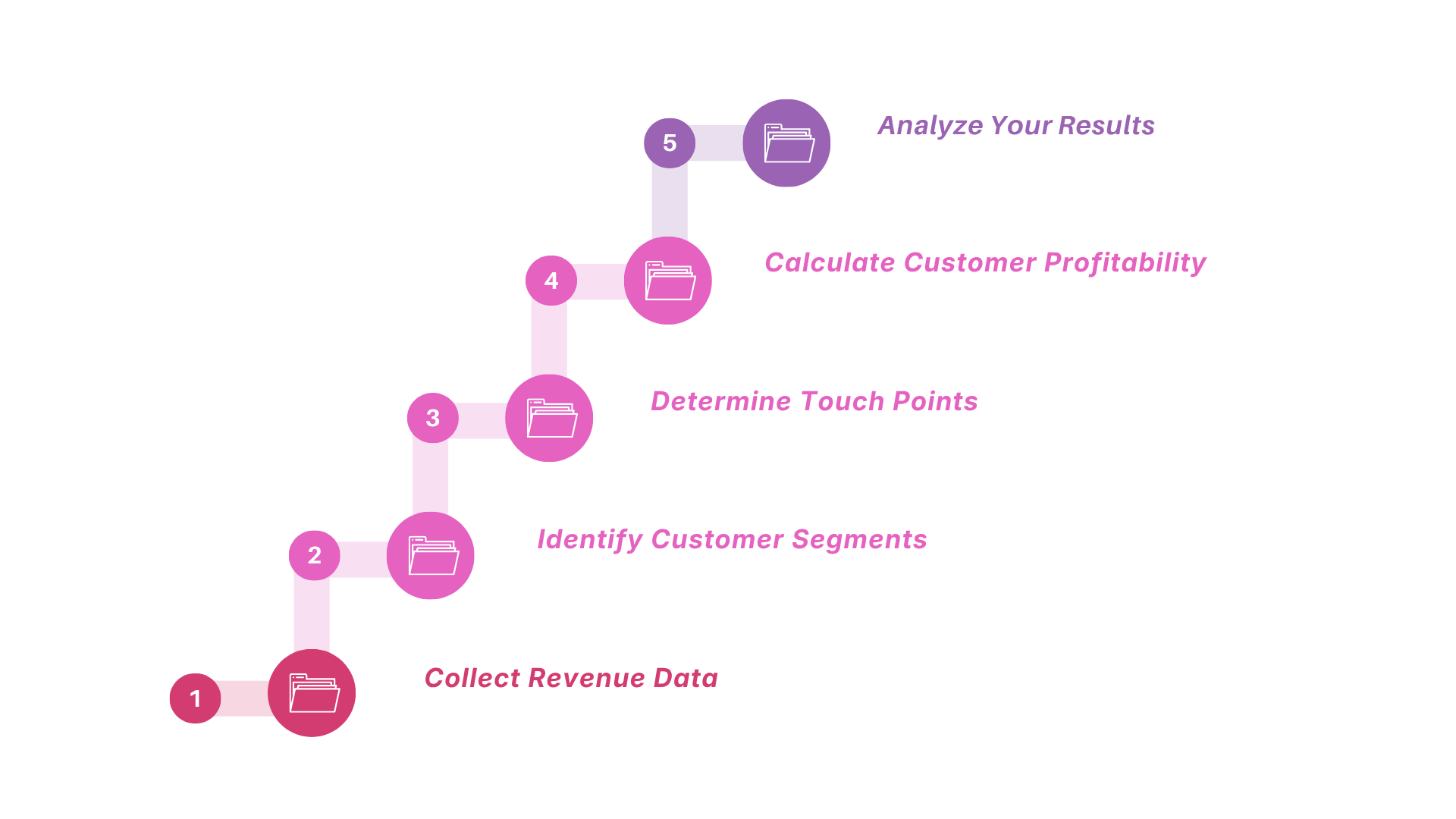
Now that we understand the concept and importance of customer profitability, here are the steps you should take to build a comprehensive customer profitability report:
1. Collect revenue information from all relevant sources
First, determine the total revenue generated by all your customers.
This could be within a given period, such as a month, quarter, or year. For accurate comparisons, keep the period consistent.
It’s also important to note where this income is generated, whether that’s from direct sales, support services, subscriptions, or other income-generating options you have available.
2. Identify customer segments and their value
If you’re handling large numbers of clients, creating customer segments allows you to spot patterns in profitability based on similar client traits.
Segments vary significantly between businesses, so consider whether factors such as location, nationality, order volume, or purchase frequency are your defining characteristics.
Various tools are also available that can help you identify these customer segments.
Another way to identify customer segments is through buyer personas, which are profiles that illustrate your customers’ behavior, preferences, and obstacles, and might already be available from the start of your marketing campaign, as this is a key part of building a strategy.
From there, segregate your revenue information across your resulting customer segments.
3. Determine touch points and costs
You can now list down the unique ways you interact with each different customer segment.
This can include customer service, social media, packaging, delivery, and other areas. From there, calculate how much it costs to enable each of these channels to serve your customers. It’s also important to account for indirect costs, such as taxes, administrative and licensing fees.
4. Time to Calculate
With the revenue and costs now identified, you can calculate the customer profitability, using the basic formula:
Customer Profitability = Revenue - Costs
Do this for every customer segment you’ve identified, too.
5. Analyze Your Results
Now that you have a unified profitability score for each customer segment, it’s time to identify which ones generate the most value for your business and which ones are not as lucrative.
Look for patterns in the activities and sales associated with each customer segment.
- Are there activities that commonly occur where higher profits are generated?
- Are lower-value clients exposed to touch points that end up costing you more than doing business with more profitable ones?
Using the steps above, you can generate all kinds of profitability analyses, which you can use to update your business strategy accordingly.
6. Consider Using an Automated Reporting Software
If this all sounds like a headache, you can make things easier by turning to software that automates reporting, like Workamajig.
This can allow you to rapidly create a client profit and loss report, without the need to manually produce data analytics and churn through old invoices.
How to Implement Customer Profitability in Your Agency
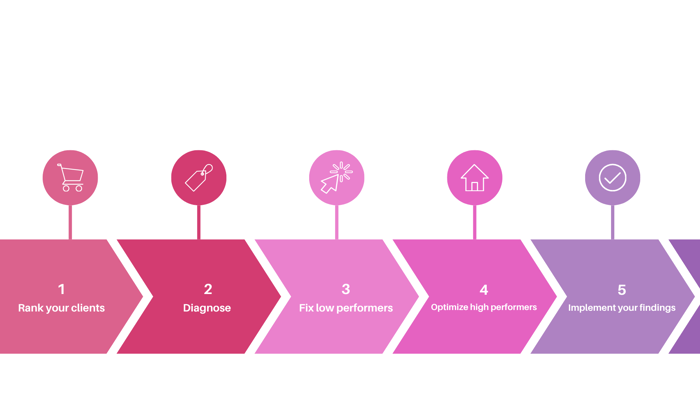
Once you’ve got the results of your customer profitability analysis, you can turn them into decisions.
Here’s a look at some steps you can take to make use of the results in your agency:
1. Rank Your Clients
Start by ranking your clients and/or customer segments into categories like ‘highly profitable’, ‘low profit’, 'break-even’, and ‘unprofitable’.
This will help you quickly understand where the agency is making and losing money, and provide deeper clarity.
2. Diagnose
Now it’s time to work out why those unprofitable customers are as such. Is there an underlying reason, such as underpricing, too many revisions, scope creep, or high associated costs?
3. Take Action on Your Lowest Performers
With the whys answered, you can now take action.
It may be tempting to simply cut out low-value clients in favor of higher-value ones.
But in many cases, it can be more cost-effective to retain and improve on existing customer relationships than to build new ones.
One way to achieve this is to offer adjusted tiers of products and services that make it more attractive for your low-profit clients to increase their business.
This can also come with various upgrades or freebies, compared to a one-size-fits-all approach. For those with high customer costs despite low purchase rates, consider exploring ways to streamline operational costs.
4. Protect Your Most Valuable Customers
For high-profitability clients, look for ways to keep them happy, stable, and scalable.
You can consider investing in exclusive promotions, VIP services, and preferential services, such as priority customer support or faster delivery options.
You might also expose them to other products or services you offer that they ordinarily may get elsewhere; this is attractive because they save on resources interacting with multiple providers, whereas they can get a better deal doing their business with you.
In most cases, you benefit more from improving your products and services for all customer segments, as goodwill and brand reputation are critical bonuses to your marketing reach. As your business scales, adding new offers that augment existing relationships, while potentially attracting new clients, will help your business stand out as a reliable resource.
5. Use Your Findings in Your Planning
To aid further business growth, you can use your profitability findings in all sorts of project planning and reports, including resource management, client reporting, sales targeting, and capacity planning.
For example, you may want to assign your strongest team members to your most valuable clients, or use customer segment pattern data to inform future lead generation.
6. Make Customer Profitability Reviews Regular
Performing regular customer profitability analysis, such as monthly or quarterly, will help you identify when a client is drifting off course and help provide up-to-date information for your ongoing planning.
FAQs on Customer Profitability
What is the 80/20 rule for customer profitability?
The 80/20 rule is a concept that suggests 80% of a company’s profits come from just 20% of its customers. Remember that nurturing your high-value customers is critical to your business success.
How do you measure customer profitability?
Customers’ profitability is measured by deducting the total expenses you spend on a customer from the total revenue the customer generates. This should be over a defined period, such as a quarter or year.
What is the difference between customer profitability and customer lifetime value?
Customer profitability measures the profits generated over any defined period, such as a month or quarter. It’s a snapshot based on data.
A customer lifetime value is a forecast of the total profits a customer will generate over their entire future relationship with your business.
Build Customer-Centered Strategies with Workamajig
Workmajig is a project management software designed for agencies.
With real-time data and automated reporting, customer profitability analysis is rapid and highly effective.
Its customer profitability report tool provides a data-driven, General Ledger-based view of each client’s profitability.
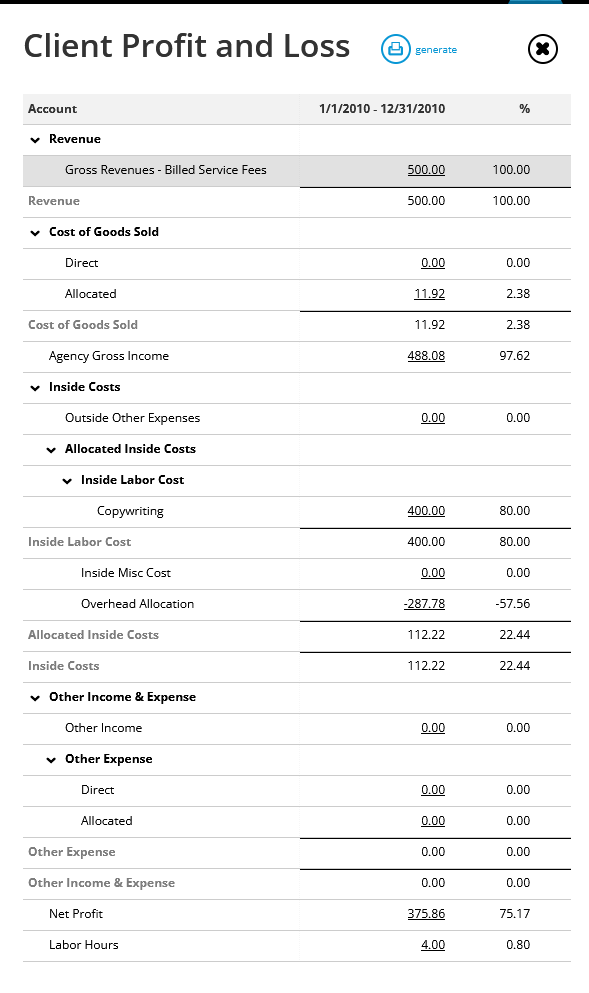
As everything within Workamajig is fully integrated, it can instantly pull from data such as billing, cost of goods sold, labor costs, adjusted gross income, and the ability to customize your reports with further data.
All this can be pulled from specific date ranges, ensuring consistency across all your client reports.
So, you won’t have to manually enter data or find old, complex invoices, emails, and spreadsheets to perform calculations and report design.
If you’d like to receive a free demo to see the extent of how Workamajig can transform your agency, feel free to contact us today.