

Project managers often have a saying that goes, “the person who says a project will take the longest and cost the most is the only person who knows how to do the job correctly”.
While that may seem disappointing, it’s often true as project stakeholders tend to be unrealistically optimistic about its duration and cost. After all, success with the least investment possible is the dream!
But in reality, almost all projects encounter setbacks and failures, resulting in overrun project schedules and higher costs.
To avoid that scenario, you need to create a project management plan with clear project objectives, practices, risk management, communication plans, and more.
Studies even show that 73% of organizations that use a formal plan always or often meet their goals.
In this guide, we’ll make all that easy to understand so your project team has a crystal clear understanding.
Key Takeaways:
TLDR? Here are the essential things to remember from this blog.
- A project management plan is an essential roadmap that details exactly what’s needed to make a project a success.
- Information should include project deliverables, project goals, budgets, timelines, communication methods, and resource allocation.
- It is a document sent to all key stakeholders, aligning them on expectations.
- They provide critical clarity upfront that reduces risk and misunderstandings.
- You should use an attractive and easy-to-read design for the document, while being wary.
- You should take learnings from previous projects.
- You must ensure it is the project manager who remains in charge.
What Is a Project Management Plan?
Project Management Plan Definition
A project management plan is a roadmap for your project and stems from the original project plan. It contains all the vital information you need to bring it to fruition, such as project deliverables, project goals, budget, timeline, project management communication methods, and resource allocation.
A Project management Plan should be shared with all relevant project stakeholders, as it acts as a reference to keep all on track and on the same page.
It should be created and overseen by a Project Management Professional (PMP), such as a project manager.
Why Is a Project Management Plan Important?
While small projects might survive if the project manager just ‘wings it,’ solving problems as you go along is rarely wise for average to large projects. In fact, according to PMI, studies have proven that having a project plan significantly improves project success and efficiency during the project life cycle.
So, how does a project management plan help?
- Identifies issues at the outset:
- By sharing the project management plan with the project stakeholders, you can identify confusion and problems before the real work is done, which will prevent project creep.
- For example, if you were imagining a deliverable one way but your client was imagining something else, this will come to light as you create the project management plan.
- Serves as a reference point:
- A project management plan anchors the project, allowing team members to refer to it throughout the project, and serves as a baseline to determine whether you are meeting your original goals.
- Keeps clients happy:
- Clients love knowing exactly what to expect from a project, and a project management plan gives them all the information they need to feel secure that their project is in the right hands.
- Provides clarity:
- A Project scope (what should be delivered and what shouldn’t) can become extremely clear when a Project Management Plan is in place, reducing disagreements, wasted time, and missed milestones or deadlines.
- For example, you’ll avoid having two employees doing the same task because neither is clear about what is expected of them, or having nobody do a particular task because it wasn’t clearly assigned to anyone.
- It effectively eliminates excuses for mishaps, as it’s all clearly laid down in ink and available to everyone involved in the project from the word go.
- Procurement decisions become easier:
- Sourcing anything from outside the company can be an expensive endeavor, especially if there isn’t a clear plan of what’s required in advance.
- A project management plan resolves that by clearly defining what should be sourced externally, what should be made in-house, how external input affects deadlines, and the sign-offs required to get the job done.
Project Management Plan Components:
- Executive Summary: An executive summary is like an outline for a project management plan. It should explain in a nutshell how you plan to solve your client’s problem or provide them with the deliverables they are requesting.
- Deliverables: This needs to be discussed with key stakeholders beforehand. Once you have agreed upon the deliverables and their contents, you can write them in the project management plan.
- Milestones and goals: Milestones are significant achievements within the project duration, while goals are the overall objectives of the project, such as increasing website traffic.
- Timeline: A visual guide depicting when milestones and deliverables need to be achieved by.
- Resource Management Plan: How many team members will you need for the project, and what materials will you require?
- Communication Management Plan: How should team members and stakeholders communicate with each other, and how often? Get this all down clearly in the project management plan.
- Change Management Project Plan: How do you react when a client asks for a change in scope or timeline? A change management plan (similar to a project scope management plan) preempts these problems and helps you deal with them effectively.
- Project Risk Management Plan: It’s always good to have a contingency plan in project management to preempt potential risks and understand the required mitigation.
Check out Master of Project Academy for a real-life project management plan example.
What Documents Are Included in a Project Management Plan?
As a project manager, you should always prepare the following documents:
- A Project Charter: The project charter provides a clear, general overview of the project. The project objectives, mission, stakeholders, expected difficulties, cost management, general scope, authority levels, and success criteria. It shouldn’t get into deep detail, but it acts as an entry point.
- A Statement of Work: A statement of work (SOW) defines the project’s scope, deliverables, dependencies, milestones, schedule management, procurement, and tasks. After reading it, stakeholders should understand what work is required, how it will be delivered, by when, and at what cost.
- A Work Breakdown Structure (WBS): A hierarchical tool used as a foundation for cost, schedule, and resource planning. It allows you to easily manage your project by breaking it down into project phases, deliverables, and subprojects.
- A Project Plan: A simpler, summarised version of the project management plan. It focuses on what the project will deliver and the overall approach. It doesn’t go into the same meticulous detail as a project management plan.
6 Best Practices for a Project Management Plan
1. Include stakeholders and the project team:
Including the opinions of stakeholders and project team members during the planning process will ensure their support of your plan throughout the project. It also sets the tone for the collaborative atmosphere you are aiming for.
2. Use an attractive project management plan template:
For your team’s sake, don’t make your project management plan very text-heavy. Instead, use colors, icons, and Gantt Charts to make reading easy and enjoyable. Your stakeholders will also appreciate it being concise and easy on the eye.
Try to take the approach of a busy stakeholder, so the information should be very targeted and easy to read.
3. Learn from previous projects:
As a project manager, you can save yourself time and heartache by learning from previous projects! You can gauge things like time and cost from experience. You can also get team members and stakeholders to weigh in on their previous experiences to get the most accurate idea possible of how to plan your project.
4. Ensure the Project Manager Is In Charge
While you need to include the voices and opinions of your team members and stakeholders, make it clear from the outset that the project manager is responsible for developing, maintaining, and enforcing the plan.
Doing so will prevent conflicting interpretations and ensure alignment as the project progresses.
5. Use a clear methodology
Define the methodology of the project upfront (such as Waterfall, Agile, or Hybrid). Doing so will set expectations for documentation, approvals, and how the work will be planned and controlled. No friction and no confusion!
6. Be Bloat Wary!
While a project management plan shouldn’t cut corners in detail, you need to be careful not to overdo it with non-targeted information.
If your plan is stacked with complex information, at the very least make it easy to understand and navigate (with a contents page, for example) to help people move through it.
Finally, that executive summary is going to be like gold dust in tackling lazy readers. So ensure that the document is water-tight!
What Are the Key Phases of a Project Life Cycle?
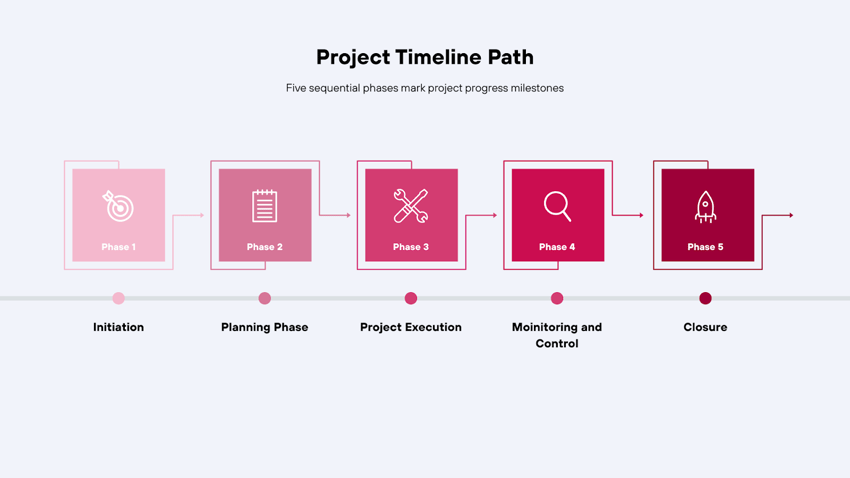
To contextualise all this, we’re going to take a look at the phases of a project life cycle.
It’s highly advised that you create an action plan for all this, including:
Phase 1: Initiation
At the start, the goals and objectives are defined. You can determine what’s possible and worthwhile by performing business case studies, project budget, timelines, and creating the project charter.
Phase 2: Planning Phase
Get planning, by defining a work breakdown structure (WBS), project methodology, and the all-important project plan as discussed in this article.
Phase 3: Project Execution
Now, you’ll carry out the project plan and produce deliverables. This will include assigning tasks to your project team, allocating resources, and managing stakeholder expectations.
It usually begins with a kick-off meeting, before later requiring team meetings and project status reports.
Phase 4. Monitoring and Controlling
Here, the project manager will track performance and ensure the project is on course.
Progress and performance metrics are measured against the plan, including schedule, budget, and scope. Risks, quality control, and dependencies are also observed.
If corrective actions are required, then they should happen promptly to avoid further complications.
Phase 5. Closure
Finally, the project is completed, and you hand over the deliverables.
Be sure to confirm all deliverables meet the success criteria and that you’ve obtained formal stakeholder approval.
You should also document the lessons learned and archive the project documentation to help you better the planning process next time. Making this a habit can make it 25% more likely that you meet future project timelines.
FAQs on Project Management Plans
What does a project management plan look like?
A project management plan is a detailed document that outlines all the vital information required to make the project a success.
There’s no fixed format for it; you may find it in a multi-page document, project management tool, or shared drive.
What is a communication plan in project management?
A communication plan outlines how information will be shared throughout the project. Taking care with your communication plan will ensure everyone is aligned and reduce misunderstandings.
Teams with strong communication plans meet 80% more of their project objectives than teams without them!
What is a contingency plan in project management?
A contingency plan is a backup strategy, so that your team knows how to react should issues arise. It will help minimize the effects, helping the project keep moving smoothly and reducing scope creep.
What are the 5 C’s of project management?
The 5 Cs refer to principles that should be focused on to make a project a success:
- Clarity: Making everything from goals, roles, and deliverables crystal clear for all.
- Communication: Ensures information flows effectively between each stakeholder and team member.
- Commitment: Getting everyone motivated and on the same page for objectives and deadlines.
- Consistency: Applying quality management, processes, methodology, and quality standards to avoid delays and errors.
- Control: The need to track progress, measurable metrics, risks, and make adjustments to keep the project on schedule, on budget, and on track with the original scope of the project.
What is the 80/20 rule for project managers?
The 80/20 rule (aka the ‘Pareto Principle’) says that around 80% of a project’s results come from 20% of the effort. So, it means focusing on the most critical tasks, risks, and resources to have the biggest impact (and not applying perfection to every minor area).
How Can Workamajig Help You With Your Project Management Plan?
Workamajig is project management software built specifically for creative teams. It has all the tools you need to develop a robust project management plan and manage your project.
Workamajig provides you with state-of-the-art tools to ease your load and streamline projects. Find out about our:
Find out how you can join thousands of happy Workamajig users today!