

Project initiation is the stage where a project is defined, evaluated, and authorized by Project Sponsors, laying the groundwork for ultimate project success. Here, project details are gathered, documented, evaluated, and approved, based on relevance, feasibility, and other key factors.
Key Takeaways:
- Project initiation is not a one-time step but an ongoing process group.
- The three key deliverables that drive successful initiation are the business case, feasibility study, and project charter.
- The project charter is your most effective marketing tool. Done right, it aligns the project with organizational strategy, ensures shared understanding among all parties, and provides the formal authorization needed to proceed confidently.
- Balance detail with efficiency during initiation. Focus on securing authorization with enough information to demonstrate feasibility and value.
- Common pitfalls include unclear objectives, insufficient stakeholder engagement, underestimating complexity, and rushing the process.
- Success criteria should extend beyond deliverables. Instead, it should define meaningful outcomes for the organization.
A critical output at this stage is the project charter, which ensures everyone involved in the project understands and agrees on what’s being proposed, the value it delivers, and the team’s approach.
Key project objectives in project initiation include:
- Defining the problem or opportunity
- Building the business case
- Establishing high-level project scope
- Securing formal approval
Shifting Our Perspective: Process Group, Not Project Phase
Modern project management frameworks define project initiation as a process group where a new project or project initiation phase is defined by obtaining authorization to start, moving beyond the idea of it being merely the first phase. This represents an evolution from older frameworks that reinforced linear thinking, defining project initiation as a project phase.
The PMBOK Guide 7th Edition defines a process group as a logical collection of project management processes that may interact throughout each phase of a project lifecycle. The frequency of these interactions varies based on project needs.
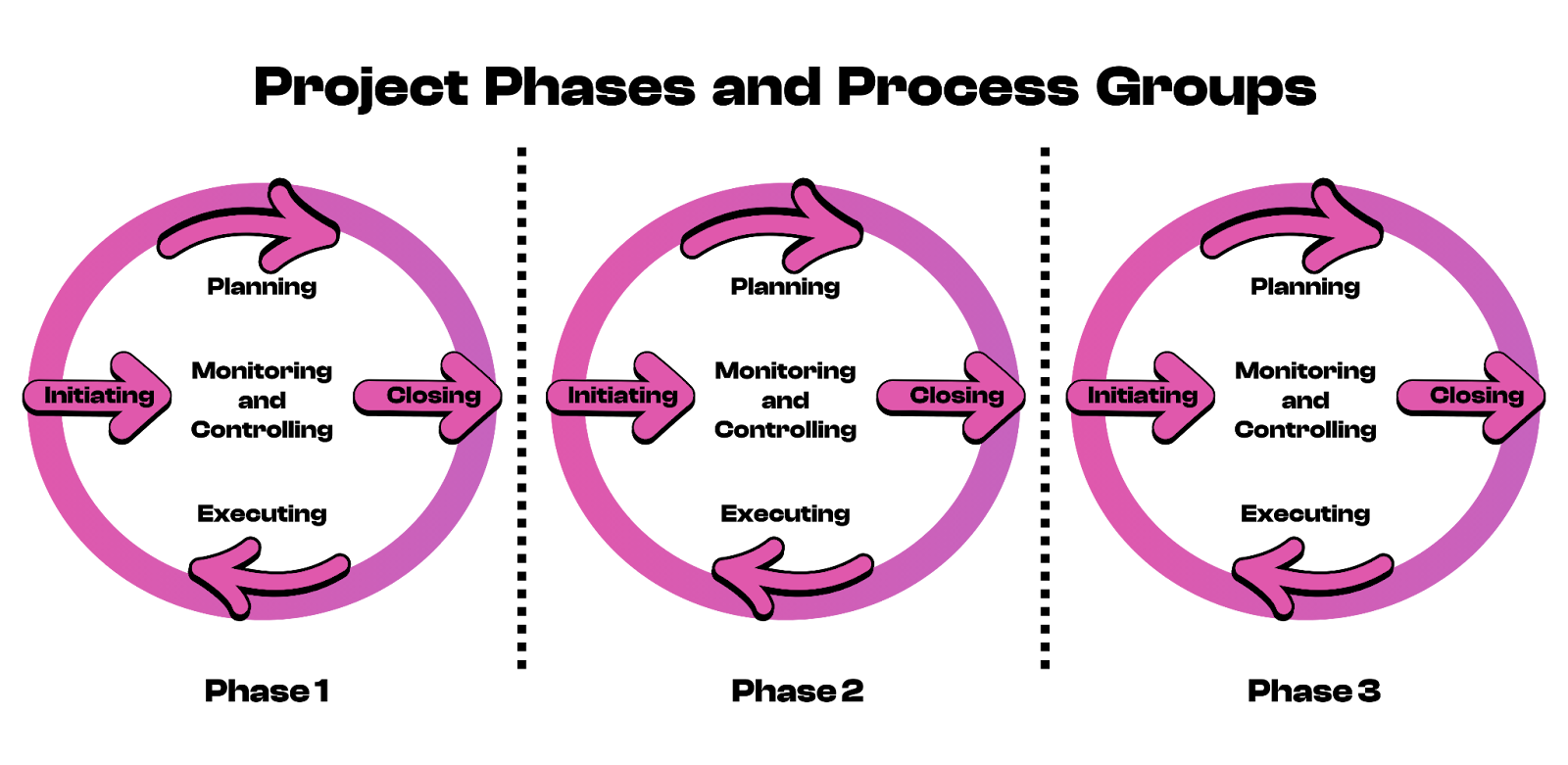
This shift from viewing initiation as a lifecycle phase to understanding it as a process group allows for a governance distinction, not just a terminology change.
First, it prevents “one-and-done” thinking. Rather than something completed once, initiation becomes an activity that happens at project start, at the beginning of each phase, and when major changes require formal authorization.
It also supports complex, adaptive, and iterative projects by allowing for incremental funding approvals and gradual but controlled scope expansion.
Finally, it reframes initiation not as the first step in a timeline but as a management activity that authorizes work whenever authorization is required. (eg. new project phases, etc.)
Benefits of a Thorough Project Initiation
Business Relevance
During initiation, business needs are thoroughly studied to evaluate how the project contributes to organizational objectives. Resources and approaches are assessed so leaders can determine if the investment is worthwhile. Through this careful scrutiny, projects are refined to deliver maximum benefit to Sponsors or Clients.
Stakeholder Support
Demonstrating strong business relevance helps earn stakeholder support. No project exists in isolation. Each is influenced by the organizational environment and resource owners. A thorough initiation process helps secure better support for the project team, potentially smoothing implementation.
Project Team Alignment
Documenting and aligning on project scope, project goals, and other key details prepares the team for what’s ahead and focuses their efforts. When team members clearly understand how their work contributes to broader goals, they can maintain this perspective while focusing on specific areas, enabling greater autonomy. Research indicates that teams with strong business understanding outperform others across key metrics:
- 83% meet business goals (vs. 78% for other teams)
- 63% stay on schedule (vs. 59%)
- 73% remain on budget (vs. 68%)
- Lower failure rates (8% vs. 11%)
These figures underscore that understanding strategic context correlates with improved delivery performance. It also helps the team become more involved with project planning if the project gets authorized to proceed.
Project Initiation Activities and Key Deliverables
Projects established before the phase or project start address strategic business information and contain high-level project details. They typically remain unchanged once the project begins, but may be reviewed during execution.
Establishing Business Relevance
Deliverable: Business Case (including Milestones)
The business case provides project justification, the project’s purpose, and the projected business value. It demonstrates how outcomes align with organizational objectives. Format varies based on development approach and project lifecycle. Financial institutions might include ROI estimates, while lean startups might describe problems, solutions, revenue streams, and cost structures, adapting to their chosen methodology.
Business value often continues accruing long after project completion, but at initiation, projections help stakeholders understand potential gains. Analysis methods include:
- Payback period: Time needed to recover the investment
- Internal Rate of Return (IRR): Projected annual yield incorporating initial and ongoing costs
- ROI: Percent return on investment
- Net present value (NPV): Future value of expected benefits expressed in current value
- Cost-benefit analysis: Comparison of project benefits against costs
Investigating Feasibility
Deliverable: Feasibility Study
Project feasibility validates the business case and confirms organizational capability to deliver intended outcomes. While not always formally required, this practice informs decisions about project pursuit.
TELOS Feasibility Framework
|
Techincal |
Economic |
Legal |
Operational |
Scheduling |
|
✔️Proof of concept ✔️ Access to technology ✔️Knowledge, skills, aptitude ✔️Stakeholder support for technology ✔️Resource requirement for technology |
✔️Funding source ✔️Stakeholder support for funding ✔️Financial constraints check |
✔️Aligns with the law and relevant policies ✔️Does not breach existing agreements with other parties ✔️Does not conflict with pending legislation |
✔️Identified procedures for project implementation ✔️Identified trainings for important skills (short-term and long-term) ✔️Impact of the project for other projects and departments checked |
✔️Enough time to deliver project requirements ✔️Potential scheduling conflicts ✔️Key deadlines |
A useful framework for feasibility assessment is TELOS:
- Technical feasibility
- Economic feasibility
- Legal feasibility
- Operational feasibility
- Scheduling feasibility
Obtaining Formal Approval
Deliverable: Project Charter
The project charter formally authorizes the project’s existence. While issued by the initiator or sponsor, project managers often draft this document for sponsor approval. Depending on organizational culture, approval may be a formal document or simply an email clearly authorizing the team to proceed.
PMI calls this a “project’s most effective marketing tool”, as it’s an opportunity to align the project with the sponsoring organization’s strategy and expand its influence.
Key elements include:
- Requirements
- Business needs
- Summary schedule
- Assumptions and constraints
- Business case, including ROI
Early charters are typically concise, sometimes just a single page. As the project progresses, this document naturally evolves with new details.
Best Practices in Project Initiation
Identify and Engage Stakeholders (and develop a preliminary communication plan)
Involve relevant key project stakeholders early in project initiation. Identifying stakeholders and understanding their influence, interest, expectations, and potential resistance can be very useful in the project initiation processes. Early alignment mitigates later conflict and provides a holistic understanding of the business environment and organizational structure—both crucial for resource allocation.
Establish a Success Criteria Beyond Deliverables
Projects can deliver every specified output on time and on budget yet still be considered failures if they don’t achieve intended outcomes. During initiation, work with stakeholders to define what success truly means beyond just completing tasks:
- How will we know this project created real value?
- What should be different six months after project completion?
- What behaviors, metrics, or conditions indicate we’ve succeeded?
- What would make stakeholders regret investing in this project?
Document these success criteria in your charter so everyone is aligned on their definition of victory.
Avoid Overplanning
While defining key details is important, focus on getting authorization rather than detailed execution planning. Reserve that for project planning and resist creating premature Gantt charts or detailed task breakdowns. Find the right level of detail—enough to demonstrate justification and feasibility without creating inefficiency or unnecessary risk. Keep the big picture clear and avoid wasting effort on a project that might not proceed.
Build in Flexibility for Adaptive Projects
For projects using agile or adaptive approaches, initiation looks different than traditional waterfall projects. You still need authorization and high-level direction, but you’re not committing to detailed scope upfront.
In these cases, your initiation documents should:
- Define the problem or opportunity clearly
- Establish vision and desired outcomes
- Set boundaries and constraints
- Authorize iterative funding and decision-making
- Identify how the scope will be progressively elaborated
This allows you to maintain governance and authorization while preserving the flexibility adaptive approaches require.
Explicitly Align with Strategy
Establish business value by clearly demonstrating how the project supports organizational goals and strategy. Ensure you understand your client’s or sponsor’s key objectives and articulate how your project objectives align with them.
Incorporate Previous Project Lessons
Learning from past projects helps teams anticipate risks, reuse effective strategies, avoid repeating mistakes, and demonstrate expertise. This not only ensures more thorough planning but also builds stakeholder confidence by showing the team’s experience and understanding.
Leverage Organizational Project Management Assets
In addition to past projects, I also learn from the organization’s past efforts. Most organizations accumulate valuable project management assets over time, whether those are templates, lessons learned databases, historical project data, or standardized processes. During initiation, actively seek out and leverage these resources.
Review similar past projects to understand:
- What challenges do they encounter
- How long activities actually took versus estimates
- What risks materialized, and how they were handled
- What stakeholders wished had been done differently
This institutional knowledge helps you create more accurate projections and avoid repeating past mistakes, significantly aiding in risk management.
Use the Right Tools
Handling initiation activities can be fast-paced and highly collaborative. To facilitate this, using the right tool can make collaboration smoother and documentation more accessible.
Rather than juggling scattered spreadsheets, email threads, and document versions, use a tool like Workamajig to keep everything organized in one place. Workamajig offers specialized features that streamline the entire initiation process—from building business cases and tracking approvals to managing stakeholder communications and storing project charters.
The key is selecting tools that match your team’s workflow and industry needs rather than forcing your process to fit generic software. When your tools support rather than complicate your initiation activities, you spend less time on administrative tasks and more time on strategic thinking that sets projects up for success.
Common Pitfalls and How to Avoid Them
Even experienced project managers can stumble during initiation. Recognizing these common mistakes early helps you course-correct before problems compound.
Lack of Clear Objectives
When goals aren’t crystal clear from the start, team members work toward different ideas of what success looks like. They tend to waste time and resources because of misaligned efforts. This ambiguity can create confusion during execution.
Solution: Have SMART objectives (Specific, Measurable, Achievable, Relevant, Time-bound) in your business case and project charter.
For example, instead of “improve customer satisfaction,” specify “increase customer satisfaction scores from 7.2 to 8.5 within six months as measured by quarterly surveys.” Involve your project sponsor in crafting these objectives to ensure alignment with their vision.
Insufficient Stakeholder Engagement
Failing to identify all key stakeholders or engaging them too late leads to missed requirements, a lack of buy-in, and resistance during implementation. You might discover halfway through execution that a critical department head opposes your approach, or that end users have needs you never captured.
Solution: Conduct a thorough stakeholder analysis. Schedule one-on-one conversations with high-influence stakeholders before finalizing your charter. Ask them directly: What does success look like to you? What concerns do you have? What constraints should we know about?
Underestimating Complexity
Optimism bias causes teams to underestimate what it truly takes to succeed. You might assume technology will work seamlessly, that resources will always be available, or that dependencies won’t cause delays. This leads to unrealistic timelines, insufficient budgets, and eventual project failure.
Solution: Perform diligent feasibility studies covering technical, economical, legal, operational, and scheduling aspects. Consult with technical experts, review similar past projects, and build in contingency buffers. If your initial assessment suggests the project is more complex than stakeholders expect, communicate this early.
Proceeding Without Formal Authorization
Starting work without a formal sign-off can create future problems because there’s no documentation that the project is truly approved. This leaves you vulnerable to sudden cancellation, resource withdrawal, or disputes about what was actually agreed upon.
Solution: Ensure your project charter receives formal approval from the project sponsor. Whether that’s a signed document, an official email, or whatever format your organization recognizes as binding, don’t begin planning or execution activities until this authorization is secured.
Rushing the Initiation Process
Treating initiation as a checkbox exercise to get through quickly undermines everything that follows. When you rush, you miss critical details, fail to build stakeholder relationships, and create a weak foundation that causes problems throughout the project lifecycle.
Solution: Allocate adequate time for each initiation activity. Remember that a solid foundation saves exponentially more time and resources later. If stakeholders pressure you to rush, explain that thorough initiation actually accelerates overall delivery by preventing rework, scope disputes, and misalignment.
Transitioning from Initiation to Planning
The boundary between initiation and planning isn’t always clear-cut, but there’s a distinction: initiation focuses on authorization and high-level direction, while planning focuses on detailed roadmaps for execution.
You know you’re ready to transition from initiation to planning when:
- You have formal authorization via an approved project charter
- Stakeholders agree on objectives and success criteria
- Feasibility has been validated
- High-level scope boundaries are defined
- Initial team members are identified
- You understand the business value you’re expected to deliver
At this point, you shift from asking “Should we do this project?” to “How exactly will we do this project?” The initiation documents you’ve created become inputs to detailed planning activities.
Wrapping Up
Project initiation is an important process group in project management focused on obtaining authorization to proceed. Success requires establishing business value, estimating resource requirements, determining feasibility, and gauging ROI. During this stage, project teams need strong collaboration skills, robust project management tools like Workamajig, and business acumen to set the foundation for a successful project.
Book a demo with us and let’s see how we can help your next project succeed.