

While a management role can sound like there is less hands-on work required, it requires a deep understanding of the entire marketing process to become successful in a marketing management career, and their contributions can make or break brands. In this article, we break down the concept of marketing management before breaking it down into a collection of helpful articles, so you can fully equip yourself to take on this role.
What is Marketing Management?
Marketing management is the process of developing and implementing a marketing strategy, built on principles from all relevant marketing practices, to achieve business objectives—this can be anything from increasing sales and engagement to establishing or growing brand awareness through various marketing efforts.
Effective marketing management requires having a proper grasp of the activities and tasks required to take a task from initiation to closure, which means a marketing manager may be inserted at any point in the pipeline to help oversee the execution of a marketing effort. This means an effective marketing manager is capable of a wide variety of tasks, including but not limited to market research and analysis, project management, and sales.
Key Takeaways
- Marketing management supports the entire marketing pipeline, from market analysis all the way down to campaign execution.
- This role is critical because it speaks to and engages nearly all marketing functions and teams, allowing for unified, data-driven decision-making.
- A holistic skillset combining strategic thinking, technical proficiency and high interpersonal skills makes for strong marketing managers.
Marketing Management: How is it Different?
Because marketing management covers a wide range of disciplines, it can be easy to confuse it with certain roles that have similar responsibilities. While they may sometimes overlap, it’s important to understand the difference—here’s a quick look at marketing management compared to a few other roles:
Marketing Functions Explained
|
Marketing Management |
Marketing Information Management |
Marketing Project Management |
|
High-level strategy and steering marketing organizations & teams toward business goals |
Collecting and analyzing marketing-related data (sales, engagements, etc.) to inform larger marketing strategies |
Day-to-day organization of tasks, and coordinating with teams to meet time and budget constraints |
Marketing information management
Marketing information management deals with the collection and utilization of market data, which is one of many disciplines that may be practiced by a marketing manager. Data can be anywhere from consumer and competitor information to general marketing research. Some of the key concepts related to marketing info management are SEO, sales data, and customer reviews. This discipline primarily assists marketing teams in positioning themselves in a market space.
Marketing project management
Marketing project management is the application of project management principles in the context of marketing-related projects—it focuses on coordinating the completion of day-to-day tasks and activities that are used to build a working marketing campaign. They make sure that tasks are accomplished on time and to standards, and they keep stakeholders aligned on the status of their respective projects. Marketing managers make decisions at a slightly higher level; often, they are the ones identifying and designing effective marketing campaigns, which are then assigned (by them or other stakeholders) to a project manager for execution.
Why is Marketing Management Important?
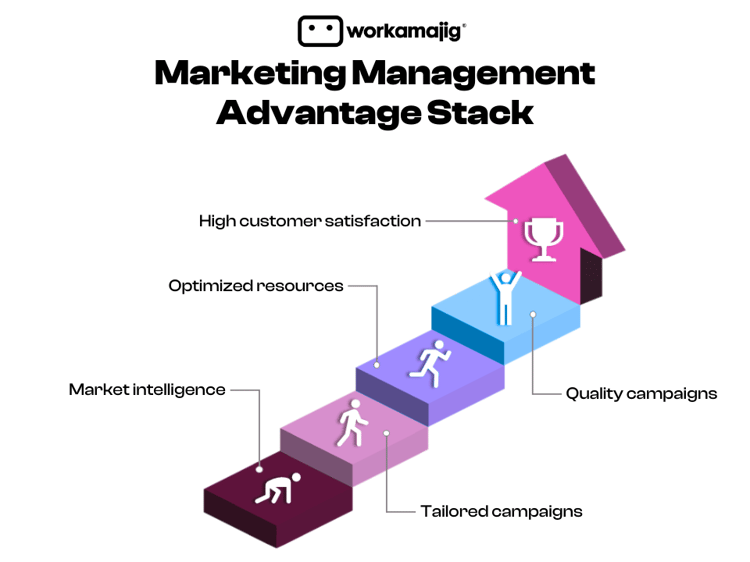
Marketing management is important because it allows a business to remain competitive, especially in fast-paced industries, where consumer demands, trends, and behaviors change quickly and frequently. Having dedicated management resources for marketing helps establish a clear direction from the highest levels of the company down to the individual task executions that comprise the marketing effort, which cascades into a solid, unified product, service, or message that consumers can easily engage with and get behind.
Because a marketing manager is able to utilize perspectives across the entire marketing pipeline, it ensures that appropriate research allows for data-driven decision-making once the team enters the planning stages. It then cascades into a more efficient production of marketing materials, which then makes it easy for your customer-facing resources to best satisfy your target customer/s.
Core Marketing Management Processes
Now that we understand the concept and the importance of marketing management, here are some of the key processes a marketing manager can expect to be involved in.
Market research & customer needs analysis
Market analysis focuses on your company’s current positioning and forms the basis for identifying the appropriate marketing strategy to implement—this includes analyzing consumer behavior among other market trends, as well as internal metrics such as your sales, site traffic, and customer reviews. An effective market analysis helps reduce risk when investing in a marketing campaign since you’re using data-driven methods for decision-making.
Strategic planning & goal-setting
Building on your understanding of the market, a marketing manager is also responsible for identifying targets that need to be hit in order to bridge the gap between your current position and the market’s demands. A strategy can be tailored towards various ends, such as increasing sales and engagement, establishing new business or customer relationships, or implementing an effective rebrand of your business.
Product development/campaign management
Following the establishment of goals is identifying what kinds of marketing activities best serve them. Here, a marketing manager may work with another, dedicated product manager to determine what kinds of projects are relevant to the marketing strategy—these can range from appearing at business conventions to attract new partners, to creating public or in-store promotions and events to promote a new product or service directly to customers. This is also where more specialized skills apply to managers, such as social media management and email marketing management, among others.
Principles of account-based marketing and integrated marketing apply here, mainly by choosing appropriate methods and channels to best market your intended product or service.
Program implementation
It’s important for a marketing manager to be able to fill in anywhere in the marketing project pipeline, and one of the biggest parts of the effort is the day-to-day project management work that goes into building an effective campaign. In many cases, however, a marketing manager works together with dedicated project management resources to organize, execute, and monitor marketing projects from start to finish. Here, a marketing manager focuses on deploying the right resources to help project managers effectively deliver their assigned work.
Monitoring
Once marketing campaigns have been launched, it’s also important for marketing managers to gain insight into their performance and then use this data to optimize their approach. The effectiveness of each campaign and how it affects the business is measured, which then informs changes to the current marketing strategy or the individual activities lined up.
You’ll find that the processes above largely cover most, if not all, the phases of a marketing project cycle, which emphasizes the need for a marketing manager to have a good grasp of all the factors that contribute to a successful campaign. By building skills in these key areas, you can expect to add value to your team at any point in the marketing effort.
Essential Skills and Tools for Marketing Management
A high-value marketing manager juggles many responsibilities, which require a wide range of skills to perform well. If you’re looking to grow your career in marketing management, focus on building around the following areas:
Strategic Thinking
Marketing managers stand out from the pack because they have a knack for seeing the big picture, allowing them to identify opportunities that align with the company’s larger objectives as well as areas of friction affecting the bottom line.
Grasping these concepts makes for an excellent foundation:
- Market intelligence - understanding the customer base, changes in their preferences and behaviors, knowing your target market, and how your marketing mix aligns with your highest-value customer segments. How does our target audience respond to our current marketing efforts? What marketing channels does our intended customer use most? Are there potential customers outside of our original targets that we can cater to?
- Financial acumen - knowing how market spend connects to the bottom line and whether that translates to sustainable return on investment. What’s our customer acquisition cost and lifetime value ratio? Are fixed costs manageable in case of market shifts?
- Business initiative - taking the above and identifying appropriate actions to take. Do you need a campaign to attract new customers or improve your relationship with existing clients? Should you revisit strategy, such as pricing strategies or marketing programs?
Technical Skills
A data-driven skillset best supports the strategic mindset, which is then made possible by building proficiency with tools and practices for collecting, organizing, interpreting, and reporting that data.
- SQL, Tableau, and Power BI are essential tools for visualizing trends, which help predict consumer behavior.
- AI and automation tools continue to grow in value for optimizing workflows, so your team spends less time manually executing campaigns. Quality control is a great supporting skill here, to ensure that AI-generated content meets brand guidelines, as well as legal/ethical requirements.
- UX/UI fundamentals don’t just apply to software development; they relate closely to content marketing and ensuring that your visual and brand management result in a smooth customer journey to the final sale.
- Understanding SEO and SEM strategies allows you to more efficiently reach your target audience and more.
- Highly underrated: excellent documentation skills. Knowing your way around documents, spreadsheets, and slideshows greatly enhances your ability to communicate with teams, from reporting insights to explaining the different marketing functions essential to your strategy.
Interpersonal Skills
The skills above help build effective marketing strategies, but none of that matters if you can’t drive a team to success. This is where communication skills come into play, allowing you to speak multiple languages with cross-functional teams.
- Emotional intelligence (EQ) is a fundamental skill in any role and is especially important in a leadership role like marketing management. Managers with high EQ understand that humans work best when they are validated, informed and supported, reducing the likelihood of burnout while increasing productivity.
- Your written and verbal skills are a natural selling point—a marketing campaign is all about messaging. Getting that across to the right audience requires proficiency in using the right media, whether that’s emails, social media marketing, or face-to-face interactions. Internally, this also allows you to achieve better buy-in with stakeholders, both in and out of the marketing department.
The best managers don’t just sit at the top. They can fit into most, if not all, marketing operations.
In some cases, they have to.
This makes proficiency in a wide range of skills and tools extra important, so their contributions add value instead of stall marketing campaigns.
Build and Manage Your Marketing Strategy with Workamajig
Effective marketing management influences competitive advantage from the start to the end of every campaign. This means using real data to make informed decisions about how to best approach, engage, and capture your market, using principles from all marketing disciplines to build cohesive and efficient digital marketing campaigns.
With Workamajig, the premier marketing management software, you have an all-in-one solution for planning, organizing, and delegating tasks, and easily transitioning between any of the three. Easily adjust your schedule or modify task requirements and assignees to ensure efficiency, and use native reporting tools to measure your progress, as well as identify and address roadblocks along the way.
Request a free demo today to find out more!