

Financial tracking is essential in project management for creative teams, such as design or marketing agencies, because monitoring costs and budgets alongside project progress is crucial for seeing ROI from your work. When creative teams track finances at each step of their processes, they can:
- Reduce stress and improve project profitability by sending accurate estimates and timelines to clients at the start. (And track adjustments to project requests with change order estimates.)
- Avoid delays or going over budget by properly allocating resources and staying on top of in-progress projects.
- Measure the success of projects (or specific services, client work, etc.) by comparing budgeted vs. actual costs and use this data to increase revenue from future projects.
Unfortunately, for creative teams, most standard project management software doesn’t include the kind of financial tracking they need (if any at all).
Most PM platforms offer only lightweight financial tracking, often powered by accounting integrations. While some include financial reports or basic budget tracking, they typically lack tools for creating accurate estimates or tracking the full scope of project costs — including outsourced labor and freelancer expenses that directly impact profitability.
So, we put together this guide of the best project management tools with comprehensive financial tracking features that help you send smart estimates, centralize and monitor all project costs, and see greater project ROI.
Workamajig is a project management tool designed for creative agencies and marketers. It includes project and task management, resource management, time tracking, financial tracking, accounting, media planning integrations, and more — so you can oversee all aspects of creative work management under one roof.
For a more detailed Workamajig walkthrough after reading, request a personalized demo.
1. Workamajig
Manage Creative Projects, People, & Finances in One Source of Truth
The Workamajig platform incorporates two core modules — project management and agency operations (with a native accounting system that replaces solutions like QuickBooks, Xero, NetSuite, Sage, etc.). It includes important features like time and financial tracking within project management workflows so you can get a more holistic view of project health and seamlessly oversee tasks, timelines, budgets, and staff.
Managing projects, people, and finances in one system simplifies operations while improving visibility into project profitability.
If you’re managing tasks in one tool, staff schedules and rates in another, and project costs in your accounting system, you can’t easily reconcile this information while projects are in motion. You’re dealing with scattered systems and data silos, catching problems too late, and then course-correcting delays or taking losses on work.
Workamajig was built to solve the operational and financial challenges creative teams face with traditional project management software.
Our fully integrated system supports the entire project lifecycle and lets teams easily manage finances at each stage with:
- Automated estimating and project planning tools. Our estimating tools are easily accessible from the CRM and project management module, so reps can share accurate quotes with clients and PMs can budget for their projects. Project managers can use our task management, resource planning, and vendor management tools to finalize work, assign resources, and manage schedules.
- Revenue forecasting tool. See the projected profit of all planned work before kick-off.
- Dedicated project expense tracking tools. Workamajig’s toolkit lets you manage all project expense types in our system — including vendor costs, media buys, out-of-pocket expenses, etc. — ensuring costs are tracked as they’re incurred and saving accounting teams from reconciliation headaches.
- Real-time project monitoring and budget tracking. As project teams log their hours and tag expenses, our system automatically updates the project’s timeline and budget.
- Change management tools. Keep scope creep in check with tools to manage change requests and fold change order estimates into project budgets.
- Billing and invoicing. Workamajig supports all standard creative agency billing types, making it easy for teams to generate accurate invoices with minimal back-and-forth.
- A complete accounting system. Workamajig is one of the only top creative agency management tools featuring a full, GL-ready accounting system. Our native system offers several benefits: one less subscription to manage, no duplication of entry, smoother reconciliation, and more advanced financial management tools.
- Powerful reporting tools. Our project, team, and financial reports offer granular insights into performance, productivity, and profitability.
After switching to Workamajig, agencies report smoother operations, better project outcomes, accurate financial tracking, time savings, and increased profitability. Check out some of our client success stories below:
- How Spawn Ideas Measured and Grew Profitability with Workamajig.
- How 2 Fish Company, LLC Decreased Time Spent on Billing by 80% with Workamajig
- Parallel Path Gleans Agency Financial Insight With Workamajig
If Workamajig looks like the right solution for your team, we’ll lay out a roadmap for tailoring the system to your workflows and onboarding your team. You’re assigned a dedicated account manager who guides you through each step, trains you on the system, and provides ongoing support.
Next up, we’ll take you through Workamajig’s complete project financial management solution in detail. You can also request a personalized demo for the full, guided experience.
Kicking off New Projects
Workamajig offers a dedicated set of tools for managing all aspects of project initiation — from project intake to building accurate estimates, finalizing project details, and assigning work to the right people.
Project intake tools
First, we offer a few different ways to take on new projects. You can use:
- Project request forms (for various types of services, different departments, clients, etc.). You can make these forms available in a portal environment for others to request projects at their convenience. Our system also lets you add custom fields to gather essential project details at the start, reducing the back-and-forth to plan and get projects off the ground.
- Our CRM. Workamajig’s native agency CRM tracks the interactions sales reps have with prospects and the details they gather about the engagement. Then, after an opportunity closes, reps can convert it to a project in Workamajig, automatically transferring all relevant information — previous conversations, project specs, etc. — over to the project team.
- Project templates. You can save all the details for specific project types, including tasks, dependencies, milestones, resource allocations, and, crucially, estimates. Then, when you kick off a new project using a template, all you need to do is review, tweak, and edit the details before pushing it to live.
Project estimating tools
If you’re using estimate templates, then you’re ready to kick off a new project after tweaking and finalizing the specifics.
Otherwise, you’ve got two other options for building out estimates in Workamajig.
The first option is to pull in estimates from the project schedule, which comes in handy when you already have all the tasks and allocations finalized. Our automated estimating tool generates an estimate based on the schedule’s details. You can also push any adjustments that you make to the estimate — e.g., adding hours to a specific phase — back into the schedule, so everything ties together.
The other option is to build your estimate from scratch. For the labor portion, all you need to do is determine hours, and Workamajig calculates the estimate by pulling in hourly rates from your rate cards (with support for multiple variations; by default, the system uses the rates on the client record).
Then, in either option, you can navigate over to our non-labor estimating tool to pull in costs for that portion. Here, you can assign a vendor, tag expenses to specific projects (or even tasks), specify amounts, and add markups.
Vendor management module
In Workamajig, you can do more than just factor vendor costs into estimates; we offer dedicated vendor management features to manage the full scope of these relationships. You can request quotes from freelancers and other outsourced production vendors, view and compare bids, and assign work.
As we mentioned above, you can incorporate these outside vendor costs into estimates so these fees don’t pop up later and impact profitability.
Task management & resource planning
After new projects come in and you’ve finalized the estimates, it’s time to kick off the final stage of planning: ensuring the work is properly structured and the right people are assigned to each job.
Our task and resource management tools help you out here:
- While our intake tools ensure that project details and specs are captured up front, you can use the task management tool to edit, add, or remove tasks, time allotments, milestones, subtasks, due dates, and anything else before giving the plan final approval.
Pro tip: Don't forget to factor in time for rounds of review and revision. Decide on a max number of rounds included in the original schedule and estimate. Then, if your project goes over that max, a change order sign-off may be necessary
- Then you can assign tasks to team members or freelancers based on their skills, bandwidth, and availability. More on this below.
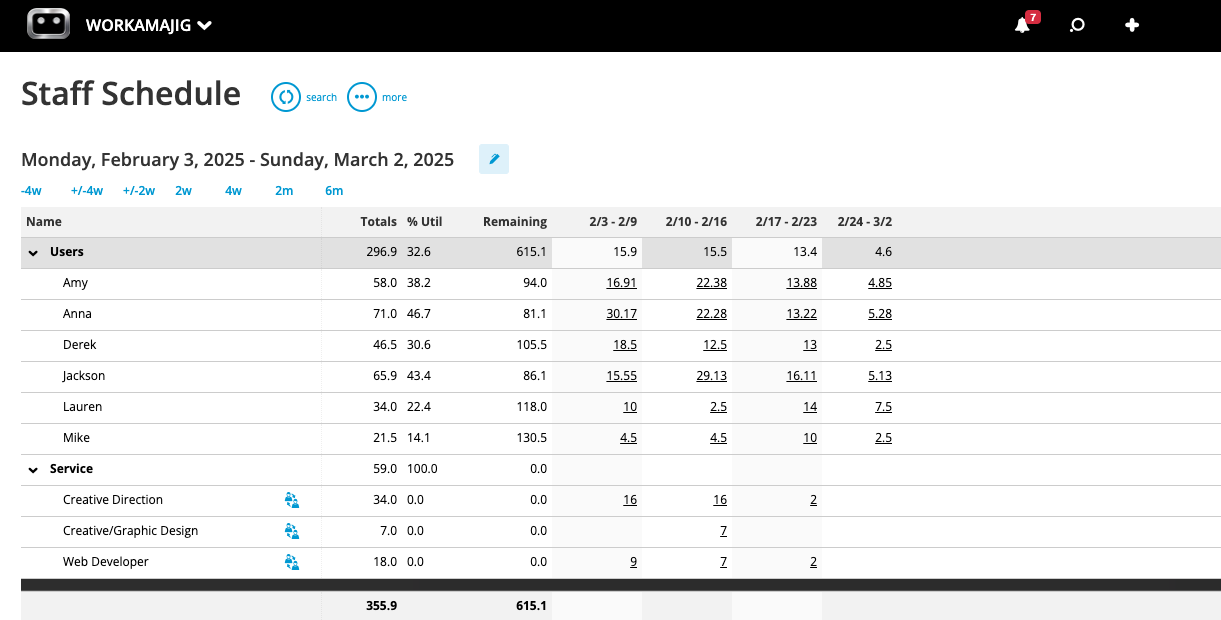
In the Staff Schedule dashboard above, you can see all team members, the total number of hours they’re available each week, their current utilization, hours per day, and remaining hours.
Workamajig also adds convenience by integrating with staff calendars; you can see meeting hours, holidays, PTO, etc., and know exactly when team members are available to work. (Our system also incorporates these hours into the totals above.)
Then you can toggle this view to display each team member’s assignments alongside their schedules, so you can assign (and reassign) tasks per capacity and availability, keeping projects moving forward and on schedule.
Our system stores all employees' hourly costs and service rates when they’re added to the system, so all assigned hours are automatically tied to actual costs. This way, the resource management dashboard and project budgets update in real time as you add staff to tasks, helping teams assign the right people to roles without exceeding project budgets.
Once you schedule projects, our system sends notifications to all team members so they know what projects are on the horizon, what they’re responsible for, and the due dates.
Read more in our guides below:
- Creative Resource Management for Agencies: Software + FAQs
- Project Resource Scheduling for Agencies & Creatives
- 10 Steps to Optimize Resources in Agency Project Management
Project Expense Tracking
Expense tracking in Workamajig works similarly to estimates: labor and non-labor expenses are managed separately and then rolled into project budgets, reflecting real-time cost burn.
Below, we explain how teams can manage and control these costs.
Tracking Labor Costs
Tracking project hours — and tying hours to employee rates — is crucial for successful project budget management; otherwise, you can’t really see what you’re spending to deliver.
If your chosen PM tool doesn’t include time tracking, you have to monitor hours and costs in external systems and then plug them into your project management budget tracker or financial reports. By the time you calculate costs, you’re already over budget — there’s virtually no window for course-correcting.
So Workamajig includes a native time tracker on task cards, allowing staff members to easily log hours as they go and enabling managers to monitor project budgets.
Staff members can add new time entries manually or use the timer to record hours as they work. They can pause timers, toggle between tasks, and mark tasks as complete when finished to submit time.
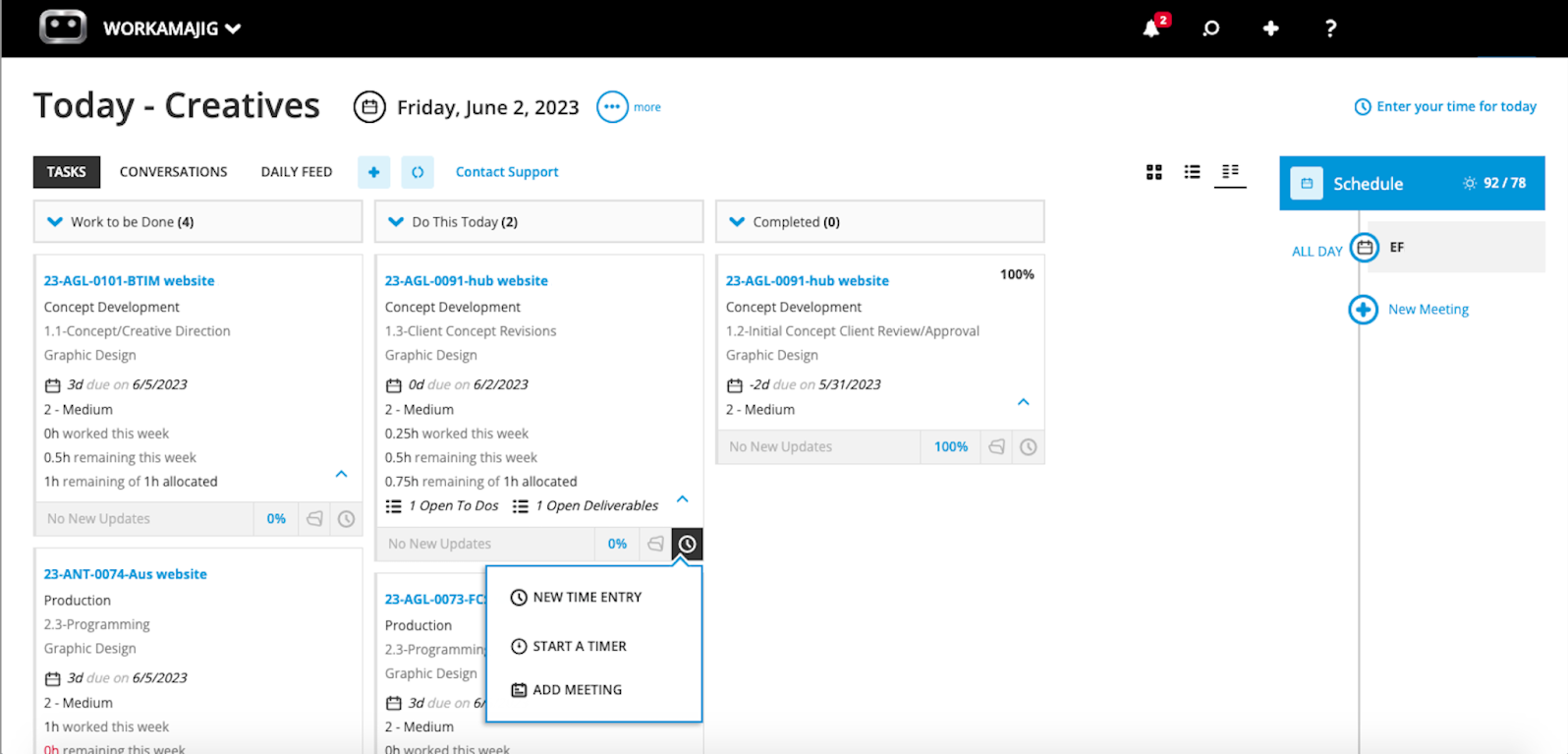
Workamajig’s calendar integration also adds meeting hours to associated projects.
For example, if a staff member’s morning meeting relates to a website project they’re working on that day or week, they could mark attendance in Workamajig. Our system automatically adds that time to the task card so employees can see how those hours contribute to the overall picture.
![Workamajig: Today - Creatives - Meeting and Scheduling [GIF]](https://www.workamajig.com/hs-fs/hubfs/Workamajig%20-%20Today%20-%20Creatives%20-%20Meeting%20and%20Scheduling%20%5BGIF%5D.gif?width=1707&height=865&name=Workamajig%20-%20Today%20-%20Creatives%20-%20Meeting%20and%20Scheduling%20%5BGIF%5D.gif)
Then, as employees add their hours to Workamajig, they flow into our centralized timesheets, so managers can choose how to handle them. They can edit time entries, write hours off, and choose what to bill.
After entries are approved, our system automatically calculates labor costs and updates the project’s timeline and budget.
Read more:Top Project Management Tools with Time Tracking (for Creatives)
Tracking Non-Labor Expenses
As we briefly discussed earlier, Workamajig offers a full suite of dedicated tools to manage all your typical non-labor project expense categories. Lots of PM tools fall short here — they might build out budgets using labor, but they don’t factor in outside expenses or make it easy to pull those in as they’re incurred.
Workamajig offers a more comprehensive approach to financial tracking, with dedicated tools to capture these expenses as they’re incurred and to handle admin tasks such as reconciliation, digitizing receipts, and managing taxes and multiple currencies.
Our project expense tracking tools include:
- Receipt capture. Team members can attach and store receipts in Workamajig (including via mobile) and tie the related expenses to specific projects, ensuring costs are tracked, budgets remain accurate, and no one’s left hunting down receipts at the end of the month.
- Credit card charges and spending account management. Thanks to our Plaid connector, you can pull these charges in directly or set up nightly auto-sync to keep balances and project tags up to date without manual entry.
- Vendor invoice management. Add copies of invoices from production vendors, freelancers, and contractors to Workamajig, then reconcile them with purchase orders, work orders, and receipts. Our system also supports online vendor payments via integrations with Edenred Pay (formerly CSI) or AvidXchange (formerly FastPay)
- Media buying integrations. Creative teams can ensure media orders and actual spend are tracked against project budgets thanks to our integrations with Strata/FreeWheel, Mediaocean, Bionic, and GaleForceMedia, which allow them to easily pull details from media buys into our system.
- Multi-currency expense management. If your agency works with international vendors, clients, or offices, Workamajig has you covered. The accounting system is fully GAAP-, GDPR-, and HMRC-compliant, and handles transactions, vendor invoices, POs, client invoices, expense reports, and bank accounts in any currency you operate in. Pay employees in their local currency, bill clients in theirs, and consolidate everything in your home currency for reporting — with automated exchange rates and separate tracking for realized vs. unrealized FX gains and losses.
Project Monitoring & Change Management
Taking the time to calculate thoughtful, detailed estimates and closely monitoring projects lets you take a proactive (vs. reactive) approach to creative project management and guarantee profitability.
Workamajig’s Projects dashboard lets you track all project schedules and budgets in a single view. It automatically updates as users add hours, mark tasks complete, and tag expenses, giving you a real-time view of project progress and cost burn. You can also compare budgeted, allocated, and actual costs as projects progress.
![Workamajig dashboard: Projects and Project Status [GIF]](https://www.workamajig.com/hs-fs/hubfs/Workamajig%20-%20Projects%20and%20Project%20Status%20%5BGIF%5D.gif?width=1714&height=853&name=Workamajig%20-%20Projects%20and%20Project%20Status%20%5BGIF%5D.gif)
As shown in the GIF above, the dashboard includes:
- Visually-friendly Gantt charts (on the right-hand side). You can color-code projects and phases to gauge progress quickly, while the black progress bars show how far along each project is.
- Finance and Project Timeline columns (on the left-hand side), alongside Project Status, Allocated Hours, Actual Hours, and a % Complete bar.
- Project health indicators. The Project Status column features icons that indicate each project’s health; yellow warnings indicate a project is at risk of delays or budget issues — so you can intervene ASAP — while red warnings mean it has already exceeded costs or due dates. For example, in the visual above, the SF website project is close to completion, but has run over the expected timeline.
Change Management Tools
Change requests are pretty much inevitable on creative projects, but that doesn’t have to be something negative. We usually find that things go wrong when these requests aren’t handled in a structured way — that’s when you end up with scope creep, endless loops, overruns, and misalignment amongst different project stakeholders.
Having a structured change management process isn’t about saying no, but about keeping scope creep in check and ensuring the project’s schedule and budget reflect the approved changes.
Workamajig treats change management as a natural part of the creative workflow and offers simple tools for managing both the requests themselves and the resulting change order estimates.
Managing change requests
First, you can manage all requests by setting up dedicated change request forms. These take in all the necessary information up front, which means requesters have to describe what they need in detail and provide the necessary specs.
You can create as many forms as you need to handle all the different request types. Maybe ones for different project types, clients, and departments.
Then, internal team members can send their requests in from Workamajig’s project dashboard, while clients can submit them through their dedicated portal.
After the request is submitted, it goes through whatever custom routing and approval workflow you’ve set up. Workamajig offers a lot of flexibility here — you can:
- Specify the roles or key people who must approve the request.
- Choose whether to route requests to multiple approvers simultaneously or sequentially. In the second case, you can even set due dates for each step.
- Specify whether the first approval is enough or if everyone needs to approve it.
Our approval workflows are also flexible enough for decision-makers to switch things up on the fly. For example, they can add new steps mid-flow if a specific request needs extra eyes.
Once a change is approved, Workamajig does two things:
- It stores the updated project details and deliverable specs as the new default.
- It tracks all previous spec sheet versions that have changed, so you can always reference what was asked for, when, and by whom.
Change order estimates
New changes typically affect a project’s budget — maybe you’re adding more hours to tasks (or reducing them) or engaging vendors for more work. When that happens, Workamajig links the costs from approved requests to the original estimates and calculates them into project budgets.
This makes financial reporting more manageable, since you don’t have to create new projects for additional requests or aggregate data. You can also track the original budget (based on the original estimate), the change orders’ budget (any estimates approved and designated as CO), and the updated budget (sum of all approved estimates).
Workamajig Portfolio Management
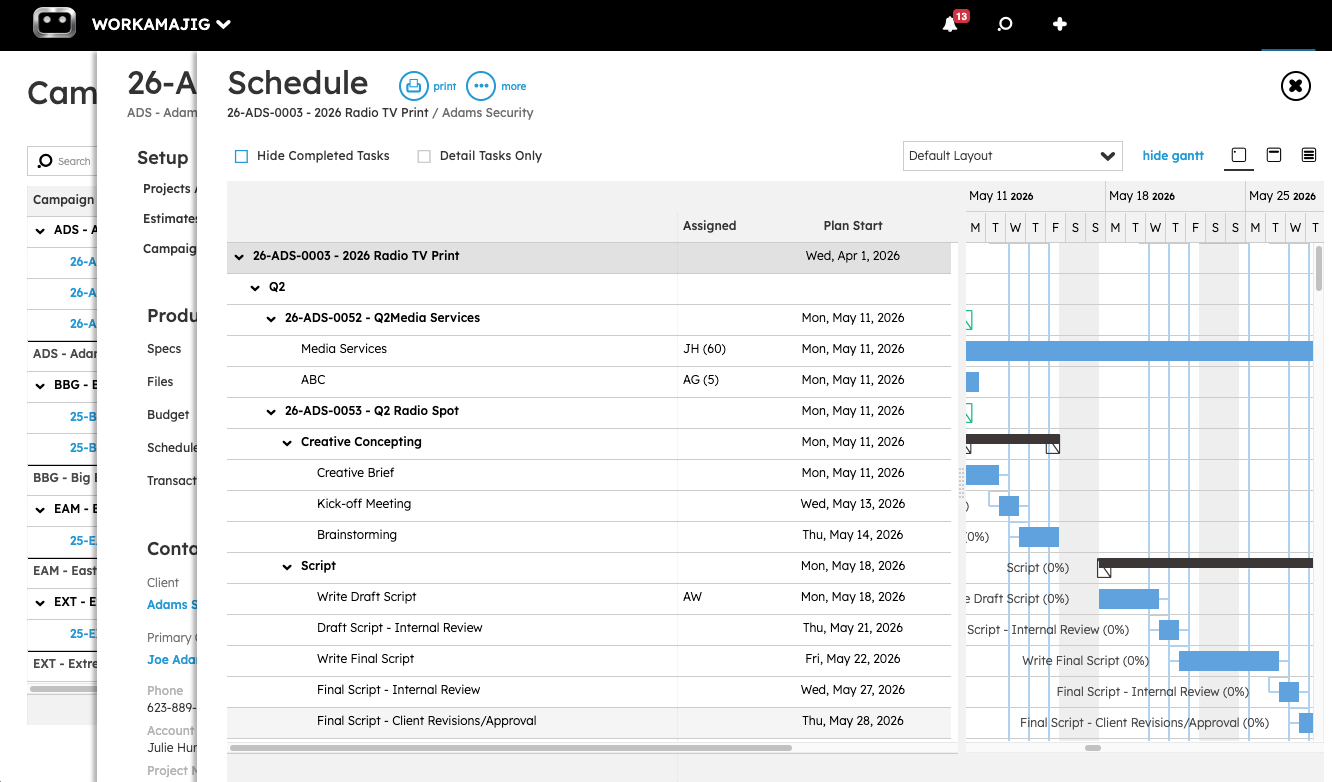
If you’re managing multiple projects that share key traits — maybe they’re all paid in-house campaigns, or maybe they’re four different projects for one client — then our portfolio feature (called Campaigns) comes in handy for several reasons:
- It unifies project budget tracking. You can build out a fully centralized portfolio budget that updates as expenses are logged across any projects, while still having the option to drill down into individual projects’ budgets.
- You get a “master” schedule. Workamajig folds all the project’s individual schedules into a single, master view (as shown in the screenshot above). From there, you can conveniently edit project details and tasks across the entire portfolio.
- Collaboration gets simpler. Create portfolio-level deliverables, file repositories, and conversation threads.
- Centralized billing and reporting. You can generate a billing worksheet for the portfolio, review and tweak the line items, and create a single client-facing invoice. We also offer dedicated campaign P&Ls for analyzing portfolio profitability.
Check out our guide to campaign management software for a deeper dive into our portfolio management features and the different ways to build out a centralized campaign budget.
Project Billing & Client Invoicing
After projects wrap up, Workamajig streamlines the billing process with our electronic billing worksheets, ensuring costs are properly accounted for, managed, and invoiced.
With our billing worksheets, billing and accounting roles can easily coordinate with the right decision-makers — usually an AE or PM — to ensure that client-facing invoices are accurate.
This workflow saves everyone from the headaches of traditional invoicing workflows, where you have to chase people for details, ask PMs what to write off or transfer, and regenerate invoices whenever there’s a typo or missing information.
Here’s how it usually goes:
- A user (typically an accounting or billing role) generates a billing worksheet. They can choose to build the worksheet out either based on the project’s transactions or as a percentage of its budget (useful for projects in progress).
- The generated worksheet comes pre-filled with all relevant line items — billable hours, expenses, transactions, prior billings — instantly pulled from Workamajig’s expense tracking. It also applies the project’s respective billing method; whether that’s time and materials, fixed fee, retainer, or media.
- Our system automatically routes the worksheet to the approver (usually a PM or AE), who can check everything and make any final changes, such as writing things off or transferring costs.
- After approval, the worksheet is routed back to the billing/accounting user, who generates the final invoice and sends it to the client.
- Clients can then view invoices from their dedicated portal and pay them via credit card or ACH.
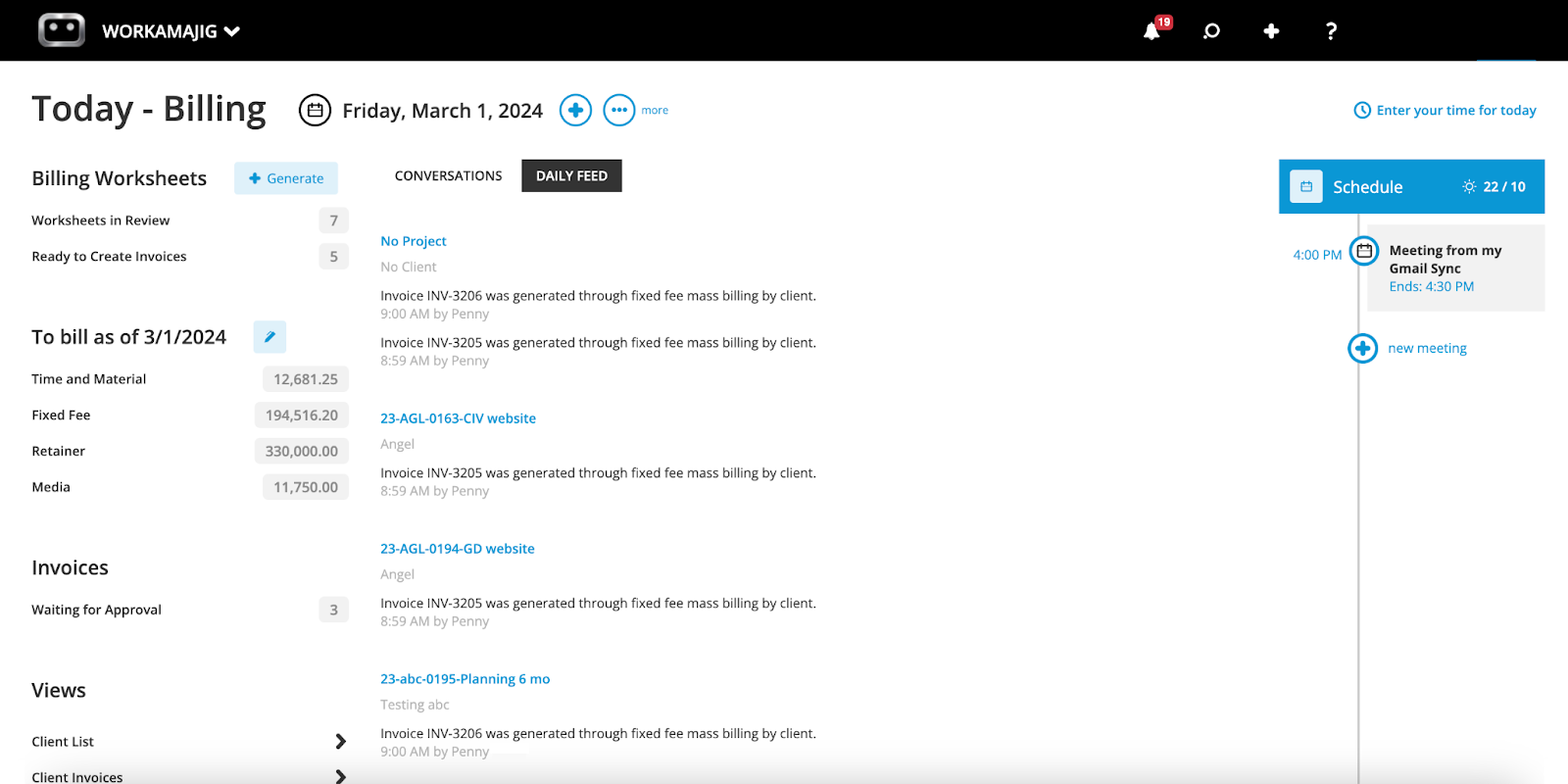
Then, billing users can monitor invoices and status updates from their personalized Today - Billing dashboard (shown in the image below). This dashboard lets users conveniently manage all things billing-related in one place — they can see what’s due to be billed, generate billing worksheets, pull up billing reports, and track worksheets out for review.
Read more: Best Creative Project Management Software with Invoicing
Project, Financial, Productivity & Agency Reporting
Workamajig’s reporting suite is far more comprehensive than most solutions in its category, because our system pulls in and combines data — expenses, time entries, resource assignments, project plans, vendor invoices, and the GL — from all modules.
So you can uncover really specific insights to inform decision-making, like which task and resource took more hours than estimated, and blend data sources to find out things like your most resource-intensive projects with thin profit margins.
Up next, we cover:
- Our most-used project reports for analyzing overall project performance and getting into the finer details of profitability.
- Time and productivity reports for analyzing team productivity and utilization.
- Financial reports for analyzing your agency’s financial health from different perspectives, e.g., through cash flow and revenue forecasting.
Project Recap Analysis
The Project Recap Analysis report lets you easily compare actual labor hours and costs against estimates, so you can evaluate how the project actually went and where issues came up — so you can plan more successful projects in the future.
As shown in the screenshot below, the report organizes everything by project stage. It displays the budgeted vs. actual labor dollars, budgeted vs. actual hours, and the baseline due date vs. actual completion date for each task.
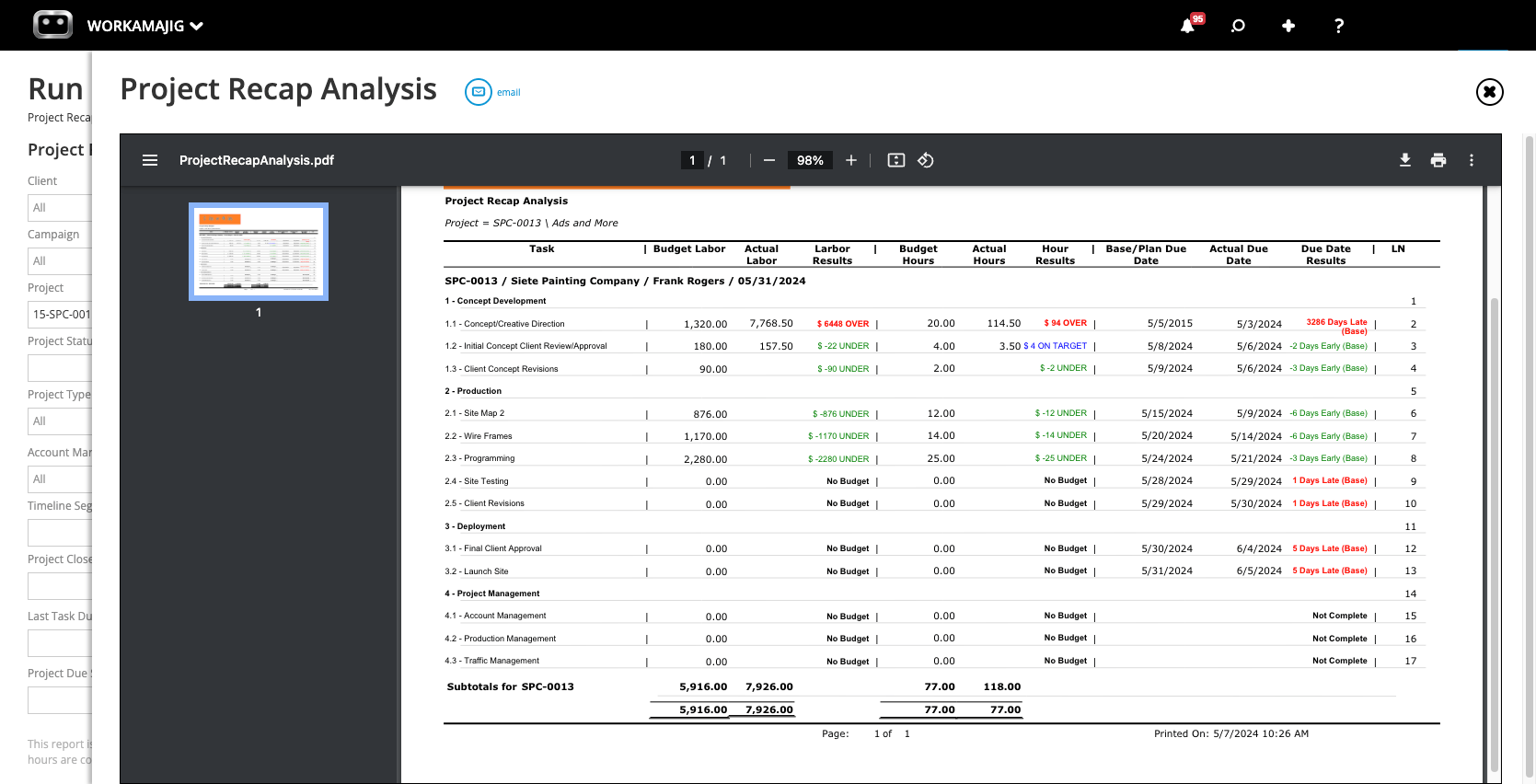
Then, you can easily spot where estimates were above, lower than, or as expected with color-coded indicators in the variance (labor results) column. Red indicates over budget, blue signals on target, and green means under budget.
Project Budget Analysis
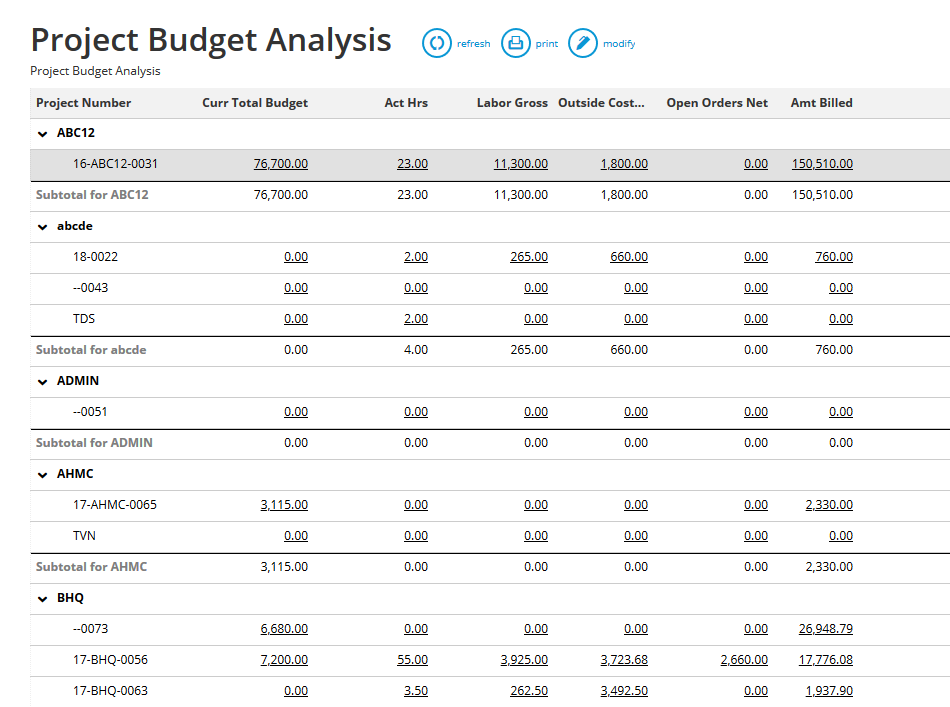
The Project Budget Analysis is useful for reviewing multiple projects simultaneously to identify any issues that stand out. The default view categorizes projects by client, but you can adjust it to suit your workflow.
The report rolls all the details for your projects into a single view — budgets, actuals, labor gross, outside costs, open orders, and amounts billed — so you can quickly scan for issues like labor gross overruns or higher-than-expected outside costs.
Another handy way to catch issues is to apply our "Project Has Budget Warning" filter, which pulls up projects where actuals have crossed 80% of their budget.
Then you can click any specific value to drill into it for the full transaction history and trace it back to the time entry, vendor invoice, or expense line that created it, all in the same connected view.
P&L Reports
The main advantage of Workamajig’s P&L reports over other budget reports is that these pull from posted GL transactions rather than just actuals, ensuring that overhead is accounted for and offering a more complete picture of profitability.
When you run a P&L report — such as a project or client P&L — you allocate overhead across projects, clients, or campaigns in your preferred way:
- By labor hours. Overhead is distributed proportionally based on the total approved hours on time sheets charged to the client or project, divided by the total approved hours for the selected date range (e.g., if a client or project is using 30% of your resources, they will be assigned 30% of your overhead).
- By labor cost. It’s distributed proportionally to total labor dollars.
- By total billing. Overhead is distributed proportionally to revenue.
- None. Review the P&L without overhead allocation.
There’s no “best” way to allocate overhead; you can use these different options to get varied perspectives, but it’s important to keep reporting consistent across the board. So, after finalizing your preferred method for overhead allocation, be sure to apply it consistently everywhere.
Our main P&L reports include:
- Project P&L (Detail View). Offers a detailed view of a single project and breaks down profitability by GL account — revenue, COGS, agency gross income, expenses, and allocated overhead. It helps evaluate why a specific project’s margin came in thin even though it tracked to budget on paper.
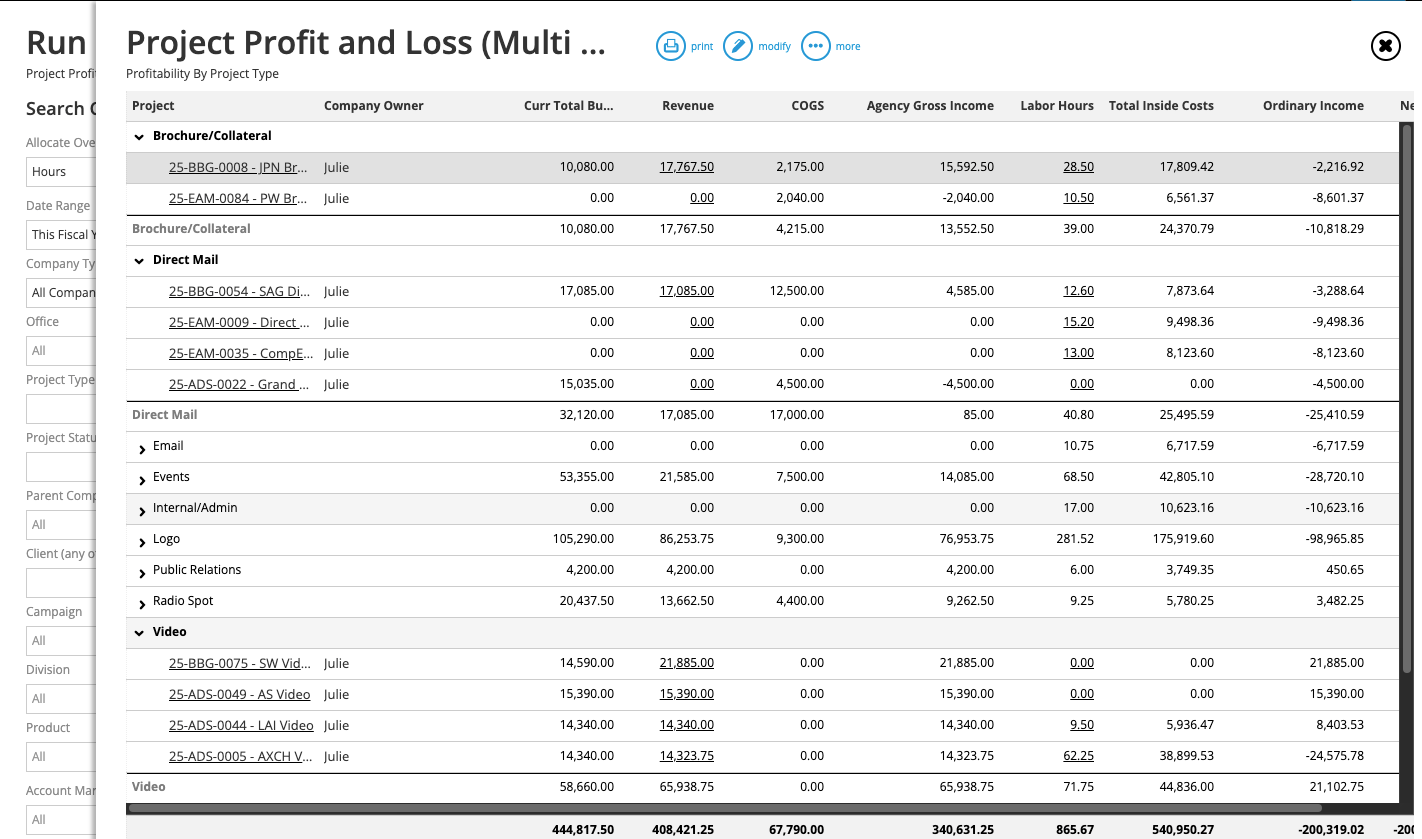
- Project P&L (Multi-View). The multi-view offers a broader view of profitability across multiple projects in one place and allows grouping by project type, client, account manager, or status. This is the view for spotting patterns and catching issues, such as which kinds of work are losing money.
- Campaign P&L (Multi-View). This report sits between the detailed and multi-view reports; it rolls up profitability across all projects tied to a campaign (a.k.a. a portfolio).
- Client P&L (Detail and Multi-View). This offers similar insights to the project P&L but at the client level, which is useful for renewal conversations and account reviews.
Time & Productivity Reports
The reports covered above can help teams catch labor overruns and see which tasks, service lines, and projects they’re associated with. But our time and productivity reports offer deeper insights into resource utilization and team performance, so you can diagnose the root cause and solve these issues for good.
For example, some clients may require more resources but aren’t paying enough to justify the effort. Some resources may be doing a lot of busywork but aren’t clocking in enough billable hours, so they're generating less revenue than they could be.
Here are our main reports and what they do:
- Time Productivity Analysis. It provides an overview of each resource's hours and financial contribution side by side, including their utilization rate, realization rate, total cost, and revenue generated. You can see which resources are bringing in more than they cost (and which aren't).
- Chargeable Utilization Report. This report offers a more accurate view than billable utilization of how much revenue an employee brings in. It measures the percentage of billable hours that are actually chargeable to a client — after write-offs, redos, and scrubbed time.
- Project Hourly Realization Rate. Compare what you actually realize per hour against your standard rate card to quickly assess whether write-offs, redos, and other challenges are hurting your margins.
Our system also features an Agency Insights dashboard for reporting on your whole team’s productivity. These reports show:
- Hours by client and service, so you know where you utilize the most resources.
- The departments or team members clocking the most hours.
- Tasks in the day’s queue and hours by task category.
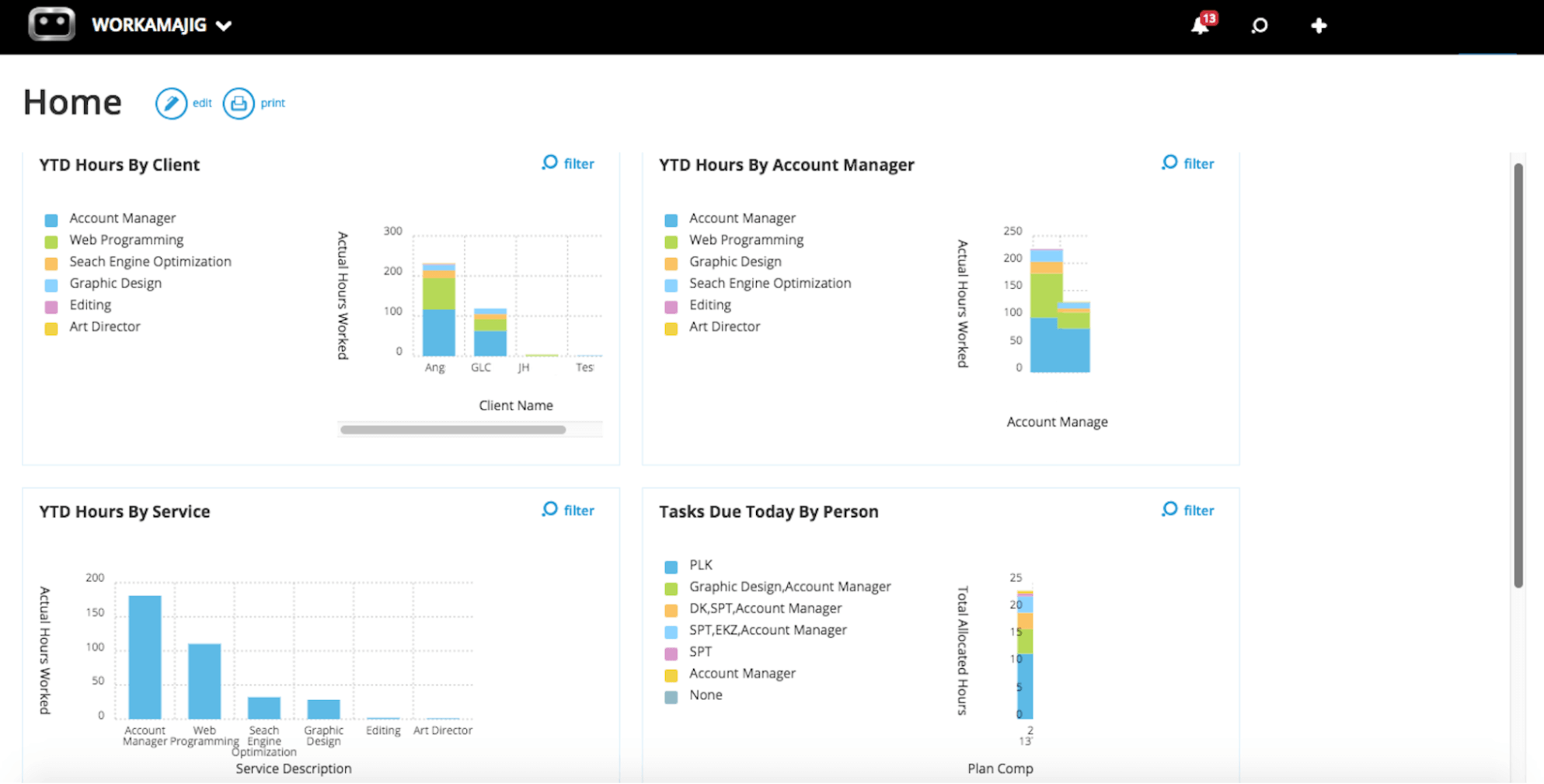
This combined data gives you a clearer picture of what your agency is working on and the overall “state of operations.” You can see the client projects and services that occupy your staff members’ time, compare billable vs. non-billable hours, see if you’re earning profit from projects, and measure your financial performance.
These are the actionable insights managers need to make real improvements.
For example:
- Are you allocating a lot of hours to a client but not seeing a profit? If so, look into the reasons and course-correct.
- Do you find certain services don’t drive a profit? Determine ways to optimize processes or decide if it makes sense to continue offering those services.
- Is one department clocking a ton of hours while another sits without work? Reorient project schedules, tasks, and resources to better balance workloads.
Identify your successes and losses to adjust strategies and increase ROI.
Note: You can talk with your Workamajig account manager about the reports and KPIs most valuable to your teams, and they can show you how to monitor those metrics in our system.
Financial Reporting Suite
In addition to the ones we’ve discussed, Workamajig offers several other out-of-the-box financial reports to analyze project ROI, cash flow, and overall profitability. Some of the most popular financial reports include:
- General Ledger (GL) reports for complete financial oversight
- Cash projections and revenue forecasting so you can plan with confidence
- Project budget drill-downs to see exactly where money is going on specific work
- Billable summary reports to compare billable vs. non-billable hours
- Hourly realization rates to help you evaluate productivity from a financial perspective
- Key metrics monitor to track the metrics that drive your business
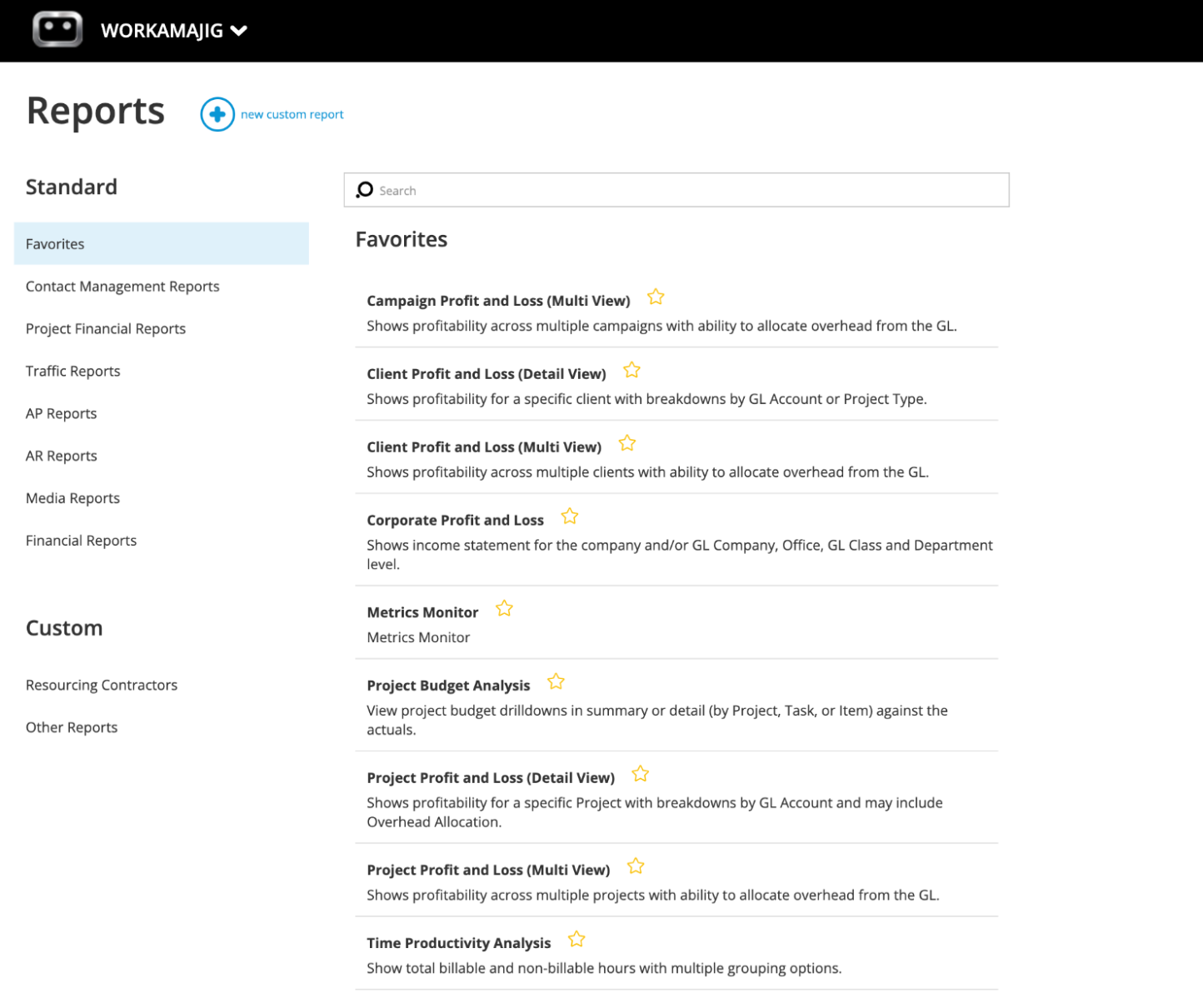
Our financial reporting suite also lets you combine any business data from across the system — client, project, resource, or financial — to create tailored, blended reports that offer deeper insights.
You can save the reports that are most important to you and easily access them from your personalized dashboard (as shown below).
Workamajig Additional Capabilities
Workamajig goes beyond project management and financial tracking, including a comprehensive toolset for managing all the moving parts of creative projects. Our system also packs in the following fully integrated tools:
- A full, GL-ready accounting software built specifically for creatives. We’ve covered our core expense management and invoicing capabilities above, but our system offers much more. It supports all AR/AP workflows and includes dedicated tools for reimbursements, reconciliation, vendor invoice management, online client payment collection, and more.
- A native agency CRM. Workamajig’s full-featured CRM supports the entire sales workflow from lead capture to client intake, with dedicated tools for managing leads, tracking engagements, generating estimates and quotes, and developing opportunities.
- Project collaboration tools. Project teams, clients, and vendors can all collaborate smoothly in Workamajig. Most day-to-day collaboration takes place on task cards, where stakeholders can tag each other for feedback or context, add comments, and upload files. Our internal proofing tools make it easy to preview content, compare files side by side, and mark up annotations directly in Workamajig.
- Personalized Today pages for each role. Just like the Today - Billing page discussed above, Workamajig offers a variety of dashboards tailored to each role and user; creatives, project managers, accountants and finance teams, sales reps, sales managers, etc., all get their own command center for managing work and taking quick actions.
- Client portals. You can create unlimited client portals to accommodate each client; we don’t charge per portal. Clients can use their portals to track project progress, join feedback discussions, view and approve content, and receive invoices.
To learn more, request a demo with our team for a personalized walkthrough of our platform and its capabilities.
Pricing & Getting Started
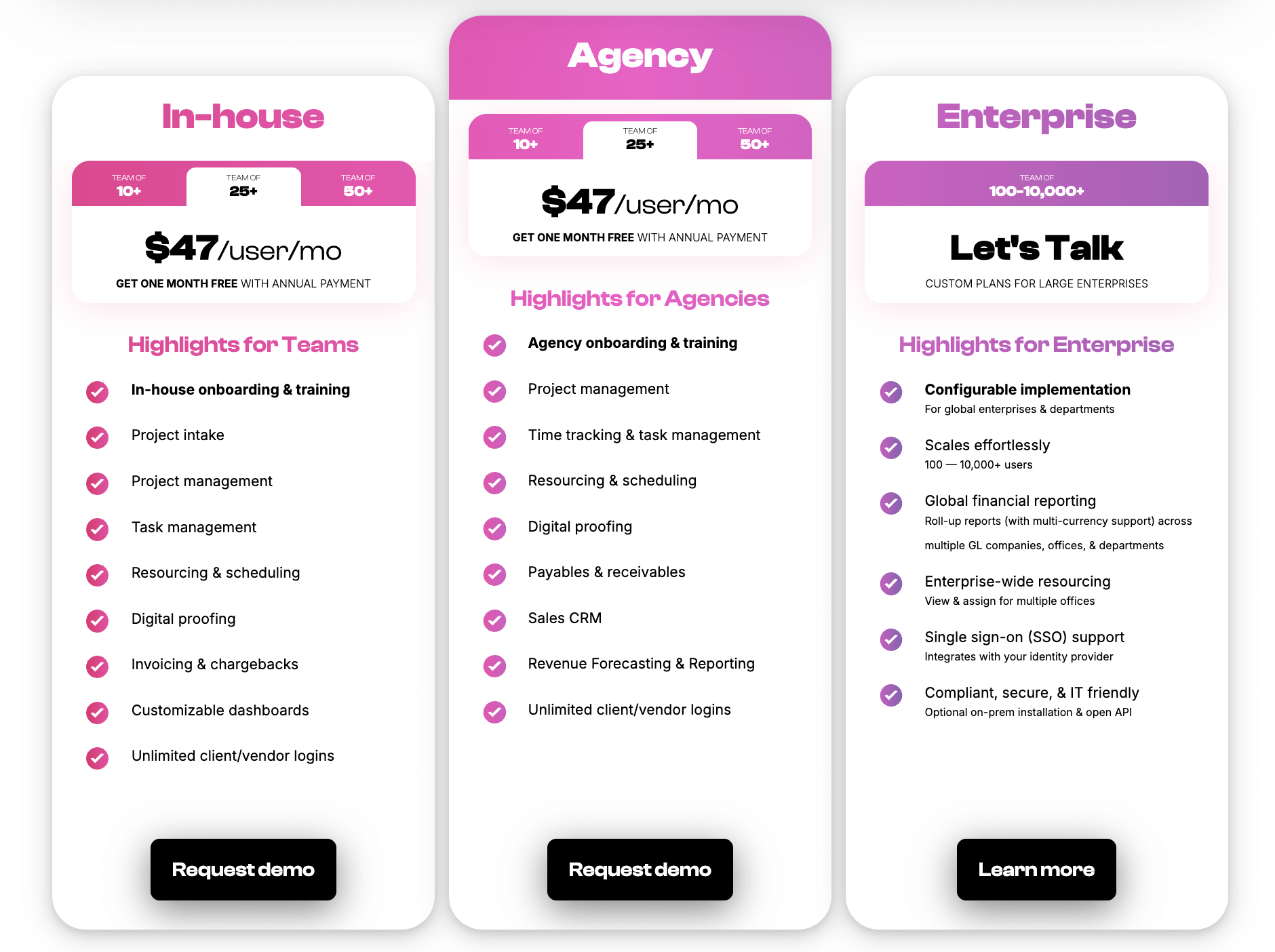
We offer tailored solutions for in-house teams and agencies, with custom packages for enterprises. All Workamajig plans include our full suite of project, resource, financial, and client management tools, and the personalized onboarding and training mentioned above. Pricing varies by team size.
Check out our packages below:
Alternative PM Tools with Financial Tracking (for Creatives & Marketers)
In the following sections, we review 9 additional popular project management tools with financial tracking.
You’ll probably come across brands like Asana, Monday.com, Trello, Zoho, and Smartsheet during your research, but we’ve left these off our list because they’re not specifically catered to creatives or marketers. They might check one box but not others (e.g., they might have resource management but not time tracking or lack certain collaborative tools creatives require).
Plus, many of these tools offer surface-level, app-powered financial tracking rather than more comprehensive tools that guide creatives through each step of their processes.
So, the project management tools below offer a broader range of features that better serve creatives and marketing teams. Advantage and Clients & Profits offer the most comprehensive suite of tools for creatives, with Productive, Function Point, Ravetree, and Scoro all being close seconds.
Then, Kantata, BigTime, and Teamwork also made our list. They don’t check all our boxes for creatives, but they do enough things well to be worth a mention.
You can also compare other project management tools for creatives here.
2. Advantage
.png?width=2000&height=878&name=Advantage%20Simpli.fi%20homepage%20(2024).png)
Advantage is one of the best project management solutions for agencies and marketers who want financial tracking and media planning in one place. Advantage is owned by Simpli.fi — a media buying and planning software company — so it's one of the few project management tools that include a full, native media buying suite.
Like Workamajig, Advantage offers a complete “work management solution” with project management, resource management, time tracking, a full accounting suite, CRM, vendor and client portals, and more.
Advantage commonly works with larger agencies and enterprises, including social media and marketing teams, CPG brands, healthcare companies, hospitality companies, and other professional services.
Users praise Advantage for its media planning and accounting tools; however, some express dissatisfaction with the platform’s project management workflows and overall ease of use, noting that navigation can be confusing and inefficient.
Read more Advantage reviews here.
Key Features
- Financial reporting with revenue forecasting
- Tools to calculate estimates & budget monitoring
- Billing & invoicing
- Media Accounting
- Time tracking
- Reporting dashboard (to analyze project performance, financials, staff hours, etc.)
- Project management
- Resource management
- Collaborative tools like proofing & reviews
- Media planning & buying — including broadcast buying, digital buying & media reporting
- Risk analysis & burn rate tracking
Pricing
Advantage offers custom quotes and does not publicly share pricing.
Read more: Best Advantage Software Alternatives for Creative Teams
3. Clients & Profits

Clients & Profits is another all-in-one agency management solution for creatives, designers, and marketers. They have experience with small businesses, growing teams, and corporate marcoms (with unique packages for different user groups).
Like Workamajig and Advantage above, the platform includes tools to manage project requests and calculate estimates, project management, resource management, time tracking, financial tracking, and an accounting system with invoicing. It also integrates with Strata and includes features for creating media estimates and converting them into insertion orders.
The platform emphasizes financial tracking and supports you by calculating estimates, projecting ROI, and providing reports to monitor and analyze costs and grow your bottom line. They also offer workflow consulting for teams that need advice on preparing estimates, allocating resources, staying within budget, or measuring profitability.
The most notable downside to using Clients & Profits is the hosting and UI. It’s an on-premise software, and user reviews suggest (and screenshots on the site show) that the platform is a little out of date. You can see it for yourself by checking out C&P’s virtual tour.
Find more Clients & Profits reviews here.
Key Features
- Financial reporting
- Project request forms & tools to calculate estimates
- Project planning & task management
- Team management with live scheduling & time tracking
- Project management & monitoring
- Collaborative tools to gather feedback from team members & clients
- Portfolio management
- Workflow automation tools
- Integrations & Adobe XD plugin
Pricing
Clients & Profits offers a range of solutions for studios, agencies, and marcoms. You choose the package that describes you and pay per user. They charge:
- $45/user/month for project and account managers (with access to estimating tools and expense reporting).
- $25/user/month for creatives (to work on tasks and track time).
- $65/user/month for studio power users, $85/user/month for marcom power users, and $115/user/month for agency power users.
Freelancers can log in to your C&P hub and view assigned work for free, or you can pay $9/freelancer/month, which enables them to collaborate on creative dashboards and record hours in time cards.
C&P charges a one-time setup fee that includes dedicated onboarding and training tutorials. They also offer further (fee-based) one-on-one training sessions if needed.
4. Productive
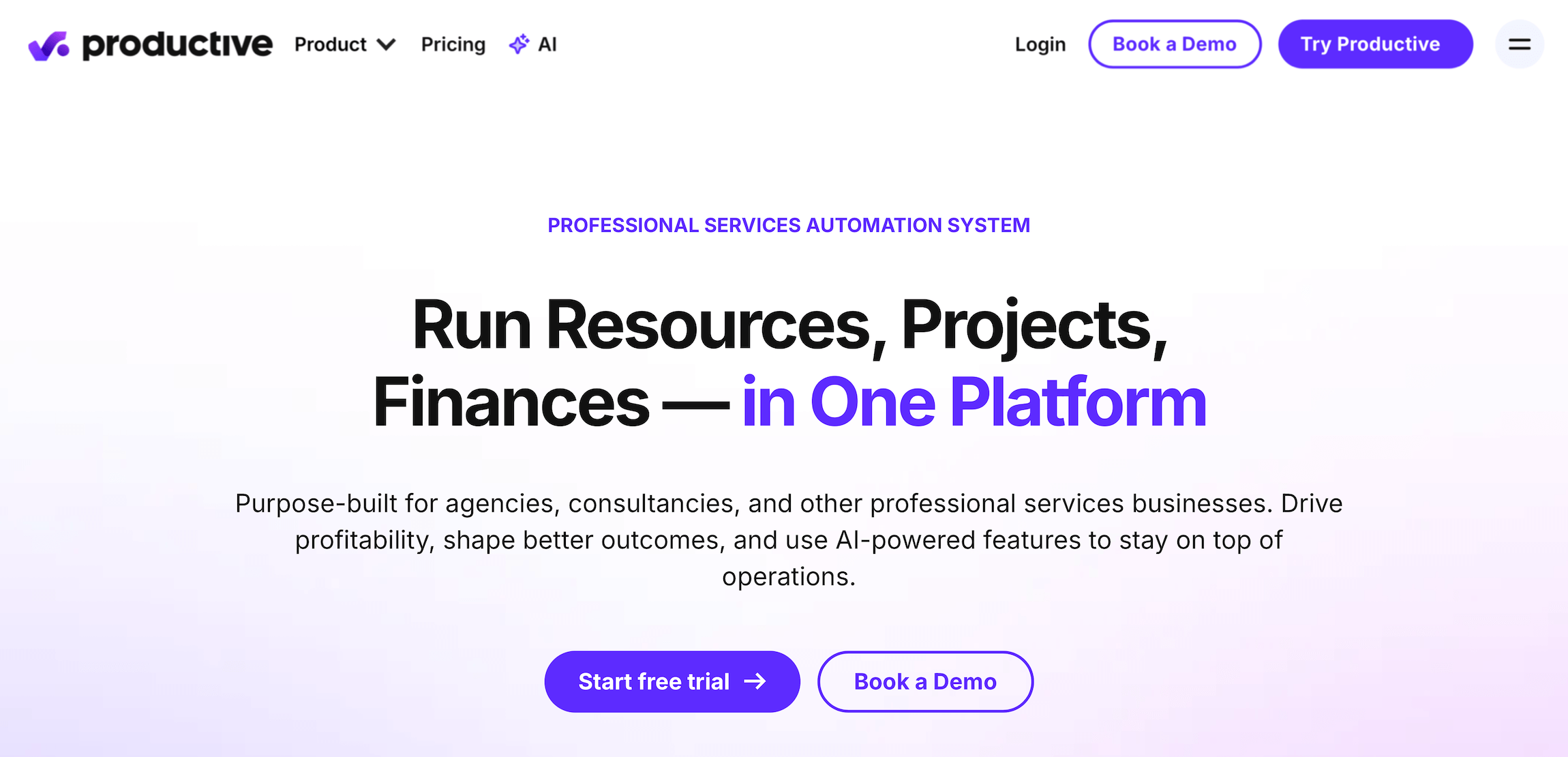
Productive is another agency management solution that combines project management, resource planning, time tracking, budget monitoring, financial reporting, and billing.
Productive includes a CRM, but it does not offer a native accounting suite (nor do any of the systems we’ll discuss from now on). But you can integrate the platform with QuickBooks (and other popular accounting software) to push invoice data between systems or to provide more data for Productive’s financial reporting tool.
It also does not include media planning tools or integrations. That said, they offer the ability to create custom integrations, so you may be able to link Productive to your media planning system and pull expense data from insertion orders. Productive also links with calendar systems (like Microsoft and Google), messaging tools (like Slack), HR systems, and other time-tracking tools.
Though Productive does not include a full accounting suite or native media planning integrations, we chose them for this list because:
- It offers features for calculating project estimates and accommodating project adjustments.
- It includes a powerful budget management dashboard to manage all in-progress projects, hours and costs, profit margins, and amounts left for invoicing. You can build and manage different types of budgets, oversee active projects, and report on the profitability of past work.
- It has tools to manage more complex projects (and their budgets) in phases, so your staff can work toward predefined milestones and adjust project plans as they complete each phase.
- It includes a variety of profitability reports and real-time profitability tracking.
- It has automated invoicing tools and supports a variety of billing methods.
Read more Productive reviews here.
Key Features
- Budget management dashboard
- Real-time profitability tracking & financial reporting dashboard
- Time tracking & timesheets
- Automated billing
- Project management
- Resource planning
- Sales CRM
- Documents (to create shared docs & collaborate with teammates)
- Open API (to integrate with outside systems)
- Mobile apps for iOS & Android
Pricing
Productive offers three packages, as well as custom plans and pricing for enterprises:
- Essential (12/user/month): Grants access to Productive’s budgeting, time tracking, expense management, and reporting tools.
- Professional($29/user/month): Unlocks access to more advanced project and budget management tools, including recurring budgets, advanced reporting (with currency conversions), and invoicing integrations.
- Ultimate (Custom pricing): Take things further with revenue forecasting, expense approvals, advanced custom fields, overhead allocation, and HubSpot integrations. Productive does not share pricing for this plan but offers a 14-day free trial to explore the package.
Read more: Best Productive.io Alternatives for Agencies
5. Function Point
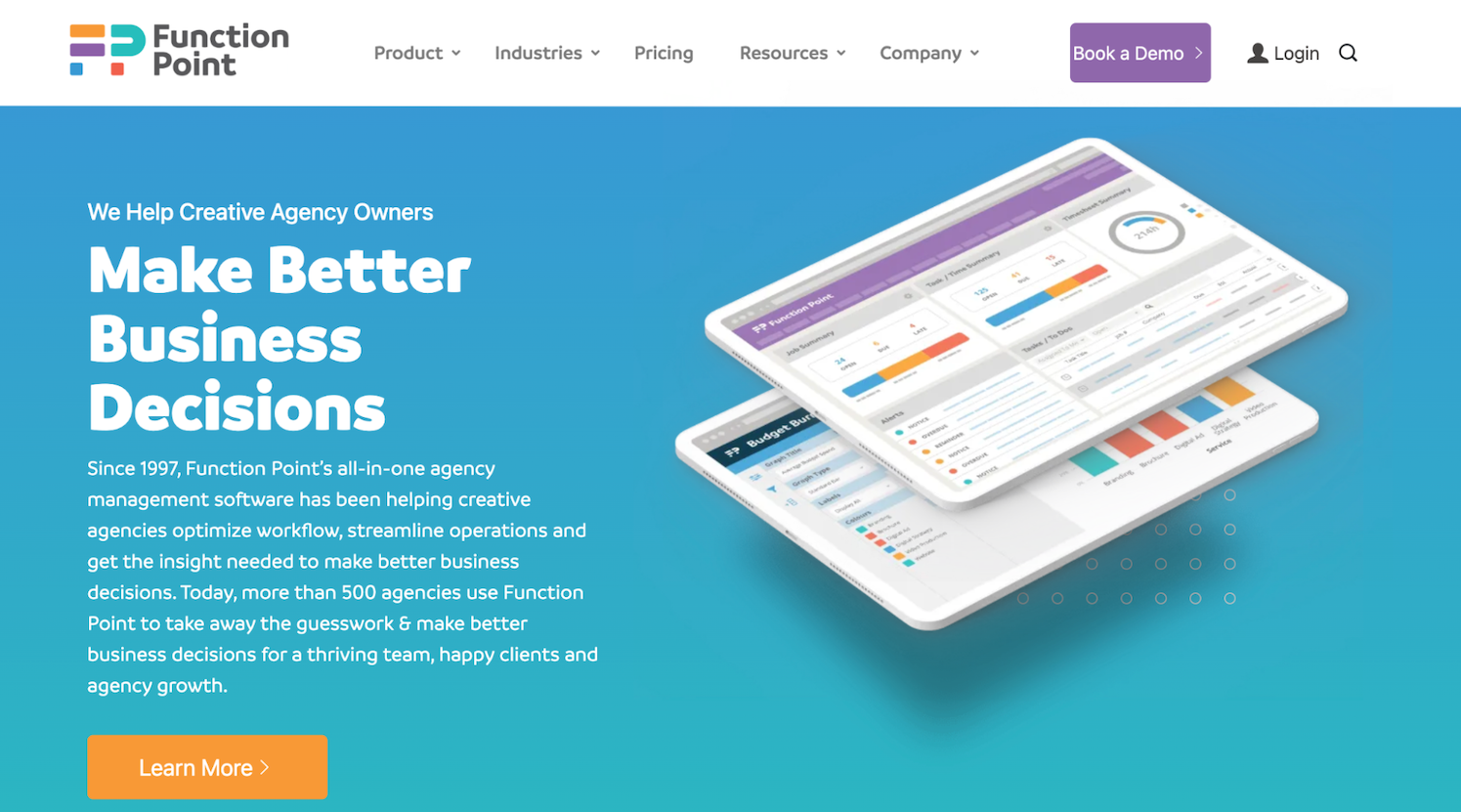
Function Point is a creative work management system with financial tracking, resource planning, time tracking, CRM, and agency insights in a fully centralized system. It was founded in Vancouver over 30 years ago and now serves over 500 agencies worldwide.
Function Point offers native tools for managing the financial side of project work, including: estimates and quotes you can send to clients for approval, time tracking that ties hours to specific projects and tasks, expense tracking for things like contractor costs or out-of-pocket spend, invoicing (one-off, retainer, or progress billing), and reporting that shows you project profitability, budget burn, and where jobs are running over.
There's also a rate card system so different staff or services bill at different rates, and you can compare what you estimated against what actually happened once the work is done.
However, FP lacks a native accounting system, so it relies on a QuickBooks integration (works with both Online and Desktop) to handle tasks such as bank reconciliation, AR/AP aging, financial statements, and taxes. A big advantage of this combo is the removal of double data entry.
Find more Function Point reviews here.
Key Features
- Client management tools, including estimates, proposals, change orders, revision tracking, and job request portals
- CRM and email integrations
- Project templates
- Project management dashboards for real-time visibility
- Project monitoring (choose Gantt charts or a Kanban board view)
- Team collaboration, including file sharing and commenting
- Resource management
- Time tracking
- Financial planning and management, including expense tracking
- Billing and invoicing
- Business intelligence reports, including in-depth profitability reports and custom reporting
- Integrations with accounting systems like QuickBooks and other business applications
Pricing
Function Point offers two plans that both include its core feature set. The main difference is that the higher tier — Optimize — includes its QuickBooks integration and advanced BI tools. The plans are:
- Standardize — $58/user/month.
- Optimize — $68/user/month.
Read more: Function Point Reviews & Alternatives
6. Ravetree
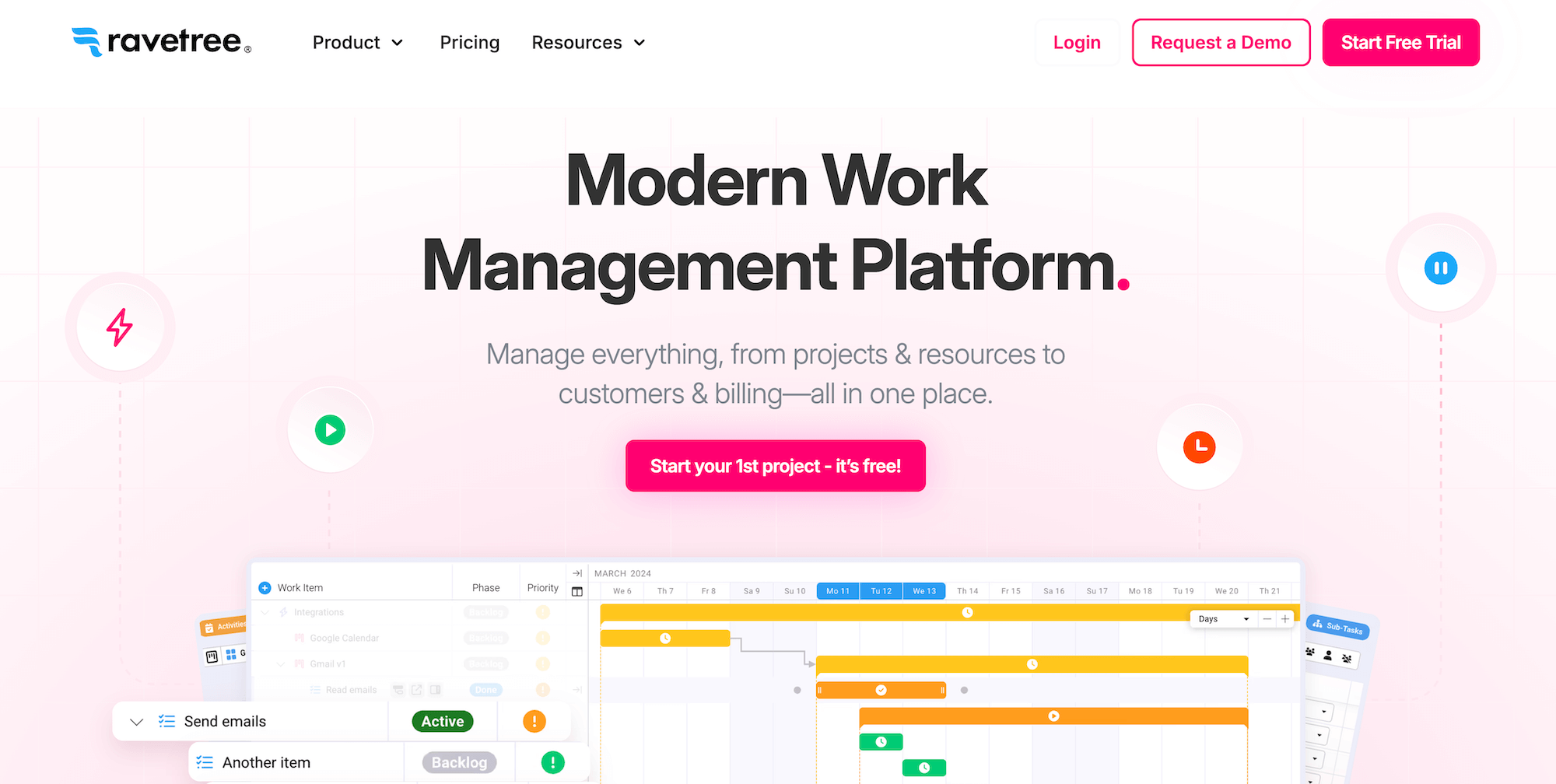
For the most part, Ravetree is pretty similar to Function Point; it, too, packs in project, resource, client, and financial management in a centralized system. Plus, like FP, Ravetree:
- Relies on third-party integrations to support accounting workflows. However, unlike FP, you’re not limited to QuickBooks; Ravetree also integrates bi-directionally with Xero.
- Offers extensive, native financial tools, including estimating, time tracking, expense tracking, invoicing, budget vs. actual comparisons, and project profitability reports.
- Offers simple pricing. All Ravetree users receive all features and support — you choose your package by how often you want to pay (monthly, quarterly, or annually). Costs vary by package, with lower rates in the quarterly and annual plans.
However, while FP is more geared towards creative agencies, Ravetree serves a broader audience, including digital agencies, universities, non-profits, consulting, engineering & architecture, and accounting & law firms worldwide. This difference shows up in Ravetree’s PM suite, which includes dedicated agile tools such as Kanban boards, Scrum sprints, backlogs, and user stories.
A couple of drawbacks to keep in mind with Ravetree are:
- Its reporting mainly focuses on project management and resource utilization. It's much less extensive for sales and agency-wide reporting.
- Several users highlight reliability issues when using the platform in their day-to-day workflows. For example, they mention files not uploading properly and occasional crashes.
Check out more Ravetree reviews here.
Key Features
- Project templates & project request forms
- Project management
- Portfolio management
- Project budget tracking and forecasting
- Billing & invoicing
- Time & expense tracking
- Retainer management
- Resource planning
- CRM
- File management
Pricing
As we mentioned above, Ravetree doesn’t have different packages per se; what you pay depends only on the subscription cycle:
- Monthly: $39/user/month
- Quarterly: $34/user/month
- Annually: $29/user/month
Whatever option you choose, you get full access to Ravetree’s complete agency management suite, plus free onboarding, training, and ongoing support (live chat and video conference).
Read more: Best Ravetree Alternatives for Agencies & Creatives
7. Scoro
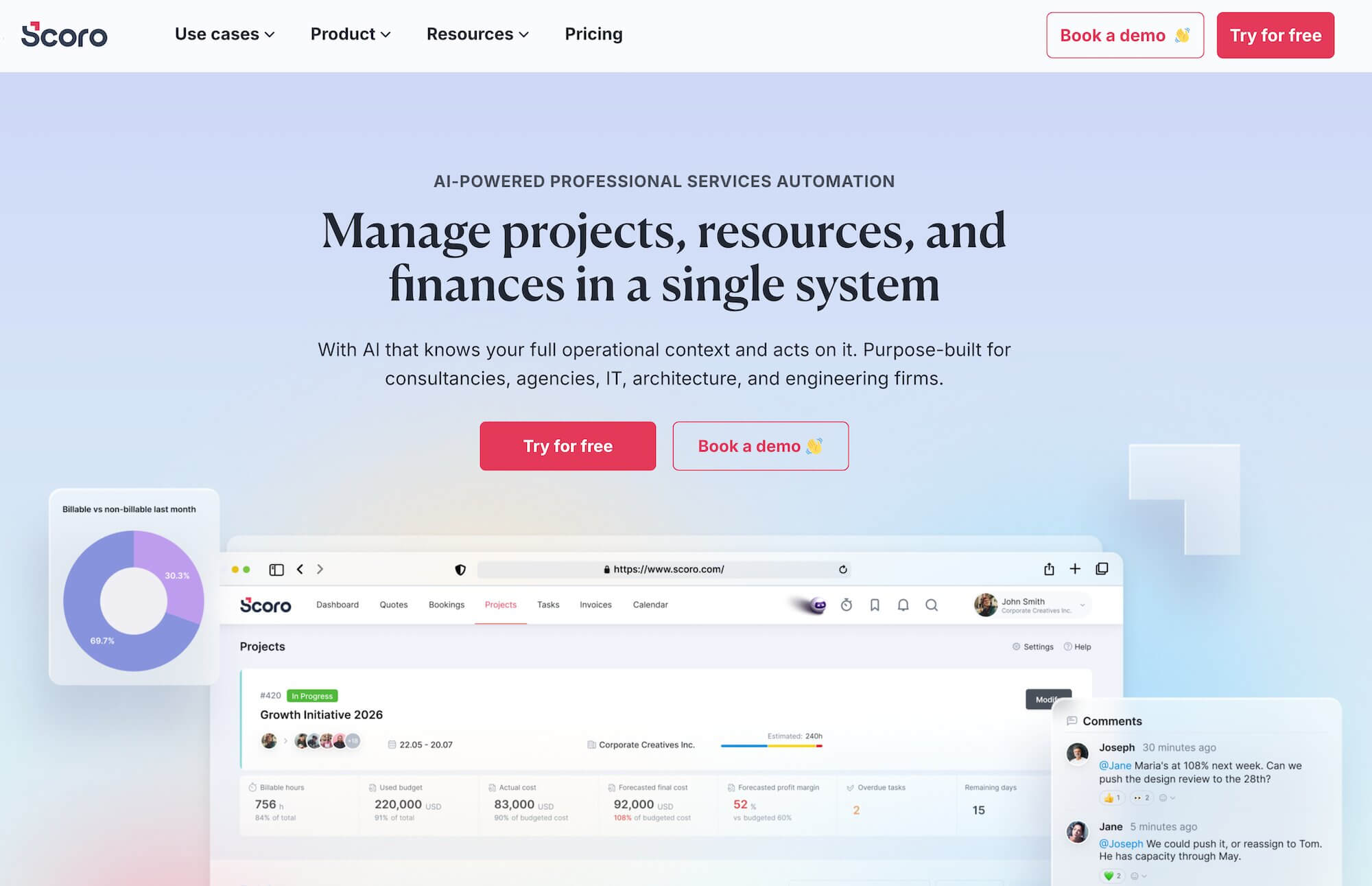
Scoro is a comprehensive work management system for agencies, consultancies, law firms, and other professional services businesses. It’s lower down on our list because it’s not specifically geared towards creatives, but it boasts a comprehensive financial management suite. All it’s really missing is native accounting, but it supports those workflows via third-party integrations (QuickBooks, Xero, and Sage) and handles many things natively.
Scoro’s full suite of financial management tools includes:
- Advanced quoting and estimating. Scoro’s quote estimation matrix helps ensure quotes are profitable by breaking down deliverables by role and effort, providing complete visibility into costs and margins.
- Comprehensive project expense tracking. Scoro tracks external and internal costs against project budgets and forecasts profitability in real time at project, role, and service levels.
- Billing and invoicing. Scoro supports pretty much every billing method used by professional services firms, including fixed fee, time and materials, and retainers. It also supports multi-currency invoicing, recurring and scheduled invoices, and mass billing.
- Online payment collection. Take in payments through Scoro’s Stripe integration and set up automated late-payment reminders to chase outstanding balances.
- Multi-entity, multi-currency, and multi-office financial management. Each entity can run its own books separately while leadership gets group-level financial visibility and consolidated reporting (available on the Ultimate plan).
Key Features
- Project management
- Resource planning
- Time tracking
- Collaboration features
- Quoting & budgeting tools
- Invoicing
- Cost management
- Real-time reporting on cost burn
- Retainers
- Sales CRM
- Advanced reporting
- Automated workflows
Pricing
Scoro offers three standard packages, but only the top one unlocks its full suite of financial management tools. Another thing worth noting is that Scoro also sells some tools separately as add-ons, such as scheduling invoices, orders, contracts, and financial document approval workflows.
Its plans include:
- Core ($23.90/user/month): A super basic plan that lacks essential features like expense tracking and detailed reporting.
- Growth ($38.90/user/month): Unlocks Scoro’s essential project, resource, and financial management tools, including project budgets, multiple currencies, retainer management, and detailed financial reports.
- Performance ($59.90/user/month): This package, recommended by Scoro, unlocks all essential platform features, including advanced financial management capabilities such as cost and profit forecasting, revenue recognition, and accounting objectives.
- Enterprise (Custom pricing): These plans offer more advanced capabilities such as multi-account reporting, single sign-on, time locking, and company budgets and forecasts.
Read more: Best Scoro Alternatives for Agencies
8. Kantata
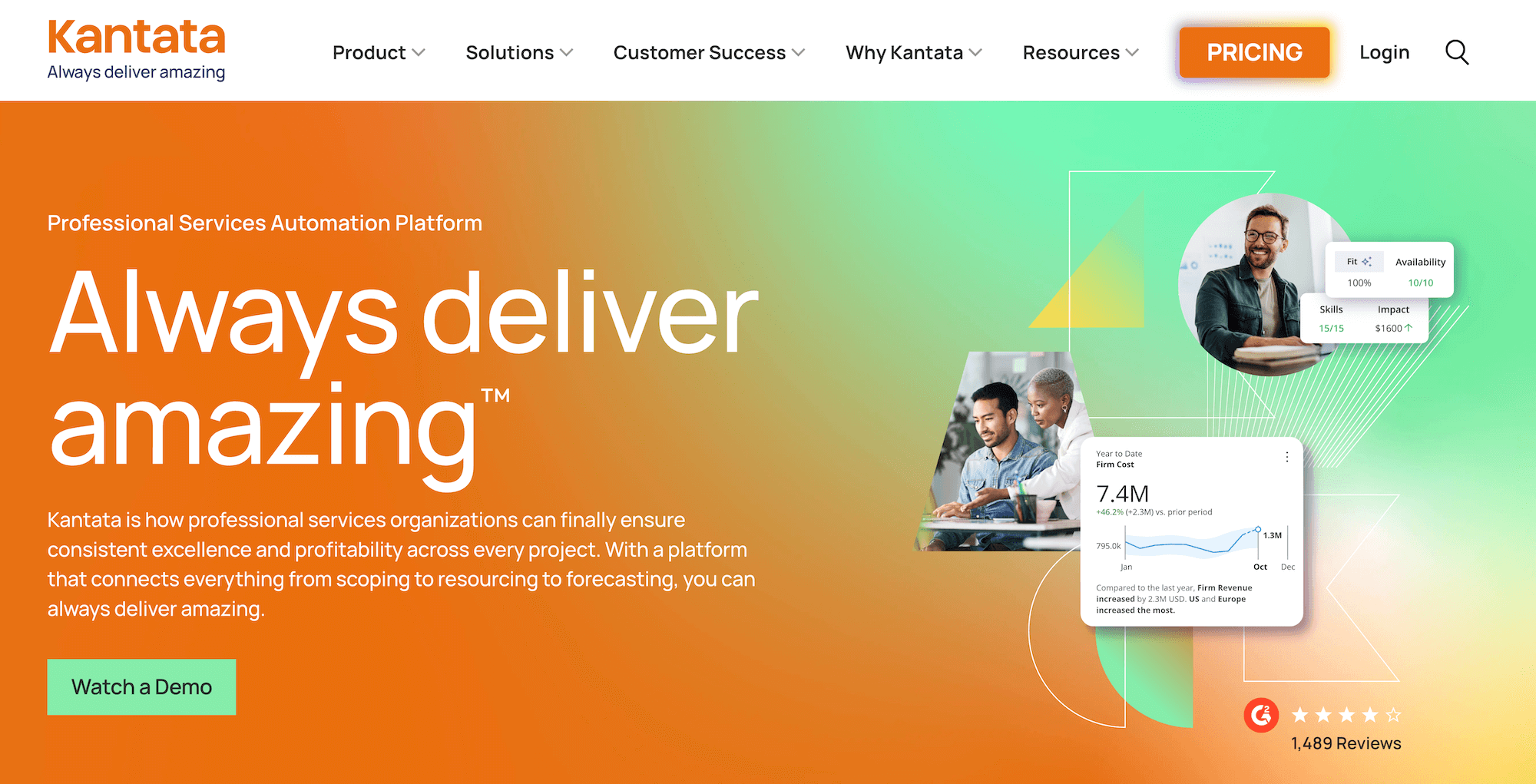
Kantata is an enterprise solution that professional services organizations use to manage their people, projects, and finances in one place. The vendor offers two solutions:
- Kantata OX, which doesn’t come with a CRM and relies on third-party integrations.
- Kanta SX, built on Salesforce’s infrastructure and natively integrated with Salesforce systems (including the CRM).
Kantata is a popular choice for large agencies and businesses operating across multiple locations with complex financial needs. It provides a full suite of project management tools that support hierarchies, complicated organizational structures, resource optimization, and detailed profitability tracking.
On the financial side, Kantata offers all the core tools, including project estimating tools, revenue recognition, flexible invoicing, purchase order management, revenue forecasting, and margin and cost insights. It also offers more enterprise capabilities like:
- Intercompany accounting. Kantata handles transactions between entities inside the same organization, which is useful for shared resources across offices or subsidiaries.
- “What-If” scenario modeling. Model exchange rate changes, rate card adjustments, or pricing scenarios and see the impact on revenue, margin, and open assignments before committing.
- Multi-currency with FX revaluation. Kantata goes beyond billing in different currencies. When exchange rates change, Kantata recalculates open assignments, milestones, and forecasts at the new rate. Account financials can be viewed in any held currency.
- Multi-entity operations. The system supports cross-entity resource sharing, consolidated reporting, and intercompany flows for organizations with multiple legal entities.
- Account credits and AR management. Track client credits, manage receivables, and reduce DSO with collections-focused workflows.
- Accounting and ERP integrations. While Kantata lacks native accounting software, it integrates with QuickBooks, NetSuite, Sage, Oracle, SAP, and Workday. It’s worth noting that some users report these integrations are weak and can lead to duplicate work.
While Kantata covers most fronts on the project and financial management side, the system falls short on the client management side (compared to tools like Workamajig, Scoro, Advantage, etc.) and has a steep learning curve.
Find more Kantata reviews here.
Key Features
- Project planning tools, like project estimation and forecasting
- Project monitoring
- Automated project management insights to guide next steps and prevent overruns
- Portfolio management
- Resource scheduling
- Resource forecasting and capacity planning
- Resource management tools, such as skills inventory and vendor management, are used to source the best talent for projects.
- Time tracking
- Budget tracking
- Project accounting to track costs, monitor project burn, and set financial goals
- Automated invoicing
- Revenue forecasting
- Feedback surveys for project teams and clients to report on satisfaction and overall project success
- Team collaboration and feedback tools, like file sharing and commenting
- Business intelligence reports, with 60+ service-centric reports
- Integrations
Pricing
Kantata doesn’t publicly disclose standard pricing. However, the website has a tool to share details about your agency in exchange for a quote.
Read more: Best Kantata Alternatives for Agencies & Creatives
9. BigTime
BigTime is a close Kantata alternative that also (1) offers two solutions, with one providing more advanced financial management tools, and (2) brings together project management, resource planning, financial management, and business intelligence.
Its two platforms include:
- BigTime PSA — which caters to single-entity businesses and fulfills most agency needs.
- BigTime Enterprise — designed for larger enterprises with complex workflows and international or global footprints. It features deeper customizations, powerful BI reporting, and multi-entity, multi-currency capabilities.
However, it does have some notable differences from Kantata. Firstly, both BigTime PSA & Enterprise lack any kind of native CRM. Secondly, many users praise its interface, describing it as lighter and more intuitive without compromising essential capabilities. BigTime PSA is also generally easier and quicker to set up than Kantata.
BigTime PSA also offers a couple of standout features, including: (1) BigTime Payments, a native, proprietary payment processing solution for accepting client payments through CC, ACH, or wire transfer, and (2) BI reporting tools (exclusive to BigTime Enterprise),which combine project, client, and financial data and enable businesses to pull data from Power BI, Tableau, and their internal data warehouse.
One thing to keep in mind with BigTime is that it’s a “modular” platform, and none of its standard packages include complete platform access. The standard plans offer core project management, invoicing, and expense management tools, and you have to pay separately for the resource, quote, and data management modules.
Check out more BigTime reviews here.
Key Features
- Scoping & quoting
- Invoicing & payments
- Time & expense tracking
- Resource planning
- Project management
- Portfolio management
- Reporting & real-time analytics
- BI reporting & data visualizations
- Customizable dashboards
- BigTime AI assistant
Pricing
BigTime’s plan structures can be a bit confusing. All packages include the project management suite (BigTime Delivery), time tracking, invoicing, expense management, and payments, but other tools — including BigTime Quotes, Resource Management, and Data Hub — are only sold as add-ons.
BigTime also doesn’t list pricing for any plans other than the Essential plan, which starts at $20/user/month. Here’s what’s included in each tier:
- Essentials: Project management, time tracking, invoicing, expense management, payments, automatic reconciliation, a QuickBooks integration, and an AI-powered assistant.
- Advanced: Unlocks custom invoice templates, multi-currency expense management, and custom reporting.
- Premier: Unlocks project budgeting, multi-level approvals, multi-currency invoicing, and custom cost and rate management. This is the only tier that really offers all the essential project financial management tools.
- Enterprise: Custom packages: contact BigTime for a quote.
10. Teamwork
We grappled a bit with putting Teamwork at the bottom of our list because, for the most part, it’s a pretty popular agency management system with project management and financial tracking features. But it’s also pretty lightweight, especially compared to the systems we’ve discussed till now.
What Teamwork does well is combining project, resource, and financial management in a system that keeps clients in the loop throughout the project lifecycle. It features native invoicing, quotes and estimates, expense tracking, real-time budget burn tracking, retainer management, multi-currency support, and detailed profitability reporting.
Like BigTime, Teamwork lacks a native agency CRM. Plus, as with Ravetree and Productive, there are quite a few reviews highlighting system glitches.
Teamwork’s simple, user-friendly interface and affordable entry-level plans are among the main reasons teams consider it. However, its higher-tier plans are fairly pricey. Plus, after factoring in the costs of a separate CRM and accounting system, it comes out more expensive than many other solutions we’ve covered.
Read more Teamwork reviews here.
Key Features
- Project intake forms and project planning
- Project management
- Project monitoring
- Resource and workload management
- Time tracking
- Internal proofing and collaborative tools
- Workflow automation tools
- Client management
- Expense management
- Budget tracking
- Invoicing
- Reporting
- Integrations and API
- Mobile apps (for iOS & Android)
Pricing
Teamwork currently offers four standard packages and custom enterprise plans:
- Free plan: Super limited, offering just enough to try Teamwork. Supports up to 5 projects, 5 users, 100 automations, time logging, and various project views.
- Basics ($13.99/user/month): Includes basic project management features but offers only very basic financial management tools.
- Accelerate ($29.99/user/month): Unlocks essential financial management tools, including retainer management, basic invoices, billable user rates, time tracking against project budgets, plus resource planning tools.
- Optimize (Custom pricing): Provides full access to Teamwork’s essential agency management tools, including advanced features for financial management (such as multi-currency budgets).
- Enterprise (Custom pricing): These packages come with single sign-on, advanced security, a dedicated account manager, priority support, and expert tech implementation.
Read more: Best Teamwork Alternatives for Creatives & Agencies
FAQs on Project Budgeting & Financial Tracking Software
What is project budgeting software?
Project budgeting software helps you plan what a project should cost, track what it actually costs, and see whether you're making money. So these systems usually include tools for building project estimates, tracking expenses at the project level, monitoring cost burn and budgets in real time, and reporting on project profitability in post-mortems.
How is financial project management software different from project budgeting software?
Financial project management software generally offers a broader range of financial features than project budgeting software.
The most basic project budgeting software systems let you build a budget based on labor costs, but don’t factor in non-labor expenses, such as vendor costs or media buys. Then, you’ve got tools that track both expenses and hours against specific projects, but are lightweight on the project management suite.
Financial project management software is typically robust on both the project and financial management sides. So these systems often include the following mix of tools:
- Project intake
- Project estimating and planning
- Project expense tracking (labor and non-labor)
- Real-time project budget tracking
- Change management
- Time tracking
- Billing and invoicing
- Project and financial reporting
It’s worth noting that many providers use the two terms interchangeably, so you’ll definitely come across vendors positioning themselves as project budgeting solutions that offer all of the above features.
How do project financial management tools improve budget tracking and cost control?
Project financial management tools improve budget tracking and cost control in a few key ways. Project teams can:
- Generate accurate cost estimates using historical and present data. This helps them develop a reliable, initial project budget to work with.
- Track updated project budgets in real-time. As hours are logged and expenses are incurred, these systems update the project budget, providing live financial visibility.
- Catch potential overruns early. Project risk alerts notify managers when a project is at risk of budget overruns, so they can intervene early and make informed decisions on how to course-correct.
- Keep scope creep in check. Change management tools provide a structured way to manage requests and ensure change order estimates are folded into the project’s budget.
What features should a good project finance management software have?
The table stakes for good project financial management software include all the tools we discussed above — intake, estimating, project planning, expense tracking, real-time budget tracking, change management, billing and invoicing, and financial reporting.
But the best systems support more advanced financial needs, such as multi-currency invoicing and expense tracking, vendor invoice management, receipt capture, and financial forecasting.
What are the top project financial management tools available?
A broad range of systems fall under “project financial management,” so here’s an overview of top names across different categories:
- Lightweight time-and-financial tracking tools. These systems don’t have extensive PM capabilities; instead, they integrate with your existing PM software and handle the financial side. Harvest, TimeCamp, and Everhour are popular choices.
- Universal work management systems with financial tools. Some top names here are Asana, ClickUp, Monday.com, and Smartsheet. These solutions are project management tools with budget tracking, time tracking (sometimes via add-ons), and basic reporting baked into project workflows.
- Purpose-built tools for creatives and agencies. This category includes two types of tools:
- Creative PM systems with financial tracking, like Productive, Function Point, Ravetree, and Scoro. These tools offer all the essential tools under one roof, including project management, resource planning, project budget tracking, quoting, invoicing, and financial reporting.
- Creative PM systems with dedicated accounting software, including Workamajig, Advantage, and Clients & Profits. These solutions are a top choice for creatives and agencies looking to bring all their people, processes, and finances into one place. They offer standout capabilities such as media billing, media-buying integrations, vendor management, and creative collaboration tools.
Getting Started with Workamajig
Workamajig is one of the most comprehensive creative project and financial management systems available for creatives, marketers, and agencies of all sizes. It brings all your people, processes, and finances together, reducing tech costs, streamlining collaboration, and helping you take profitability to the next level.
Request a free demo of Workamajig for a complete walkthrough of our system to take the first step toward more profitable projects.
Read more: