

Key Takeaways:
- Work Breakdown Structure (WBS) organizes project deliverables into a hierarchical structure focused on the project’s “what,” not the activities or timelines.
- Effective WBS structures follow key principles such as the 100% Rule, mutual exclusivity, and using deliverable-focused language (nouns instead of verbs).
- Creative agencies benefit from WBS because it improves scope clarity, budgeting, accountability, scheduling, and management of client revisions and feedback loops.
- The most common WBS types are deliverable-based, phase-based, and hybrid, with deliverable-based structures often working best for creative and agency projects.
The Work Breakdown Structure (WBS) is essential for getting a project off the ground. Having worked with creative agencies for 30+ years, we've seen teams make the same WBS mistakes repeatedly:
- Over-decomposition: Breaking work down to such a granular level that managing and tracking tasks becomes more work than doing them
- Missing the 100% rule: Decomposing some deliverables but not others, leaving gaps in scope coverage
- Ignoring iteration: Creating a WBS as if every deliverable goes straight from start to final approval, without accounting for client feedback and revisions
- Disconnected from execution: Building a beautiful WBS during planning that has no connection to how you actually track time, allocate resources, and monitor costs
- Generic templates: Using WBS structures designed for a construction project or manufacturing, when creative work has fundamentally different workflows
This beginner-friendly guide will help you avoid these pitfalls with a practical approach to WBS that accounts for how creative projects actually unfold.
What is a Work Breakdown Structure in Project Management?
A work breakdown structure defines everything a project needs to accomplish, organized into multiple levels, and displayed graphically. You might have also heard WBS referred to as “hierarchical breakdown” or “hierarchical decomposition”.
Essentially, the WBS defines the “what” of the project. Everything you need to accomplish in the project is displayed in a single, easy-to-understand hierarchical structure. The purpose of this project management tool is to break down complex activities into smaller, more manageable constituents or subtasks.
The work breakdown structure can be confusing, especially for new project managers. Despite its name, it doesn’t actually involve breaking down work; it involves breaking down deliverables.
For example, organizing a digital brand launch is a very complex endeavor. Apart from the launch itself, you need to develop a visual identity, create a website and digital assets, craft a social media content plan, organize an integrated campaign, and optimize.
Here is an example of a work breakdown structure of a digital brand launch:
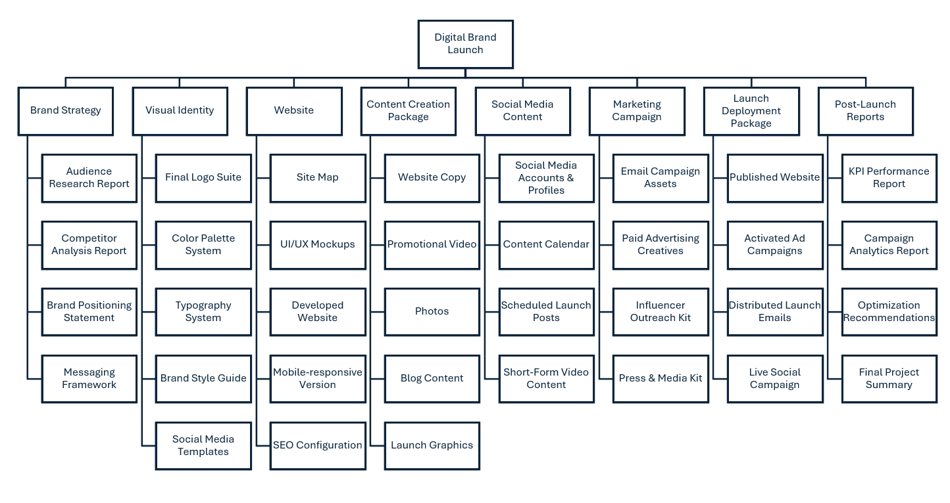
As shown above, a WBS breaks down all these complex activities into smaller, more manageable components or subtasks. You can have one group responsible for the Brand Strategy. Within this group, you might have one team focused on the Audience Research Report, Competitor Analysis, and so on.
You’ll notice that the WBS doesn’t describe any actions. Instead, every item is a noun describing an end product. This is one of the fundamental features of a WBS: it describes deliverables, not the activities necessary to get there.
What are the Characteristics of the Work Breakdown Structure?
Not every breakdown of project deliverables can be classified as a WBS. For it to be called a work breakdown structure, it must have certain characteristics:
- Hierarchy: The WBS is hierarchical in nature. Each “child” level has a strict hierarchical relationship with the parent level. The sum of all the child elements should give you the parent element.
- 100% rule: Every level of decomposition must make up 100% of the parent level. It should also have at least two child elements.
- Mutually exclusive: All elements at a particular level in a WBS must be mutually exclusive. There must be no overlap in either their deliverables or their work. This is meant to reduce miscommunication and duplicate work.
- Outcome-focused: The WBS must focus on the result of work, i.e., deliverables, rather than the activities necessary to get there. Every element should be described via nouns, not verbs. This is a big source of confusion for beginners in WBS.
Here’s an example of a bicycle construction broken down into three levels:
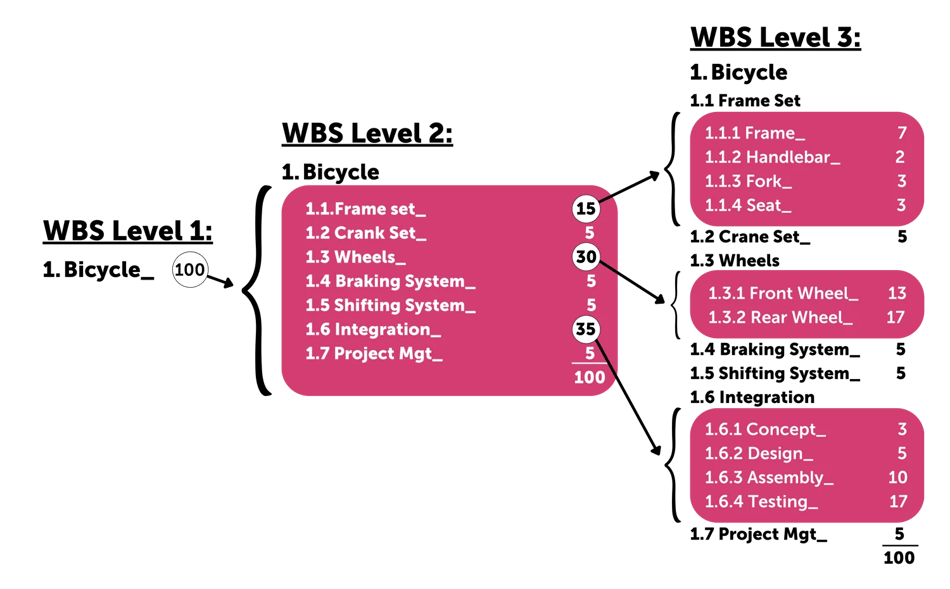
The numbers next to each item indicate the number of hours or resources required to complete the work. The sum of all these must be 100 at each level. This is the “100% rule” in action - the sum of the work at each “child” level must be 100% of the work at the “parent” level.
It’s common to have three levels of decomposition in the WBS. You might have a fourth and even a fifth level in case of extremely complex projects. For most projects, however, three levels will suffice.
Why Creative Teams Need a Work Breakdown Structure
Creative projects fail more often due to poor planning than poor execution. Agencies consistently underestimate hours, miss scope elements, or can't track where budgets are going wrong until it's too late to recover.
Without structured work decomposition, you're estimating projects based on gut feel rather than detailed analysis of required deliverables, which is why so many agency projects end up 20-30% over budget.
The WBS is a laser-focused breakdown of all the key deliverables needed to make the project successful. Creating one offers several advantages, such as:
- Project Schedule and Cost Basis: The WBS is the foundation of the project schedule and cost estimation. Once you know all the deliverables required to complete the project and their hierarchical relationships, it will be much easier to assign resources and set deadlines.
- Clear Accountability: Since all elements in a WBS are mutually exclusive, it helps create accountability. A team assigned to a single work package is wholly accountable for its completion, reducing overlaps in responsibility.
- Commitment: The WBS gives teams a very high-level overview of their responsibilities. Since each team is responsible for a specific component at a time, it helps make them more committed to completing their assigned tasks.
- Reduced Ambiguities: The process of developing the WBS involves the project manager, project team, and all relevant stakeholders. This encourages dialogue and helps everyone involved flesh out their responsibilities. Thus, everyone has less ambiguity and a better idea of what they're supposed to do.
- Avoid Scope Creep: Your WBS clearly defines what needs to be delivered upon project closure. Throughout project execution, stakeholders could propose changes that could potentially derail your project timeline and jeopardize resource management. But with documented deliverables and sub-deliverables, the project team members would be able to negotiate more effectively.
Creative work involves iteration and feedback loops that make planning harder than traditional project management, but that's exactly why WBS matters: by decomposing deliverables properly, you build in time for revisions at each work package level instead of discovering too late that client feedback consumed your buffer.
Types of Work Breakdown Structures
While the principles are the same, WBS users should be aware that different industries and different projects will require different applications of Work Breakdown Structures - i.e., different types of WBS.
Deliverable-Based WBS
The most common type of Work Breakdown Structure remains the Deliverable-Based WBS. Deliverable-based WBS organizes work around the outputs you'll create. For our digital brand launch example, top-level elements are the Brand Strategy & Plan, Visual Identity, Website & Digital Assets, Social Media Content, Marketing Campaign, Launch Event, and Post-Launch Optimization Plan. Each then breaks down into the specific deliverables needed to complete that output.
For creative agencies, deliverable-oriented WBS is typically more effective because it clearly shows what you're producing for the client and maps directly to billing and invoicing—you can price by deliverable rather than by vague phase.
However, Phase-based WBS structures make sense for projects with distinct stages where different teams take over.
Phase-Based WBS
Phase-oriented WBS structures work around project lifecycle stages. To demonstrate, here is the Phase-Based version of our Digital Brand Launch WBS, where project stages are customized:
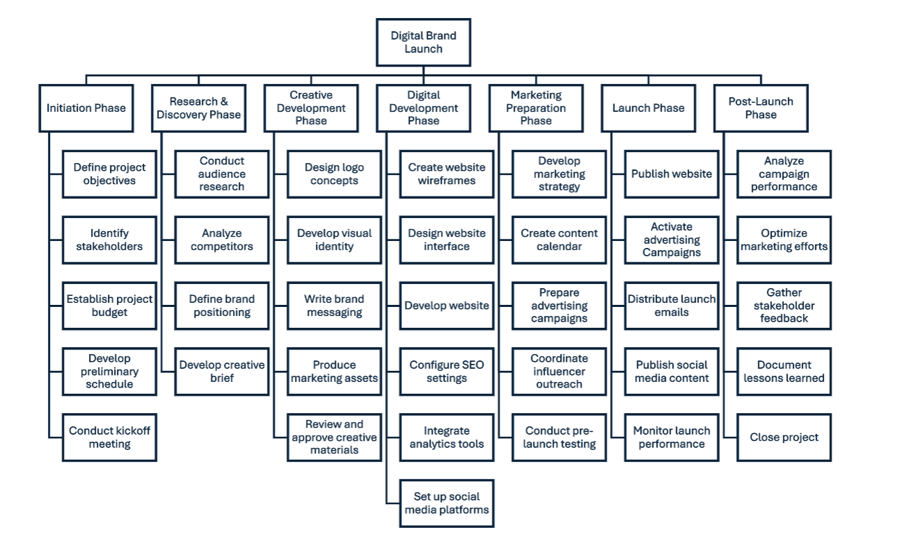
This approach works better for creative projects that follow a linear process, but it can create overlap issues where the same deliverable appears in multiple phases.
Organizing your WBS by phase could be beneficial for bigger projects. For example, Event Production projects might benefit from phases like Planning, Vendor Coordination, Promotion, Setup, Event Execution, and Breakdown & Review.
Hybrid WBS
Many creative teams end up using a hybrid: top-level structure organized by deliverables, with work packages underneath following a phase progression that reflects their actual workflow. The key is choosing a structure that matches how you actually track progress and bill clients.
Other
There are additional subtypes of WBS (such as noun-oriented, verb-oriented, and time-phased); however, the vast majority fall into deliverable-based or phase-based types.
How to Create a Work Breakdown Structure (Step-by-Step)
1. Understand the Project’s Scope
Before you can create a WBS, you need a thorough understanding of the project’s scope and objectives. You’ll want to refer to your project charter to develop the scope statement and scope management plan.
2. Determine Major Deliverables
Once you understand the project scope, start the WBS development process by determining the key deliverables. There are two heuristics you can follow for determining major deliverables at the 2nd level:
- Each deliverable must be essential to the project's success
- Each deliverable should be the responsibility of an independent team
3. Determine Work Packages
As you learned above, a work package is a deliverable at the lowest WBS level of a WBS. So in a typical 3-level WBS, determining work packages is one of the most important parts of the WBS development process, and it will require extensive input from your project team and stakeholders.
You aim to pick a major deliverable and identify all the work necessary to complete it. These work packages must be:
- Independent: The work package must be mutually exclusive and not depend on other ongoing elements.
- Definable: The work package should have a definite beginning and end and should be understood by all project participants.
- Estimable: You should be able to estimate the work package's duration and resource requirements.
- Manageable: The package must represent a "meaningful unit of work," i.e., it must accomplish something concrete and can be assigned to an individual or team. It should also be measurable.
- Integratable: The package must integrate with other elements to create the parent level.
- Adaptable: Ideally, the package can accommodate changes in scope according to the project's requirements.
If the work can’t meet the above requirements, you can decompose the WBS into another level.
There are a few heuristics you can follow for determining work packages:
- 8/80 rule: A common rule of thumb is that each work package must be no longer than 80 hours and no less than 8 hours in total length. If it is longer, decompose it further. If it is shorter, think of going up by one level.
- Reporting period: Another common rule is to limit each work package to a single reporting period. If it takes longer than one reporting period (monthly, weekly, etc.) to accomplish, decompose it further.
4. Create a WBS Dictionary
The WBS dictionary outlines the definition and scope of WBS elements. It is a supporting document meant to help incoming project teams better understand each work package.
You don't necessarily need a WBS dictionary, especially if the project is simple or has a limited scope. However, the dictionary can greatly improve clarity for complex projects with a lot of churn.
Here are a few details you can include for each item in the WBS dictionary:
- Work package ID (see the ID convention below)
- Work package name
- Work package description
- Assigned to (individual or team name)
- Department
- Date of assignment
- Due date
- Estimated cost
The level of detail you want to include is entirely up to you.
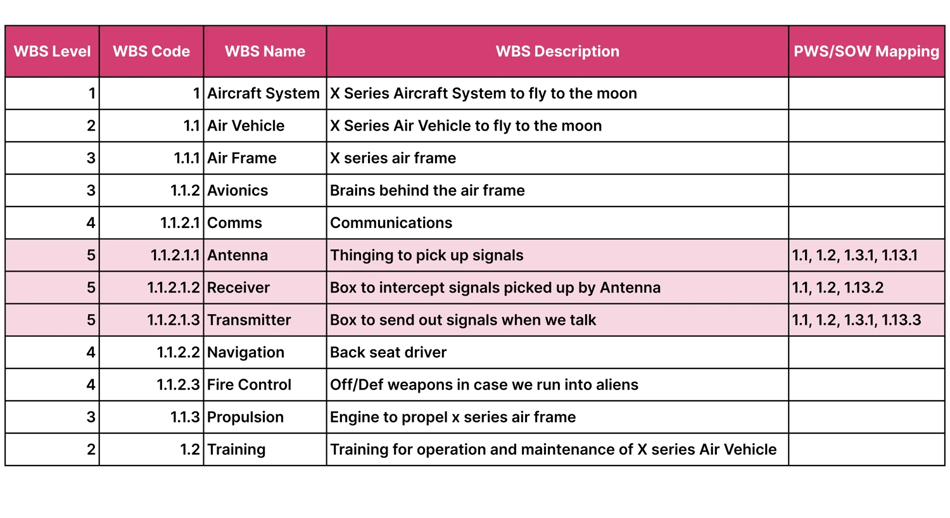
Here’s a more simplified WBS dictionary example with element ID, name, and description:
5. Use the Right WBS Format
Once you have all the work packages and the WBS dictionary, it’s time to create the WBS.
There are several WBS formats you can follow. The simplest way to do this is to create text-based hierarchical groupings. By convention, you use numbers and decimal points to indicate the level of the element.
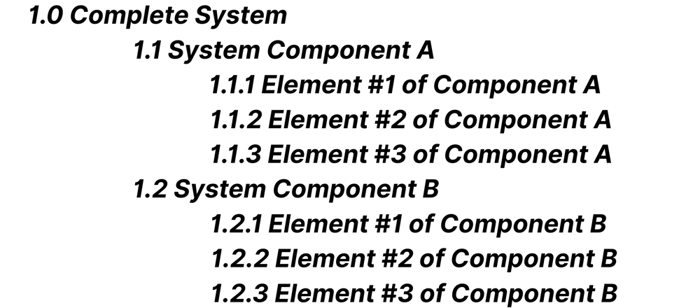
Alternatively, you might use a more visual tabular structure, as in our previous examples.
Once you’ve made the work breakdown structure, share it with your team. Use it to get a high-level overview of the project’s progress.
Work Breakdown Structure Template
While creating a work breakdown structure is technically easy (it’s just a flowchart or an Excel sheet), it can be time-consuming.
This is why we created this work breakdown structure template to help you get started.
This template contains both a tree view and a tabular view. Use either as you see fit.
In the next and final section, I’ll share some best practices for getting the most out of your work breakdown structure.
Work Breakdown Structure Best Practices for Creative Projects
Following a few best practices in the WBS creation phase can greatly improve the accuracy of your project schedule. Here are some you should follow when creating a work breakdown structure:
1. Use Nouns, Not Verbs
As said earlier, the purpose of a WBS is to track deliverables, not activities. The "what" of the work matters, not the "how" of getting there.
One way to achieve this goal is to use nouns when adding elements to the WBS. Every element in the WBS should be either a noun or an adjective.
For example: "House foundation" instead of "Removing earth to create the foundation", or "Communication plan document" instead of "Gathering requirements for communication plan".
2. Follow the 100% Rule Closely
A work breakdown structure is meant to be exhaustive. There should be no deliverables outside of the WBS. This is why you must follow the 100% rule. Every level should be everything you need to deliver. Anything beyond that should be scrapped. This helps you spot gaps and redundancies. It also ensures that every project component is complete and nothing is left behind.
In contrast, to create the social media content, you first need the photos you’ll use. In such a case, combining them into a single work package would be better.
3. Mind the Level of Detail
A common mistake when creating work breakdown structures is to keep the level of detail either too broad (i.e., too few levels) or too narrow (i.e., too many levels). Like Goldilocks, there is a level of detail that's "just right".
Ideally, your decomposition should stop before you can use verbs to describe the element. If this happens, you know you've got too many levels.
Aim for 3-5 levels. Any further than that, and you'll likely have a project that's too complex (and might be better as a program).
4. Use a Project Management Software
Using a template is a quick and efficient way to create a WBS project. But if you want the WBS to integrate with the rest of your project documents, the best source of templates is your project management software.
Most project management tools, such as Workamajig, will have built-in capabilities to create a work breakdown structure from scratch. You can simply specify your level of detail and add element data to create a WBS quickly.
The best part about using a PM tool is that your WBS data is available to you when you’re creating your project schedule.
Compare the best creative project management software here.
5. Engage Stakeholders
Though it’s you and your company who will be working on the project, including stakeholders in creating a WBS, it can give you valuable insight as to the best way of breaking down deliverables. It’s also a great way to ascertain that you are on the same page as stakeholders in regard to what exactly the deliverables will be.
6. Align WBS with Project Schedule
Another important document in project planning is the project schedule. When creating your WBS, ensure that the deliverables and milestones listed within it mirror those in your project schedule to avoid confusion.
Work Breakdown Structure vs Project Schedule vs Project Plan
A common source of confusion for beginners is the difference between the work breakdown structure, project schedule, and project plan.
While these three often describe the same thing—what is to be achieved in the project—they vary greatly in scope and details.
|
Project Management Document |
Primary Focus |
Describes |
Includes |
Does NOT Primarily Include |
Main Purpose |
|
Work Breakdown Structure (WBS) |
Project scope and deliverables |
The "what": Deliverables needed to complete the project |
Major deliverables, sub-deliverables, work packages, hierarchical decomposition of work |
Timelines, schedules, resource assignments, budgets |
Gives the project team a clear and focused understanding of what must be produced |
|
Project Schedule |
Timing and sequencing of work |
The “what,” “when,” and “who” of the project |
Tasks, durations, deadlines, dependencies, milestones, assigned resources |
Detailed management strategies or governance plans |
Organizes and tracks when project work will occur and who is responsible |
|
Project Plan |
Overall project management approach |
How the project will be executed, managed, monitored, and controlled |
Scope management, schedule management, communications, risk management, change management, budgeting, governance, quality plans |
Detailed task decomposition alone |
Serves as the comprehensive guide for managing the entire project lifecycle |
Work breakdown structure describes the deliverables needed to complete the project, i.e., the “what” of the project. It doesn’t include timelines or resources. The goal of the WBS is to give the project team a hyper-focused idea of what they need to achieve.
The project schedule describes the project’s deliverables, deadlines, and resource requirements. Think of it as the “what,” “when,” and “who” of the project.
The project plan is an expansive document covering virtually every aspect of the project and its management. It includes details on how the project will be executed, managed, and controlled. It usually has several constituent plans governing communications, risk management, change management, etc.
In terms of the level of detail, you can think of the project plan as the broadest, followed by the project schedule, and finally, the work breakdown structure.
How Can I Align the Work Breakdown Structure with Project Milestones?
Where does the WBS fit within the project management framework?
To avoid confusion and make your WBS effective, it’s important to ensure that it aligns seamlessly with your project milestones plan, amongst other documents.
The WBS structure springs from the project charter. Ideally, the high-level deliverables in the WBS should match, word for word, the goals and deliverables listed in the project scope statement.
Consequently, the WBS is one of the first documents you create in the project management lifecycle. You’ll create it before you create the Gantt chart or the project plan.
This means that the WBS is often the first deliverable in a project.
While the stated benefit of a WBS is in helping you keep track of deliverables and manage project scope, it has another key use in project management: creating the project schedule.
As this PMI conference paper points out, understanding the deliverables included in a WBS and mapping their relationships is crucial for charting a project schedule. In this process, you first create a WBS dictionary (i.e., a list of deliverables), turn these deliverables into a map of relationships (i.e., a network diagram), and use it to create the schedule.
You can also use the map of deliverables (and the relationships between them) in a WBS to determine the resources to be used in creating them. This is called a Resource Breakdown Structure (RBS).
A resource breakdown structure consists of the material and human resources required to complete a deliverable. For example, if you’re creating a chair as part of a larger house remodeling project, you’ll need:
- A carpenter
- Raw materials such as wood, polish, nails, glue, etc.
- Tools such as hammers, saws, drills, etc.
You can represent these resources as follows:
Once you understand how resources will be used to create each deliverable, you can also improve your project scheduling—one of the many ways a work breakdown structure is useful in project management.
Using Workamajig to Build and Manage Your Work Breakdown Structure
As indicated, creating a WBS can be a relatively straightforward process; however, as a project increases in complexity and size - or requires significant changes mid-delivery - it’s important to have a robust tool that can be as flexible and intuitive as you.
As a tool designed for creative and agency project management, Workamajig’s Work Breakdown Structure features help users plan their projects, visualize interconnected tasks, and quickly adapt to changes, delays, and roadblocks.
Thanks to easy-to-read dashboards and project views, it’s simple to view time tracking, access files, search conversations, and update schedules - providing a clear picture of where you may need to make alterations to your WBS or where certain deliverables are in conflict or off-schedule.
With an intuitive interface and powerful features, you'll be able to streamline your workflow and get your projects done on time and on budget.
Schedule a free demo to learn how Workamajig can support your Project Management plans.