

When comparing Kanban vs Agile, first know that they can work together to great effect!
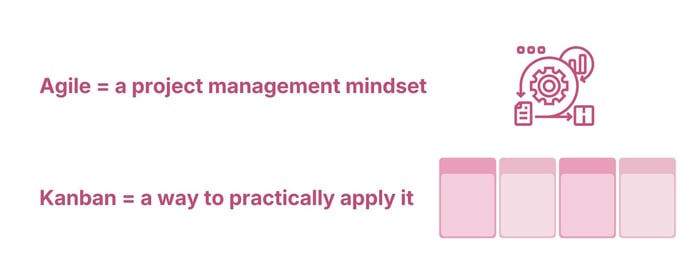
The key difference is that Agile is the broader project management mindset, and Kanban is a way to practically (and visually) apply it.
As they both focus on efficient flow and frequent feedback changes, the combination of Agile and Kanban is seen across many industries, particularly in agencies where an adaptive workflow is so crucial.
In fact, 87% of Kanban teams praise the use of it within Agile for providing a more effective approach than their previous methods.
In this guide, we’ll explain Kanban vs Agile, and show how and when you can use them together effectively:
Key Takeaways:
- Agile and Kanban are not competing concepts (however, both can be used separately).
- Agile is a project management methodology for iterative, flexible project management.
- Kanban is a workflow method and visualization tool that can be used within agile.
- Using Kanban in agile is ideal when you need a continuous workflow, with frequent reprioritization, and a clear visualization.
What Is The Difference Between Agile And Kanban?
When understanding Kanban vs Agile, the key differences are that:
- Agile is a project management philosophy
- Kanban is a specific visual framework that you can use within Agile.
- The two don’t compete with one another.
Although Kanban is an agile approach, the two can be used independently.
Agile is often used without Kanban, especially given that other alternatives like Scrum are available. Kanban works independently, especially in areas like support requests, maintenance, and ticketing systems.
But, because they fit so perfectly together, Kanban is used by project managers to optimize the flow of work within Agile.
Just as Agile breaks down projects into smaller deliverables, Kanban uses units of progress (via Kanban cards).
|
|
Kanban |
Agile |
|
Origin |
|
|
|
Key Philosophy |
|
|
|
Roles |
|
|
|
Progress Tracking |
|
|
What Is Agile?
Agile methodology is a mindset and set of values for iterative, flexible project management.
It enables fast-paced changes, collaboration, and strong adaptability to customer feedback. Projects are broken down into smaller deliverables, and changes are expected after every retrospective.
To achieve these qualities, project managers can follow these four core values:
- Focus on individuals: Human contributions and collaboration are valued over processes and tools.
- Providing working deliverables: Drafts and mock-ups are valued over documentation.
- Open to client collaboration: Client input and feedback are valued to meet their needs, instead of negotiations.
- Flexible response: A welcoming approach to change requirements is required, even late in the project.
How is Agile Used?
Agile is used by breaking projects into small, iterative cycles. Work is then delivered frequently, with adaptations made based on feedback.
This approach makes it valuable for projects that benefit from feedback early on.
For example, by delivering software early and welcoming changing requirements, a software team could improve its product continuously (rather than in a panic at the end).
Agile workflow is all aided by the use of frameworks like Scrum (with structured sprints and roles) or Kanban (and its continuous flow and helpful visual Kanban boards).
What Is Kanban?
Kanban is a workflow method that can be used within the Agile methodology.
It’s used to visualize workflow, focusing on a continuous flow of tasks that result in continuous improvement and reduced bottlenecks.
It was developed by the Japanese car manufacturer Toyota back in the 1940s to reduce waste and improve manufacturing efficiency.
How Is Kanban Used?
As Kanban is a visual approach to Agile, it’s used via ‘Kanban boards’.
Kanban boards feature columns that separate stages of workflow, such as ‘To-Do’, ‘In Progress’, and ‘Complete’.
‘Kanban cards’, which represent tasks, then move through the stages, giving a clear overview of where tasks are, and how many other tasks are currently in that stage.
Importantly, Kanban uses ‘work-in-progress (WIP) limits’. These are rules that you can set to prevent bottlenecks and overwork your team.
As a result, Kanban brings extra focus, reduced multitasking, and a more efficient workflow.
Kanban vs Agile: When Should I Use Them Together?
Many people make the mistake of thinking Kanban competes with Agile and can’t be used together. That’s wrong.
The real question should be, "Does Kanban fit within our Agile approach?”
The main reasons organizations use Kanban within agile are:
- 78%: To improve visibility of workflows and dependencies
- 56%: For continuous improvement
- 44%: To increase delivery speed and throughput
- 42%: To improve lead time and cycle time
- 40%: To improve responsiveness to business needs
If you can say yes to these questions, then using Kanban with your Agile team is a solid idea:
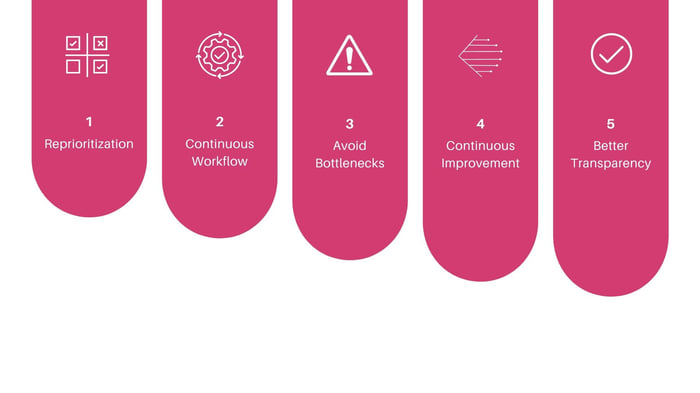
1. Do Your Priorities Frequently Change?
If your priorities are often in flux, Kanban lets you prioritize tasks and stages at any time with minimal disruption.
Your team will be able to pull new work from the product backlog without the need to wait for the next sprint.
2. Is Your Work Continuous?
The Kanban method is ideal for a continuous flow of tasks, as work items will constantly move along the conveyor belt of progress.
This makes it ideal for tasks like support tickets, operations, infrastructure, and content production.
3. Do You Suffer from Bottlenecks?
Kanban within Agile allows you to set WIP limits so you can limit the amount of work your team members can take on at any one time.
Plus, the visual aspect makes identifying bottlenecks extremely easy.
4. Do you want continuous improvement?
Using the Kanban system within agile allows you to make continuous, minor changes. It’s a revolution, not an evolution. That’s all, thanks to the regular feedback loops that agile promotes and the fluid nature of Kanban.
3. Do you want better transparency within your team?
Finally, if you want to make teamwork and an understanding of progress clearer within your team, then Kanban is a great tool for Agile.
Everyone will have a clear, visual cue on where tasks are, which aids self-organization and trust. This can be especially helpful for cross-functional teams.
Scenarios of When to Use Kanban in Agile:
The word “kanban” might sound familiar because many software teams have adopted it to manage their development workflows and projects (it’s also known as “lean development/delivery” or LDD).
Many product owners and agencies turn to it to improve flow, identify bottlenecks, limit work in progress, and focus on continuous delivery and development.
Some companies even use it to manage non-development tasks like marketing campaigns or HR activities like hiring new employees!
Here are some common examples where using Kanban in Agile makes sense:
Client Support
Kanban is very useful for agencies that are handling a steady stream of tasks that can’t be planned.
For example, a web agency can use it to handle the constant stream of bug fixes, updates, and site adjustments they receive from their clients.
As these requests may come at varying rates, this allows you to understand the throughput rate and avoid overloading the team with too much at once!
Content Production
Any agency that produces content will know that you’ve got to move through stages. Whether it’s blogs, social content, newsletters, or videos, you almost always need an idea, a draft, an edit, and approval.
Kanban works well in these scenarios because it makes the current stage of each piece of content clearly visible. So, you don’t get lost or stuck in a bottleneck.
Marketing Campaigns
Marketing agencies often juggle multiple deliverables at once. Tasks and projects get pushed back and forth at an exhausting rate.
That is, until you use Kanban’s clearer and more adaptable approach.
If a client messages that a part of the marketing project needs a revision, you can update the board without waiting for another sprint cycle.
Creative Product Development
Whether you work in video, graphic design, or are a member of a software development team, you’ll know that feedback is critical.
You could wait until you’ve finished your deliverable for feedback. But then you’re going to have to undo a lot of work if it’s not right.
If you’re tired of that, then you can use Kanban to incorporate feedback checkpoints into your workflow, giving your team a simple way to track where each asset is in the pipeline.
Smaller Agencies
Smaller agencies often prefer to avoid sprint planning, formal ceremonies, and defined roles. If that sounds like your team, you can use Kanban within Agile to gain a flexible structure that prevents going over capacity.
Frequently Asked Questions
Is Kanban Agile or Lean?
Kanban can be both Lean and Agile. But it’s most often treated as an Agile framework.
Lean project management is about minimizing waste to optimize efficiency. It applies manufacturing concepts to project management to do this. Similarly, Kanban maximizes efficiency by ensuring that work in progress is managed and a continuous workflow is maintained.
Agile project management is about breaking down projects into smaller deliverables. This practice must be done in Kanban to represent the tasks in Kanban cards, which makes Kanban in Agile a viable tool.
Is Kanban Agile?
Kanban is a tool that can be used within Agile methodology to visualize progress.
However, it can also be used outside of Agile and does not require that you follow the agile manifesto for it to work.
What is the difference between agile and kanban in simple terms?
Agile is a flexible approach to project management. It’s the mindset. Kanban is a visual tool for managing tasks, focusing on workflow, and is used within the Agile mindset.
Scrum vs Kanban: Which is best for agile?
The choice between being a Scrum team and a Kanban team within Agile comes down to your goals.
Kanban focuses on continuous flow, frequent reprioritization, and a clear visualization of your workflow.
The Scrum framework may be a better option for agile when you want predictability and planned, sprint-based team delivery. Unlike Kanban, Scrum uses a time-boxed approach.
If you want the benefits of both, you can use a hybrid ‘Scrumban’ approach.
What are WIP Limits?
Work-in-progress limits (WIP limits) are rules that you can set at stages within Kanban to limit the number of tasks that your team can take on at any one time. This can prevent bottlenecks and overcapacity, helping to improve focus and productivity.
How Workamajig Makes Using Kanban and Agile Extra Effective
Workamajig is a project management software that transforms projects and profits.
Designed for agencies and remote management, it makes using Kanban in Agile easy and extra effective. Here’s how:
Tracking with Integrated Data
Workamajig is an all-in-one project management software, so every piece of data from your budget and timelines to resources and labor hours is integrated.
That means you can track progress on bugs, features, tickets, and task status all in real time - making Kanban’s functionality more effective than ever before.
Organize with Visual Tools
Workamajig is packed with visual tools and templates, from Kanban and Scrum boards to process flows and Gantt charts (all with the opportunity for deep customization).
This flexible approach means you can quickly see your progress and workflow from different perspectives, with the click of a button.
Report in Real-Time
With Workamajig, there’s no need for you to manually design reports, Kanban boards, or dig through spreadsheets. It’s all produced for you, in real time, at the click of a button.
That makes stakeholder and client reporting on progress, blockers, and metrics easier than ever before.
Collaborate with Teams
Collaboration with Workamajig occurs all under one hood. Using comments, attachments, and notifications, you can share reports, update Kanban boards and task statuses, and share deliverables all within one place.
And this is true for all involved, as everyone can gain access to a Workamajig dashboard, from your team members and leadership to freelancers and customers.
It can even connect to external email servers, so you don’t need to move around.
If you’d like to learn more about how Workamajig can transform your project management, we welcome you to request a free demo with our team!
Summary:
Rather than comparing Kanban vs Agile, remember that they can work together to make your agile team’s workflow clearer, more efficient, and free from bottlenecks.
However, you must keep your Kanban boards up-to-date. This is best achieved with project management software, like Workamajig, which will also streamline the process.