

Creative project management software with built-in automatic invoicing offers several benefits:
-
It can track various project expenses and aggregate all billable items for invoices. (You should be able to choose your preferred billing method for each project — e.g., fixed fee, media, time & materials, or retainer.)
-
It streamlines invoicing by minimizing back-and-forths and ensuring accurate invoices. As a plus, some systems allow teams to send invoices directly to clients and collect payments online.
-
It saves all invoices so you can keep a clear, organized history, confirm payments, and report on project profitability.
-
It supports teams that deal in multiple currencies, with tools that automatically track currency conversions, connect foreign accounts, and facilitate transactions across currencies.
Many project management tools now offer an invoicing module; however, not all are designed for creative workflows, and invoicing features don’t all work in exactly the same way.
We compiled a list of popular creative project management software with invoicing features that offer all the conveniences mentioned above. Our list kicks off with our own solution, Workamajig, followed by nine additional options.
To learn more about Workamajig after reading, request a free demo with our team.
1. Workamajig
Comprehensive Project & Agency Management Software for Creatives & Marketers
Workamajig is an all-in-one solution with tools to manage all aspects of the creative workflow. Our toolkit combines and fully integrates both project management and agency management features. It includes:
- Project request forms and templates
- Project planning tools, such as features to build accurate estimates
- Real-time project monitoring with budget tracking
- Resource management
- Vendor management
- Collaboration tools (for project teams and clients)
- Client Portals
- GL accounting software
- Billing and invoicing
- Financial reporting
- Agency Insights
Workamajig is an agency management system that brings together all your people, processes, and data in one fully integrated system.
Instead of working across (and paying for) a project management system, staff scheduling tool, accounting software, CRM, time tracking app, and cloud storage drive separately, you get everything under one roof. This saves on redundant software costs, reducing admin work, and streamlining workflows.
All of our system’s modules communicate seamlessly in real-time — bringing together sales, project, resource, and financial data to offer real-time visibility across agency operations and allow your teams to work more strategically. Unifying this data empowers teams to:
-
Develop profitable project plans with confidence. Our automated estimating tool pulls in cost data from multiple sources (such as resource requirements, purchase orders, and vendor invoices) to help project managers build accurate project budgets.
-
Monitor budgets and timelines in real-time. Workamajig tracks actual labor hours and project-related expenses, so PMs can accurately monitor project burn. Our system automatically notifies managers about potential overruns so they can act quickly to correct course.
-
Track profitability on a deeper level. Beyond tracking agency-wide profitability, Workamajig’s various P&L reports help agencies evaluate which clients, projects, and service types are profitable — and which aren’t.
We offer guided, personalized onboarding for all agencies so we can configure Workamajig to specific requirements and show the ins and outs of the platform — how to kick off projects, manage staff, monitor invoices, track revenue, and measure profitability.
We’ll show you how our system works below, specifically reviewing our accounting system, invoicing feature, and project management suite.
But if you’d like a more in-depth walkthrough of Workamajig, please request a free demo.
You can also see how agencies using Workamajig have saved time, boosted profitability, reduced admin work, and simplified their tech stacks in the case studies below:
- How 2Fish Company reduced time spent on billing by 80%
- How Parallel Path benefits from tracking project budgets, labor, and costs with Workamajig
- How Ten Adams uses Workamajig to drive business insights & profitability
Workamajig Accounting System: Billing, Invoicing & Financial Reporting
When it comes to invoicing, Workamajig is especially convenient because it’s not just an “invoice builder.”
Our full accounting system facilitates the entire billing, invoicing, and payment process — with tools to support all types of agreements, streamline workflows, ensure accurate invoicing, and analyze financial performance.
Workamajig’s complete stack of accounting tools supports:
-
Multiple billing methods — including fixed-fee, time & materials, retainer, advanced, prebilling, work-in-progress (WIP), and media. You can specify the billing method for each project or client so it’s automatically applied during invoicing.
-
Partial invoicing — generate invoices (based on billing items, tasks, or services) as projects progress to keep cash flow steady and reduce risk.
-
Mass billing — generate batch invoices or create a single invoice for multiple projects.
-
Retainers — manage simple retainers by scheduling recurring invoices or collect upfront payments for hours-based retainers using Advanced Billing.
-
Multiple currencies — manage international clients and vendors by enabling foreign currency tracking that includes automatic exchange rate updates, and the ability to process transactions in different currencies.
-
Online payment collection — ensure you get paid on time by making the process simple for clients.
-
Vendor invoice management — store all invoices in one place, cross-check and reconcile invoices with work requests, and send payments.
-
Project-level expense tracking — our system automatically pulls in all project-related charges (such as labor and vendor costs) as you build project plans and as projects progress. It also links to credit card accounts, media buying tools, tax compliance solutions, and other systems to consolidate all project costs for invoicing and reporting.
-
All other accounting processes — including expense management and reimbursements. You can read about our accounting software’s complete feature set in this guide.
-
Global compliance requirements — including GAAP, GDPR, and HMRC.
|
Some of our integration partners include:
You can see the full list of integrations and extended features here. |
In the following sections, we’ll take you through the entire billing process in Workamjig and cover how these tools support various workflows. We cover:
-
Workamajig’s Today Billing Dashboard — a one-stop shop for managing all things related to billing.
-
How Workamajig supports the entire billing process — generating a billing worksheet, finalizing details to securing approvals, creating an invoice, sending it to clients, and accepting payments.
-
Managing vendor invoices — including generating and scheduling invoices, reconciliation, and making online payments.
-
Workamajig’s Financial Reporting suite — with robust out-of-the-box and custom reports for evaluating profitability, cash flow, and your agency’s overall financial health.
Today - Billing Dashboard
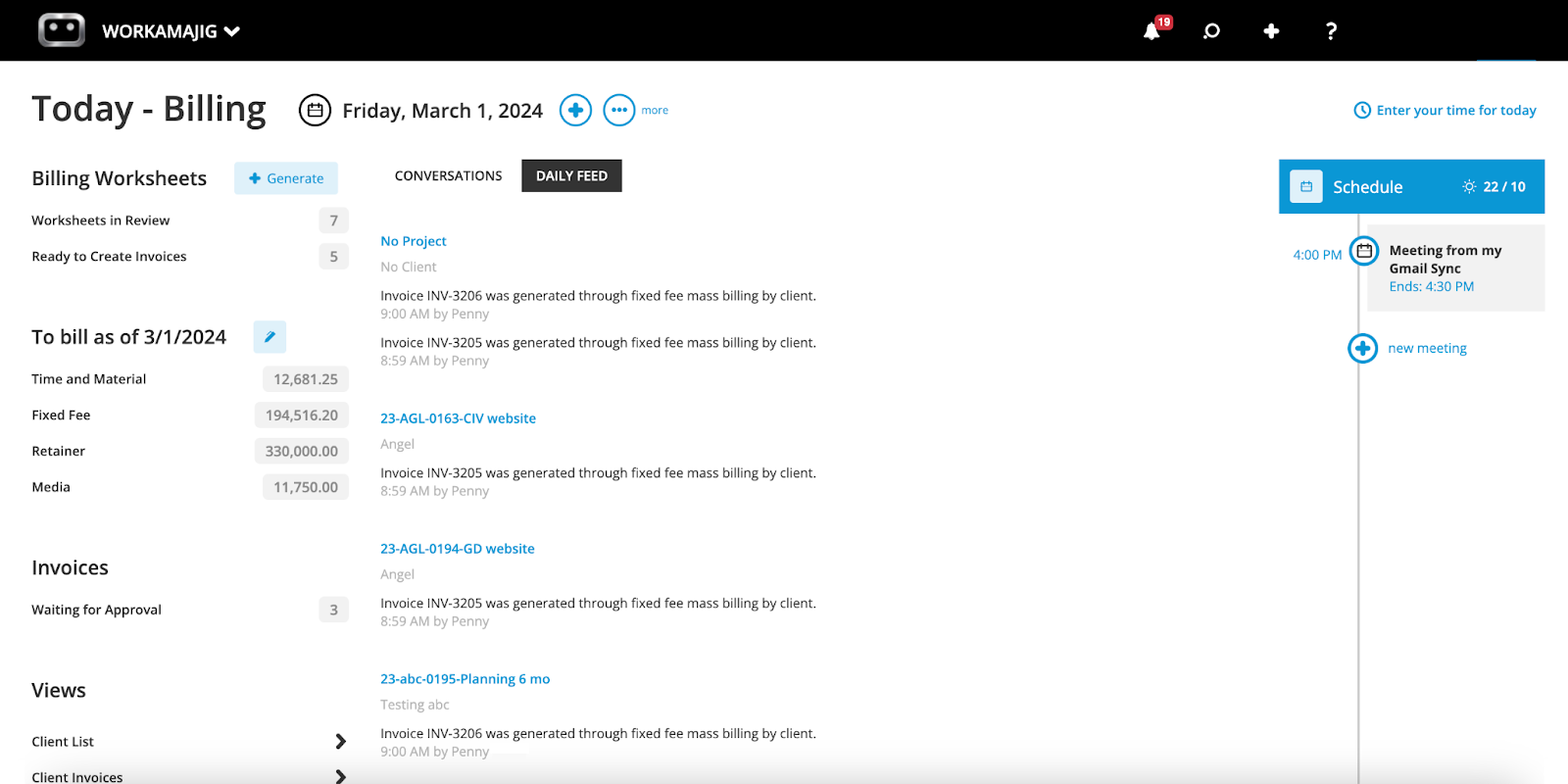
Workamajig’s Today - Billing Dashboard (shown in the screenshot above) provides a single, central view for managing all billing-related activities and tracking of pending tasks and recent conversations.
The left navigation keeps billing teams up-to-date with what’s available to bill, displaying:
-
Any billing worksheets out for review.
-
Any projects to be billed, sorted by their billing type — time & materials, retainer, media, and fixed-fee. Our system constantly monitors projects for billable items and pulls the information into your dashboard.
-
An overview of invoices and their status — so users can instantly see which invoices require attention and take actions to keep things moving.
Meanwhile, the “Views” section offers convenient access to all billing-related reports, so billing teams don’t have to hunt for them in different parts of the system.
Clicking any of the fields — such as client lists, invoices, transactions, or conversations — takes the user to dedicated listing screens that display all related information.
From here, they can easily handle pending tasks (such as transactions that require review and approval).
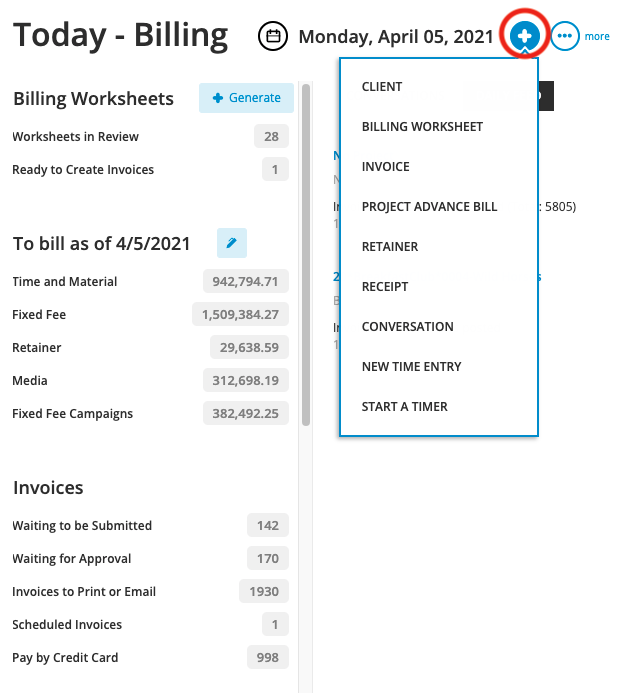
Then, clicking the ⊕ symbol (shown below) lets billing teams take quick actions without leaving the dashboard — such as storing a receipt, generating an invoice or billing worksheet, or submitting a new time entry.
Billing & Invoicing in Workamajig
While there isn’t a universal, industry-standard for billing, there are two typical billing workflows that we frequently see:
-
A billing user prints reports detailing the budget, transactions, and prior billing amounts, and reviews them with the account executive or project manager to decide what to bill for the current period.
-
A billing user generates an invoice and sends it to an account executive or project manager for review.
However, these workflows aren’t the most efficient because they typically involve lots of back-and-forths, adjustments, reprints, and deletions before the final client invoice is issued.
Although Workamajig can support most billing workflows (e.g., billing directly from projects), including the two discussed above, we recommend a more streamlined workflow centered on billing worksheets.
Most agencies that we work with follow this approach because it saves time and reduces headaches by allowing account executives or project managers to decide what gets billed before the invoice is created.
-
First, the billing team generates a worksheet for the cycle — either based on transactions or as a percentage of the project’s budget.
-
This worksheet — which outlines all of the project information along with transactions and prior billings — is routed to an AE or PM for review.
-
Then, they can make any necessary changes directly to these sheets — marking items up or down, transferring costs, or writing off items — before submitting the finalized worksheets for approval (our system automatically routes them back to the billing team).
Your billing team can access all these worksheets by navigating to the master worksheet on the Today - Billing Dashboard.
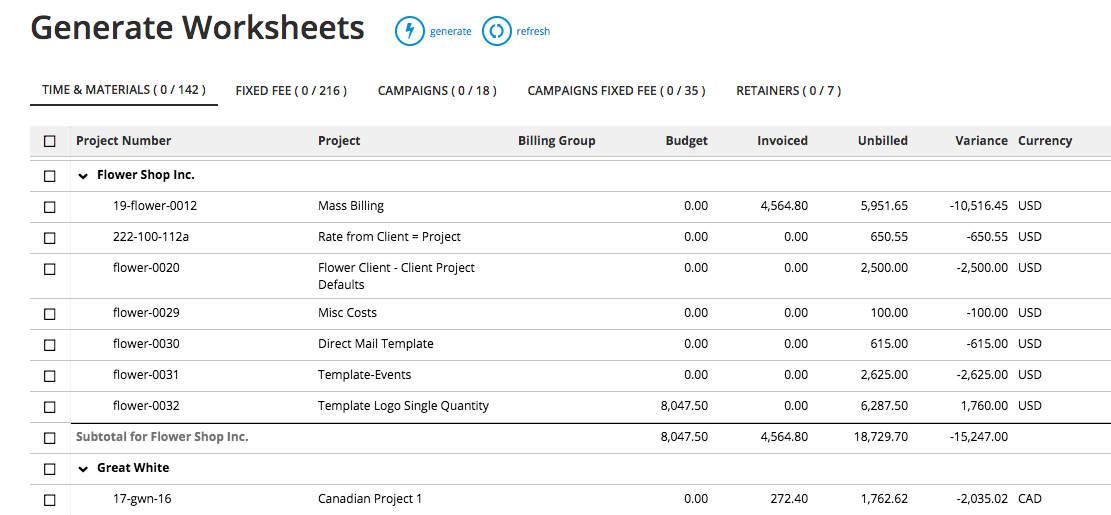
They can use our search filters and apply any other customizations:
-
Drill down into the billing details of a specific project or service.
-
Make any final tweaks, such as editing line items.
-
Select the billing worksheets to generate an invoice for. Workamajig also supports mass billing with a convenient “select all” button to save time.
After converting worksheets to invoices, billing teams can send them to clients.
Retainer Management — Advanced Billing & Retainers
Workamajig can support pretty much any type of retainer agreement, sometimes using different features that aren’t strictly labelled as “retainers.”
Retainers are one of those things everyone has their own definition of, so depending on how you define them, setting up the agreement in Workamajig might follow a different process.
While you can read extensively about using Workamajig for retainer management here, we’ve included a quick overview below of how our system manages the two most common types of agreements:
-
Simple retainers are a recurring billing method in which you bill a client a set amount for services you’ve agreed to provide (e.g., graphic design) over a specific period (e.g., per month). Workamajig’s “Retainer” billing method handles this by allowing you to invoice clients at regular intervals for a fixed amount (regardless of the number of hours worked or expenses incurred).
-
Hours-based retainers involve clients paying for a set number of hours (e.g., 100) over a defined period (e.g., per quarter). Workamajig’s Advanced Billing lets you collect payment upfront — charging for a portion of the hours in advance (e.g., 20, 30, or 50) — then bill the remaining hours after delivery.
Workamajig also lets you track retainer burn in real time. If you use up the agreed-upon hours before the retainer period is up, you’ll know to negotiate additional payment with the client.
Vendor Invoice Management
Workamajig’s accounting system saves billing teams hours of their time by streamlining reconciliation and providing simple tools for managing discrepancies.
Billing teams can add and attach copies of vendor invoices to our system and reconcile them with purchase orders, work orders, and receipts before sending them forward for payment processing.
When entering a vendor invoice, our system prompts users to specify which vendor it’s for. Then, Workamajig automatically retrieves any open purchase orders associated with them.
For example, let’s consider a specific print vendor. The billing team can view all the open purchase orders with this vendor across different projects:
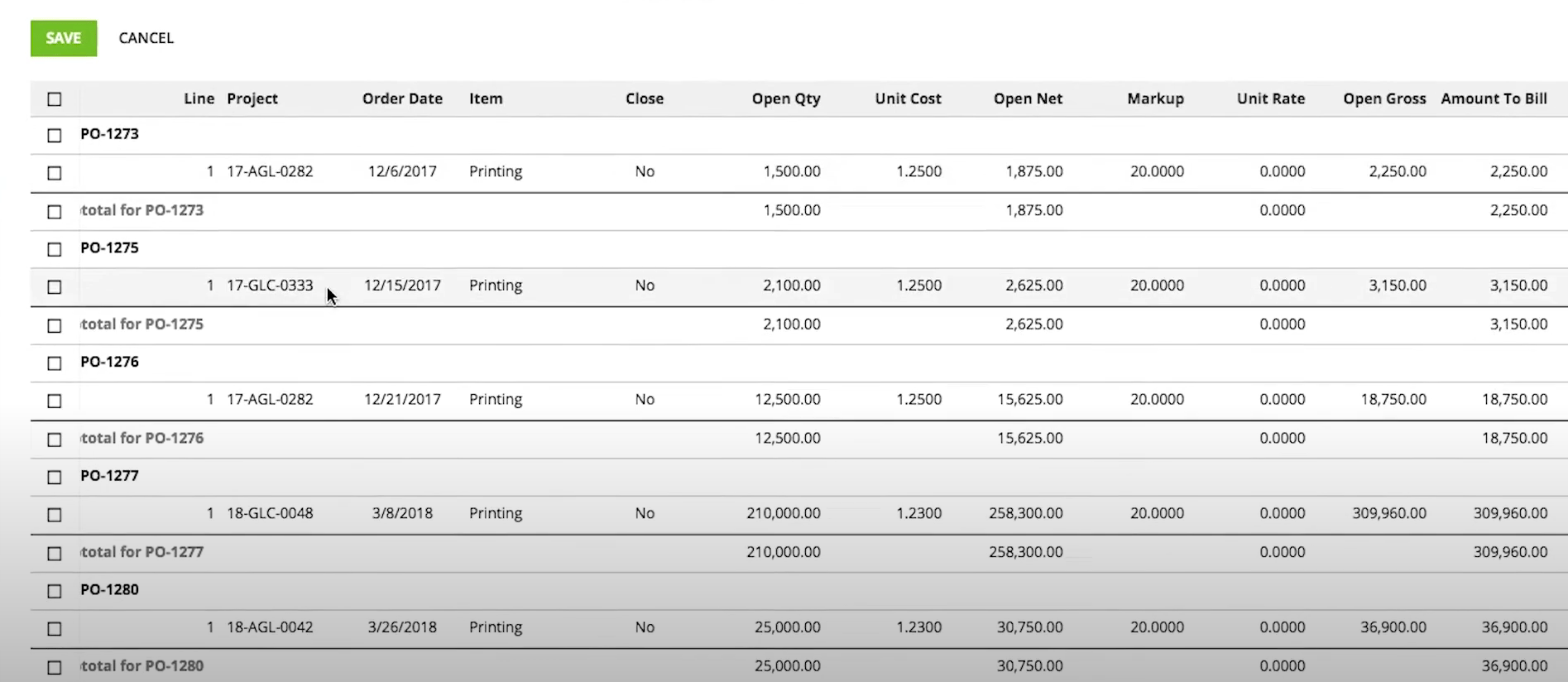
Then, they can attribute one or more POs to each invoice, and the changes automatically reflect in the project’s financials (i.e., its expenses, budget, and profitability).
From here, Workamajig helps users accurately close purchase orders and capture any additional billing opportunities when discrepancies arise. If the vendor invoice totals don’t match the purchase order, billing teams can:
-
Adjust the figures directly in our system to ensure an exact match and that the invoice reads correctly for payment.
-
Leave the purchase order open if the shortage or overage will be reflected in a later invoice.
-
Handle an overage by either: 1) allocating it to the billing portion of the project, ensuring it’s captured in client billing, or (2) writing it off so it isn’t passed along.
Once the invoices are finalized, users can conveniently send vendor payments via the integrations we mentioned above.
Since Workamajig tracks all vendor invoices and initial quotes, billing teams can also keep track of which vendors are reliable (and which aren’t) over time.
They can compare quotes and POs to final invoices and identify recurring discrepancies in their dealings with specific vendors. In such cases, it’s best to investigate the root cause to see if it’s time to reconsider the relationship.
Financial Reporting Suite
Workamajig also includes a powerful financial reporting suite that helps you track your agency’s financial performance and analyze profitability in greater depth.
Take our P&L reports, for example — whether by service, client, or project — they go beyond surface-level profitability to reveal where you’re earning the most and where you’re taking losses.
With that clarity, you can make data-driven decisions to boost your bottom line. That could mean assigning lower-cost resources to specific clients or rethinking services with thin profit margins.
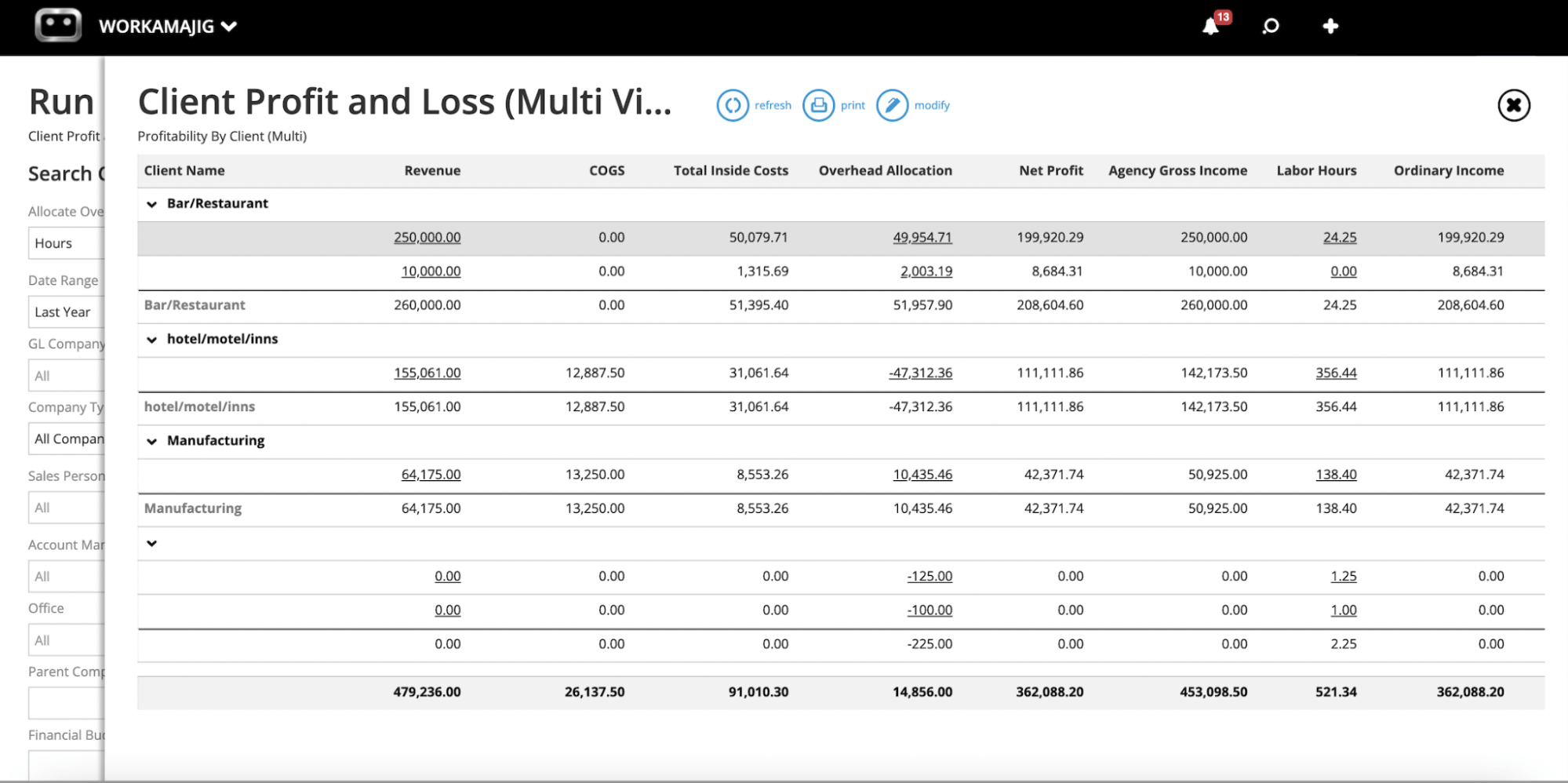
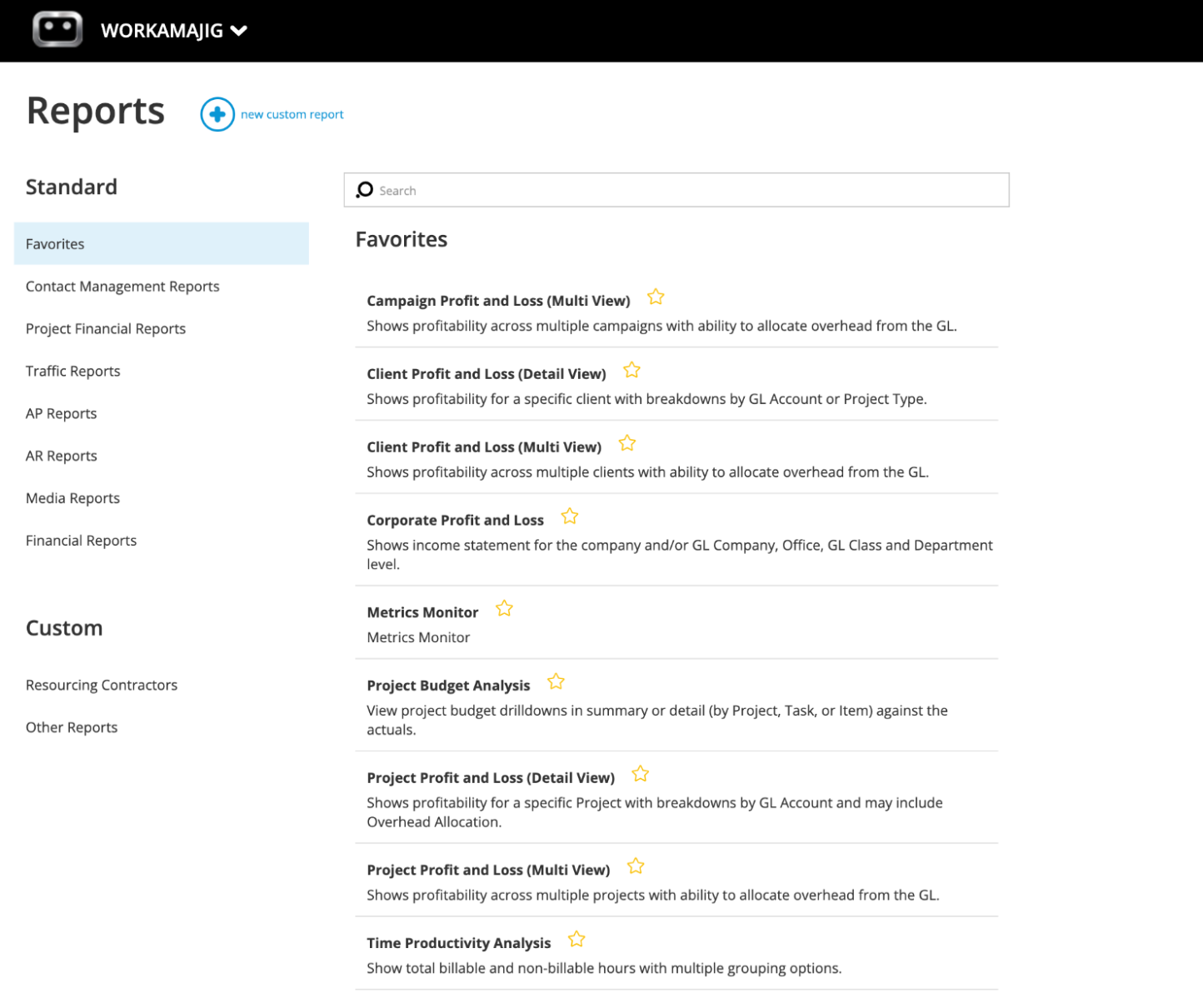
Our full reporting suite includes a range of out-of-the-box reports to meet your needs, and you can also design custom reports. Some of our most popular reports (alongside the P&Ls) are:
- General Ledger (GL) reports for complete financial oversight
- Cash projections and revenue forecasting so you can plan ahead with confidence
- Project budget drill-downs to see exactly where money is going on specific work
- Billable summary reports to compare billable vs. non-billable hours
- Hourly realization rates to help you evaluate productivity from a financial perspective
- Key metrics monitor to track the metrics that drive your business
You can save the reports that are most important to you and easily access them from your personalized dashboard.
Read more: Best Creative Project Management Tools with Financial Tracking
Our accounting software fully replaces standalone tools like QuickBooks, Xero, and NetSuite, so you don’t need to link an outside system to power any of the functionality or financial reports.
How Workamajig Supports the Full Creative Project Workflow
In the sections below, we’ll take you through our project management module and explain how our system tracks costs and billable hours for invoicing.
Managing Project Requests & New Opportunities
There are three primary ways to manage project intake in Workamajig.
The first option is to use project request forms. You design these with custom fields to collect details on project requests, then connect the forms to your site or share them via user portals.
Request forms are more popular for in-house creatives, but agencies often use them for existing clients — clients can submit work requests at any time, and managers can see all new requests in their dashboards.
Managers can review work request details, approve or deny work, and start building estimates. Custom forms streamline the initial back-and-forth so teams can quickly kick off new projects.
Workamajig also offers a native CRM to power new client intake.
Our CRM connects with your website contact form to automatically pull in new leads, so your sales team can review submissions and begin qualification. Then, they can convert promising leads to Opportunities — those will appear in our Kanban-style Opportunities Dashboard, where sales teams can work them through the funnel and track deal stages.
![Workamajig Sales Dashboard and Opps [GIF]](https://www.workamajig.com/hs-fs/hubfs/opportunities.jpg?width=1105&height=575&name=opportunities.jpg)
After winning Opportunities, sales teams can convert them into new projects. Our system automatically transfers all the details and attachments from these initial conversations so everyone on the project team understands the full scope.
Read more: Best Agency CRM Software: Reviews & How to Choose
Planning New Projects
To plan and schedule new projects, managers can use our flexible templates to streamline and standardize the process.
Managers can design templates for different project types and specify tasks, subtasks, dependencies, milestones, resources, time allotments, timelines, billing methods, budgets, and more. Managers only have to plug in a few details to get started on a new project, and the right team members are notified of their tasks and due dates.
In addition to templates, Workamajig offers various tools to finalize project details and build estimates, so managers can ensure they’re accounting for all project costs from the start.
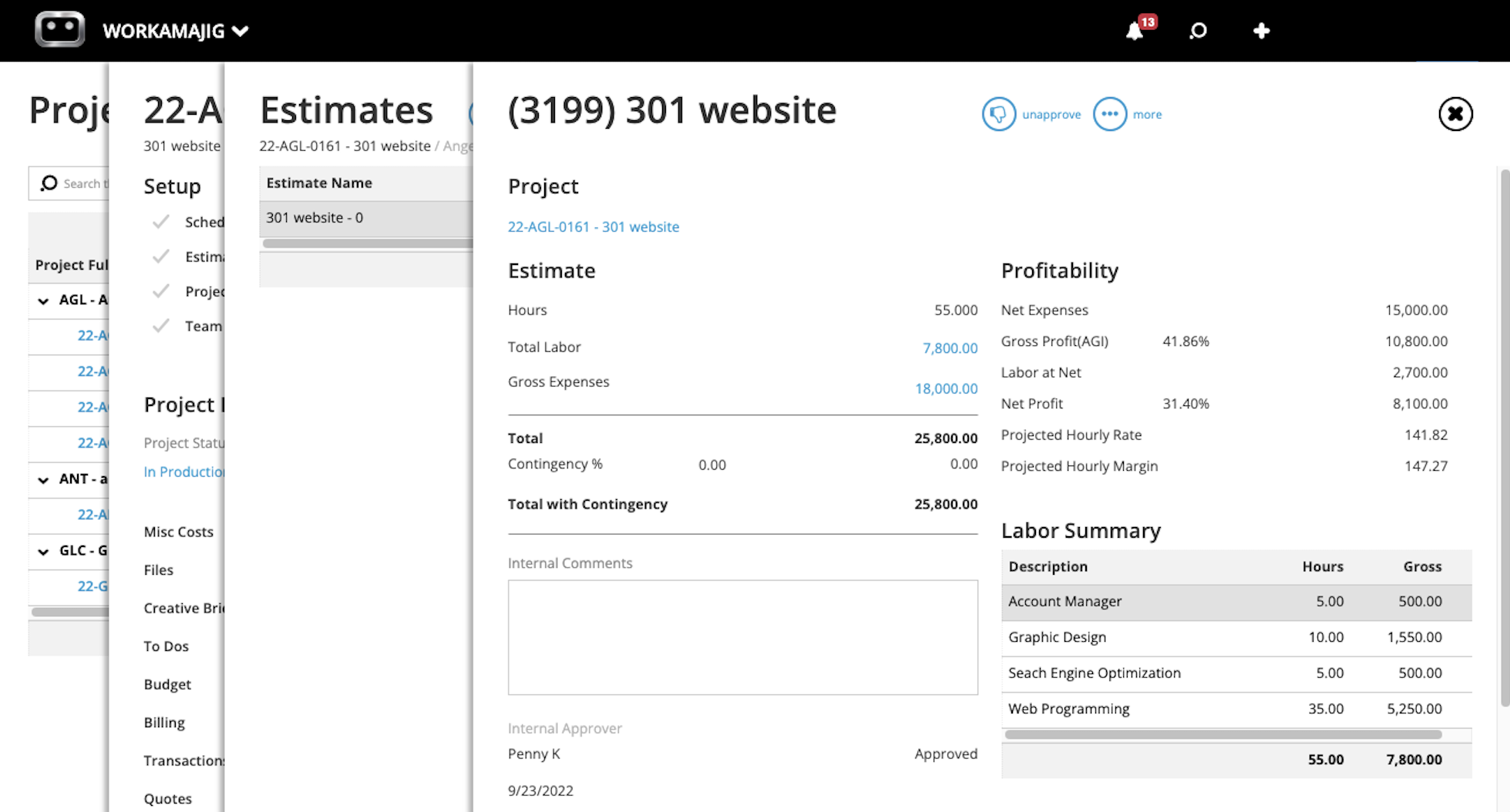
For starters, our task management tools let managers adjust project details before officially kicking them off. They can review and tweak things like time allotments, due dates, subtasks, and dependencies.
As they finalize plans, Workamajig’s automated estimating tool helps accurately set budgets by factoring in all relevant historical and current data — including labor costs, vendor costs, contingencies, and overhead.
![Workamajig Schedule Dashboard: Start at the project schedule, Allocate hours & set start dates for individual tasks & revisions [GIF]](https://www.workamajig.com/hs-fs/hubfs/Workamajig%20Schedule%20Dashboard%20%5BGIF%5D.gif?width=1725&height=852&name=Workamajig%20Schedule%20Dashboard%20%5BGIF%5D.gif)
When project plans are finalized, managers can use Workamajig’s native resource and vendor management tools to assign staff and freelancers to projects.
-
Resource management: Managers have all the information they need to make the best use of each person’s time and skills — they can view staff members and their current workloads, including total bandwidth and available hours. Our system even integrates with calendars, so managers can see when staff are available. Then, managers can assign staff to tasks.
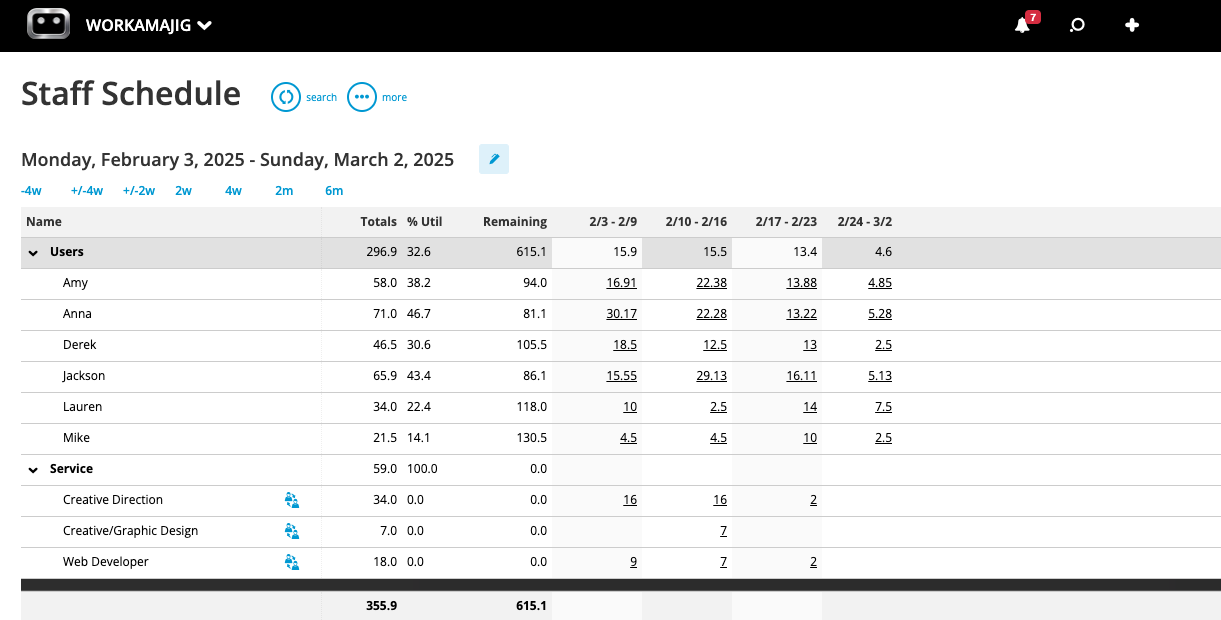
Scheduled and actual hours update in real time as work is assigned and time is logged. With hours tied to hourly costs and service rates, managers get instant visibility into costs as projects progress.
-
Vendor Management: Managers can outsource work by submitting quote requests, reviewing bids, assigning freelancers to tasks, and generating purchase orders. Our system supports unlimited vendor portals (at no extra cost) to manage relationships with freelancers and other third-party contractors like production vendors. Managers can also use these portals to track work, receive invoices, send payments, and keep a digital trail of all communications.
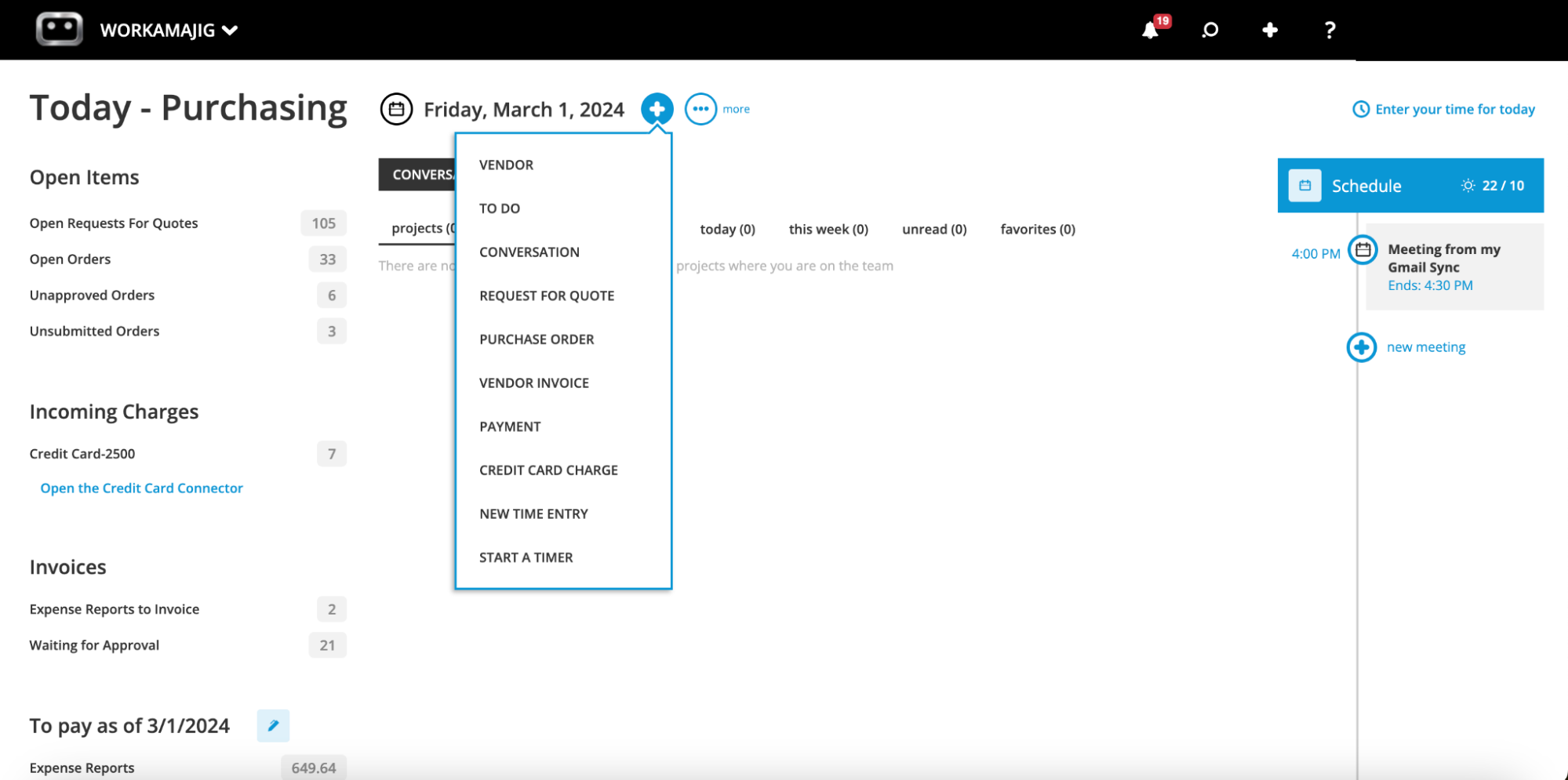
Native vendor management is not only convenient but crucial for teams that frequently collaborate with outside partners; it lets managers create a clear, comprehensive project plan, improve resource planning, and incorporate these costs into estimates so they don’t impact projected profitability.
Project Monitoring
Workamajig includes a Projects Dashboard with customizable Gantt charts to visualize project progress after kick-off. Our dashboard conveniently provides real-time status updates as project team members complete tasks and log their hours.
In the GIF below, you can see how each project and its timeline are laid out, with a black progress bar showing how far along each is.
The dashboard also provides project status breakdowns (next to the Gantt charts), including each project’s name, budget health, timeline adherence, status, allocated and actual hours, and % complete.
![Workamajig dashboard: Projects and Project Status [GIF]](https://www.workamajig.com/hs-fs/hubfs/Workamajig%20-%20Projects%20and%20Project%20Status%20%5BGIF%5D.gif?width=1714&height=853&name=Workamajig%20-%20Projects%20and%20Project%20Status%20%5BGIF%5D.gif)
Our dashboard even displays warnings and sends notifications about projects at risk of exceeding budgets or falling behind schedule. The Finance or Project Timeline columns highlight in yellow when projects are at risk, and then in red when they exceed planned budgets or timelines.
For example, the GIF above shows yellow warnings in the timeline columns for specific projects, and the “SF website” project is highlighted in red.
This intuitive view shows managers exactly which projects require attention, so they can proactively course-correct. For example, if a project’s budget enters the yellow, PMs can:
-
Investigate the root cause. Are the actual hours for one or more tasks higher than the budget hours? Did an unexpected cost occur? For example, was a vendor’s invoice much higher than their quote?
-
Take action based on what they find. They could reduce budgeted hours for upcoming tasks or reassign certain tasks to a junior resource with a lower service rate.
Time Tracking
Workamajig includes native time tracking to help power the real-time project monitoring discussed above and to record and invoice for all billable hours.
Users can record time in a few ways:
-
Add time to task cards directly.
-
Use timers to track time as team members work. This gives managers an accurate view of how long tasks take and makes the process more convenient for teammates. Users can also pause timers and toggle between tasks as they work. They mark tasks complete to submit time.
-
Add time from calendar events and specify which projects they are related to.
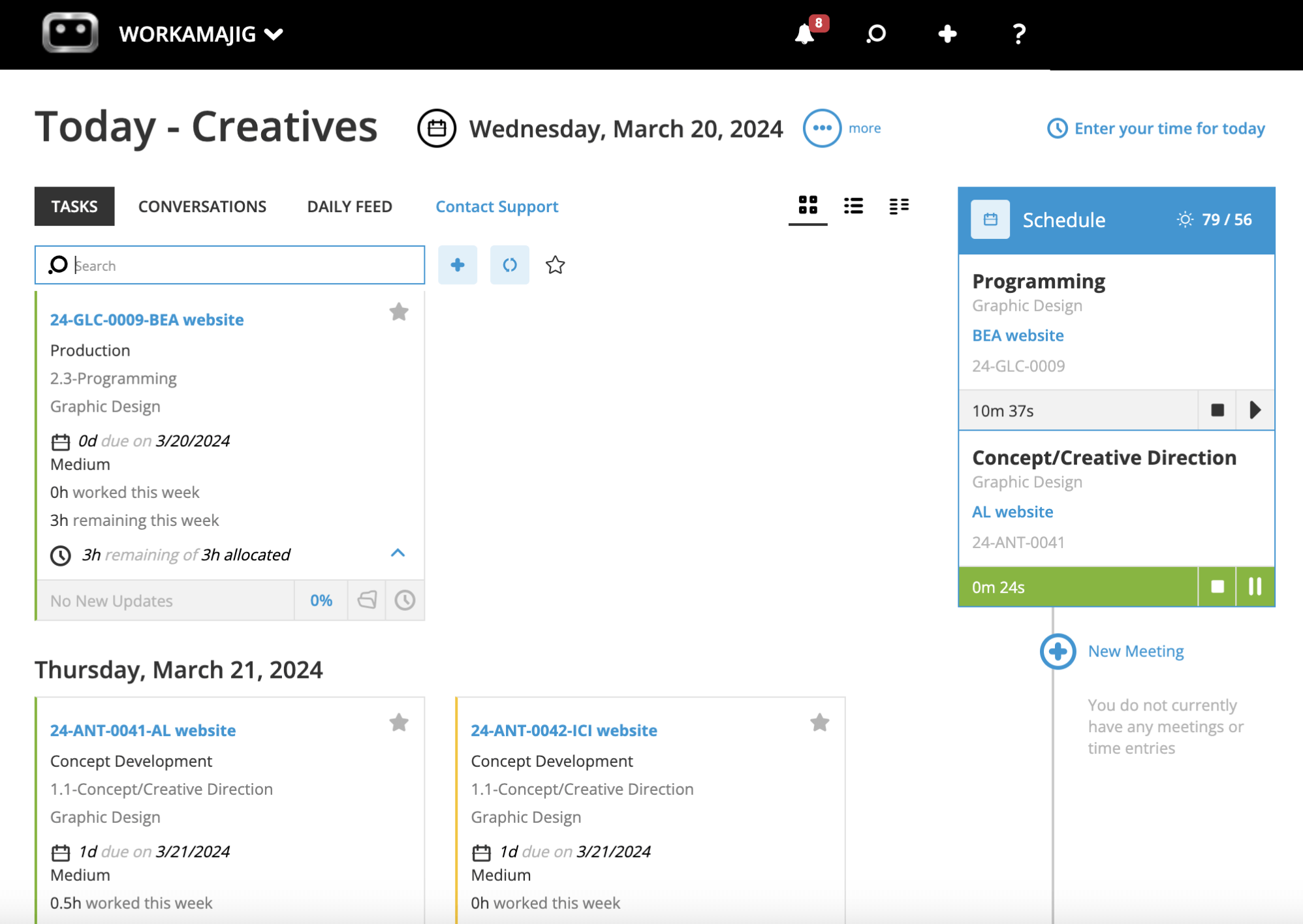
Our system saves staff time and service rates, automatically updating project labor costs as employees enter their time. Then, these logged hours flow into:
-
Centralized timesheets. Managers can see how time is spent across all projects and drill down into individual projects. When reviewing a project's hours, managers can approve and edit time entries — ensuring they’re accurately captured before invoicing.
-
The Projects Dashboard. As actual hours flow into the project, managers can compare hours to estimates and monitor the impact on the project’s budget.
These insights can help project managers make informed decisions to optimize resource allocation. For example, if a project is at risk of going over budget, the project manager can view the impact of reassigning specific tasks to a more junior resource.
Read more: How to Track Creative Project Management Hours
Team Collaboration
Workamajig offers user-friendly tools for teams to work through and collaborate on projects in our system.
First, we provide role-based Today Dashboards for all users (like the Today - Billing Dashboard discussed above), tailored to their responsibilities, so they know exactly what to work on, when, and for how long. This view lets everybody, agency wide, plan their days and weeks ahead.
Then, all daily work and team collaboration happens on task cards. Users can:
- Open task cards to see what’s expected and the details to start working
- Tag other users for more information or feedback as they go
- Upload content and media for review (our system accepts various file types and lets teams organize content into folders to avoid cluttering task cards)
Then, other stakeholders — teammates, managers, and even clients — can jump into task cards, see progress and attachments, and leave feedback using internal proofing tools. Users can annotate files, and all comments are saved in the history for reference.
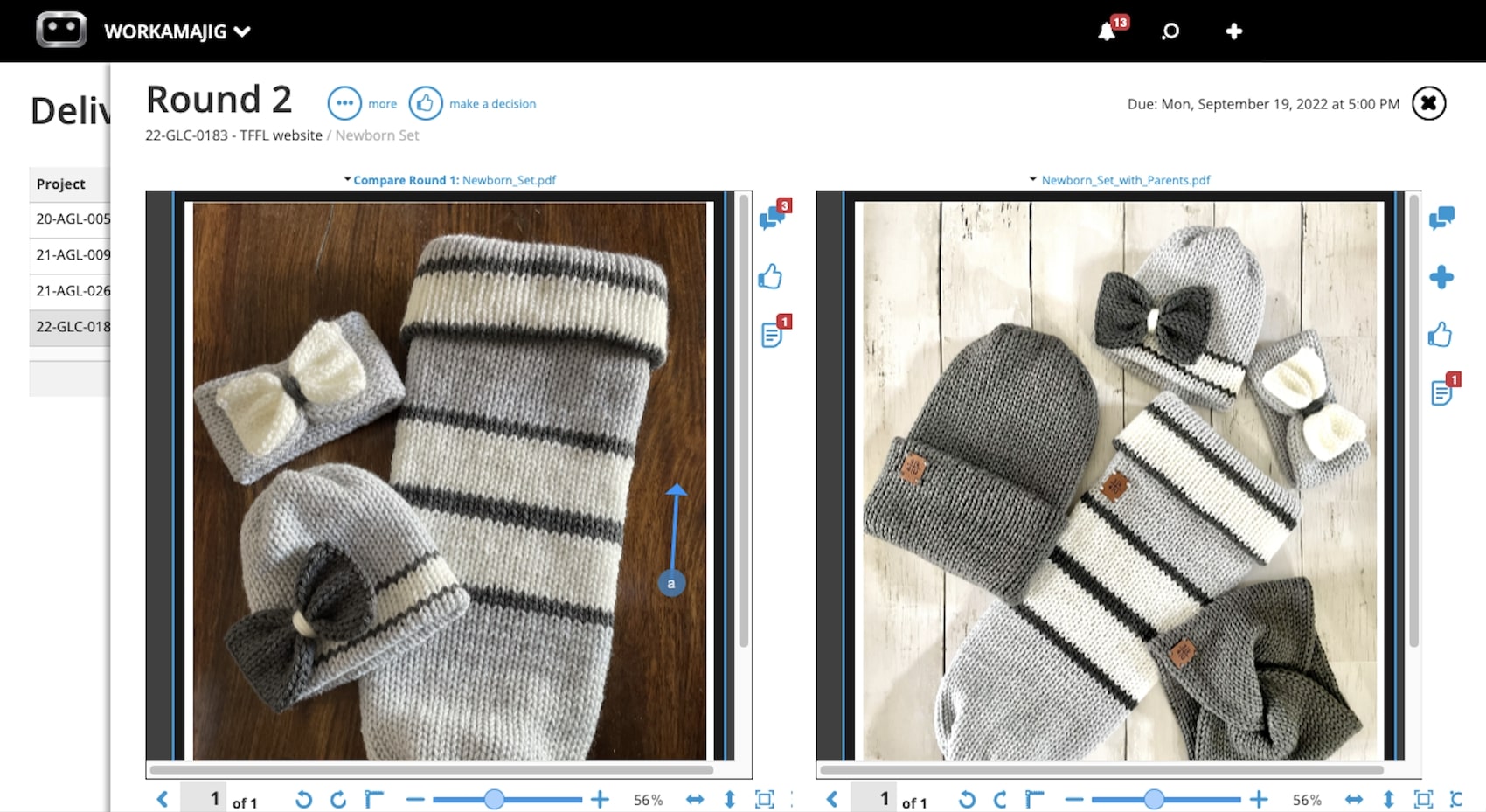
Our system also keeps a version history of files, so project team members can see how content evolves through feedback and refer to old versions.
All details — comments, files, version history — are saved in task cards for easy reference.
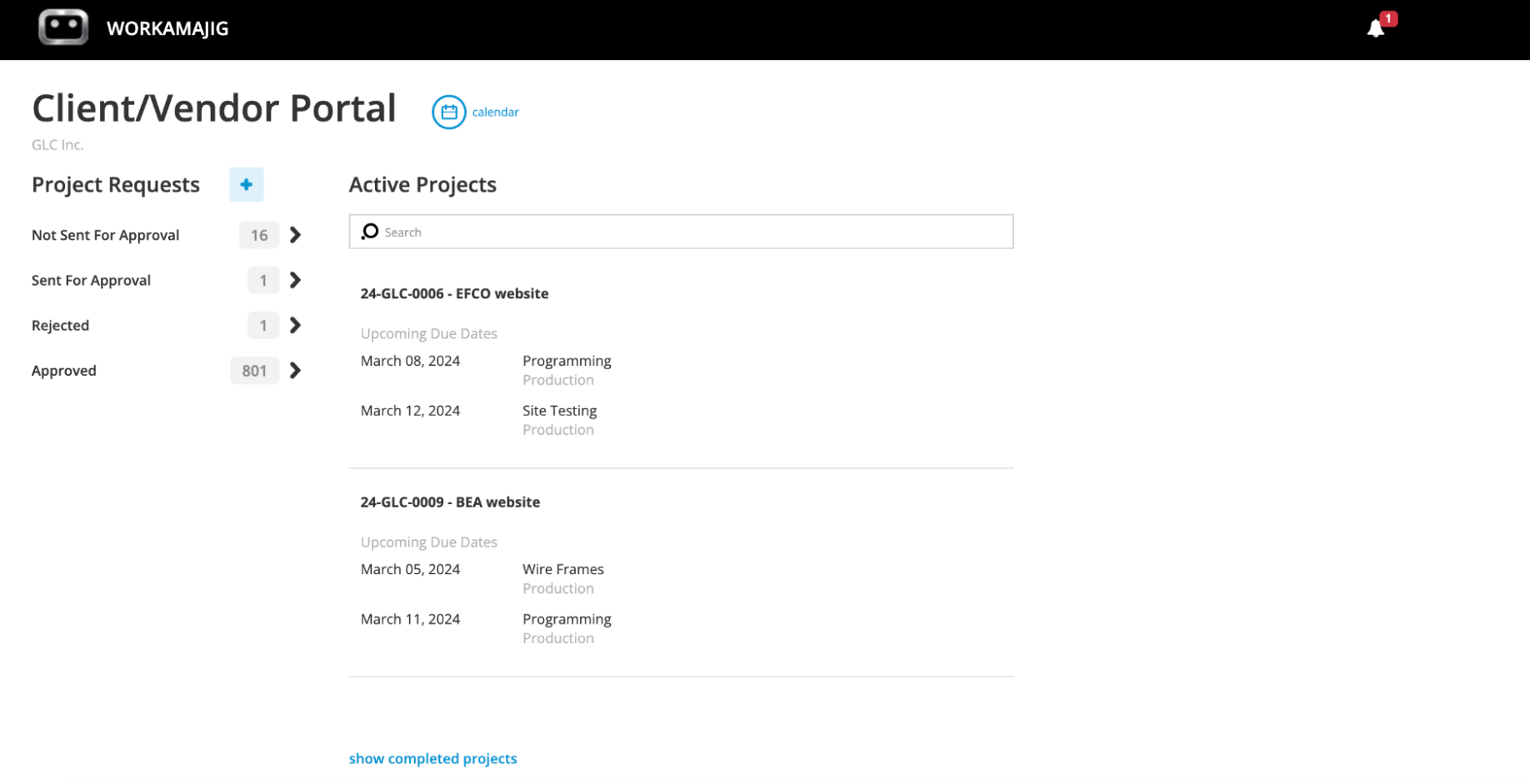
Client Portals
Workamajig lets managers create (unlimited) client portals so clients can securely log in to our system and:
- Track project progress — so they don’t have to email your team for updates
- Provide feedback and final approvals on projects
- Make additional project requests — our system and invoicing tool can also manage change requests
- Access deliverables (no more slow, clunky file sharing!)
- View project budgets — they can see how much has been billed and how much remains based on progress
Agency Insights
In addition to the financial reporting dashboard we discussed above, our system includes an Agency Insights Dashboard that provides a real-time snapshot of how teams spend their time.
This dashboard displays hourly reports by client, service, project, department, and more, so managers can see where they’re using the most resources. Plus, they can see what their teams are working on right now, along with hours tracked by project or task type.
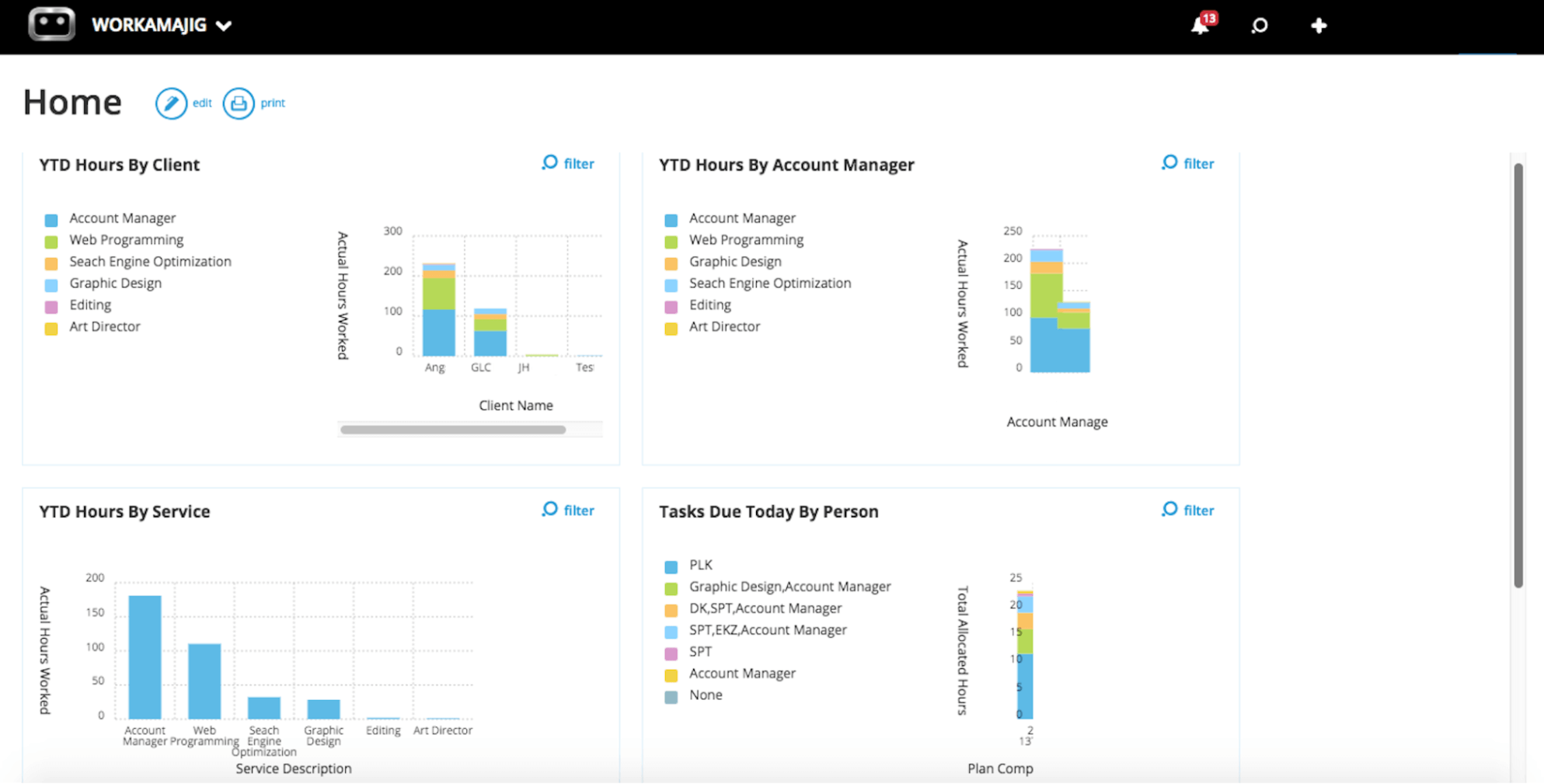
By combining this data with insights from project profitability reports, managers can get a deeper understanding of the agency’s operations and see where they can make real improvements. For example:
-
If one team is clocking many hours while another is relatively free, they can consider adjusting project schedules and resource allocations to deliver projects faster or balance workloads.
-
If a service demands a lot of staff and effort but isn’t generating much profit, they might rethink the package altogether — which may involve adjusting it, retiring it, or replacing it with something fresh that better serves the agency’s bottom line.
Getting Started
This was just a quick glimpse at our features and how they work — for a complete walkthrough of Workamajig, you can request a personalized demo.
In the demo, we’ll discuss the challenges you’re facing with your current tools and walk you through how Workamajig can better support your processes and your team. When you’re ready to get started, you’ll be paired with a dedicated account manager who will guide you through setup and training so you can hit the ground running.
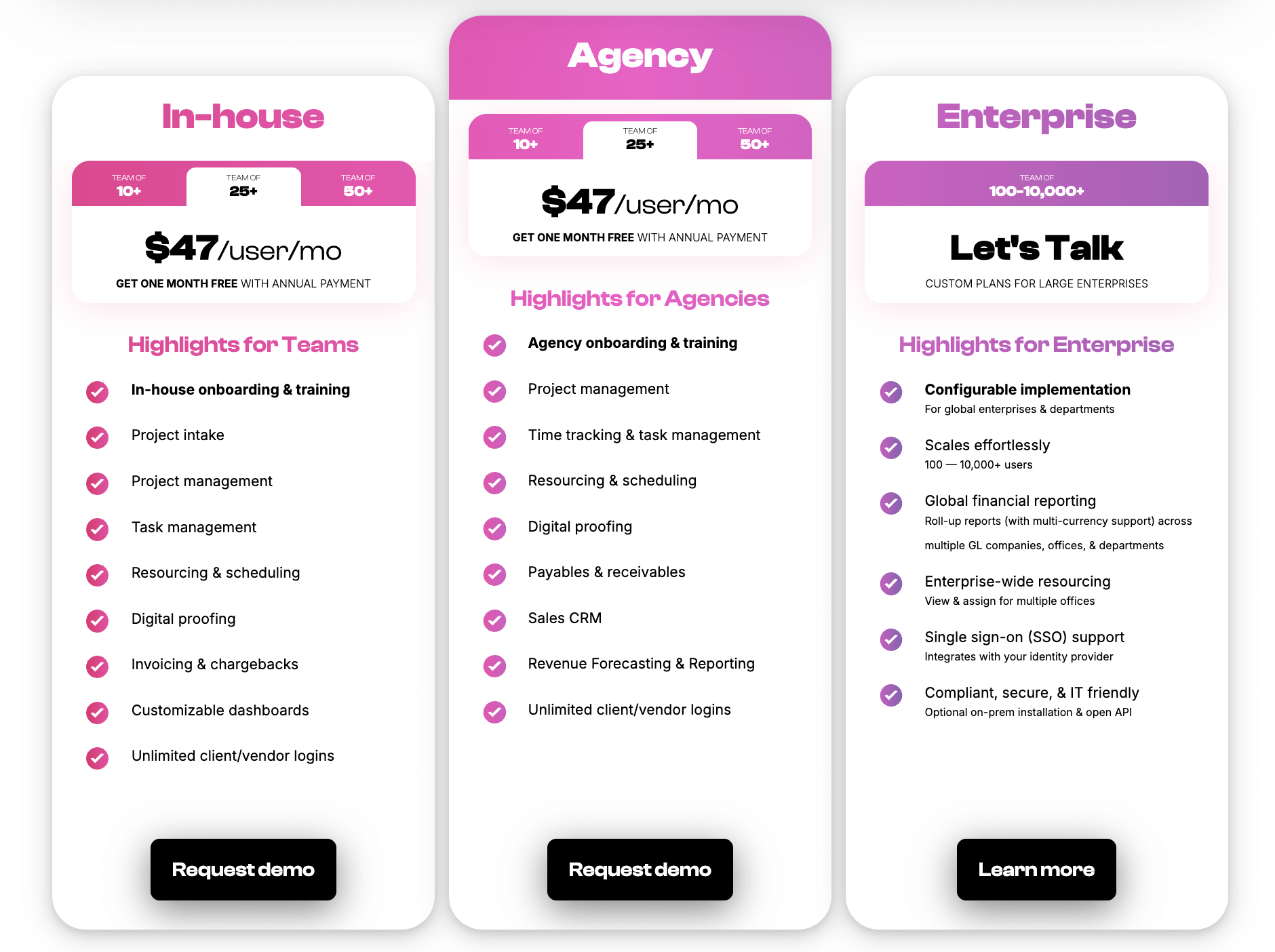
We offer solutions for in-house teams and agencies, tailored to your team size, plus custom packages and pricing for enterprises (100+ users). Check out our plans below:
See what our clients have to say about their success in Workamajig below:
Alternative Project Management Software with Invoicing (for Creatives & Marketers)
In addition to Workamajig, you might also see some of the names below in your research.
You can also compare the top project management tools for creatives in this guide.
2. Advantage
.png?width=2000&height=878&name=Advantage%20Simpli.fi%20homepage%20(2024).png)
Like Workamajig, Advantage is a creative project management tool that features a complete accounting system. Teams like Advantage because it includes native media buying via Simpli.fi (so if you need to add this to your toolset, you might consider this system).
Advantage’s accounting system includes robust billing and invoicing, and it often receives positive reviews for these features.
The platform supports multiple billing methods, lets you set automated billing rules, and offers customizable invoice formats. It also has tools to centralize vendor invoices and send payments. You can manage everything in Advantage’s Billing Command Center.
However, it’s worth noting that Advantage doesn’t have the best multi-currency support for agencies serving clients outside of their home country.
Another common frustration with Advantage is that the platform is a little clunky. While it brings a lot of functionality under one roof, its features are split across different interfaces, meaning you often have to toggle back and forth to access the tools or data you need.
The idea behind this setup is to keep things organized and control user access, but constantly switching between views can be a real headache for admins and project managers.
It’s also worth noting that Advantage’s plans are on the pricier side, as the system is geared toward enterprises, so smaller teams and agencies may find this option out of budget.
Find more Advantage reviews here.
Features
- Media Accounting
- Billing & invoicing
- Estimates
- Budget Monitoring
- Financial reporting
- Revenue forecasting
- Project management
- Resource management
- Collaborative tools like proofing & reviews
- Time tracking
- Media planning & buying — including broadcast buying, digital buying & media reporting
- Risk analysis & burn rate tracking
- Reporting dashboard (to analyze project performance, financials, staff hours, etc.)
Pricing
Advantage does not publicly share pricing; you must contact them for a custom quote.
Read more: Best Advantage Software Alternatives for Creative Teams
3. Clients & Profits

Clients & Profits (C&P) is the other solution on our list that features a complete, GL-ready accounting system. It’s a scalable agency management system with native project management, resource management, time tracking, CRM, and financial management modules.
C&P’s modules are fully integrated, consolidating data and simplifying project and financial management workflows. The system supports a variety of billing methods (time & materials, fixed fee, retainers, media), lets managers build accurate estimates using historical project data, and generates invoices by pulling cost data directly from projects. Managers can then export invoices from the system and send them over to clients for review and payment.
The platform’s accounting system provides several tools to automate everyday tasks — including invoice generation and scheduling, bank reconciliation, vendor invoice reconciliation, and payment collection across different channels.
It also offers various tools and integrations to support creative agency workflows specifically, including:
- Media planning tools with media buying integrations
- Marcom tools, including job tracking, costing, and chargeback systems
- An Adobe XD plugin that connects Adobe’s Creative Cloud apps
If you’re considering C&P, one thing to keep in mind is that it’s primarily an on-prem solution. However, thanks to multiple upgrades over the years, users can now access the system via a web app on different devices (mobile, tablet), rather than being limited to desktop access. And C&P now offers a hybrid cloud-based storage model, so you can back up your data to their cloud.
It’s also worth noting that several users say C&P’s UI/UX is somewhat outdated, which can make teams less comfortable adopting it. But you can form your own opinion here by checking out the product’s virtual tour.
Read more Clients & Profits reviews here.
Features
- Project intake management & project request forms
- Project & task management
- Project tracking
- Collaborative feedback tools for project teams & clients
- Portfolio management
- Accounting software
- Automatic billing & invoicing
- Vendor invoice management
- Financial reporting
- Integrations with bank and credit card accounts & media planning systems
- Resource management — with live scheduling for staff members
- Project monitoring
- Time tracking
- Adobe XD plugin
- Automation tools that can be tailored to different workflows and use cases
Pricing
Clients & Profits offers multiple packages tailored for creative teams and agencies:
-
Creative ($19/user/month): Entry-level access for designers and creatives. Includes core project management, jobs/estimates/change orders, timecards and smart timers, calendars, online collaboration, and basic expense tracking.
-
AE/PM ($39/user/month): Designed for account executives and project managers. Includes everything in Creative plus deeper project management and billing workflows, purchase orders, and additional management tools.
-
Power ($59 to $109/user/month): The pricing for this tier depends on which type of package you subscribe to:
-
Studio ($59/user): Full-feature access for power users with advanced capabilities such as financial accounting, job costing, comprehensive reports, online approvals, and snapshot analysis.
-
Marcom ($79/user): Includes everything in the Studio version, plus media planning, buying, billing, and online approvals.
-
Agency ($109/user): Unlocks advances/retainer billing.
-
Read more: Clients & Profits Software: Reviews & Alternatives
4. Flowlu
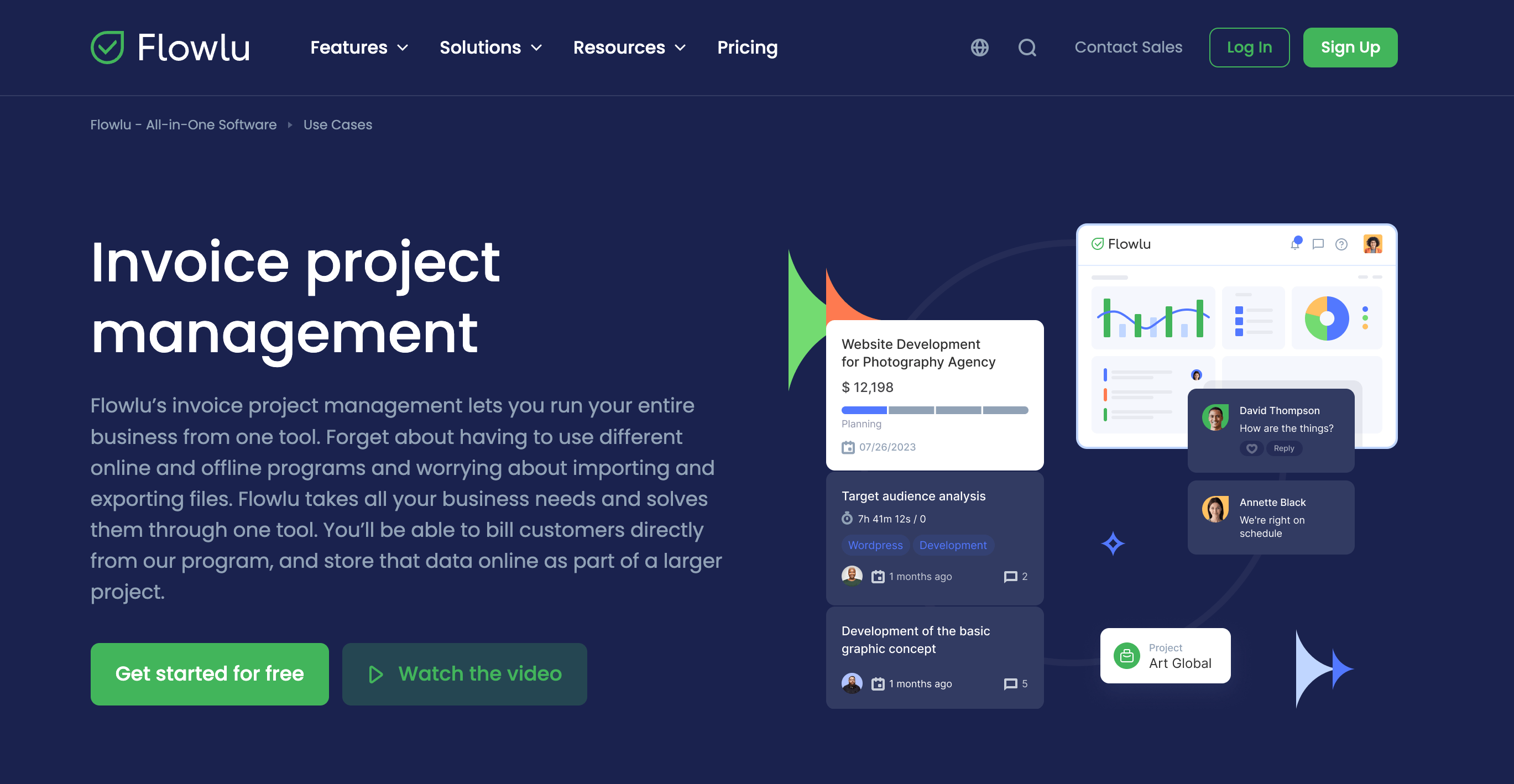
Flowlu is another project management tool for creatives, but it also advertises its solution to contractors, legal firms, crypto and blockchain professionals, IT departments, manufacturing companies, educational institutions, and other professional services.
The brand offers packages and solutions for teams of all sizes, but aims to appeal to smaller teams with a free plan, affordable pricing, and ease of use.
Flowlu provides online invoicing as a core feature within its project management software. Teams can customize estimates and invoices, choose between billing methods, and receive payments through Flowlu. (Flowlu connects with several online payment gateways so clients can pay directly through the invoice.)
The notable downsides of Flowlu are 1) it doesn’t offer native accounting software, and (even worse) 2) it lacks integrations with outside accounting systems. While you can manage invoices and payments within Flowlu, it’s a hassle to export any of that information to an accounting software for broader agency financial management.
Users also note that setting project workflows can be wonky in the lower-tiered packages, as those plans don’t include all features (like proposals), which can create problems in “working around” those steps. (So you almost want to choose a more expensive plan to avoid these potential troubles.)
Check out more Flowlu reviews here.
Features
- Online invoicing
- Financial management
- Project management
- Task management
- Agile & issue tracker
- Resource management
- Online CRM
- Collaborative tools
- Mind maps
- Document builder
- Client portals
- Knowledge base
Pricing
Flowlu offers a free plan, two standard packages, and custom packages for enterprises:
-
Free ($0, limited to a two-user workspace): This includes basic task & project management, invoicing and online payments, and expense tracking. It supports two users, 1 GB of storage, and unlimited projects, tasks, and contacts. However, it lacks critical features, such as time tracking.
-
Essential ($12/user/month): Includes everything in the free plan, plus basic time & financial tracking, email sync, CRM reports, and essential PM features (task dependencies, subtasks, etc.).
-
Advanced ($22/user/month): The Advanced plan includes email tracking, client portals, and advanced CRM reporting, project management (including portfolios), time tracking, finance, and HR.
-
Ultimate (Custom pricing): This unlocks Flowlu’s full suite of features.
Flowlu also offers a free 7-day trial with its Essential and Advanced plans.
5. Scoro
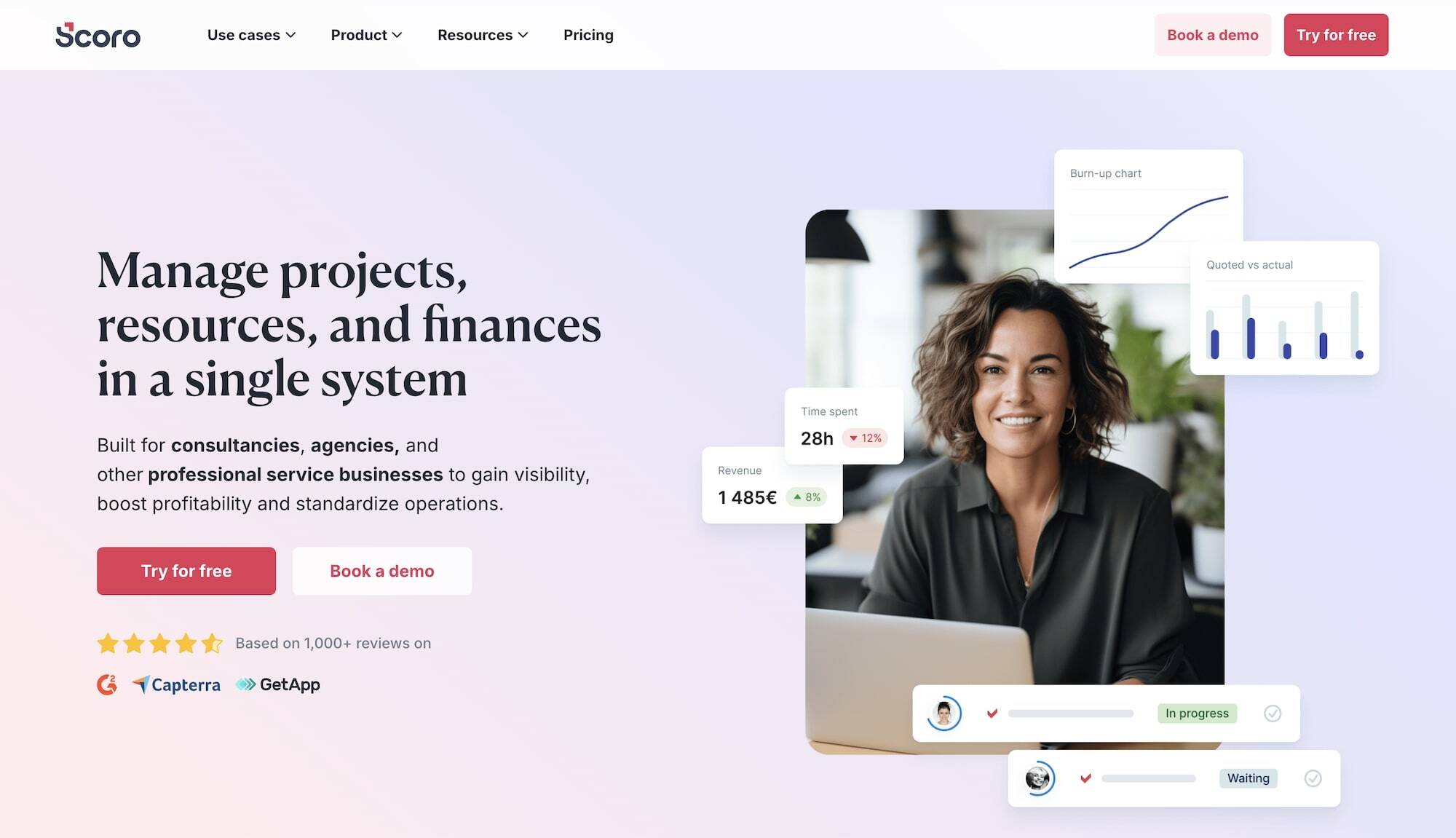
Scoro is a work management system for agencies, consultants, law firms, software developers, A&E firms, and other professional services teams. It offers native project management, billing and invoicing, resource management, CRM, financial forecasting, and reporting tools.
Scoro is packed with several handy tools to support invoicing workflows:
-
Automated invoicing tool. It converts confirmed quotes into invoices and applies the correct project billing method — such as fixed-fee or time & materials — saving you time and ensuring accuracy.
-
Retainer management. Schedule invoices to be generated and issued at fixed intervals.
-
Partial invoicing tool. Generate invoices for a proportion of work as a project progresses.
-
Forecasting tool. See how much you’ve already invoiced on a project and what’s left.
It’s also built for global teams, supporting multiple currencies and allowing each office or location to manage its finances separately.
Scoro’s various, automated financial reports provide insights into cash flow and profitability. For example, you can compare gross income month-over-month or year-over-year, or break down service delivery costs to identify your most profitable clients, services, and projects.
The platform’s project management suite is pretty well-rounded, though it lacks some key features, including project intake forms and native file proofing tools. Plus, users report that some tools are a bit tricky to use, leading to inefficient workflows.
Also, Scoro’s Performance package — which unlocks all of its essential agency features — is pricier than many of the other tools on our list. And users must pay separately for client portals, which adds to the overall cost, especially as your agency scales.
Features
- Project management
- Quoting & budgeting tools
- Invoicing
- Cost management
- Retainers
- Resource planning
- Time tracking
- Collaboration tools
- Sales CRM
- Reporting
Pricing
Scoro offers multiple paid subscription tiers and a free 14-day trial (no credit card required):
-
Core ($23.90/user/month): This entry-level plan includes project & task management (task lists, boards, Gantt charts), calendars, contact & client management, quotes & invoicing, dashboards, and basic reporting to manage work and finances from one place.
-
Growth ($42/user/month): Includes everything in the Core plan, plus enhanced project controls such as project budgets & templates, retainers, recurring tasks, multi-currency support, utilization reports, and more detailed financial analytics. It lacks some key features such as scheduled invoicing & bills, revenue recognition & forecasting, and timesheet views.
-
Performance ($59.90/user/month): Offers Scoro’s full suite of features, unlocking advanced forecasting tools (resource planning, cost/profit forecasts), planners & timesheet views, task matrices, price lists, and deeper financial reporting capabilities. This is Scoro’s recommended plan for agencies.
-
Enterprise (custom pricing): Designed for larger organizations needing enterprise-level features like company-wide budgets & forecasts, approval workflows, advanced reporting, and options such as single-sign-on.
Read more: Best Scoro Alternatives for Agencies
6. Ravetree
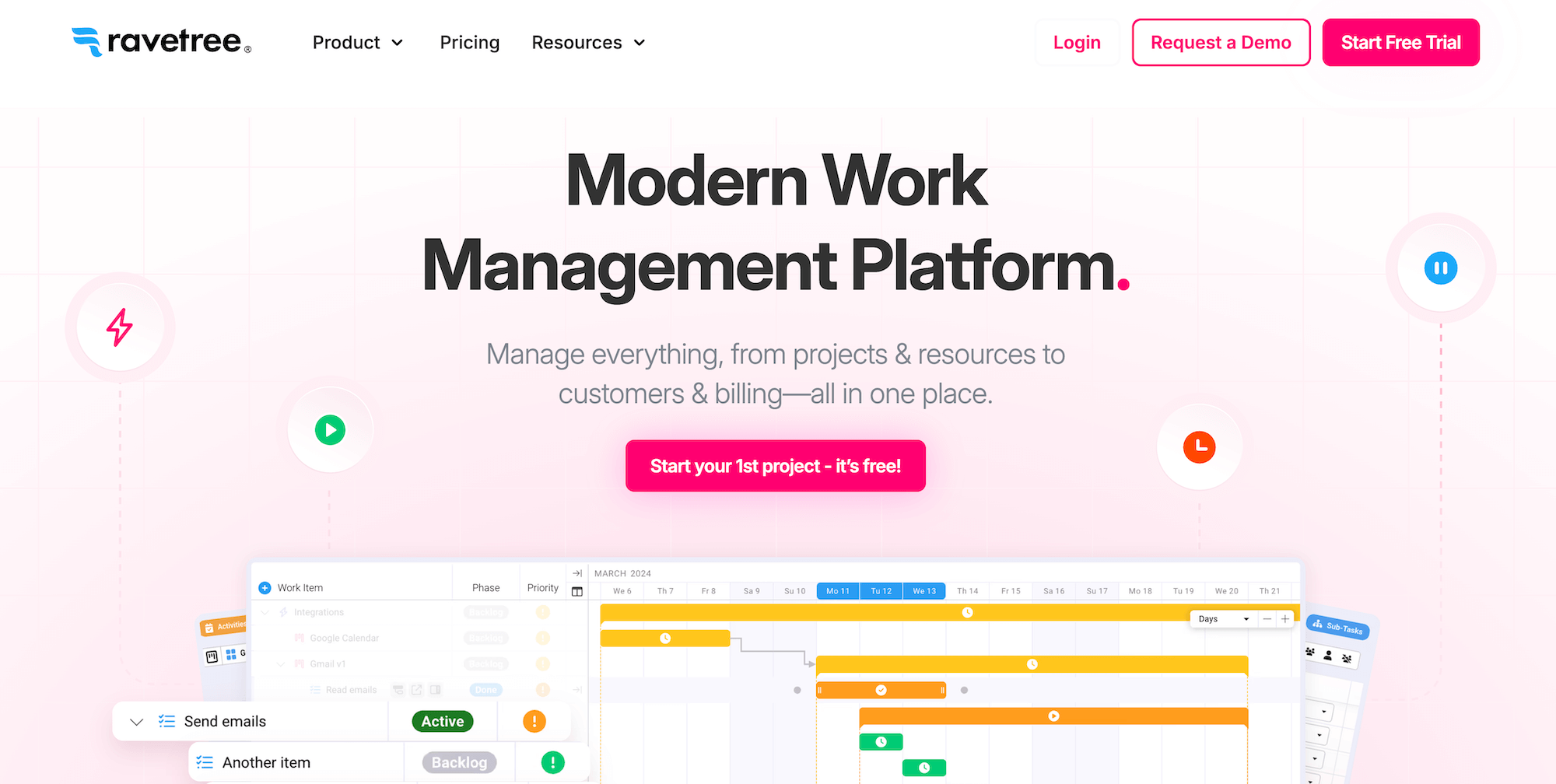
Ravetree positions itself as a complete work management system for agencies, consultancies, and other professional services organizations. It features project management, invoicing, resource planning, time tracking, budget and expense tracking, CRM, and client portals under one roof.
While many all-in-one tools miss features here and there — maybe they lack project intake forms or their reporting features are super basic — Ravetree’s modules are feature-rich overall.
Its billing software lets you set up bill rates for projects or work roles, create client-specific rate cards (with start and end dates), and automatically generate invoices from time logs, expenses, and service items. You can also make estimates from scratch or reusable templates, and email them directly to prospects or clients for approval.
Ravetree’s retainer tool stands out for letting teams manage these agreements from start to finish on autopilot. You can schedule auto-generated invoices and projects, and even auto-charge customers (thanks to the Stripe integration).
However, Ravetree lacks a comprehensive accounting system, so you’d need to integrate it with QuickBooks or another standalone system to support all your accounting workflows. The reporting features are mostly limited to the project management module, so you won’t find extensive financial reporting tools in this solution.
Ravetree’s project management suite supports the entire project workflow, from intake to billing. It features project templates, request forms, timeline views, portfolio management, budget tracking, forecasting, and team management tools.
Users praise Ravetree’s ease of use, customizations, and helpful customer support team — but the platform can be glitchy at times; for example, some users report that the system freezes abruptly or that entries, such as time logs, aren’t always saved.
Read more Ravetree reviews here.
Features
- Project templates & project request forms
- Project management
- Portfolio management
- Project budget tracking and forecasting
- Billing & invoicing
- Time & expense tracking
- Retainer management
- Resource planning
- CRM
- File management
Pricing
Ravetree offers a single plan that includes the complete Ravetree work management platform, unlimited projects & file storage, and free onboarding, training, and support. This plan is available on a monthly pay-as-you-go basis for $39 per user, with discounted quarterly and annual plans.
Ravetree also offers a free trial so you can evaluate the platform before committing to a paid subscription.
7. Function Point
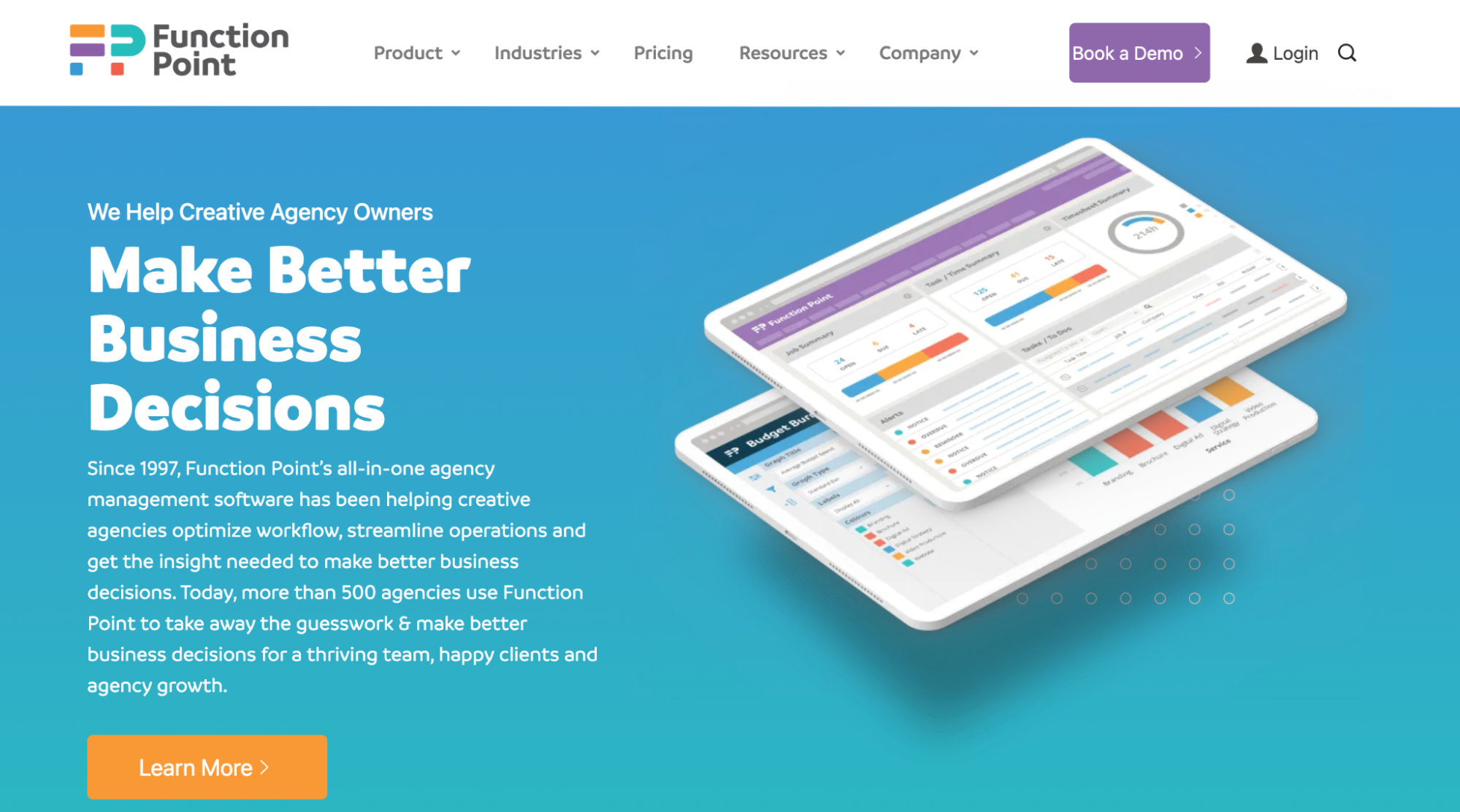
Function Point (FP) is another end-to-end agency management system that’s tailored to creative workflows. The brand has been working with creative teams — including advertising agencies, marketing teams, design studios, and production companies — for over three decades.
Like Scoro, Function Point features modules for project management, resource planning, invoicing, time tracking, CRM, client management, financial management, and reporting. Function Point receives a lot of praise for its invoicing tool, which lets users automatically generate visually appealing, customizable invoices from existing jobs.
In Function Point, you can generate invoices in various ways — such as using estimated values, actual values, or actuals plus estimates. The system also comes with other handy tools to simplify your workflows, including:
-
Batch invoice generation — spend less time on creating several invoices (for different companies and jobs) by generating them all in one go.
-
Multi-job, single-invoicing — for when you want to conveniently invoice the same client for multiple projects or jobs.
-
Deposit invoices — for keeping track of pre-billed amounts and other unearned revenues. When these invoices are synced to your account system, the deposit amount is recorded in an unearned revenue account.
-
Approval routines — you can set up a process for reviewing and approving invoices in Function Point. The system notifies the specified approver (usually accounting staff) when a new invoice is generated, so they can review it in FP and mark finalized invoices as “approved.”
FP lets you print finalized invoices as PDFs, specify the level of detail, and send them off to clients. The platform also offers two related, optional reports that you can customize and include alongside invoice printouts:
-
The Expanded Summary Report — which provides a detailed breakdown of the actual amounts, estimated hours/quantities, estimated amounts, service group (i.e., the service’s category), etc., for the job being invoiced
-
The Status Report — which also pertains to actuals and shows the service group, the date on which time was tracked, staff initials, the hourly rates, the quantity of hours, and the totals.
FP’s project management module checks all the essential boxes — it features project templates, extensive task management tools, real-time project monitoring with budget tracking, and portfolio views for grouping and managing multiple projects.
One thing to keep in mind about Function Point is that many reviewers report challenges navigating the platform and finding the information they need. For example, some mention that it takes many steps to add or update the details for a task or estimate.
Check out more Function Point reviews here.
Features
- Project templates
- Project management, with tools to manage several projects at once
- Project monitoring (choose Gantt charts or a Kanban board view)
- Invoicing tools
- Financial management, including expense tracking
- Client management tools, including estimates and proposals, CRM, email integrations, change order and revision tracking, and job request portals
- Team collaboration, including file sharing
- Resource management
- Time tracking
- Business intelligence reports, including profitability reports and custom reporting
- Integrations with accounting systems like QuickBooks and other business applications
Pricing
Function Point offers two standard plans:
-
Standardize ($53/user/month): This is the core agency management subscription, including project management (Gantt charts, task dependencies, Kanban boards), resource & time management, client management, and financial tools (expense tracking, batch invoicing, budgeting).
-
Optimize ($62/user/month): Includes everything in Standardize, plus QuickBooks Online integration and advanced business intelligence reporting (custom saved reports, data visualization, report sharing).
Read more: Function Point Reviews & Alternatives (Buyer's Guide)
8. Bonsai
Hello Bonsai offers a full stack of integrated project, financial, and client management tools — including task management, project monitoring, resource management, budget tracking, CRM, invoicing, expense management, payments management, bookkeeping, and meeting scheduling. It also lets users set up dedicated client portals and offers tools to build and manage proposals, contracts, agreements, work requests, and estimates.
Bonsai’s invoicing tool is particularly robust. It pulls in time and expenses when generating invoices, lets users set up recurring billing (e.g., for retainers), and includes multi-currency and multi-tax-rate support (useful for mixed-tax jurisdictions).
Bonsai also offers three payment options to collect credit card and ACH payments directly from invoices — including Bonsai Payments (a proprietary solution), Stripe Payments (via integration), and PayPal (also via integration).
Although the platform offers several tools, some users note that Bonsai is tailored to the needs of freelancers and small businesses and may fall short for larger teams. For example, users highlight limitations with its:
-
User roles and permissions. Users can be designated as "partners," with access to all modules and business data (including financials), or as "collaborators," who can only view existing projects. The platform doesn’t leave room to customize access based on staff roles and responsibilities.
-
Financial and bookkeeping tools. For example, the bookkeeping feature automatically logs processing fees as expenses, but doesn’t track multiple bank accounts, check writing, payroll, etc.
Overall, these limitations persist across modules, so agencies must rely on workarounds or third-party integrations via Zapier (Bonsai lacks native integrations).
While Bonsai may not be the best choice for larger teams, solo entrepreneurs and smaller agencies appreciate its modern design, intuitive interface, and support for essential workflows. As one user puts it, “If you need heavy-duty CRM or full accounting features, you will still pair it with other tools. But for everyday operations, it delivers a smooth, streamlined experience.”
Find more Bonsai reviews here.
Features
- Project and task management
- Project budget tracking and forecasting
- Resource allocation
- Resource planning with capacity and margin tracking
- Time tracking
- Client communication tools
- Expense management
- Invoicing
- Proposal tools and contract builders
- Meeting scheduling and calendar integrations
- Lightweight CRM
- Reporting
Pricing
Bonsai offers four standard plans. However, the Basic plan lacks invoicing features, and only the Premium and Elite plans remove Bonsai’s branding.
-
Basic ($15/user/month): This plan includes time tracking, project and task management, CRM, and unlimited clients.
-
Essentials ($25/user/month): Everything in the Basic plan, plus invoices & payments, expense & income tracking, proposals & contracts, forms & questionnaires, and client portals.
-
Premium ($35/user/month): Unlocks project insights, workload management, custom fields, profit & productivity reports, and more.
-
Elite ($59/user/month): Everything in Premium plus custom permissions, timesheet locking, the option to markup expenses, custom data imports, and integration with Xero.
Read more: Bonsai Software Reviews & Alternatives: Buyer's Guide
9. ProProfs Project
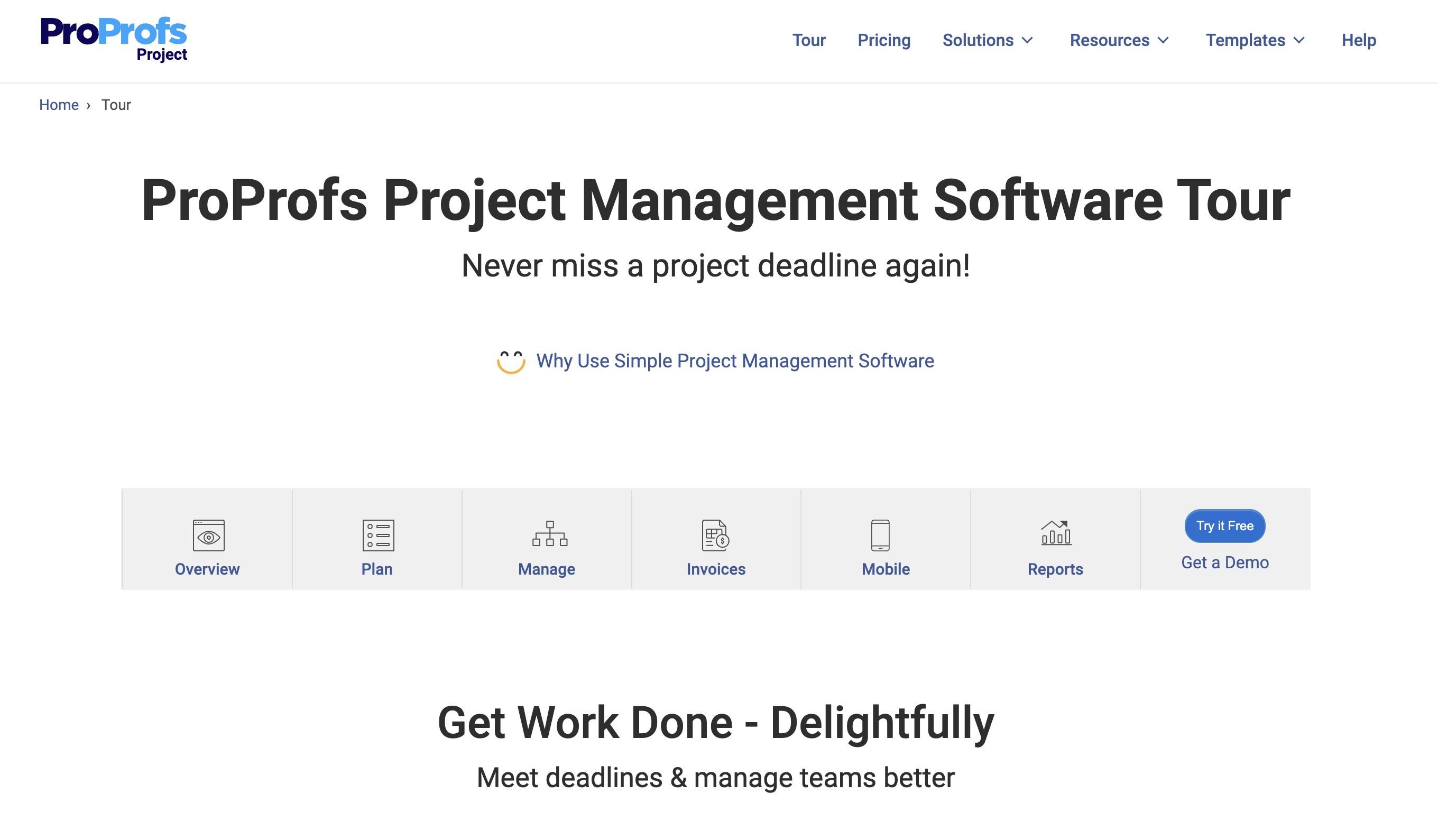
ProProfs is a large software-as-a-service (SaaS) provider offering a range of business applications, including a chat tool, survey maker, knowledge management software, customer support solution, and a project management platform. (You might like its project management system if you already use other ProProfs applications.)
ProProfs Project is advertised to creative agencies and marketers, but also caters to IT professionals, consultants, and other service-based businesses. This solution typically appeals to smaller teams with budget-friendly packages and an intuitive, easy-to-use platform.
The invoicing feature on this platform offers several conveniences: you can create estimates and set budgets, monitor project hours and costs, and calculate billable hours efficiently. The system automatically generates invoices, routes them to clients, and includes notifications prompting them to view and pay on time.
Overall, ProProfs receives positive reviews and is well-known in the software industry.
However, the software is somewhat basic in terms of functionality. Some reviewers are dissatisfied with the platform’s reporting features, noting that it omits important data and provides only surface-level metrics. And other reviews say that it lacks automation tools, which pulls managers into more operational work.
Read more ProProfs Project reviews here.
Features
- Billing & invoicing
- Budget monitoring
- Profitability reporting
- Time tracking (with timesheets)
- Project management
- Task management
- Resource management
- Customizable project monitoring dashboard
- Collaborative tools, reminders for tasks & task history
- Automation tools
- Mobile apps
- Customizable reporting dashboard
Pricing
ProProfs offers two packages. Both include all core features, so you can access the billing and invoicing features in either plan. You choose packages by choosing the number of seats you need.
-
Free (supports up to 5 users): Includes all core project management features with no limits on functionality. This plan lets teams manage tasks and projects, collaborate, and use essential views and tracking.
-
Business ($39.97/month): Supports unlimited users and includes all platform features, plus dedicated onboarding and support.
10. Paymo
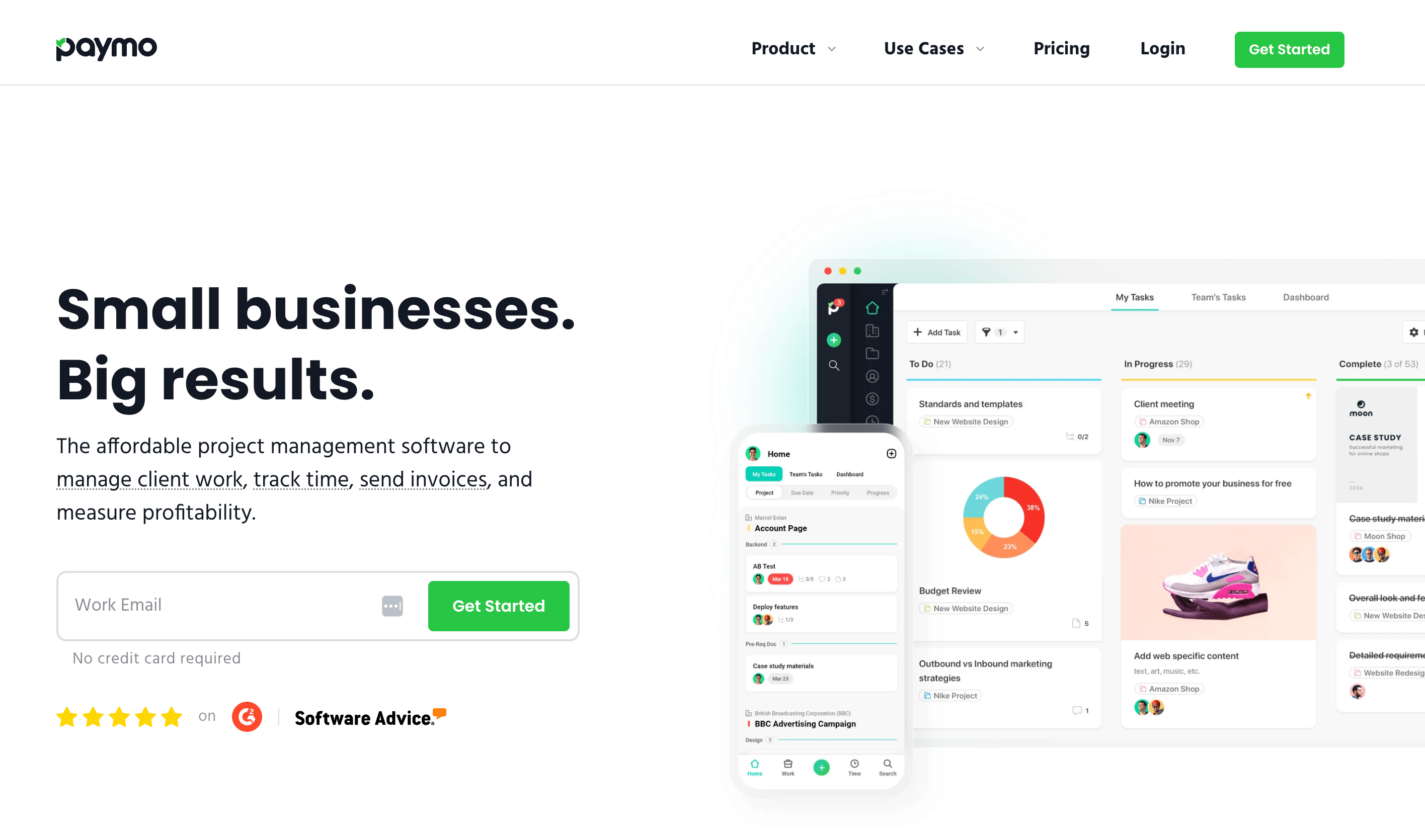
The last platform on our list, Paymo, is another option for small businesses. This brand works with creatives and marketers in both in-house teams and agencies, but its solution also appeals to other professional services providers (software developers, architects, and engineers).
Paymo’s invoicing tool lets you generate invoices from timesheets or other CSV files (if you track time in spreadsheets) and customize them to your liking. The editor is user-friendly, allowing you to add line items, drag and reorder items, insert brand elements such as logos, and include notes for clients. Then, you can export invoices to your accounting software (like QuickBooks Online) and collect client payments.
Note: They also offer a recurring invoices feature, so you can design invoices for repeat projects and schedule them to be sent.
This tool lacks automation and accounting capabilities, so it cannot offer all the conveniences of the software solutions mentioned above. Still, you might like this option if you prefer to build out invoices or have complex processes that require a more hands-on invoicing approach. The system automates certain tasks while still giving you control over the final document and invoice dispatch.
Paymo’s project management tool supports all aspects of the creative workflow with estimates, task management, team scheduling, project monitoring, time tracking, collaborative tools, invoicing, online payments, and reporting.
Check out more Paymo reviews here.
Features
- Invoicing & online payments
- Financial management
- Profitability tracking
- Task management
- Time tracking (with Pomodoro timers for improved time management)
- Resource management
- File management
- Collaboration tools (e.g., internal proofing & versioning)
- Reporting dashboards
- Customization options
- Multilingual features
- Open API
- Mobile apps for iOS & Android
Pricing
Paymo offers four packages:
-
Free ($0/month — limited to 1 user): Includes unlimited time tracking and unlimited invoices, but limited clients (1), limited projects (2), unlimited tasks, task list view, desktop & mobile apps, and 1 GB storage.
-
Solo ($5.90/month — limited to 1 user): Everything in Free plus flat-rate & retainer projects, up to 3 clients, up to 5 projects, task calendar & Kanban views, guest access, in-app tech support, and 5 GB storage.
-
Plus ($10.90/user/month): Includes everything in Solo plus recurring tasks, bulk time entries, active timers, timesheet reports, project templates, project profitability, recurring invoices, estimates & expense tracking, integrations, API access, and 50 GB storage.
-
Pro ($16.90/user/month): Adds to Plus with Gantt chart views (task & portfolio), task dependencies, employee scheduling & workload, project schedule timeline, timesheet approvals, leave management, priority support, online remote assistance, and 500 GB storage.
Paymo’s paid packages also include a free 15-day trial.
FAQs on Project Management Software with Invoicing
Below, we answer some of the most commonly asked questions about project management software with invoicing:
1. What are the key benefits of integrated project management and invoicing software?
A fully integrated project and invoicing solution simplifies project billing and improves invoice accuracy by directly pulling in project expenses and costs — and many of them also support online payment collection via integrations. This saves internal teams time and helps you get paid faster.
2. What features should I look for in project management software with invoicing capabilities?
On the project management side, you should look for:
- Project intake forms and templates
- Project planning tools
- Collaboration tools that support internal and external stakeholders
- Project monitoring with budget tracking
On the invoicing side, you should look for:
-
Expense tracking — that lets you tag expenses to specific projects and track them in one place, and then aggregates all billable items (vendor costs, labor costs, media buys, etc.) when generating an invoice
-
Support for all project billing methods you use — such as fixed fee, media, time & materials, retainer, and advanced
-
Multi-currency support — that automatically tracks exchange rates, supports foreign bank accounts/credit cards, and lets you process transactions in different currencies
-
Vendor invoice management — with tools to store invoices, manage reconciliation, and send payments
-
Tools for accepting client payments — either via native solutions or third-party integrations
-
Financial reporting — that lets you evaluate profitability and understand your agency’s overall financial health
And of course, you should ensure that both modules work together so you can manage project and financial data together in real-time project workflows.
3. What integration capabilities should I prioritize when selecting project management software with invoicing?
It depends on the platform you choose. In simpler project management software — that doesn’t include full accounting software — you’ll need to prioritize integrations with accounting systems like QuickBooks or Xero.
But if you choose an all-in-one system like Workamajig or Advantage, you don’t need to rely on outside integrations for invoicing workflows. These tools support all essential project management, billing and invoicing, and accounting processes. Integrations here connect with supporting tools that automate everyday tasks — such as accepting online payments, managing media buys, or tracking credit card expenses — to make your life even easier.
4. Why is multi-currency support important for project management software with invoicing?
If you’re working with clients across different countries, a system that supports multiple currencies is essential. It allows you to bill clients in their local currency at the current exchange rate, saving all parties from the hassle of dealing with exchange-rate fluctuations and manual currency conversion.
Multi-currency support also ensures all invoices and records are in the correct currencies, which is helpful for tax and compliance purposes.
5. What are the top project management software options that include invoicing features?
There are many project management tools with built-in invoicing features that cater to businesses with diverse needs. Here’s an overview of some top options:
-
Workamajig, Advantage, and Clients & Profits. These all-in-one systems include fully integrated project management and accounting modules, making them a top choice for agencies and creative teams looking to consolidate their tech stack, streamline workflows, and unify data across their business.
-
Flowlu, Scoro, Ravetree, Function Point, and Bonsai. These agency and professional services management systems have more lightweight features than those in the category above. They either lack specific modules (e.g., native CRM or accounting suite) or features (e.g., project intake forms or retainer management).
-
ProProfs Project and Paymo. These simpler project management tools are tailored to the needs of small businesses. They seamlessly integrate invoicing and time tracking into project workflows, but don’t offer more advanced financial and accounting tools.
Getting Started with Workamajig
Workamajig’s robust project management software streamlines all creative workflows and brings all your project and financial data together, which helps teams:
-
Ensure accurate invoicing — Workamajig brings all transaction and expense data together in one place and streamlines billing processes to minimize back-and-forth, redundancies, and errors.
-
Prevent budget overruns — our real-time project monitoring alerts PMs when projects are at risk of exceeding budgets, so they can intervene early and correct course.
-
Strategically plan projects and resources — our system equips PMs with historical and current data to build accurate estimates.
Request a personalized demo today and see firsthand how Workamajig can consolidate your tech stack, support all your workflows, and unify your business data.
Related reads: