

Marketers need a project management tool that helps them oversee every part of project planning and execution. It should include project and task management features to plan work and track progress. But in our experience working with agencies and internal marketing teams, these users also need tools to:
-
Manage internal staff and team members, including schedules and hours
-
Source freelancers and manage those relationships
-
Store and share marketing collateral and other digital assets required for each project
-
Collaborate with project team members and clients; ideally, the software should include proofing and version history tools so designers, managers, and clients can work together to finalize content
-
Simplify client communication and give clients visibility into project progress, so they can check status without asking your team for updates
-
Integrate with media planning solutions and other marketing tools to pull data into projects and reporting
-
Plan project budgets and track costs
This last element — financial management and budget tracking — is what 99% of project management software misses. Without cost tracking built into project workflows, marketers operate in the dark until it’s time to calculate costs and send invoices.
Strategic marketers manage projects, people, clients, content, and costs in one system. That’s how they guarantee profitability.
Most project management software — like Monday.com, Jira, Asana, Zoho, Trello, and Basecamp — aren’t built for marketing teams. They lack native features for managing creative projects and marketing campaigns, forcing teams to rely on multiple third-party integrations to support their workflows.
This guide covers 10 of the best project management software designed specifically for marketing teams, all of which support the workflows mentioned above. We also review 8 general-purpose PM tools, breaking down which workflows they support natively (and where you’ll need integrations), so you can make the right choice for your team.
For a walkthrough of Workamajig’s marketing PM software, keep reading or request a free demo to see how it compares to generic PM systems.
1. Workamajig
All-in-One Marketing Project Management Software for Agencies, Internal Teams & Enterprises
We designed Workamajig as a project management tool specifically for marketers, creatives, and agencies. It’s a comprehensive work management platform that combines project and agency management, including task management, resource management, time tracking, vendor and client management, accounting, financial reporting, and more.
Our goal in developing Workamajig was to solve the problems marketers and creatives face with generic project management software — like lacking the detail needed to build accurate estimates or allocate resources properly, not being able to track schedules or tie work hours to projects, and not having tools to track costs alongside project work.
Workamajig brings everything under one roof, connecting workflows and automating day-to-day tasks — so you’re not juggling different systems to manage different parts of creative projects (and wasting time and money trying to integrate them).
We pair the platform with hands-on, ongoing support so you can fully leverage every feature and get the most value.
-
We meet with every new client before starting Workamajig to review current processes and challenges and provide a personalized demo of the platform. This helps us determine how Workamajig can support your team and workflows and plan next steps.
-
We provide free onboarding and training to configure the platform to your requirements and ensure smooth adoption.
-
Our team regularly checks in to make sure Workamajig remains optimized for your needs and to make adjustments as your needs evolve.
Most marketing departments can fully launch Workamajig in ~90 days. Bringing team members, clients, and vendors on board is straightforward thanks to its intuitive navigation and user-friendly features.
|
We have over 35 years of experience helping marketers and creatives fine-tune processes to improve operational efficiencies and project profitability. We’ve worked with teams big and small, even household names like Progressive and WebMD. You can read some of our client stories below to see how marketing teams use Workamajig:
“Workamajig really streamlines everything for us and helps us keep everything in line when there are so many projects and moving parts with so many different people and departments. It really keeps everything on the right track and all the communication in the same place.” – Sheila Bizzel, Senior Project Manager at Red Letters Communication |
Below, we’ll briefly review Workamajig’s project management features that satisfy the criteria above. For a full walkthrough, request a demo with our team.
Planning & Monitoring Marketing Projects
Project Intake — Capture Campaign Details From the Start
Marketing teams usually field several types of requests and manage a variety of project types — from rebranding campaigns to new product launches. They need a structured approach to handle all these requests, collect essential information upfront, and prioritize the right projects.
Workamajig streamlines intake and ensures teams have everything they need to kick off projects efficiently. There are a few ways to get started:
-
Option A is to manage intake through our native CRM: This is a popular choice for agencies. As leads are captured, qualified, and engaged in the CRM, sales teams can collect client requirements, share estimates, and record project specs in one place.
When an opportunity is won, reps can convert it into a new project or campaign, automatically transferring all relevant information (including the complete conversation history) to the project team. This allows PMs to kick off projects without chasing sales for details.
-
Option B is to use project request forms: In-house teams use these to manage requests from other departments, while agencies use them for repeat clients. Managers can customize forms for common project types and services, including fields specific to the scope of work. They can then view requests in a centralized dashboard, review details, approve or deny work, and begin estimating.
-
Option C is to use project templates: PMs can customize and reuse templates for repeat project types, such as seasonal promotions, PPC campaigns, or social media campaigns.
Project Planning — Finalize Tasks, Build Estimates, and Assign Resources
Thanks to our project intake tools, managers have all the details they need from the start, so they don’t have to build plans from scratch.
They can move straight to finalizing plans and assigning work using Workamajig’s project planning tools, including:
-
Task management: Managers can review and adjust time allotments, due dates, dependencies, and assigned resources to ensure everything is accurate.
-
Automated estimating: As PMs finalize plans and assign work, Workamajig automatically pulls in the data needed to build accurate budgets and estimates, including labor costs, vendor costs, contingencies, and overhead.
-
Resource scheduling and vendor management: PMs can source the right resources based on project requirements and assign work accordingly. We explain how these tools work in more detail below.
![Workamajig Schedule Dashboard: Start at the project schedule, Allocate hours & set start dates for individual tasks & revisions [GIF]](https://www.workamajig.com/hs-fs/hubfs/Workamajig%20Schedule%20Dashboard%20%5BGIF%5D.gif?width=1725&height=852&name=Workamajig%20Schedule%20Dashboard%20%5BGIF%5D.gif)
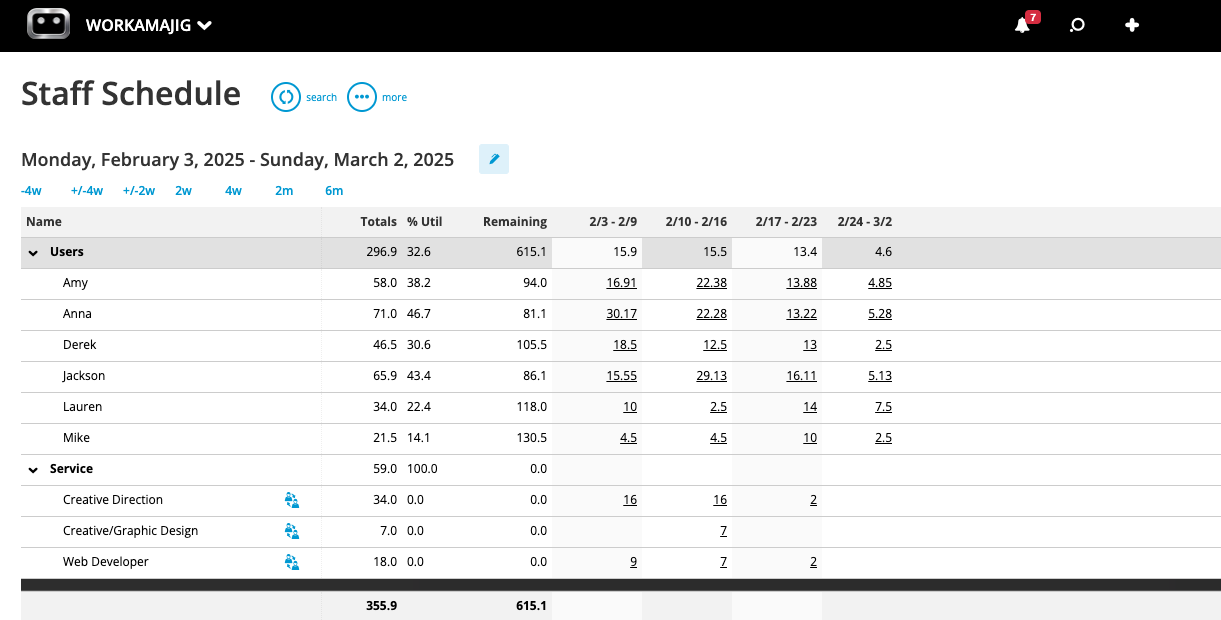
Our staff scheduling dashboard (shown in the screenshot below) allows managers to source resources with the right skill sets and plan schedules around capacity and bandwidth. It displays all available team members with a breakdown of their schedules, including:
-
The maximum hours they’re available to work. When calendars are synced with Workamajig, team members can indicate when they’re busy or out of the office (so managers don’t book them during those times).
-
The hours they’re already scheduled for (including a daily breakdown).
-
Their remaining available hours.
These insights help managers prevent scheduling conflicts and ensure workloads are evenly distributed. For example, they can adjust weekly allocations for individual team members to balance workloads and quickly reassign tasks if someone is out or overloaded.
At times, PMs lack the in-house talent needed for specific projects — maybe the skill set is missing, or resources are at full capacity — so they have to bring in outside help. Workamajig’s vendor management features are especially useful here. Managers can:
-
Source freelancers for projects. PMs can request quotes, receive and compare bids, and assign work. They can also incorporate freelancer costs into project estimates, ensuring all costs are accounted for during planning and avoiding surprises later.
-
Manage freelancers’ work. Freelancers have access to dashboards that show active projects, daily to-do lists, and task details, so managers don’t have to coordinate everything over email or track multiple threads.
-
Manage vendor invoices and payments. Workamajig includes a complete accounting system that lets billing teams reconcile invoices, handle overages, and pay vendors online. (More on this later.)
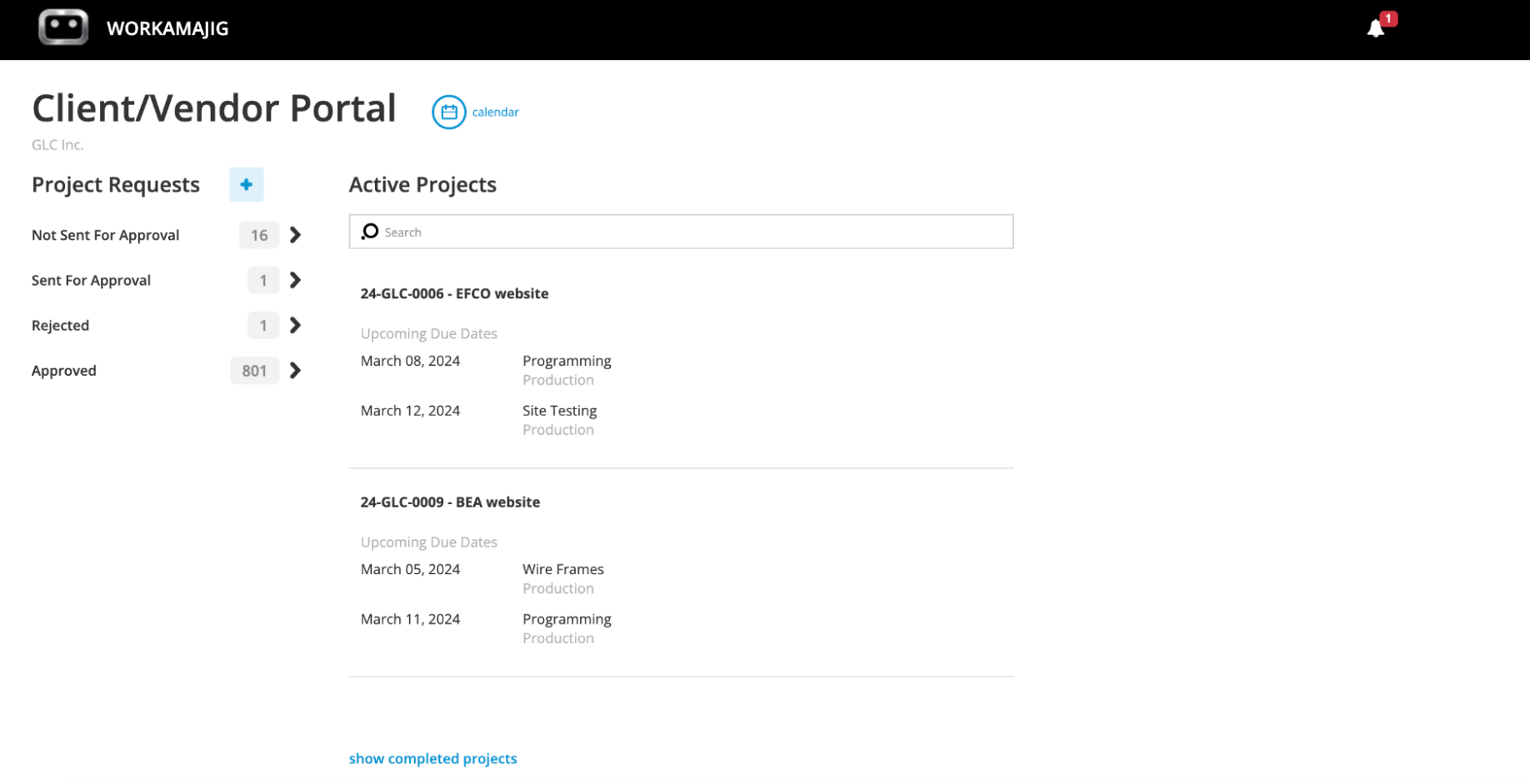
Teams can create unlimited vendor portals (and we don’t charge per portal).
Read more:
- Best Agency Scheduling Software
- Project Resource Scheduling for Agencies & Creatives
- 10 Steps to Optimize Resources in Creative Project Management
Project Collaboration Tools — Streamline Creative Feedback Processes
Our system offers personalized, role-based Today dashboards that show each user what they’re assigned to and what to work on when. These dashboards help each user track urgent tasks, plan their week, and take quick actions.
For example, the Today – Creatives dashboard allows creative users to:
- See their tasks in different views — including card, grid, and tile. The dashboard also organizes these tasks by status (e.g., completed or due today)
- Record the hours spent on each task
- Mark tasks as complete
- Submit deliverables
- View recent Project Conversations and open new ones
- See their meetings for the day and schedule new ones
- Track all the tasks they performed for the day from their Daily Feed
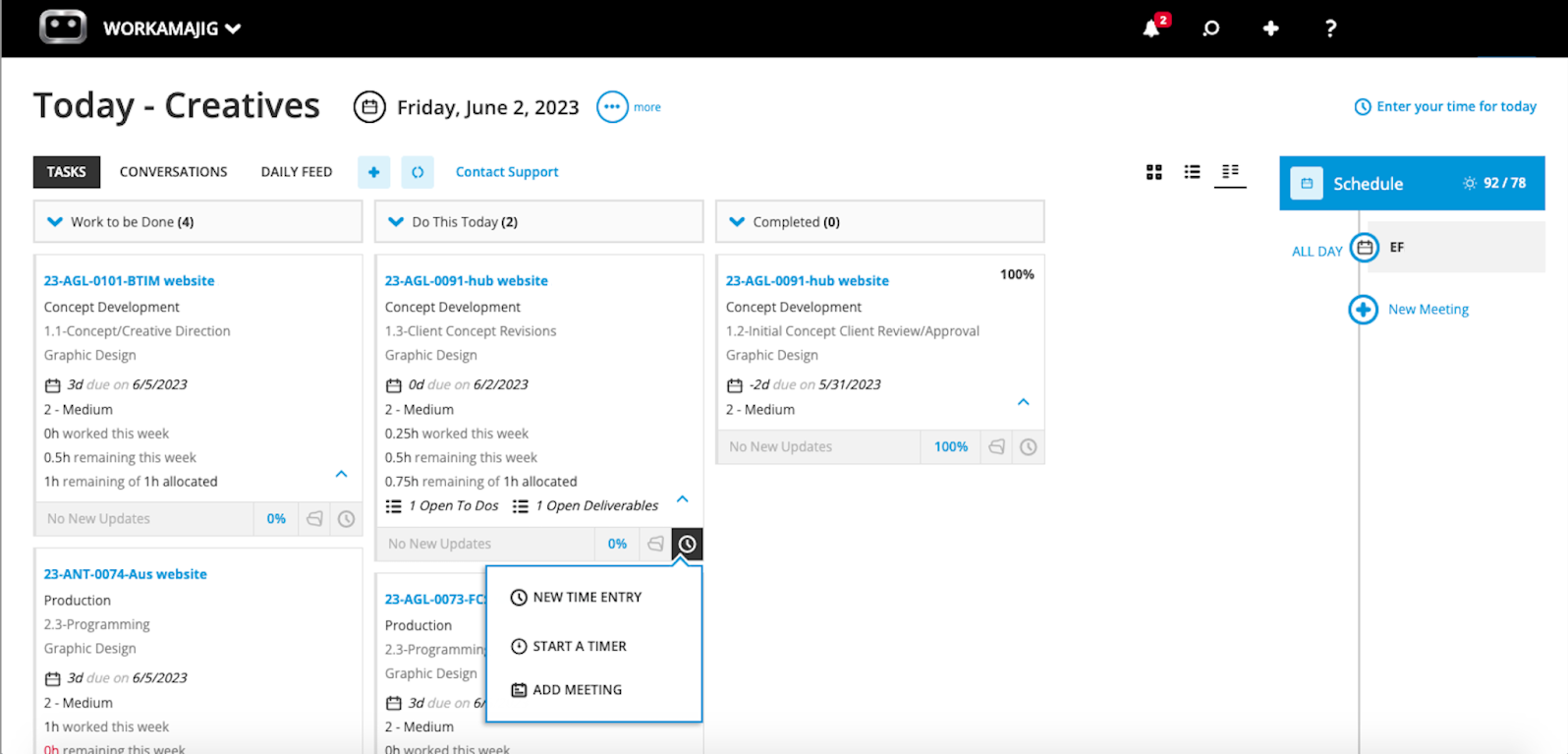
This saves managers time by clearly showing team members and freelancers what to work on, how much time to spend on each task, and when tasks are due. Managers don’t have to micromanage.
Similarly, the Today - Project Manager dashboard is tailored to managers' responsibilities. They can:
- Send prompt replies to new project requests and client emails
- Stay on top of projects and proactively troubleshoot issues
- Plan their day, manage workloads, and handle other operational tasks
- Review billing worksheets so client invoices can be finalized
- Take quick actions, such as logging time or scheduling meetings
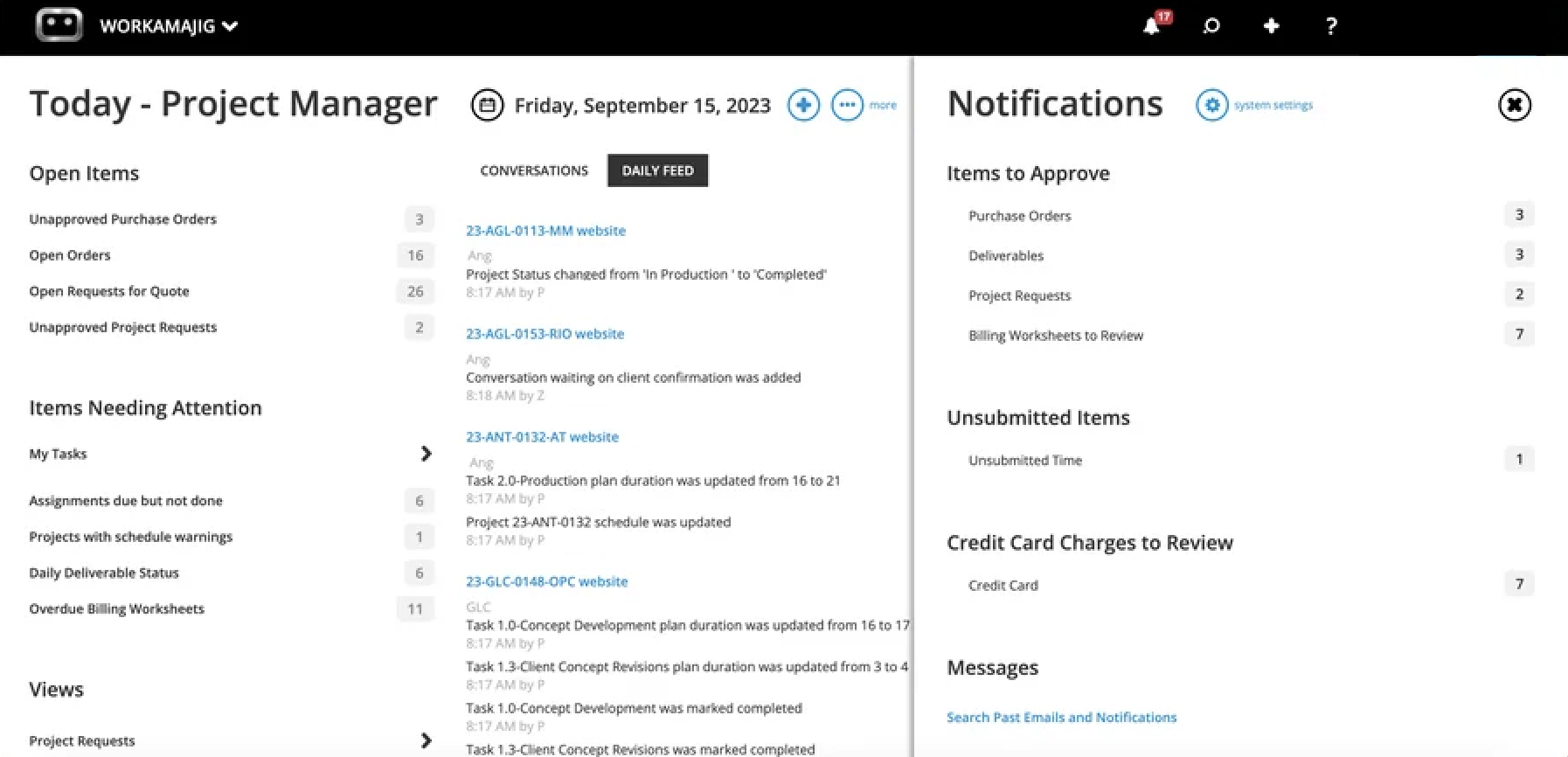
In addition, our system offers a range of collaboration tools to manage feedback, creative assets, and revisions.
Most day-to-day collaboration happens directly on Workamajig’s task cards. From there, teams can view task details and use the following tools to collaborate with internal and external stakeholders:
-
Project conversations. Teams can create notes that all project stakeholders (clients, vendors, and staff) can participate in. All conversations are stored so teams can easily reference them later.
-
Commenting. Users can comment on task cards and tag stakeholders to request additional context or feedback.
-
File sharing. Teams can create file repositories for individual projects or entire portfolios, and our system supports all common file types used by creative teams — including images, video, audio, design files, documents, PDFs, HTML, and more.
-
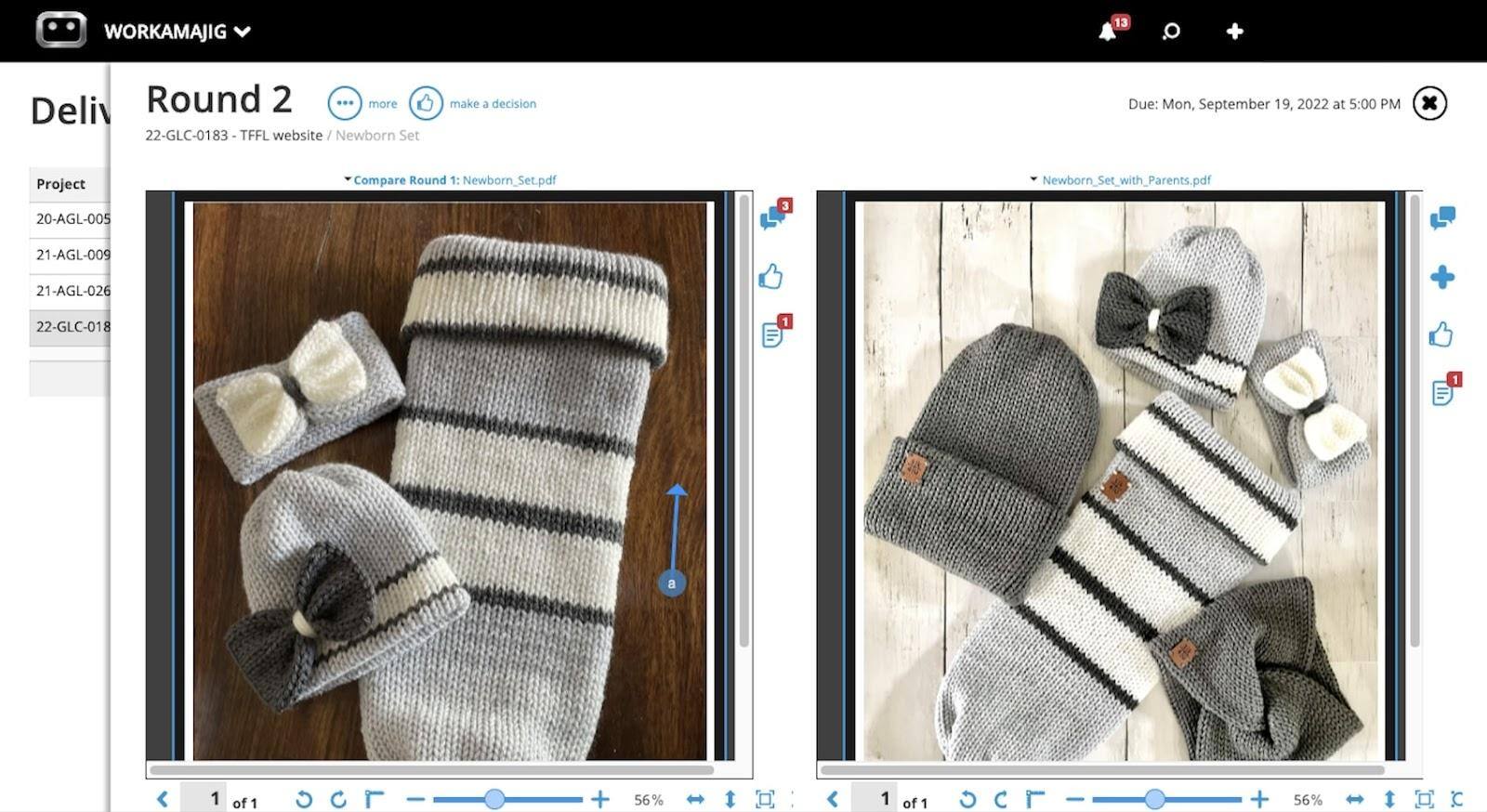
Internal proofing. Users can preview content in Workamajig, compare files side by side, and annotate them using built-in tools. Editors can then review the feedback and upload new versions as they make changes.
-
Version history. Our system stores version history for all files, so users can quickly reference past content and see edits between versions.
-
Feedback controls. Managers can restrict the number of feedback rounds to keep revisions focused, avoiding endless loops and scope creep.
-
Client portals. Teams can create unlimited client portals. Clients can request work, track project progress, share feedback, communicate with project teams, view invoices, and access deliverables.
Time & Expense Tracking — Monitor Real-Time Project Burn and Catch Issues Early
Workamajig provides several tools to keep an eye on project status after kickoff. Users can monitor real-time timelines and budgets, track actuals vs. estimates, and see exactly when projects are expected to cross the finish line. These insights allow managers to spot issues before they snowball and cause delays or cost overruns.
First, our system provides handy tools to monitor actual hours and costs as projects progress:
-
Project expense tracking. Workamajig pulls in project-related charges (including labor and vendor costs) as PMs build out project estimates. Then, as projects progress, it tracks expenses using actuals. Our system also lets teams easily consolidate costs from various other sources as they’re incurred — including media buys, credit card accounts, and receipts.
-
Time tracking. Teams can track time in Workamajig using:
-
Timers — the most accurate way to record time. Employees can turn on timers when they start tasks and pause them at any time they need a break or switch tasks. Our system records their hours when tracked by the timer.
-
Timesheets — to manually log hours the old-fashioned way.
-
Calendar event tracking — teams can use our calendar integrations to add meeting hours and tie them to specific projects. Our system automatically pulls in all scheduled meetings — users only need to confirm they attended, and Workamajig will record the hours.
-
As staff enters their time, our system automatically updates the project budget. Then, Workamajig updates: (1) the schedule with actual start and complete based on their actual progress, and (2) their actual cost of labor is reflected as a burn against estimated profitability projections.
Managers can conveniently see the status of all projects and track updated timelines and budgets from the project monitoring dashboard.
![Workamajig dashboard: Projects and Project Status [GIF]](https://www.workamajig.com/hs-fs/hubfs/Workamajig%20-%20Projects%20and%20Project%20Status%20%5BGIF%5D.gif?width=1714&height=853&name=Workamajig%20-%20Projects%20and%20Project%20Status%20%5BGIF%5D.gif)
This dashboard displays all active projects in a user-friendly view, with customizable Gantt charts and health breakdowns. PMs can color-code project phases and see exactly how far along each project is by referencing the black progress bars (as shown in the Gantt chart above).
Our monitoring dashboard also includes:
-
Project health breakdowns (on the left-hand side of our Gantt charts) with color-coded icons that highlight project status. Green means everything’s going well, yellow signals that the project is moving more slowly than anticipated or costs are reaching a warning percentage threshold, and red indicates overruns.
For example, the SF website project above shows red highlights in the Project Timeline and % Complete columns, meaning it has passed its original deadline dates and could be at risk of completing the project on time. -
Proactive risk alerts. When projects enter the yellow territory, Workamajig automatically notifies managers so they can intervene and correct course. For example, if a project’s budget is at risk, they might reduce the budgeted hours for upcoming tasks or adjust resource schedules (e.g., by assigning work to a junior role with a lower hourly rate).
|
In Workamajig, time and expense data are used for more than real-time project monitoring. Our system also uses actual hours and costs to:
We discuss these capabilities in the upcoming project reporting, financial reporting, and agency insights sections. |
Read more: Agency Cost Management Tools & Best Practices
Project Portfolios — Centralize Budgets, Schedules, and Reporting
Workamajig’s portfolio management feature — called Campaigns — lets you bring multiple projects under a single umbrella, unifying tasks, project schedules, budget tracking, file sharing, team collaboration, and reporting. This feature is handy for centralizing, executing, and monitoring more complex marketing initiatives.
Marketing agencies and in-house departments can both benefit from portfolio management in different ways — for example:
-
Agencies can create portfolios for specific client initiatives — like a product launch — that pulls together every workstream (e.g., paid ads, landing pages, email, social content) so the team can track combined budget burn, monitor deadlines across all deliverables, and ensure everything ships in coordination.
-
In-house teams running multi-channel campaigns can link every workstream together and track total cost burn in one place, making it easier to pace spending and flag overruns before they blow the quarterly budget.
You set up a new portfolio from scratch or save time using Workamajig’s campaign templates (our system also lets you convert won opportunities into campaigns from the CRM). Then, you can:
-
Add existing projects to the portfolio, and build out any new ones. Workamajig then pulls in all the details of each project — tasks, schedules, estimates, shared files, etc. — into the portfolio.
-
Build out a centralized campaign budget using estimates of each project — so you can track cost burn for the entire portfolio.
Each portfolio features a campaign scheduling dashboard (shown below) that you can use to visually track progress, edit tasks across the portfolio, or pull up the details of a specific project.
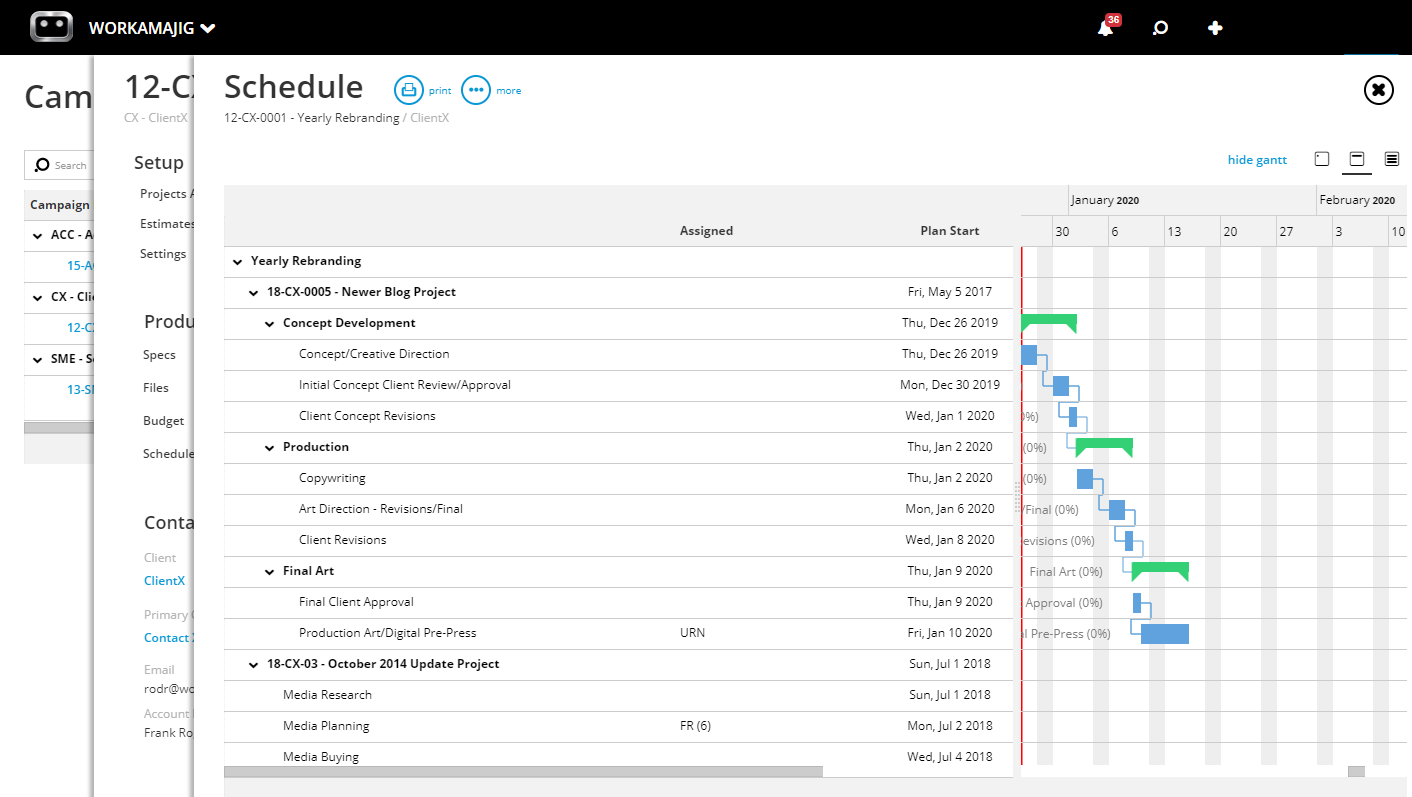
In the screenshot above, you’ll notice how the Gantt-style view shows how each project contributes to the bigger picture.
The dashboard also displays segments corresponding to different phases of the portfolio’s lifecycle — concept development, production, and final art. They can be customized to your liking — for example, some teams add segments for each financial quarter.
Workamajig also features a customizable campaigns dashboard to conveniently track schedules, budget burn, recent conversations, and deliverables. You can also edit the campaign's settings and view related details, including shared files, transactions, budgets, and more.

|
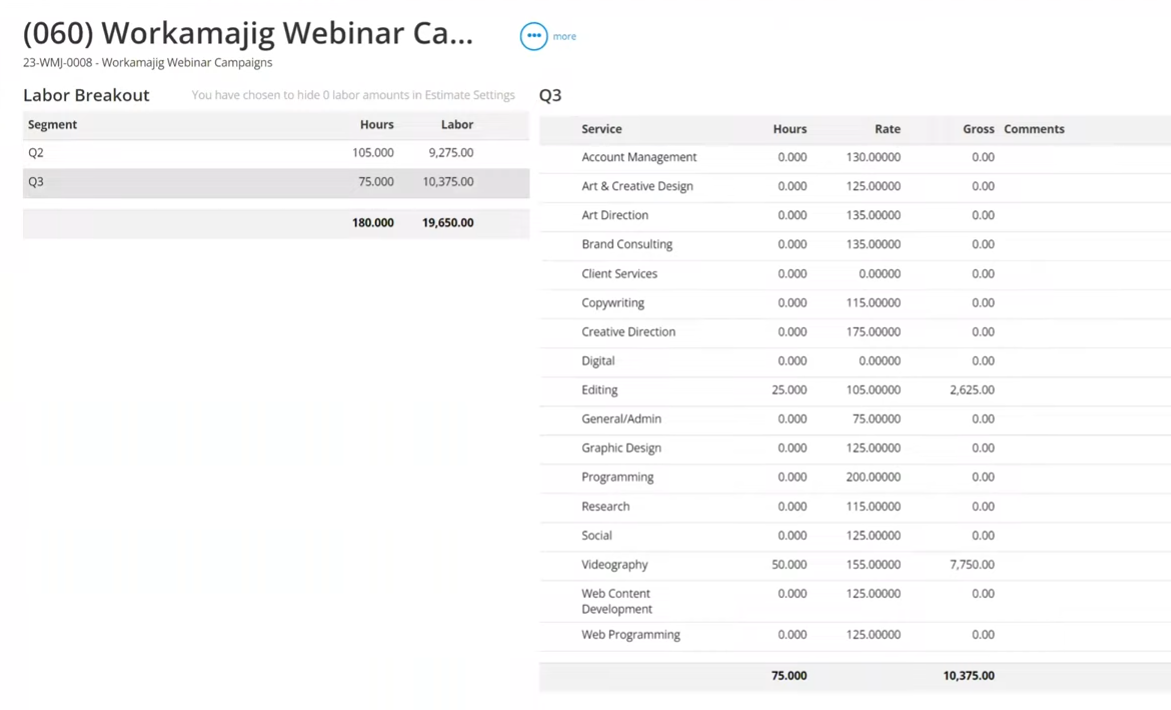
Building a Portfolio Budget When Projects’ Details are Missing The method that we discussed above for building out a campaign budget assumes two things:
If you don’t have all of this information, then you can still build out campaign budgets using your agency’s service rates. Our budgeting feature includes a “by service” option that takes the hours you’ve committed to for each service — e.g., 200 for copywriting and 100 for art direction — and multiplies them by average hourly rates to calculate labor rates. Then, the total labor gross for all services are used to build a centralized campaign budget. |
Read more: Best Campaign Management Software for Agencies & Creatives
Project Reporting Tools
Workamajig provides an extensive project reporting suite to evaluate project performance and profitability from different perspectives.
The three most popular project reports include the recap analysis, budget analysis, and P&L — here’s more on what each one tells you.
Project Recap Analysis
The recap analysis report provides a clear breakdown of actual vs. estimated labor hours, labor costs, and due dates, highlighting variances to show where work exceeded — or fell short — of expectations.
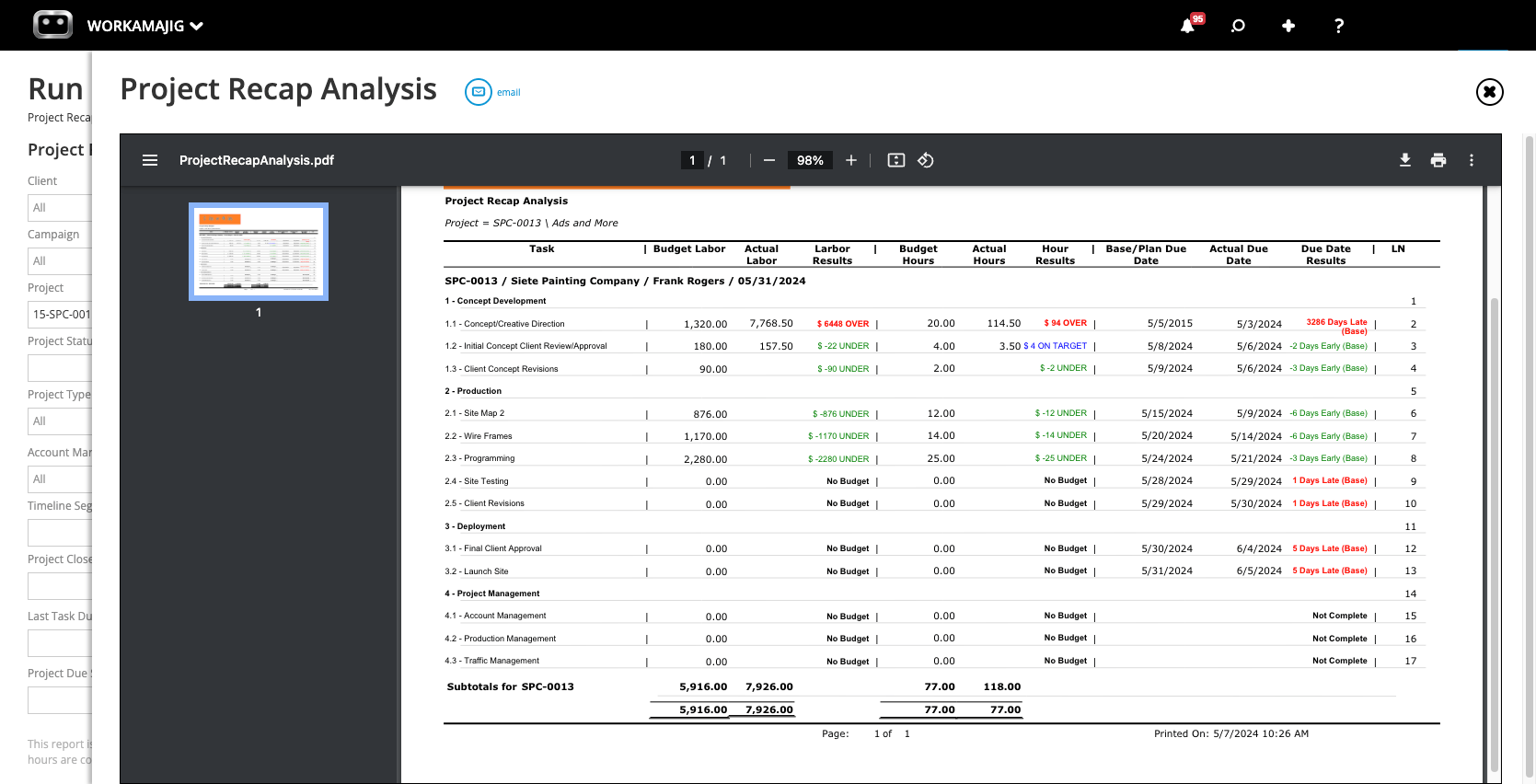
This helps teams dig into the finer details of a project and where things went wrong. For example, if a specific type of work consistently takes longer than expected across projects, then you may want to reconsider its time allocations.
Project Budget Analysis
The project budget analysis report details how your budget compares to actual spending across multiple projects.
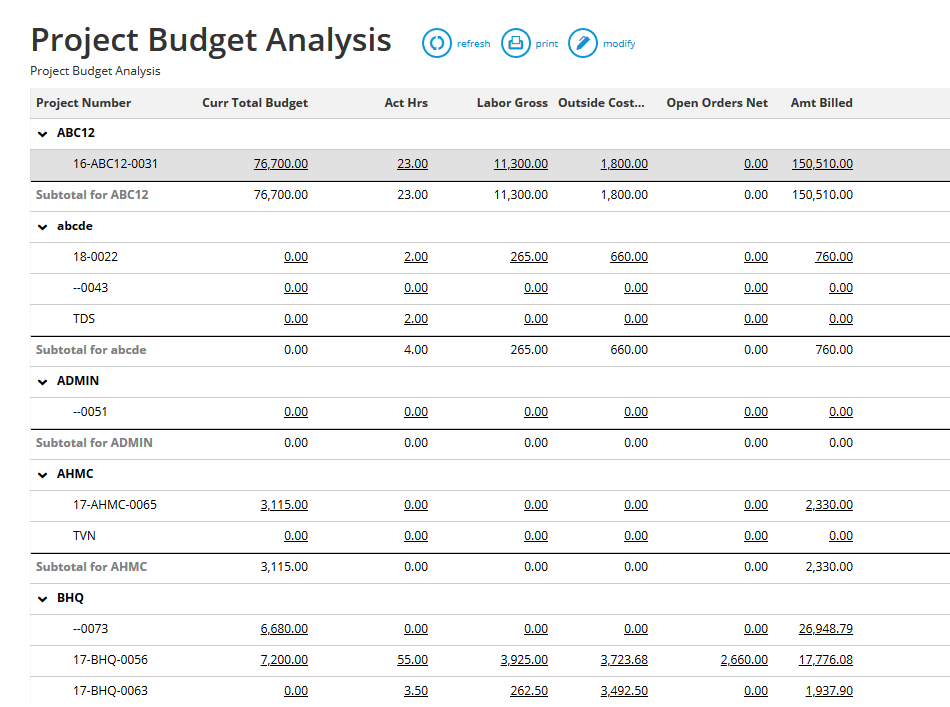
You can click into the columns here to drill down and view the individual transactions. By default, the report shows the project’s full transaction history, but you can also narrow these results down by selecting a date range.
The report, along with the approved budget page, lets managers view a project at either a high level or in detail — broken down by project, task, or item — against the current budget. You can customize which columns appear and make your own layouts that reflect how you calculate gross profit, labor net, etc., and save your settings for future use.
Project Profit & Loss
While Workamajig features your standard corporate profit and loss (P&L) reports, our system also includes project P&L reports so you can see exactly where you’re making money or taking losses.
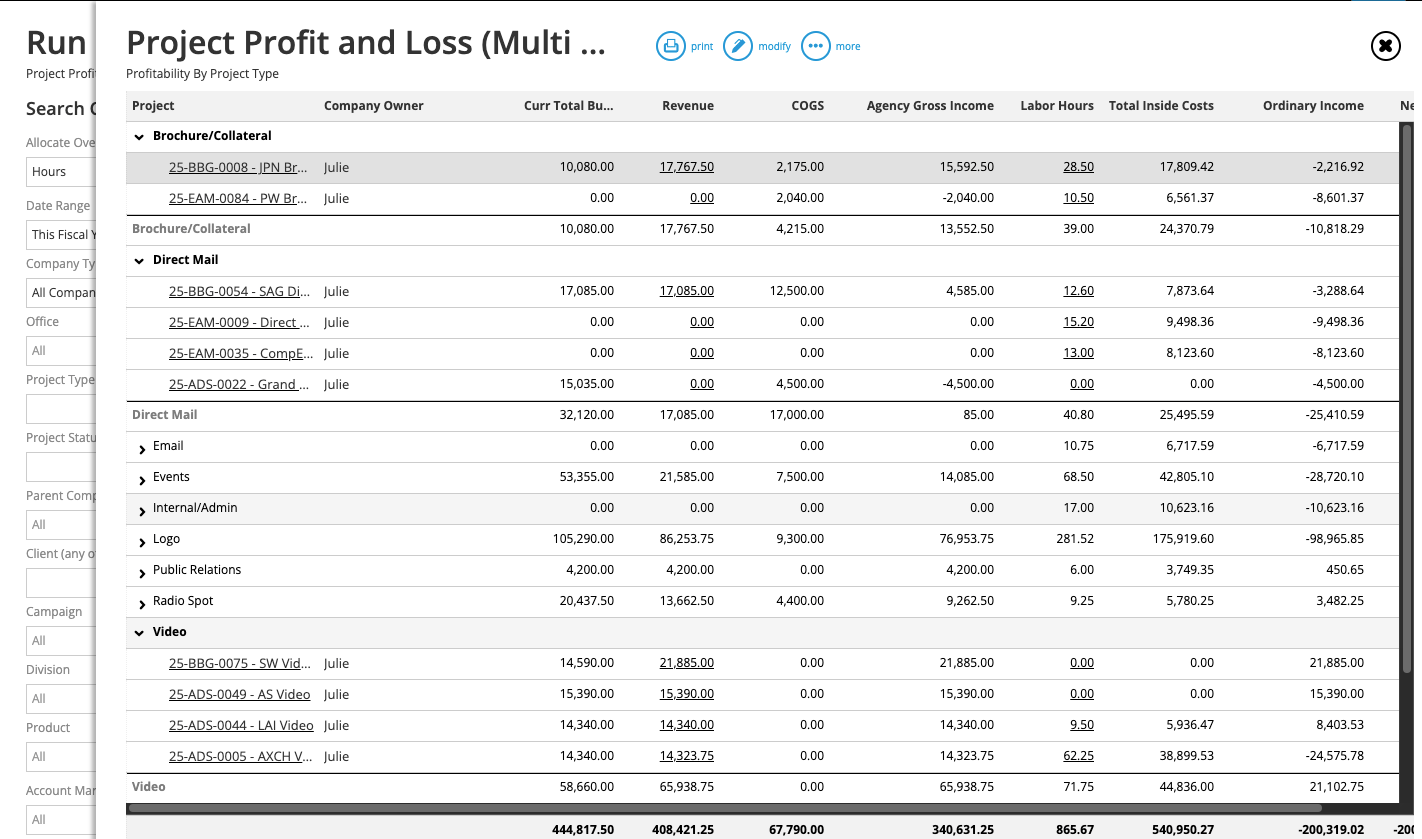
Our project P&L reports are available in two formats:
-
Detailed views — to evaluate the profitability of a specific project with breakdowns by general ledger account, so you can see where money is being spent. For example, the breakdown may show that labor hours were efficient but vendor costs were higher than expected, reducing the profit margin.
-
Multi-views (as shown in the screenshot above) — so you can see the profitability of multiple projects and spread overhead costs from the general ledger across them.
These P&L reports also calculate profit differently from the Budget Analysis reports. While the latter calculates labor directly from staff hours, our P&L reports take into consideration an allocation of overhead based on actual hours utilized for the project.
Read more: Project Status Reporting Made Simple (with Templates & Tools)
Workamajig Accounting Suite
Workamajig comes with a full accounting suite that fully replaces systems like QuickBooks, NetSuite, Xero, or Sage (allowing marketers to consolidate their tech stack even further). Our various accounting tools:
-
Streamline the entire project billing workflow. Workamajig supports multiple project billing methods (time & materials, fixed fees, retainers, media, advanced billing, work-in-progress billing), so teams can choose their preferred method per project.
Billing teams can collaborate with AEs and PMs in Workamajig to ensure all line items are accurate and billable hours are accounted for before they generate a final invoice. -
Track and aggregate project expenses. As mentioned above, Workamajig automatically pulls in labor and vendor costs. We also offer several integrations to consolidate costs from different sources. For example, teams can import:
-
Charges from both credit card and spending accounts via our Plaid integration.
-
Expenses from media buys via our integrations with Strata/FreeWheel, Mediaocean, Bionic, and GaleForceMedia.
-
Enable vendor invoice management. As we mentioned earlier, Workamajig lets teams manage, reconcile, and pay vendor invoices. Users can conveniently make online payments to vendors through our integrations with Edenred Pay (formerly CSI) and AvidXchange (formerly FastPay).
-
Allow marketing teams to collect online payments. Billing teams can collect client payments in various ways, including through credit cards, through Workamajig’s integrations with Payflow Pro and Authorize.net.
-
Support global teams. Our accounting system is GDPR-, GAAP-, and HMRC-compliant. It also supports multi-currency and multi-entity accounting, including tracking foreign-currency exchange rates and processing transactions.
-
Facilitate all other accounting workflows. That includes accounts payable and receivable, receipt management, expense management, reimbursements, and more. You can read all about these features in our guide to the best media accounting software.
Next, we’ll take you through:
-
How to manage the entire project billing process in Workamajig.
-
How to keep track of what’s happening (e.g., invoice status, pending billing worksheets) and take quick actions from your central command hub, the Today - Billing Dashboard.
-
Workamajig’s financial reporting suite and Agency Insights dashboard.
Project Billing & Generating Client Invoices
As we mentioned above, Workamajig enables billing teams to coordinate with AEs and PMs before the final invoice is generated, ensuring they get it right the first time.
While our system supports any standard billing workflow, following our recommended approach saves agencies time and reduces headaches by minimizing back-and-forth, adjustments, reprints, and deletions. Here’s how it works:
-
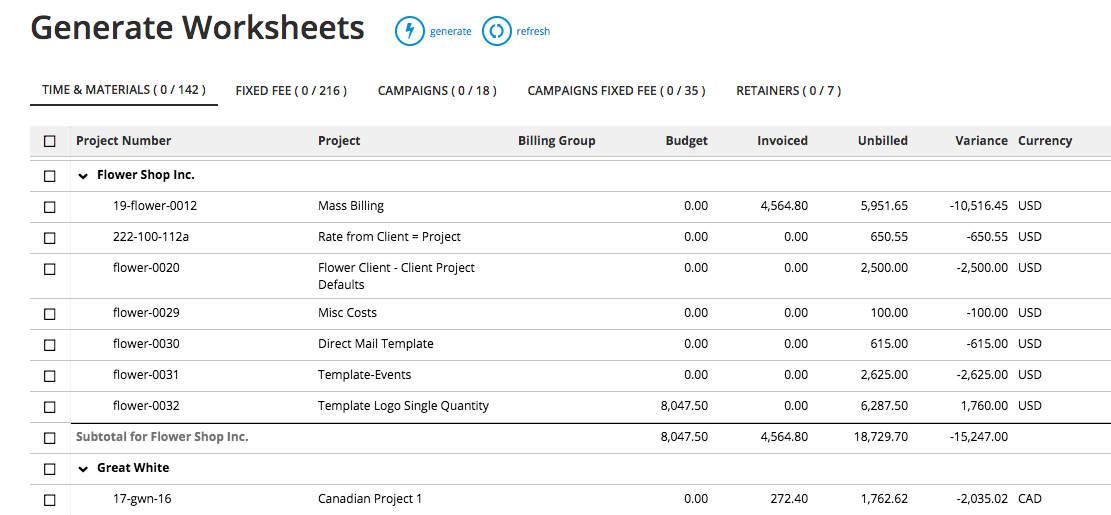
When a billing cycle approaches, users generate an electronic billing worksheet for the project, which is based on either 1) the project’s budget or 2) transactions.
-
The worksheet comes pre-filled with all relevant line items, including expenses, transactions, and prior billing, thanks to Workamajig’s time-and-expense tracking.
-
Workamajig automatically sends the worksheet to the designated approver — usually an AE or PM — so they can double-check all the line items and make any changes (e.g., marketing items up or down, writing things off).
-
Once they’ve signed off on everything, they can submit it for approval, which automatically routes it back to the billing team.
Then, the billing team can generate a final invoice from the approved worksheet, send it over to clients, and request payment.
Read more: Best Creative Project Management Software with Invoicing
Workamajig Today - Billing Dashboard
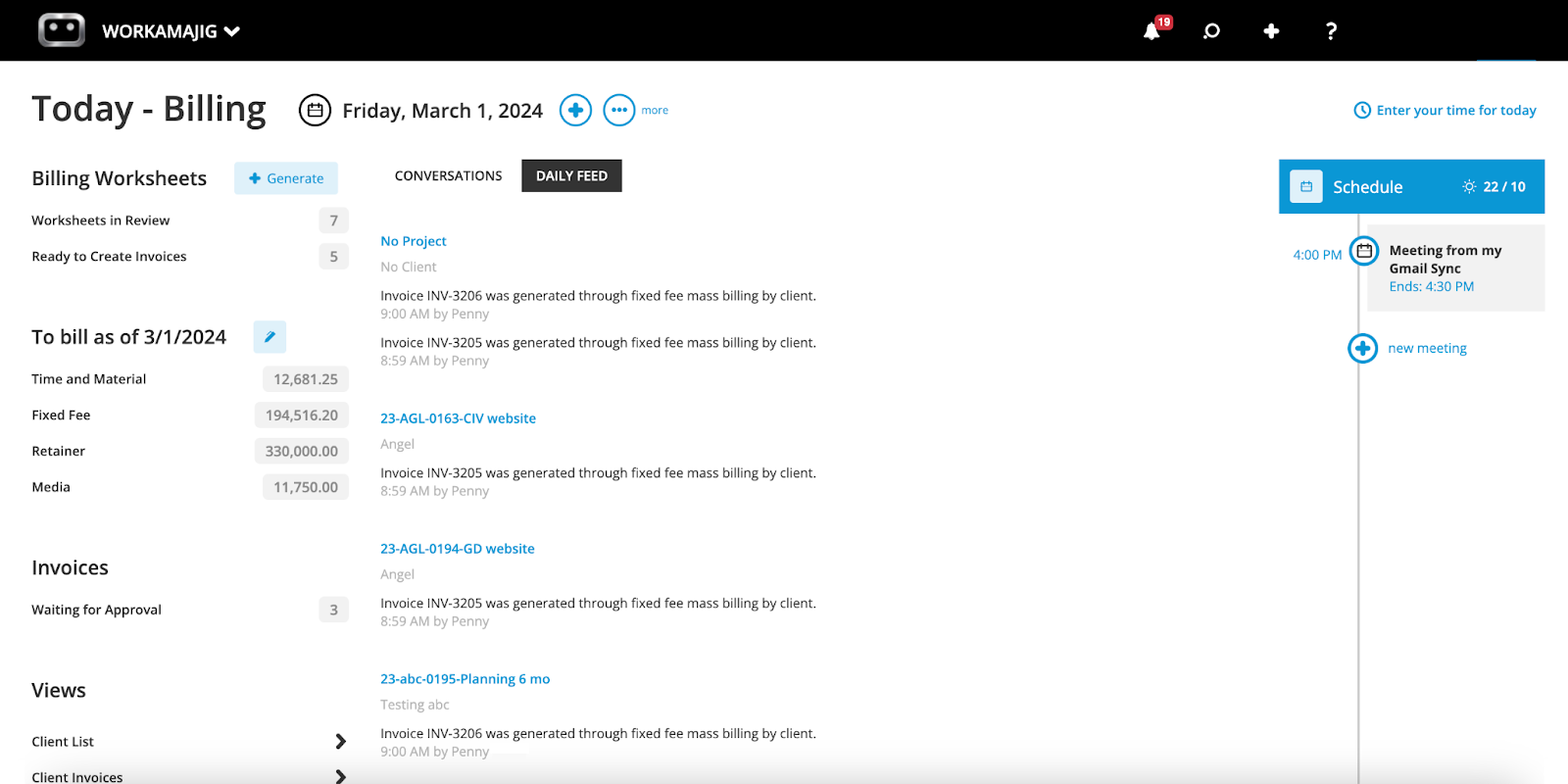
Billing roles in Workamajig get their own personalized Today - Billing Dashboard (as shown in the screenshot above) to track what’s available to bill, take quick actions, view recent conversations, and access billing reports.
For example, while the billing workflow that we described above takes place:
-
Billing worksheets are classified as “Worksheets in Review” when they’re routed to the AE or PM.
-
They’re classified as “Ready to Create Invoices” once they’ve been submitted for approval.
The dashboard also helps billing users track:
-
Projects that need to be billed. Our system constantly monitors projects for billable items, pulls the information into your dashboard, and organizes each entry by project billing type — including time & materials, retainer, media, and fixed-fee.
-
The status of invoices. They can instantly see which ones require attention (e.g., pending approvals) and take action to keep things moving.
-
Billing-related reportings. Users can conveniently navigate to listing screens — such as client lists, transactions, or invoices — or their preferred reports from the Views section of the dashboard.
Users can also:
-
Take quick actions right from the dashboard — such as storing a receipt, generating an invoice or billing worksheet, or submitting a new time entry.
-
View all billing worksheets using the “search” feature. From here, they can edit line items, write things off, and generate invoices (including in bulk).
Financial Reporting
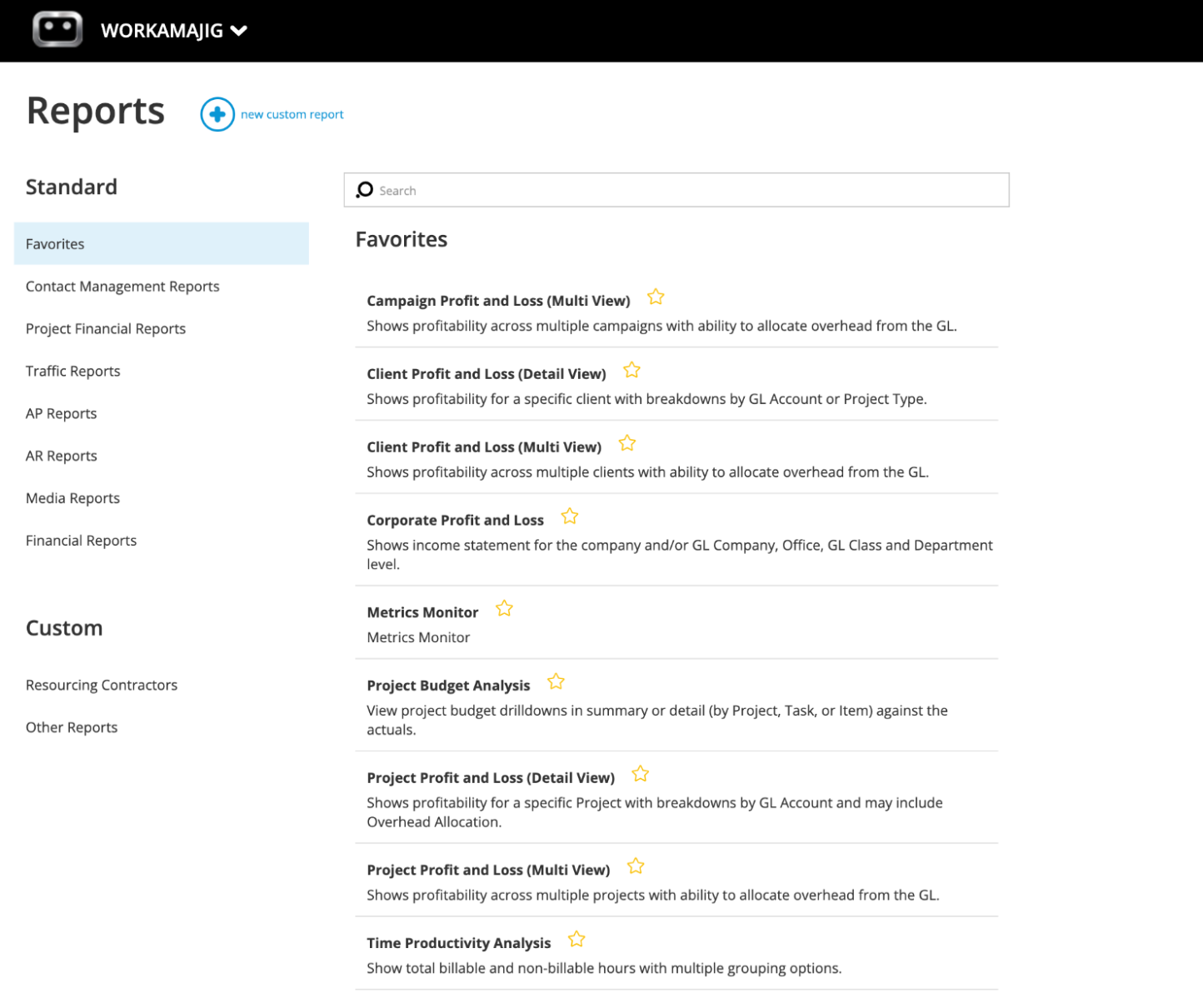
In addition to the project-specific financial reports that we discussed earlier, Workamajig’s financial dashboard includes a variety of reports to monitor your agency’s financial performance. Some of our most popular reports are:
-
General Ledger (GL) reports for complete financial oversight
-
Cash projections and revenue forecasting to assist with future planning
-
Budgeted vs. allocated vs. actual costs
-
Other P&L reports — including corporate, campaign, and client
-
Cash flow — our system automatically defers advanced payments to provide more accurate numbers here
-
Client and campaign profit and losses — offering different perspectives into agency profitability
-
Billable summary reports to compare billable vs. non-billable hours
-
Hourly realization rates to help you evaluate productivity from a financial perspective
-
Key metrics monitor to track the metrics that drive your business
You can save your most-used reports as Favorites to conveniently access them from your personalized dashboard.
Read more: Best Creative Project Management Tools with Financial Tracking
Agency Insights
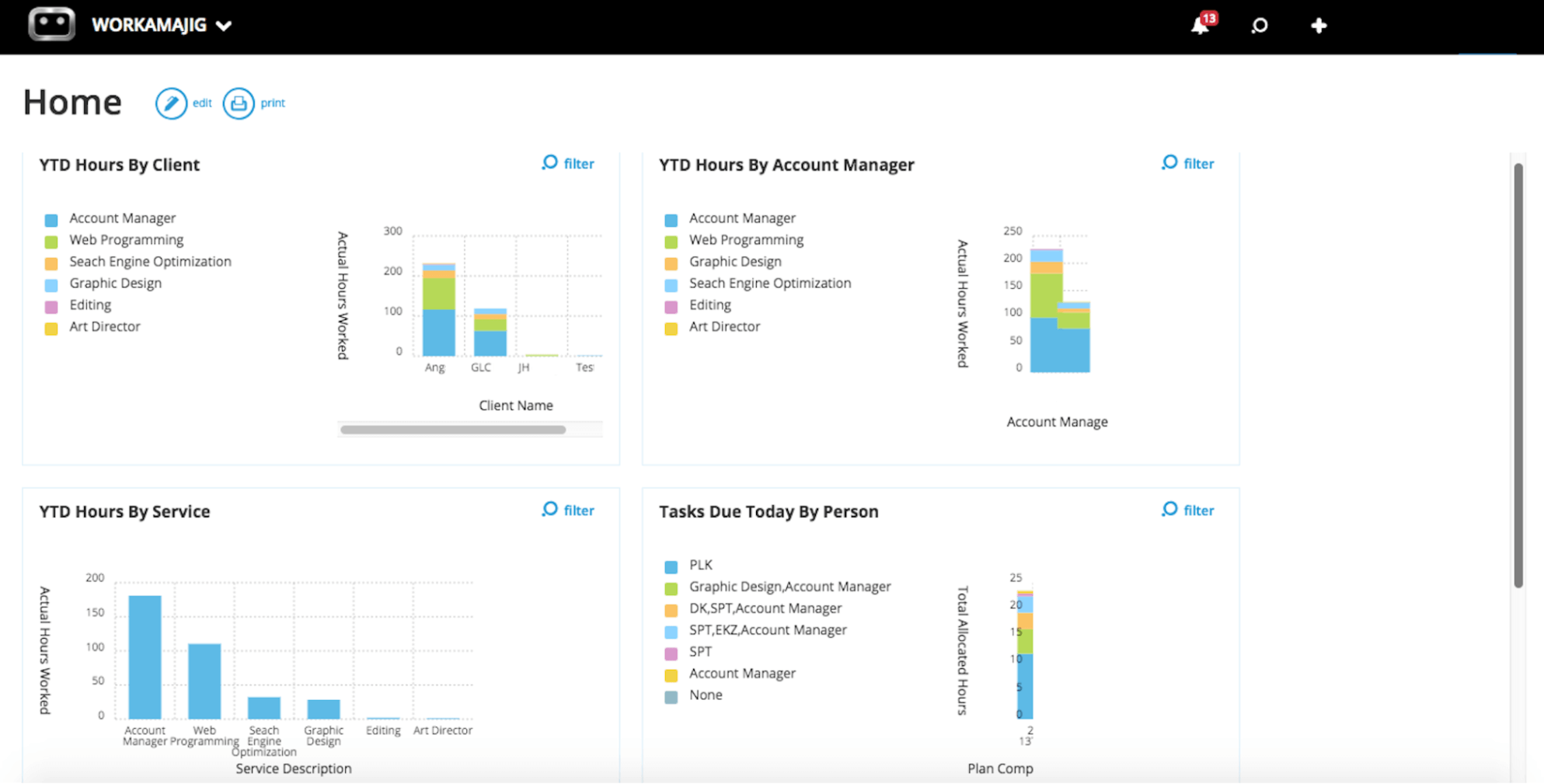
In addition to financial reports, Workamajig includes an Agency Insights dashboard to analyze project hours and see where your team members and freelancers spend their time.
This dashboard shows you hours by client, service, and department — you can dig into which clients, projects, and tasks take up the most time and get a feel for how long these tasks take, on average. You can also see which teams you utilize the most often and who works the most hours.
Agency Insights helps you:
-
Balance project schedules to ensure everyone has a consistent workload.
-
Identify resource-intensive services and determine ways to complete tasks more efficiently.
-
See which clients you’re spending too much time on and determine how to troubleshoot.
-
Track billable vs. non-billable hours, implement labor budgets, and optimize resource allocation.
-
See where teams will be spending their time in the days and weeks ahead to make any adjustments.
Pricing & Getting Started
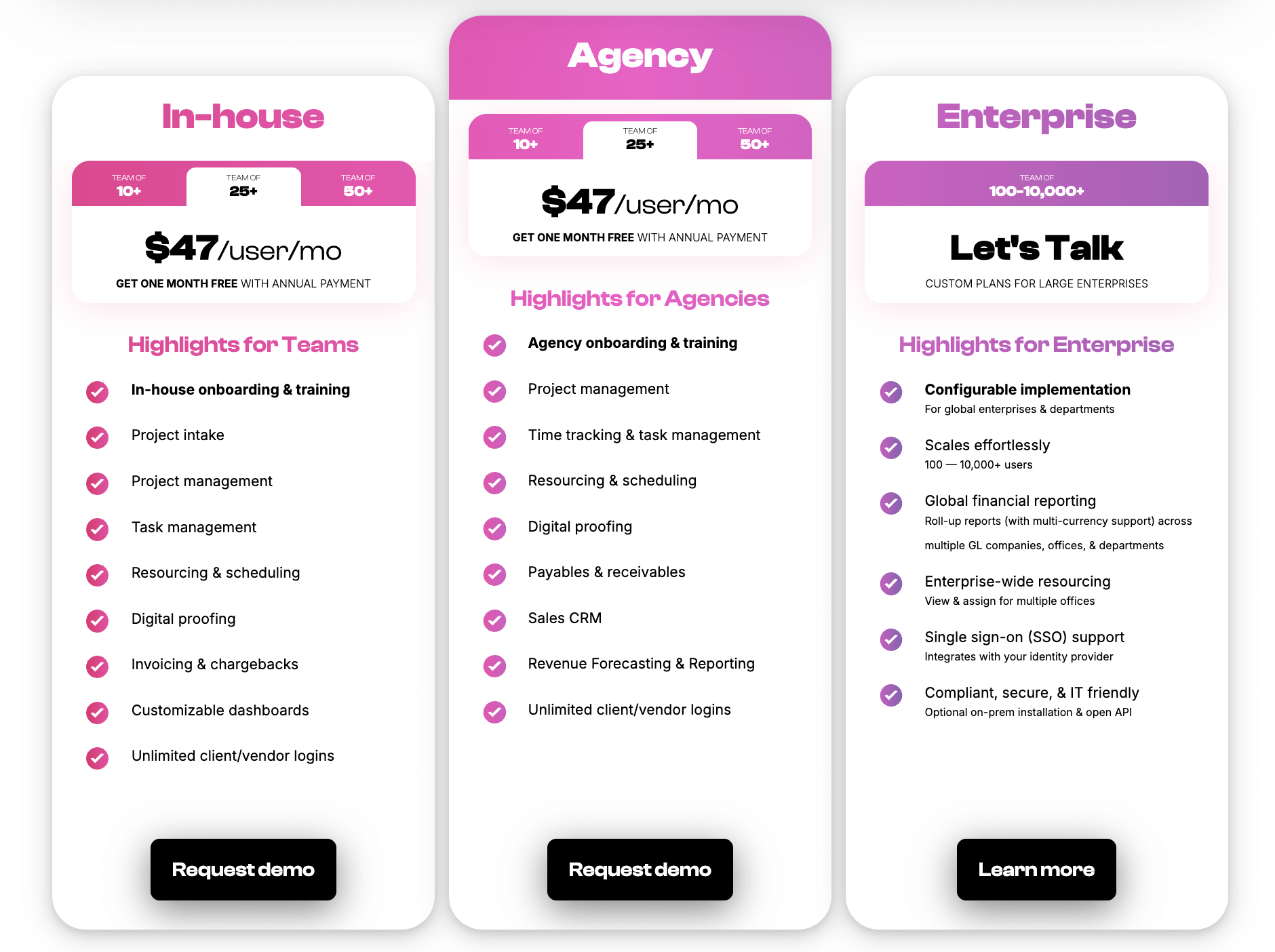
We offer solutions for in-house teams and marketing agencies, and can also design custom enterprise plans. During your demo, you can specify whether you’re interested in Workamajig to support an internal marketing department or an agency, and we’ll show you how we configure our platform to meet your requirements.
All of our plans include a dedicated account manager who provides free onboarding, training, and ongoing support — pricing is based on team size:
To learn more about Workamajig’s marketing project management tools, request a demo.
2. Advantage
.png?width=2000&height=878&name=Advantage%20Simpli.fi%20homepage%20(2024).png)
Advantage is a popular project management solution for marketers because it offers comprehensive agency management software, including native media buying and planning, following its merger with Simpli.fi.
Marketers who need media planning software — in tandem with project, resource, financial management, accounting, and time tracking — often turn to Advantage’s solution.
Advantage is typically reserved for larger agencies and marketing teams in enterprises, as it’s a very comprehensive software (and comes with an expensive price tag).
All in all, Advantage receives positive customer reviews; customers appreciate that it includes full media planning software and an accounting suite. However, some mention that set-up is lengthy and the platform has a bit of a learning curve; they also mention dissatisfaction with the overall ease of use.
Notably, some users dislike Advantage’s project management workflow, but they offer demos before starting, so you can gauge this yourself and see if Advantage’s PM tools would align with your processes.
Read more Advantage reviews here.
Notable Features for Marketers
- Project & task management
- Tools to calculate estimates
- Resource management
- Vendor management
- Time tracking
- Collaborative tools like proofing & reviews
- Media planning & buying — including broadcast buying, digital buying & media reporting
- Budget monitoring
- Media Accounting
- Billing & invoicing
- Financial reporting with revenue forecasting
- Reporting dashboard (to analyze project performance, financials, staff hours, etc.)
Pricing
Advantage doesn’t disclose pricing online — if you're interested in this tool, you must contact them for a quote.
Read more: Best Advantage Software Alternatives for Creative Teams
3. Clients & Profits
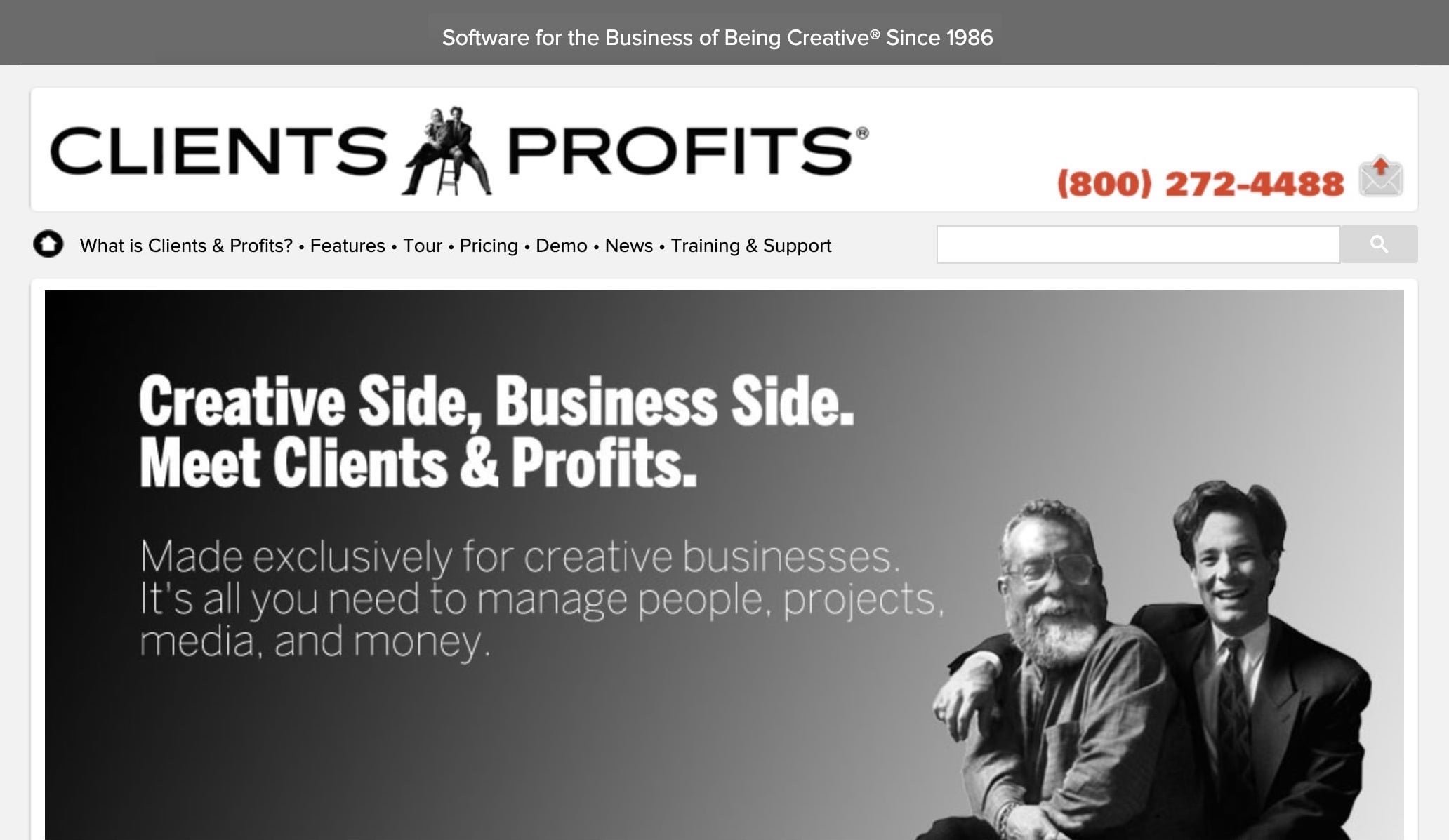
Clients & Profits offers a project management tool for marketing agencies and marcoms. In addition to project and task management, C&P includes resource management, time tracking, media planning integrations, financial management, and accounting. It was designed to help marketers “manage people, projects, media, and money.”
C&P works with marketing teams and agencies of all growth stages; they can configure their platform for various use cases and show you how to adjust settings as you scale, add users, or change processes.
They also offer consulting services to guide your marketing strategies and show you how to see greater ROI from your work. (C&P has been working with marketers and creatives since 1986.)
Customers typically like C&P for their hands-on approach and consulting services, but voice complaints about the software's usability, as the features and UI could use a modern upgrade.
Find more Clients & Profits reviews here.
Notable Features for Marketers
- Project request forms & tools to calculate estimates
- Project planning & task management
- Project management & monitoring
- Team management with live scheduling
- Time tracking
- Vendor management
- Collaborative tools to gather feedback from team members & clients
- Portfolio management
- Workflow automation tools
- Financial reportin
- Full accounting system with automatic billing & invoicing tools
- Integrations with media planning systems
- Adobe XD plugin
Pricing
Clients & Profits offers unique packages for studios, agencies, and marcoms. You choose the package that fits your teams and pay per user.
- Power users receive full access to the C&P platform for $59/month.
- Project managers can join the platform for $39/month.
- Creatives and other team members can join for $19/month.
- Freelancers can access the platform in a free plan, but you can also pay an extra $9/freelancer/month to give them access to collaborative & time tracking tools.
Read more: Clients & Profits Software: Reviews & Alternatives
4. RoboHead
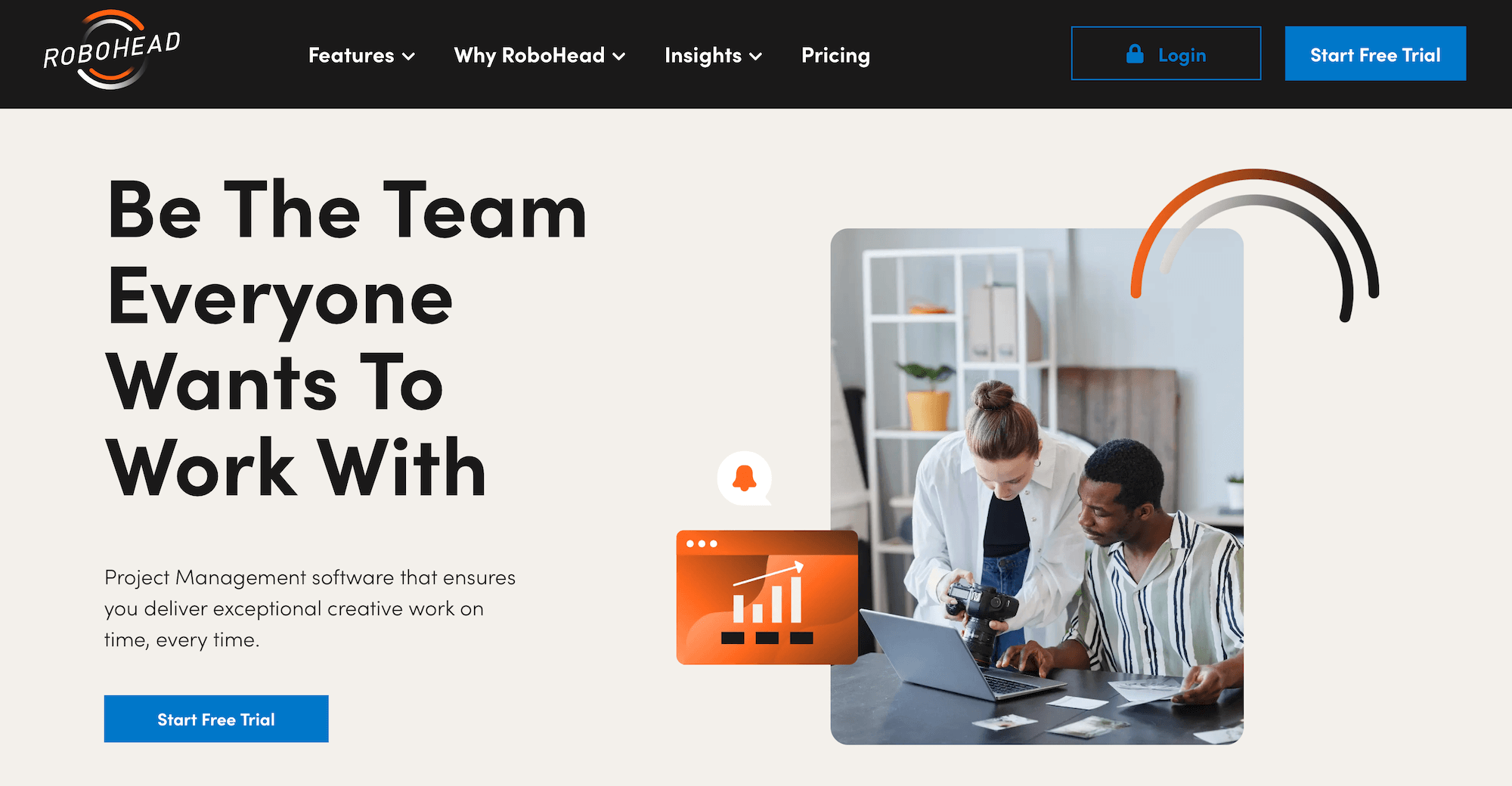
RoboHead is a project management tool tailored to marketers’ and creatives’ workflows. They offer packages to support teams of all sizes, but this solution might appeal to small and growing teams due to its ease of use and modern, intuitive features.
RoboHead’s solution brings project management, resource management, time tracking, and financial reporting under one roof. It also offers a range of collaborative tools to help project teams, freelancers, and clients work together and push projects over the finish line.
RoboHead does not include a full accounting system or media planning features. However, marketers like that RoboHead integrates with various business applications (like calendar tools, accounting software, and Adobe’s Creative Cloud).
Check out more RoboHead reviews here.
Notable Features for Marketers
- Project request forms
- Project planning with templates
- Task management
- Project management & monitoring
- Team management with staff scheduling
- Time tracking
- Collaborative tools to support feedback discussions & revisioning
- Portfolio management
- Workflow automation tools
- Financial reports
- Integrations
- Adobe XD plugin
Pricing
RoboHead doesn’t share pricing on its site; you have to contact them for a custom quote.
We should also note: RoboHead offers free onboarding and a 60-day money-back guarantee if you’re unhappy with the platform.
Read more: Best RoboHead Alternatives for Creatives & Marketers
5. Productive
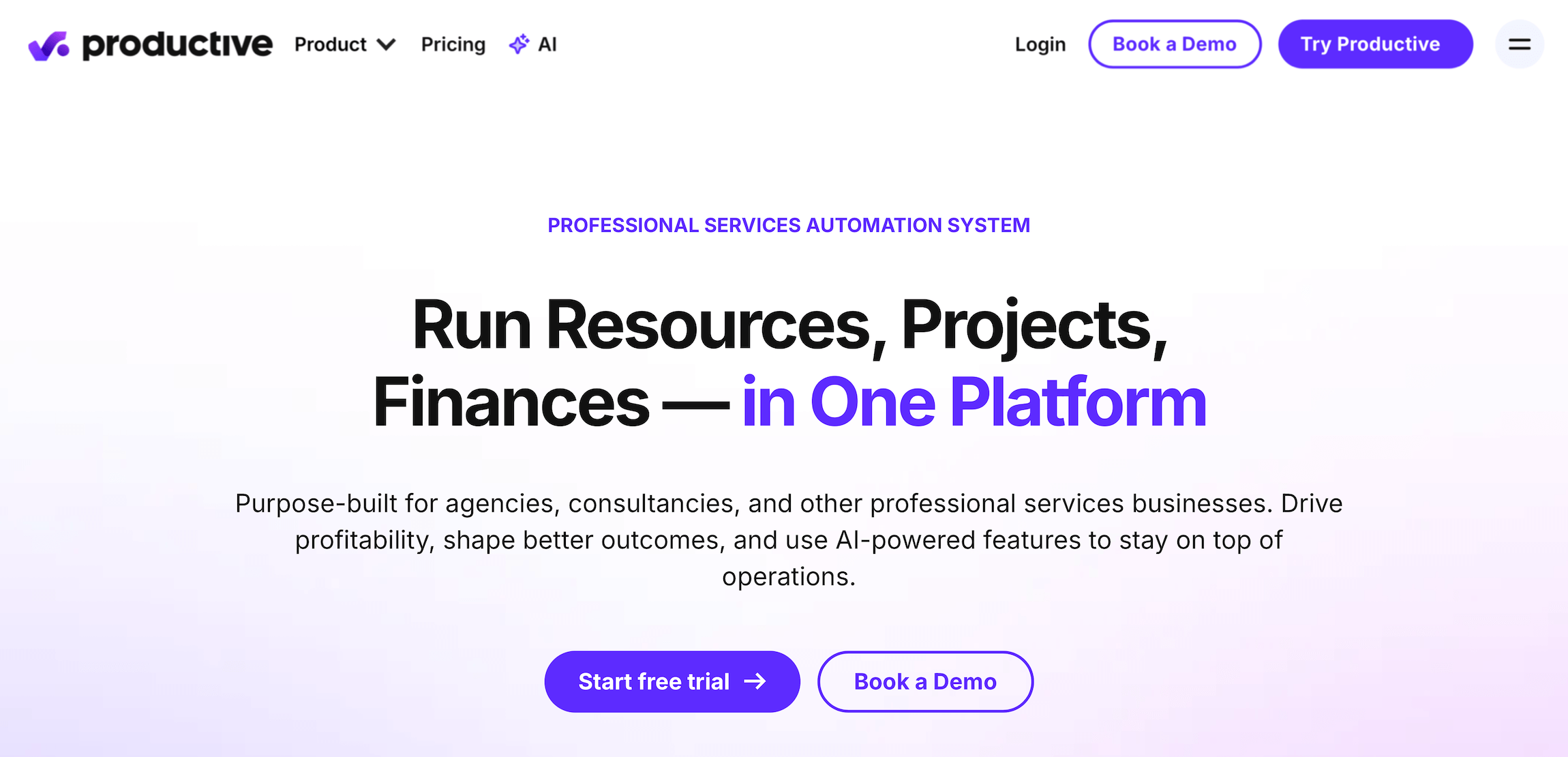
The next option on our list, Productive, is advertised as an agency management software for marketers and creatives. It brings project management, resource planning, budget monitoring, time tracking, financial reporting, and invoicing under one roof. Users like Productive for its variety of tools for calculating accurate estimates, managing budgets, and tracking real-time profitability.
Unlike the options above, Productive does not include a full accounting suite or media planning tools, so it might be better for small businesses or growing teams that aren’t as interested in those solutions.
Productive integrates with dozens of software to serve as marketers’ single source of truth. Although it doesn’t offer accounting or media planning tools, marketers can use the open API to connect those systems with Productive and pull data into the system. Productive also uses integrations to power or supplement certain features, like financial reports.
Productive’s notable integrations include QuickBooks, Zero, Sage, SAP, Justworks, ADP, Slack, HubSpot, Google, Microsoft, and Jira.
Read more Productive Reviews here.
Notable Features for Marketers
- Sales CRM
- Project management
- Resource planning
- Time tracking & timesheets
- Documents (to create shared docs & collaborate with teammates)
- Budget management dashboard
- Real-time profitability tracking & financial reporting dashboard
- Billing & invoicing
- Reporting
- Open API (to integrate with outside systems)
- Mobile apps for iOS & Android
Pricing
Productive offers three packages and custom enterprise plans.
Packages include varying features and levels of support, though Productive’s site recommends choosing the Ultimate package to access all core project management tools.
-
Essential ($12/user/month): Their entry-level plan with basic feature access.
-
Professional ($29/month/user): Their mid-level package contains more advanced project, resource, and budget management tools.
-
Ultimate plan ($40/user/month): Their top-tier package unlocks access to even more advanced features (such as revenue forecasting) and HubSpot integrations.
Read more: Best Productive Alternatives for Agencies
6. Scoro
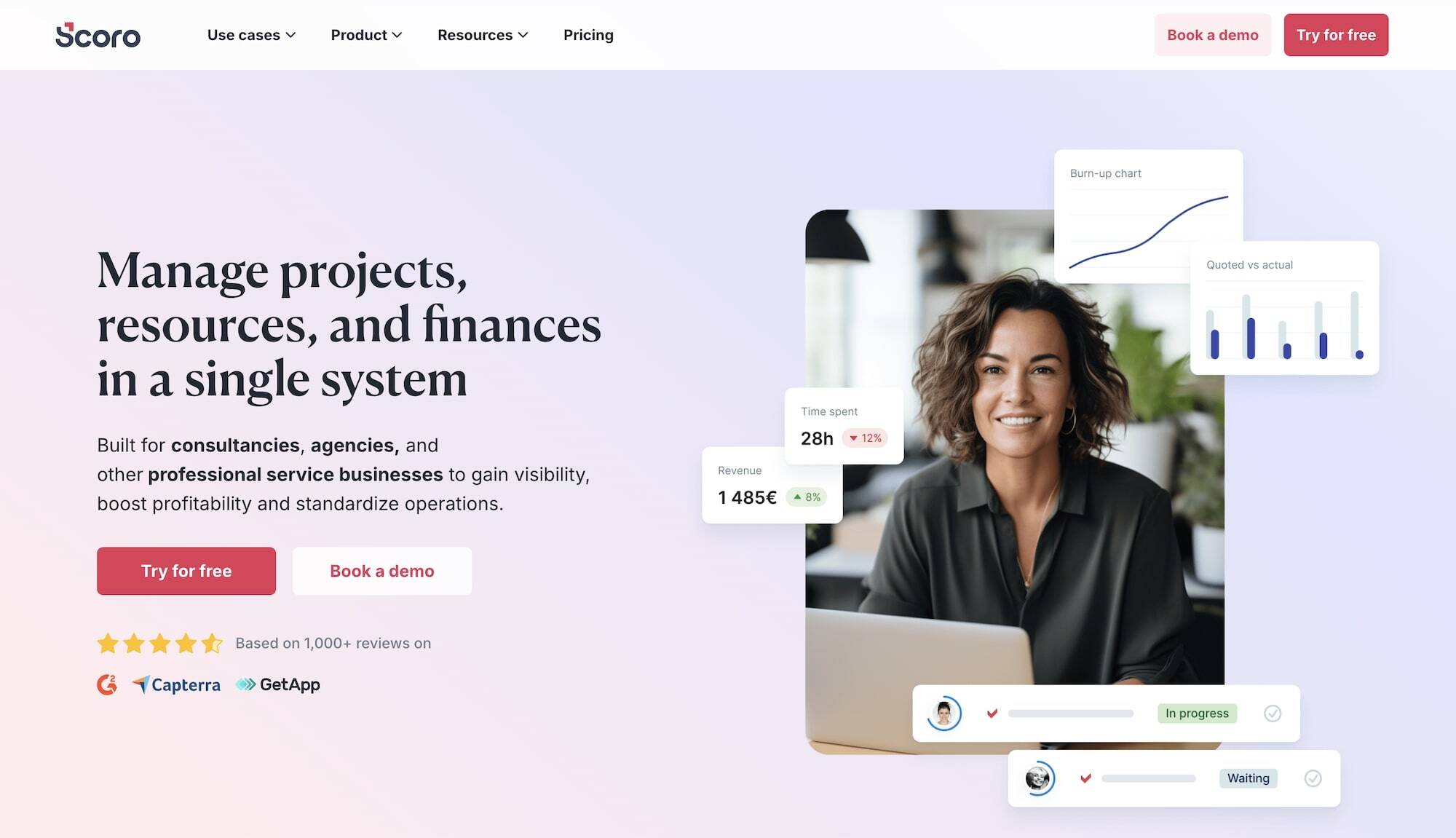
Scoro offers an extensive project and agency management system that supports service businesses, including agencies, consultancies, and professional services providers. Like Productive, Scoro supports all essential daily workflows, from project management to financial reporting.
Users particularly love Scoro’s robust project monitoring and powerful financial management tools. The system lets them:
-
Create service packages that standardize proposal creation, ensuring sales reps price services the same way.
-
Ensure projects are profitable by comparing actuals vs. estimates across portfolios.
-
Monitor the progress of all projects (with customizable summary bars), track cost burn, and forecast profitability likelihood by accounting for the remaining work.
-
Build accurate estimates that factor in effort, cost, and price planning.
-
Automate invoicing and track how much each project has been invoiced with a forecasting tool.
-
Automatically track key metrics and ensure Scoro alerts the right people when thresholds are met by setting up “watchdogs.”
However, it’s not the best option on our list for smaller teams because:
-
Its learning curve is steep. Users say the platform is complex and requires effort to learn, but Scoro provides dedicated onboarding support only for teams with at least 50 users.
-
Accessing all features is expensive. Users must upgrade to Scoro’s highest-tier plan to unlock essential features, including portfolio visualization tools, task matrices for progress tracking, cost and profit forecasts, and revenue recognition. Plus, several features are sold separately as add-ons, such as scheduling, invoicing and billing, customer portals, and the option to allocate time and expenses to existing invoices.
Notable Features for Marketers
- Project management
- Resource planning
- Time tracking
- Collaboration tools
- Quoting & budgeting tools
- Invoicing
- Cost management
- Retainers
- Sales CRM
- Reporting
Pricing
Scoro offers three standard packages and custom enterprise plans (quotes are given on request). Its standard packages include:
-
Core ($23.90/user/month): Only offers basic features and lacks essential tools such as project templates, recurring tasks, and financial reporting.
-
Growth ($38.90/user/month): Unlocks Scoro’s main project, resource, and financial management tools, but offers very limited CRM capabilities (only contact management).
-
Performance: ($59.90/user/month): The recommended package that offers all of Scoro’s essential capabilities, including cost and profit forecasts, revenue recognition, price lists, sales pipelines and reports, and more.
Scoro’s enterprise plans unlock multi-account reporting, time locking, company budget & forecasts, and more advanced features.
Read more: Best Scoro Alternatives for Agencies
7. Function Point-3.png?width=906&height=604&name=Untitled%20design%20(12)-3.png)
Founded in Vancouver over 30 years ago, Function Point now serves over 500 agencies worldwide. The all-in-one system offers all the features agencies need to manage their people, processes, finances, and client relationships. Its top plan also lets users integrate with QuickBooks Online (QBO) to support accounting workflows.
Function Point receives high praise for its robust time tracking, invoicing, client management, and reporting tools. With FP, teams can:
-
Set custom rate cards and billability preferences.
-
Automate invoicing and store all invoices in the system.
-
Set up portals for clients to request work, communicate with internal teams, and track progress. Internal teams can also create client-facing estimates, use client intake briefs to collect essential information, manage change orders, and track revisions.
-
Compare staff billability to utilization, visualize data sets, create custom reports, and evaluate profitability by client, project, and service.
Many users also express appreciation for Function Point’s support and product teams. They say customer service is responsive and helpful, and that FP has developed the platform based on feedback over the years.
The two main downsides of Function Point are:
-
Expensive packages. Even the base plan (which lacks BI reporting and QBO integration) is more expensive than Workamajig, and its top plan is more expensive than tools like Scoro.
-
Steep learning curve. Many users say that learning the platform takes a long time, though FP does offer guided onboarding to help them.
Check out more Function Point reviews here.
Notable Features for Marketers
- Project templates
- Project management, with tools to manage several projects at once
- Project monitoring (choose Gantt charts or a Kanban board view)
- Invoicing tools
- Financial management, including expense tracking
- Client management tools, including estimates and proposals, CRM, email integrations, change order and revision tracking, and job request portals
- Team collaboration, including file sharing
- Resource management
- Time tracking
- Business intelligence reports, including profitability reports and custom reporting
- Integrations with accounting systems like QuickBooks and other business applications
Pricing
Function Point offers two standard plans that both include all of its core features. The main difference is that the second plan — Optimize — unlocks the QuickBooks Online integration and advanced business intelligence reporting tools (custom saved reports, data visualization, report sharing).
The plans are priced as follows:
-
Standardize — $58/user/month
-
Optimize — $68/user/month
Read more: Function Point Reviews & Alternatives (Buyer's Guide)
8. Teamwork
Teamwork has experience with a wide variety of marketing teams and agencies. However, it appeals more to enterprises and global brands (think household names like Disney, Netflix, Spotify, PayPal, HP, and Panasonic).
Teamwork is an app-based agency management system that includes project management, resource management, time tracking, budget monitoring, and financial reporting. It also features portfolio management capabilities with visual, Kanban-style portfolio boards to simplify progress and schedule tracking.
However, it relies on third-party integrations for CRM and accounting capabilities — such as HubSpot, Salesforce, Xero, and QuickBooks Online. It also supplements various other features through integrations, too. Consequently, investing in Teamwork doesn’t necessarily let you consolidate your tech stack, but it lets you connect systems to centralize marketing efforts and improve workflow management.
Teamwork’s customer support team is available to guide users through onboarding and help them customize the software to their specifications.
Find more Teamwork reviews here.
Notable Features for Marketers
- Project intake forms
- Project templates & automation tools
- Project management
- Customizable project monitoring dashboards
- Resource & workload management
- Time tracking
- Team collaboration, commenting, proofing, file sharing & version history
- Client management
- Expense management
- Budget tracking
- Invoicing
- Tools to manage retainers
- Reporting
- Integrations with dozens of business applications
- Mobile apps for iOS & Android
Pricing
Teamwork offers a (very limited) free version of their software, two upgraded packages, and custom enterprise plans.
-
Deliver ($13.99/user/month): This package provides access to Teamwork’s advanced project management and automation tools.
-
Grow ($25.99/user/month): Teamwork recommends this package because it grants full feature access and offers more generous limits (for storage, projects, templates, etc.).
Read more: Best Teamwork Alternatives for Creatives & Agencies
9. Bonsai
Bonsai is a lightweight work management designed specifically for service businesses, including marketing, creative, software development, consulting, architecture, interior design, and other industries.
The platform’s user-friendly interface and affordable entry-level plans make it particularly appealing to freelancers, solo entrepreneurs, and small businesses.
It’s easier to implement than tools like Productive or Function Point and offers all the same core modules — project management, resource planning, time tracking, client management, and financial management. It also features a suite of tools for managing contracts, proposals, estimates, invoices, and formal agreements.
However, Bonsai may not be the best option for growing teams for two main reasons:
-
It lacks specific features across most modules. For example, users mention that Bonsai’s CRM is basic and the system doesn’t offer the most comprehensive financial management and accounting features, so they have to pair it with other tools.
-
Bonsai’s pricing tiers push users to upgrade to access essential features. For example, only the two most expensive plans remove Bonsai’s branding, and only the highest tier includes a Xero integration that’s required to support accounting workflows. Most growing teams have to pay for Bonsai’s top plan to access all the tools they need, and they may still need to pay for other systems to fully support workflows.
Read more Bonsai reviews here.
Notable Features for Marketers
- CRM
- Client management features, including communication tools & portals
- Project management module
- Task management
- Templates
- Team & client collaboration features
- Resource planning
- Estimating
- Time tracking
- Financial management
- Budget tracking
- Invoicing
- Integrations
- Automation
- Reporting
Pricing
Bonsai offers four standard packages:
-
Basic ($15/user/month): Offers limited access to Bonsai’s CRM and project management suite, plus time tracking tools. We don’t recommend this plan because it lacks financial management tools.
-
Essentials ($25/user/month): Unlocks financial tools, including invoicing and expense & income tracking, plus project templates, client portals, and scheduling tools.
-
Premium ($39/user/month): Bonsai’s most popular plan — it unlocks reporting, workload management, integrations, and various other features to support marketing team workflows.
-
Elite ($59/user/month): Full platform access with dedicated support.
Read more: Bonsai Software Reviews & Alternatives
10. ProProfs Project
ProProfs is a B2B software solutions provider that offers a whole range of different products, including an employee LMS, knowledge management system, help desk, survey maker, quiz maker, webinar tool, and more. Its PM tool — ProProfs Project — combines project management, resource planning, time tracking, and billing and invoicing.
Unlike many other universal PM tools, ProProfs Project’s financial management tools are pretty well-rounded. You can create estimates, set project budgets, track time ND expenses, monitor project burn, calculate billable hours, and generate invoices (including for any out-of-pocket expenses, such as travel or vendor costs).
Users praise ProProfs Project’s simple, affordable plans, ease of use, and extensive feature set. They say it helps them organize all their project activities in one place, account for expenses, and improve team collaboration and productivity. However, the most common complaint on review sites is that the solution's reporting tools are weak.
Find more ProProfs Project reviews here.
Notable Features for Marketers
- Billing & invoicing
- Budget monitoring
- Profitability reporting
- Time tracking (with timesheets)
- Project management
- Task management
- Resource management
- Customizable project monitoring dashboard
- Collaborative tools, reminders for tasks & task history
- Automation tools
- Mobile apps
- Customizable reporting dashboard
Pricing
ProProfs’s free plan offers access to all of the platform’s features and includes generous limits across the board. It supports up to five users.
The vendor also offers a paid Business plan that supports unlimited users. It’s priced at $49.97
per month, and includes dedicated onboarding and support.
Universal Project Management Software for Marketing Teams
If you want to learn more about the universal project management software — some of the other popular names you see when comparing systems — we’ve got you covered with a list of 8 popular tools below. We take you through each tool’s strengths and explain which workflows it supports and where it falls short.
You can also review more names in our guide here.
1. Flowlu
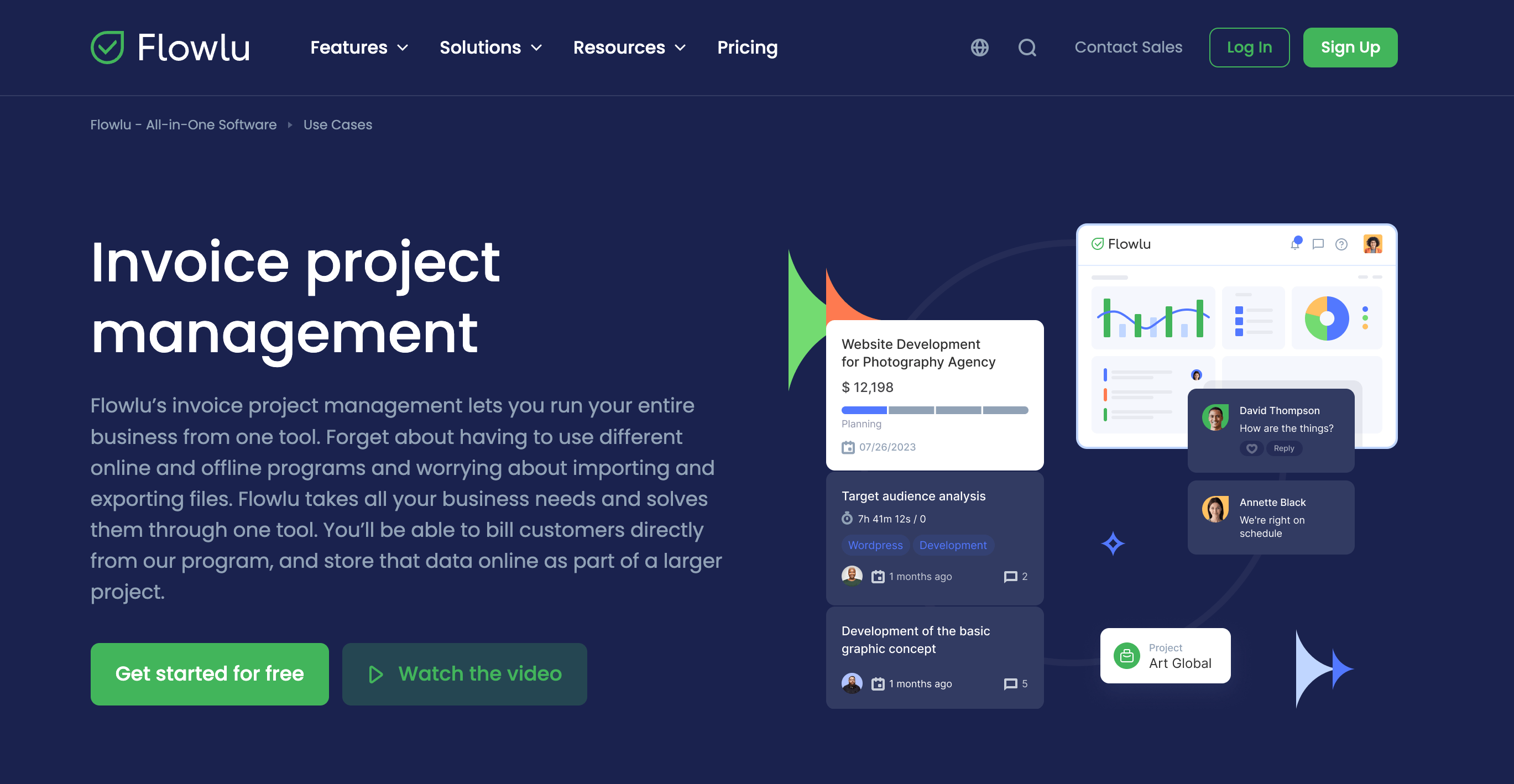
Flowlu is a robust, all-in-one work management software offering project management, CRM, time tracking, financial management, knowledge management, document creation, HR management, and workflow automation. It's used by marketing agencies, creative teams, legal firms, IT departments, manufacturing companies, educational institutions, and various professional services businesses.
Flowlu offers several handy tools to support core marketing project management workflows, including:
-
Mind maps. So teams can visualize their ideas and illustrate their thoughts — whether they’re developing an SEO strategy, planning an ad campaign, or designing an email marketing flow.
-
An online chat. For internal users to discuss ideas, share updates, and request context. The chat complements Flowlu’s various other team collaboration tools, including shared calendars, comments, mentions, custom focus groups, and more.
-
Customizable dashboards and reports. For teams to visualize project data in real-time, such as portfolio tracking (for expenses, profitability, timelines, etc.), task progress monitoring, or even team availability visualizations.
-
Project automation tools. Teams can set up automation rules to assign tasks, share status updates, alert key stakeholders, and more, with a no-code, drag-and-drop automation builder.
Flowlu does come with a few notable downsides that are important to consider, namely:
-
It lacks native accounting software and doesn’t integrate with any third-party ones, either. This means you’d have to export data across systems or use a third-party integration tool that Flowlu integrates with, such as Make or Integrately.
-
The learning curve is steep, and users mention that technical support is considerably lacking, slowing team adoption. For example, according to one user: “Technical support is pretty much nonexistent (WHEN they respond, it takes days). Imports and some integrations are still buggy and won't work.”
Check out more Flowlu reviews here.
Notable Features for Marketers
- Lead capture forms
- Opportunity tracking & lost opportunity reasons
- Personal email inboxes
- Email templates
- Email metrics tracking
- Project workflows — create templates with predefined stages, milestones, and marketing tasks
- Task templates
- Task management
- Project portfolios
- Project financial planning
- Project expense & revenue tracking
- Agile & issue tracker
- Collaborative tools
- Resource planning & management
- Online invoicing
- Financial management
- Mind maps
- Document builder
- Client portals
- Knowledge base
Pricing
Flowlu offers a free plan, two standard packages (with a 7-day free trial), and custom plans for enterprises:
-
Free: The free plan supports 2 users and offers basic project management tools (with one workflow), limited CRM access (up to 100 contacts), invoicing, estimates, expense tracking, and collaboration tools.
-
Essential ($12/user/month): This unlocks essential PM features (task dependencies, subtasks, etc.), basic financial & time tracking, and more robust CRM features, including sales pipelines, email sync, and CRM reports.
-
Advanced ($22/user/month): The Advanced plan includes email tracking, client portals, and advanced features for CRM reports, project management (including portfolios), time tracking, finance, and HR.
-
Ultimate (Custom pricing): Full platform access.
2. ClickUp
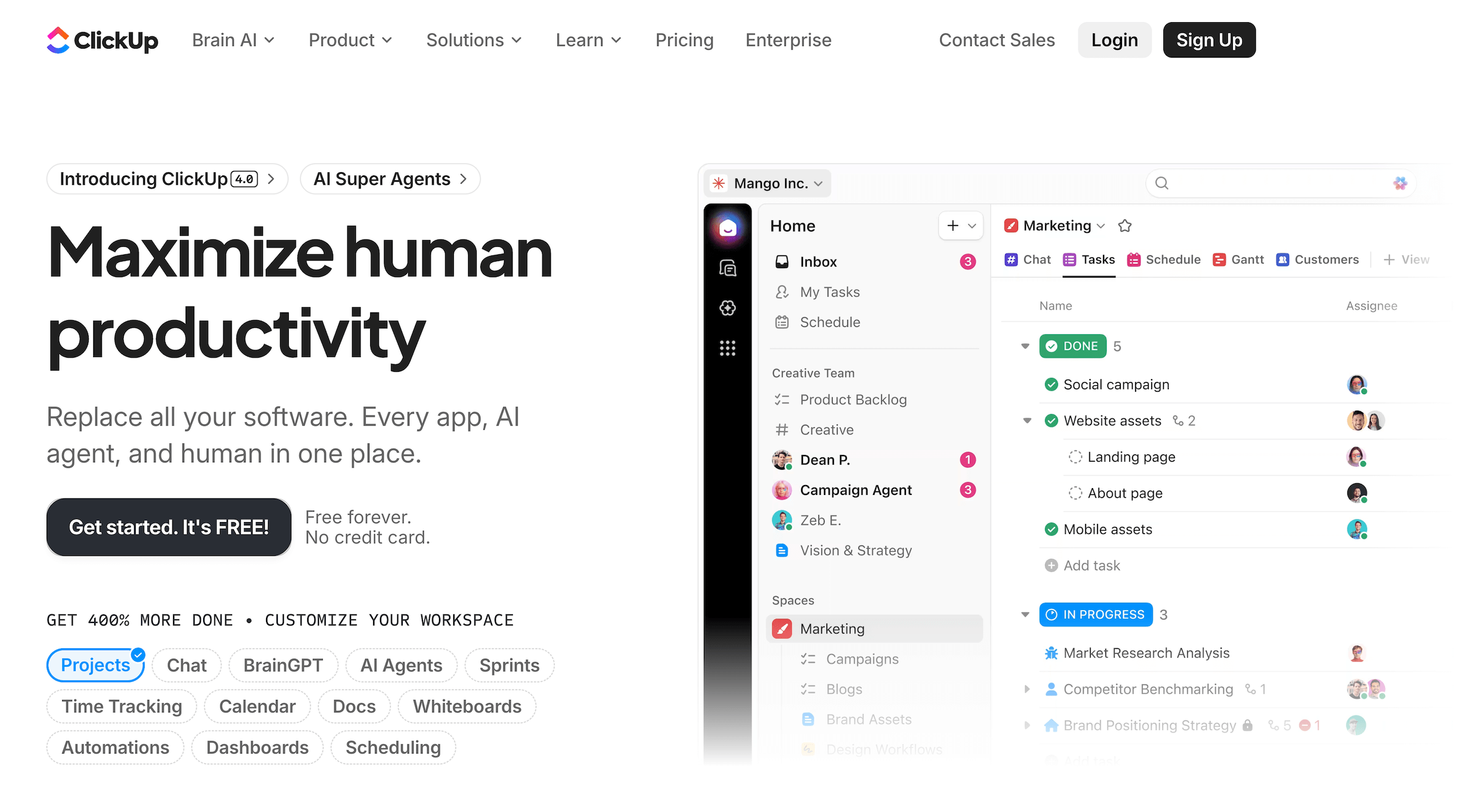
ClickUp is among the best project management tools, offering a comprehensive feature set that brings together project management, team collaboration, resource planning, and workflow automation.
It positions itself as an all-in-one productivity tool that teams can use to manage all their workflows in one place using both native apps and third-party integrations. For example, ClickUp offers the following native apps:
- ClickUp Chat for internal teams to communicate in real-time.
- A unified inbox that centralizes the user’s communications across all projects (including mentions, reactions, shared documents, change notifications, and more).
- ClickUp Docs — the platform’s version of MS Word/Google Docs — plus a complete knowledge base system, ClickUp Wiki.
- Whiteboards to facilitate visual collaboration.
- Native screen recording.
- Web forms and calendars.
- Native time tracking and resource scheduling.
Plus, teams can support all their various other workflows via dozens of native integrations and thousands of third-party ones (they can also build custom integrations using ClickUp’s API).
Teams also appreciate ClickUp's customization and flexibility. They mention that although the platform has a steep learning curve, ClickUp can be tailored to their unique workflows. However, ClickUp’s rich feature set and app-based infrastructure come with a notable downside (aside from the compromise on ease of use): several users report that the app is often slow to load and that the system is buggy overall.
Find more ClickUp reviews here.
Notable Features for Marketers
- Project intake forms
- Project templates
- Task management
- Multiple project views
- Sprint management
- Folders and spaces
- Custom fields
- Chat messages
- Goals & portfolios
- Dashboards
- Mind maps
- Activity views
- Whiteboards
- Native time tracking
- Resource management
- Advanced security
- 1000+ integrations
- Powerful enterprise tools
Pricing
ClickUp offers a generous free plan, two standard packages, and custom enterprise plans.
-
Free plan: Supports unlimited users and includes all the core project management features, including different project views, basic custom fields, and sprint management.
-
Unlimited ($7/user/month): Unlocks integrations, Gantt charts, custom fields, chat messages, and forms. This tier also includes native time tracking, resource management, goals, portfolios, and unlimited storage, as well as folders and spaces.
-
Business ($12/user/month): Everything in the Unlimited plan plus workload management, sprint points & reporting, activity views, unlimited mind maps, timeline views, and whiteboards.
ClickUp’s enterprise plans unlock white labelling, team sharing for spaces, custom roles, advanced permissions, and a range of governance and security controls. Enterprise customers are also paired with a dedicated account manager to support them at every step.
Read more: Best ClickUp Alternatives for Agencies & the Creative Industry
3. Motion
Motion’s project management suite offers various smart tools to boost productivity, including the following AI-powered tools:
-
A chat feature that answers knowledge questions
-
A smart calendar that prioritizes tasks, sends alerts for at-risk deadlines, and reshuffles schedules when necessary (e.g., if some meetings overrun or are postponed)
-
A meeting assistant (for scheduling) and meeting note taker
-
An AI document assistant that extracts relevant details from documents (e.g., action items and deadlines from meeting notes) and converts them into action (by creating tasks, assigning them, and scheduling them on calendars)
-
Project monitoring dashboards
-
Spreadsheets that automate manual work and data entry
It also features AI-powered project and task management capabilities to help teams quickly kick off new projects, track their progress, and manage the entire project lifecycle. The system also uses intelligent forecasting to predict when a project will be completed, based on your team’s capacity and other work commitments.
While Motion’s AI-first approach is appealing, many user reviews suggest that it suffers from a bit of ClickUp syndrome — i.e., it offers so many things that the platform can feel overwhelming, and some reviewers describe the interface as cluttered and unintuitive.
Users also report that the platform lacks key features found in more robust project management tools — such as the ability to record time on task cards.
Read more Motion reviews here.
Notable Features for Marketers
- AI task planner
- Dynamic day re-planning
- Unified calendar
- AI meeting scheduler
- Booking pages & availability sharing
- Capacity & workload planning
- Task management
- Recurring tasks — to automate repetitive tasks
- Project management
- Workflow automation from SOPs
- Project workflow and task templates
- Resource planning (AI-driven)
- Real-time collaboration
- Docs & knowledge management
- AI content creation & editing
- AI searches across the workspace
- AI chat (create/update work with prompts)
- AI meeting notetaker
- Bottleneck & blocker detection
- Smart notifications & reminders
- Shared team schedules
- Mobile & desktop apps
Pricing
Motion offers two plans — ProAI and BusinessAI — although it segments its pricing for individuals and teams. The individual plans are significantly pricier.
-
ProAI ($49/month for individuals and $29/user/month for teams): Includes all essential AI project management tools but lacks time tracking, team capacity planning, Gantt chart & Timeline views, central billing, and advanced dashboards & reporting.
-
BusinessAI ($69/month for individuals and $49/user/month for teams): Full platform access with permissions & access control, priority support, white glove onboarding (for teams only), and more AI credits.
4. Zoho Projects
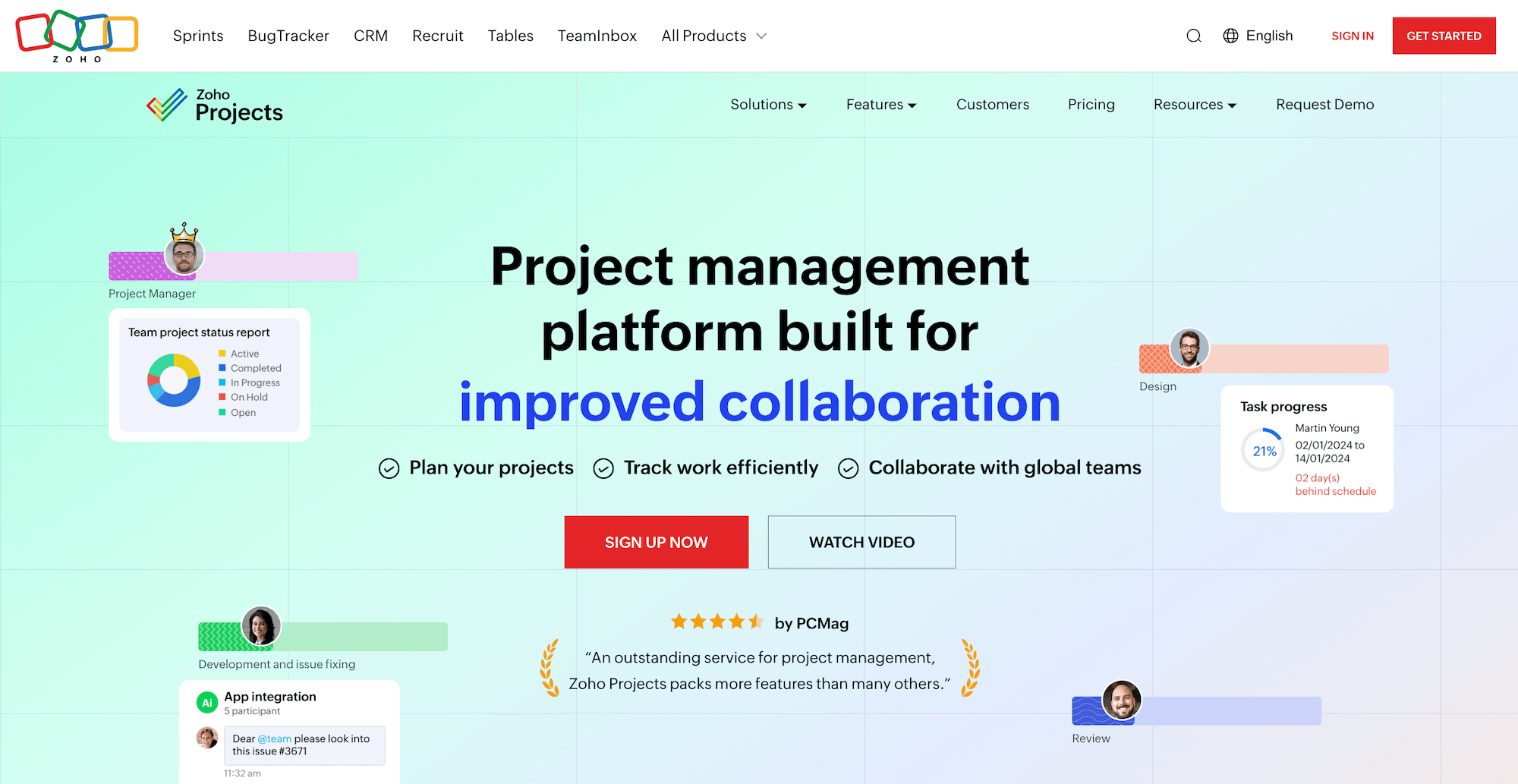
Zoho offers over a dozen solutions to support various business functions — including sales, marketing, IT, legal, and more. Zoho Projects can be a good option if your organization already uses other Zoho apps, or if you have a broad set of team needs that can be fulfilled by its various solutions.
Zoho Projects is the vendor’s project management platform, featuring powerful portfolio management tools, critical path analysis, baseline setting, native time tracking, an issues tracker, and more. However, its resource planning app, Zoho Shifts, is offered as a separate solution. While Shifts includes a free plan, it offers only basic features and has a 25-user limit.
The vendor also offers a more premium project management bundle called Zoho Projects Plus, which includes Sprints (an agile-focused PM tool that supports the scrum methodology), Analytics (BI reporting), WorkDrive (file management), NoteBook (secure note-taking app), and, of course, Projects.
While Zoho’s free and entry-level plans are attractive, subscription costs can stack up as your needs evolve. You’d have to update to the more expensive plans for each app to access their complete feature sets, increasing your overall tech costs.
Check out more Zoho Projects reviews here.
Notable Features for Marketers
- Project templates
- Project planning & scheduling
- Gantt charts (baseline & critical path)
- Time & expense tracking
- Budget management
- Resource management & workload tracking
- Issue & bug tracking
- Workflow automation (Blueprints)
- Approval workflows
- Advanced reporting & analytics
- KPI & progress tracking
- Document management
- File sharing & version history
- Project feeds
- Forums & discussions
- Real-time chat
- Client portals
- Calendar & business hours management
- Access controls & permissions
- Activity tracking & audit logs
- Billing & invoicing
- API & web tabs (embed external apps)
- Mobile apps (iOS & Android)
Pricing
Zoho Projects offers four standard plans:
-
Free: For up to five users and 3 projects. It lacks key capabilities, such as project custom modules, custom views, advanced automation, time tracking, and custom fields.
-
Premium ($5/user/month): This plan removes project limits and adds core project management functionality, including project templates, time tracking, blueprints (workflow automation), and advanced task management.
-
Enterprise ($10/user/month): Unlocks custom roles and profiles, advanced custom fields and statuses, read-only users, single sign-on, and enhanced security and governance features for large organizations.
-
Unlimited ($15/user/month): Offers higher limits, multi-user and multi-project timesheets, DAP integration, and more.
5. Nifty
Nifty (also known as NiftyPM) brings together various tools in a single platform — including project management, document management (Nifty Docs + integrated MS docs), secure file sharing, time tracking, team workload management, file proofing, native forms, and a team chat that supports direct messages plus group chats.
Plus, unlike ClickUp, Nifty includes most of these features across all plans instead of selling them as add-ons. Users also report that Nifty is significantly easier to use than other feature-rich PM tools (such as ClickUp), and its interface is more intuitive with less bloat.
Nifty’s goal tracking tool is one of its standout features. Teams can set KPIs to track across projects, teams, and individuals. These can be tracked by individual tasks, entire task lists, or more specific data, such as custom tags or fields.
Marketing teams also praise Nifty’s collaboration tools, which help them work on campaign initiatives and deliverables. They can:
- Share ideas, get feedback, and engage various stakeholders in the Discussions tab
- Refine campaign messaging and plans on shared documents
- Track all interactions and deliverables with activity logs and timestamps
However, several users note that, since Nifty is primarily a PM solution, its budget tracking and reporting tools are limited.
Notable Features for Marketers
- Project portfolios
- Project & task management
- Milestones & roadmaps (timeline view)
- Task dependencies
- Subtasks & checklists
- Team workload & activity overview
- Cross-project reporting
- Real-time project status
- Workflow automation (recurring structures & templates)
- AI project builder (Orbit AI)
- Docs & knowledge management
- Collaborative project documents
- File storage & sharing
- Team chat
- Time tracking
- Goals & progress tracking
- Status tracking
- Custom workflows & task statuses
- Workspace & project hierarchy
- Mobile & desktop apps
- Integrations & API
Pricing
Nifty offers a free plan, two mid-tier packages, and an enterprise plan (called Unlimited). However, the Free, Starter, and Pro plans all have a fixed number of user seats — so teams can’t customize those packages.
-
Free: Limited to 2 active projects and 100 MB storage, which makes it suitable only for individuals or very small teams. It includes core features like tasks, milestones, discussions, docs, and team chat.
-
Starter ($49/month for 10 users): Unlocks time tracking & reporting, budget tracking, custom fields, and supports 40 projects and unlimited clients.
-
Business ($10/user/month): Unlocks file proofing, team workloads, goals tracking, custom roles, native forms, and more. We recommend this plan or above for interested users.
-
Unlimited ($16/user/month): Unlocks Nifty’s full platform, including enterprise-grade controls and no limits.
6. Jira
Jira is an enterprise-grade project management system that supports software development, digital marketing, IT, design, and operations teams. It's offered by Atlassian, a major provider of collaboration tools that owns household names like Trello and Loom.
When Jira launched in 2002, it was originally designed for dev teams to support their complex workflows — manage the development lifecycle, catch bugs, and track issues. It has since evolved to support other teams, although it notably retains its complexity. For this reason, marketing teams often find it difficult to adopt. The trade-off can be worth it because of Jira’s robust feature set and enterprise governance tools, but smaller teams may prefer a simpler solution.
Jira’s project monitoring and reporting tools are particularly noteworthy. The system offers extensive tools for visualizing tasks, tracking progress, managing work across multiple iterations, and more. Teams can customize various aspects of the PM suite — including columns, card fields, workflow stages, dashboards, and more to reflect their team’s unique workflows.
You can see how marketing teams use Jira in this video demo or see its core features for yourself by signing up for Jira’s free plan.
Notable Features for Marketers
- Task & issue management
- Subtasks & issue hierarchy
- Backlog management
- Sprint planning
- Release planning
- Scrum boards
- Custom project views
- Agile reporting (burndown, velocity, sprint reports)
- Dashboards & real-time reporting
- Workflow customization
- Custom issue types
- Statuses & transitions
- Approval workflows
- Automation (rule-based & AI-assisted)
- Automated notifications & updates
- Intake forms
- Goal & work alignment
- Dependency mapping
- Cross-team project tracking
- Roadmaps for long-term planning
- Parallel sprint support
- Advanced planning
- Resource & workload visibility
- Capacity planning (via roadmaps & reports)
- Time tracking (native & via apps)
- Permissions & role-based access
- Audit logs & security controls
- Integration with dev & business tools (Slack, GitHub, Figma, Gmail, etc.)
- Open API & marketplace apps
- Mobile apps (iOS & Android)
- AI features — planning, summaries, automation with natural language
Pricing
Jira offers four plans — but only the higher tiers (Premium and Enterprise) unlock the advanced cross-team planning, reliability, and governance features needed for complex organizations. The platform’s per-user cost decreases as seat volumes increase, and teams can switch plans as they grow.
-
Free: Includes a generous 10-user limit, 2 GB storage, community support, low automation limits, and access to all of Jira’s essential PM tools. It lacks advanced permissions, audit logs, and administrative controls.
-
Standard (from $7.91/user/month): This plan adds user roles and permissions, 250 GB storage, external collaboration, audit logs, AI features, and higher automation limits, making it suitable for growing teams. However, it lacks advanced roadmapping, 24/7 support, and sandbox environments for safe testing.
-
Premium ($14.54/user/month): Unlocks need cross-team planning, dependency management, advanced roadmaps, unlimited storage, customizable approvals, sandbox environments, 99.9% uptime SLA, and 24/7 critical support.
Jira’s Enterprise plans are designed for very large companies and add centralized governance across multiple Jira sites, 99.95% uptime SLA, advanced security and compliance, and single billing for multiple instances.
7. Monday
Monday offers several business solutions (sold separately) that all fully integrate, including project management, CRM, email automation, software development management, and customer service systems.
Its project management suite — known as Monday Work Management — is highly customizable and includes hundreds of project templates to help teams get started. It also features extensive capabilities in portfolio management, resource management, and risk assessment.
Monday’s seamless integration of its Work Management, CRM, and Campaigns (email automation system) software is a big reason why some in-house marketing teams choose it over other universal PM systems. They can plan out campaign materials, launch email marketing campaigns, and then capture and nurture leads — all from the same platform.
However, as with other universal PM tools, Monday is pretty limited in its project financial management — lacking comprehensive tools for budgeting, cost control, and profitability reporting (which is especially important for agencies).
Plus, since users have to pay separately for all three solutions (and then also for accounting software), Monday’s cumulative costs are on the higher end.
Check out more Monday reviews here.
Notable Features for Marketers
Monday Work Management
- Project templates
- Shareable forms
- Project management
- Task management
- Project monitoring
- Custom fields
- Customizable notifications
- Portfolio management & dashboards
- Multiple views and customizable reports
Monday CRM
- Templates for lead, contact & deal management
- Unlimited boards and customizable pipelines
- Lead management
- Centralized communication hub — view meetings, calls, emails, and notes
- Deal management — including stage, owner, interactions, and more
- Activity management — log calls, emails, etc.
- Email tracking & automations
- Lead scoring
- Sales forecasting
- Sales analytics & advanced analytics
- Account management
- Collection tracking
Monday Campaigns
- Centralized campaign management
- Segmentation and personalization
- Automated email sequences
- Campaign analytics
- Professionally designed, out-of-the-box email templates
- Custom account email templates
- Dynamic content (based on contact data)
- Advanced automation workflows
- Dedicated IP
Pricing
Monday Work Management offers a free plan, three standard packages, and custom enterprise plans. Only the Pro tier unlocks the full set of workload, time-tracking, and advanced reporting capabilities.
-
Free plan: Offers limited access to the project management suite with 3 boards, 3 documents, and 8 column types. It supports up to 2 users.
-
Basic ($12/user/month): Adds unlimited items, 5 GB storage, dashboards (single board), and AI credits. It lacks Timeline/Gantt views, automations, integrations, and guest access.
-
Standard ($14/user/month): Unlocks more project views (Calendar, Timeline, & Gantt), guest access, and 250 automations/integrations per month. However, it still lacks time tracking, workload management, private boards, and advanced reporting.
-
Pro ($24/user/month): The recommended plan that unlocks monday’s full project and portfolio capabilities, including time tracking, workload & resource management, private boards, dependencies, advanced dashboards, and high automation limits for scaling teams.
Work Management’s Enterprise plans unlock enterprise-grade security, advanced permissions, governance, and large-scale automation capacity for complex organizations.
Monday CRM offers the following three standard packages:
-
Basic ($12/user/month): We don’t recommend this package because it lacks automations, integrations, advanced reporting, and email sync, limiting it to simple contact and pipeline tracking.
-
Standard ($25/user/month): Adds two-way email integration, activity management, quotes & invoices, and 250 automations/integrations, making it viable for growing sales teams — but it still has relatively low automation limits and limited analytics depth.
-
Pro ($41/user/month): The recommended plan that unlocks the full CRM feature set, including sales forecasting, advanced analytics, email tracking & sequences, large automation quotas, and multi-board dashboards for scalable revenue operations.
Enterprise plans offer greater scalability with higher limits, enterprise-level security, multi-level permissions, and large-scale automation.
Monday Campaigns currently offers one standard plan and custom enterprise packages:
-
Pro (from $50/month for 2k contacts): Includes all the platform’s essential features, including the campaign manager, marketing segments, campaign analytics, dynamic content, and templates.
-
Enterprise plans: Offer advanced automation workflows, a dedicated IP address, and a limit of 15 emails per contact per month.
Read more: Best Monday.com Alternatives for Agencies & Creatives
8. Asana
Asana is one of the easiest universal project management systems on our list to use, without sacrificing any essential features. It offers portfolio management, time tracking, resource planning, forms, and universal reporting tools, and Enterprise plans boast advanced security and governance capabilities.
The platform also supports over 300 integrations, including popular marketing, creative, and CRM apps — such as Canva, Figma, YouTube, EngageBay, HubSpot, Salesforce, and MailChimp.
Marketing and creative teams in particular like Asana because it’s a very visual, intuitive platform that’s quick to set up. They can create a single portfolio for campaigns and track campaign status, budget, progress, and more in one place.
Asana also offers a handy feature that lets users “multi-home” the same task in different projects — so, for example, teams can have separate customer-facing and internal projects without complicating tracking.
One of the big reasons why Asana has become a household name in project management is that it’s easy to adopt and affordable. The platform’s free plan used to support up to 10 members (the limit is now 2, at the time of writing), and it still offers enough features for small teams to manage their projects.
Keep in mind that Asana’s more comprehensive features are locked behind its highest-tier plans, though. For example, only the most expensive standard package (Advanced) includes native time tracking, portfolio workloads, approvals, proofing tools, and CRM integrations. Meanwhile, custom branding, project admin controls, and capacity planning tools are available only in custom Enterprise plans.
Notable Features for Marketers
- Project management
- Project planning tools, like templates & project intake forms
- Project views — including list, Gantt, timeline, Kanban, and calendar views
- Task management & task assignment
- Resource management with capacity planning
- Time tracking
- Inbox
- Guest management
- Goals — set company goals & Asana AI will help tie projects to overall objectives
- Integrations & API
- Automation rules & AI studio
- Reporting dashboard
- Mobile apps (for iOS & Android)
Pricing
Asana offers a free plan, two standard packages, and two enterprise plans.
-
Free: Supports up to 2 users. It includes unlimited tasks, projects, messages, multiple views (list, calendar, and board), status updates, and time tracking via integrations. It also offers unlimited file storage (with a 100MB file limit),
-
Starter ($13.49/user/month): Everything in Free plus custom project templates, project intake forms, more advanced project monitoring, and a workflow builder. Teams can add up to 500 users on this plan.
-
Advanced ($30.49/user/month): Offers Asana’s full suite of project management tools, including proofing, advanced reporting, Goals, and native time tracking.
Asana doesn’t publicly list the pricing for its enterprise packages, but they unlock resource management, white-labelling, scaled security features, and premium support.
FAQs on Marketing Project Management Software
We’ve answered the most commonly asked questions about marketing project management software below.
1. What is marketing project management software?
Marketing project management software is uniquely designed to support the workflows of marketing and creative teams, which involve multiple stakeholders, long review cycles, diverse skill sets, collaboration with third parties (vendors and freelancers), and tracking expenses across multiple sources.
2. What are the benefits of marketing project management software?
An all-in-one marketing project management solution lets you:
-
Plan staff schedules to ensure the right people are available when needed and monitor capacity to keep workloads balanced.
-
Manage relationships with production vendors, freelancers, and other third parties in one place.
-
Collaborate with internal and external stakeholders and collect feedback on creative assets.
-
Track expenses from all sources (including media buys, vendor costs, and out-of-pocket expenses) to monitor project burn and evaluate profitability.
-
Organize marketing campaigns into portfolios to simplify management, billing, and reporting.
3. What to look for in marketing project management tools.
These systems should offer the following tools:
-
Project intake — to ensure delivery teams have all the information they need to kick things off.
-
Project planning — to help PMs finalize plans, build out accurate estimates, and assign work.
-
Resource management and capacity planning — to ensure the right people are available when they’re needed, and workloads are fairly balanced.
-
Vendor management — to manage third-party relationships, source freelancers for work, track costs from production vendors, and evaluate vendor reliability over time.
-
Stakeholder collaboration — to streamline review cycles and ensure final deliverables reflect client expectations.
-
Time & expense tracking — so teams can generate accurate invoices and evaluate project profitability.
-
Portfolio management — to simplify campaign management, monitoring, billing, and reporting.
4. What integrations should I prioritize for marketing project management software?
The best marketing project management systems should include all the tools we’ve discussed above under one roof, minimizing the need for major third-party integrations. So the integrations that you prioritize should support your core workflows, e.g.:
-
Payments — tools that support online payment collection ensure you get paid faster. Similarly, you can use integrations to pay vendors and freelancers online.
-
Lead capture — to pull in leads from multiple sources, such as marketing automation and email marketing solutions.
-
Media planning & buying — these integrations let you pull in details and costs from insertion orders and apply them to client invoices.
However, if you choose a “universal” project management system instead, you’ll need to integrate it with other platforms to support your core operations and workflows (typically accounting, CRM, and financial reporting tools).
5. How do marketing project management tools improve team collaboration?
They help teams collaborate better by:
-
Bringing all stakeholders — staff, vendors, and clients — together in one place.
-
Supporting iterative review cycles that shape deliverables at each stage.
-
Streamlining communication — users can collaborate on task cards or hold conversations at the project level.
-
Ensuring clear accountability — everyone knows what they have to do, when it’s due, and what the expectations are.
-
Offering real-time visibility into project progress and burn so PMs can spot issues, determine where to intervene, and act quickly.
-
Preventing scheduling conflicts and burnout with staff scheduling and capacity planning tools.
6. What’s the best free marketing project management software?
ProProfs Project and Flowlu both offer free plans that include many of their core platform features.
ProProf Project’s free plan is more generous overall — it supports up to 3 users and includes all of the platform’s core features. Meanwhile, Flowlu’s free tier supports 2 users and includes basic features, such as contact management in the CRM.
Here’s a detailed breakdown of how their plans compare:
Flowlu vs ProProfs Project Comparison (click to expand)
| Feature / Limit | Flowlu – Free Plan | ProProfs Project – Free Plan |
| Users | Up to 2 users | Up to 3 users |
| Projects | Unlimited | Unlimited |
| Tasks & subtasks | Task management with milestones; only 1 workflow | Up to 50 open tasks & subtasks at a time |
| Project views | Kanban & list views | Full PM features (list, calendar, Gantt, etc.) |
| CRM | Included (100 contacts, 1 pipeline, lead forms) | The system lacks a CRM |
| Invoicing/finance | Invoices, estimates, expense & payment tracking | Invoices, estimates, and billing |
| Time tracking | Time-tracking module present (basic) | Time-tracking plus timesheets |
| Knowledge base/wiki | Basic wiki + mind maps | Not a knowledge base product |
| Collaboration | Chat, comments, mentions, company feed, calendar | Collaboration, activity logs & messaging (unlimited) |
| Automation | Not included | Unlimited automations |
| Templates | Basic | Unlimited templates |
| Reports | Basic | Unlimited work reports |
| Integrations / API | Not included | API & SSO included (as part of “all features”) |
| Customization | Not included | Custom fields, statuses, workflows, priorities |
| Support | Help center + AI bot | Standard support |
Getting Started with Workamajig
Workamajig is a comprehensive marketing project management software that brings task management, resource management, time tracking, vendor and client management, and financial reporting into one system.
For over 30 years, we’ve helped marketers, creatives, and agencies unify their marketing workflows, streamline daily operations, reduce tech stack costs, save time, and increase their bottom line.
To learn more about how Workamajig can support your team, request a personalized demo.
Related reads: