

Advertising agency management software should allow you to oversee all areas of operations — including your projects and campaigns, people, and finances — so you aren’t stuck jumping around (and paying for) dozens of software solutions.
A high-quality system should include:
-
Customizable project intake forms, templates, and project planning tools, like task management and estimating.
-
Project monitoring with timeline and budget tracking.
-
Team collaboration tools, such as file sharing and internal proofing, to support content creation and feedback processes.
-
Staff scheduling, time tracking, and resource utilization reports to support resource management.
-
Customer relationship management (CRM) software to manage new leads through the sales pipeline, convert closed opportunities to new projects, and analyze wins vs. losses to improve client acquisition.
-
Accounting software to monitor your chart of accounts, automate invoicing, support accounts payable and receivable workflows, and manage digital payments.
-
Financial reporting to measure agency, client, and project profitability, forecast revenue, and monitor key performance metrics.
-
Integrations or APIs to synchronize your tech stack and support all of your agency’s creative initiatives.
-
Flexible packages to support scalability — this way, you can find a system fit for your growth stage and adapt the platform as your agency evolves.
There are dozens of agency management tools available, so we’ve narrowed it down to the 9 top-rated options to help you choose the right one for your advertising agency.
At the end, we briefly cover some other tools that you might come across in your search, such as Wrike, Monday, Asana, and NetSuite, and explain why they’re not the best choice for advertising agencies.
To see how Workamajig can support your agency workflow, request a free demo with our team.
1. Workamajig
All-in-one, configurable, scalable operating system for advertising agencies
Workamajig is one of the most comprehensive agency management systems, designed specifically for advertisers, marketing teams, design studios, and other creative professionals. Our robust toolset checks the boxes mentioned above and supports the complete creative workflow, from project planning and monitoring to invoicing and profitability reporting.
We’ve worked with agencies of all sizes for over 30 years, ranging from small teams with a dozen users to enterprises with hundreds of staff. Our system brings all your users and processes under one roof so that everyone can work productively in parallel.
We set you up for success when you join Workamajig:
-
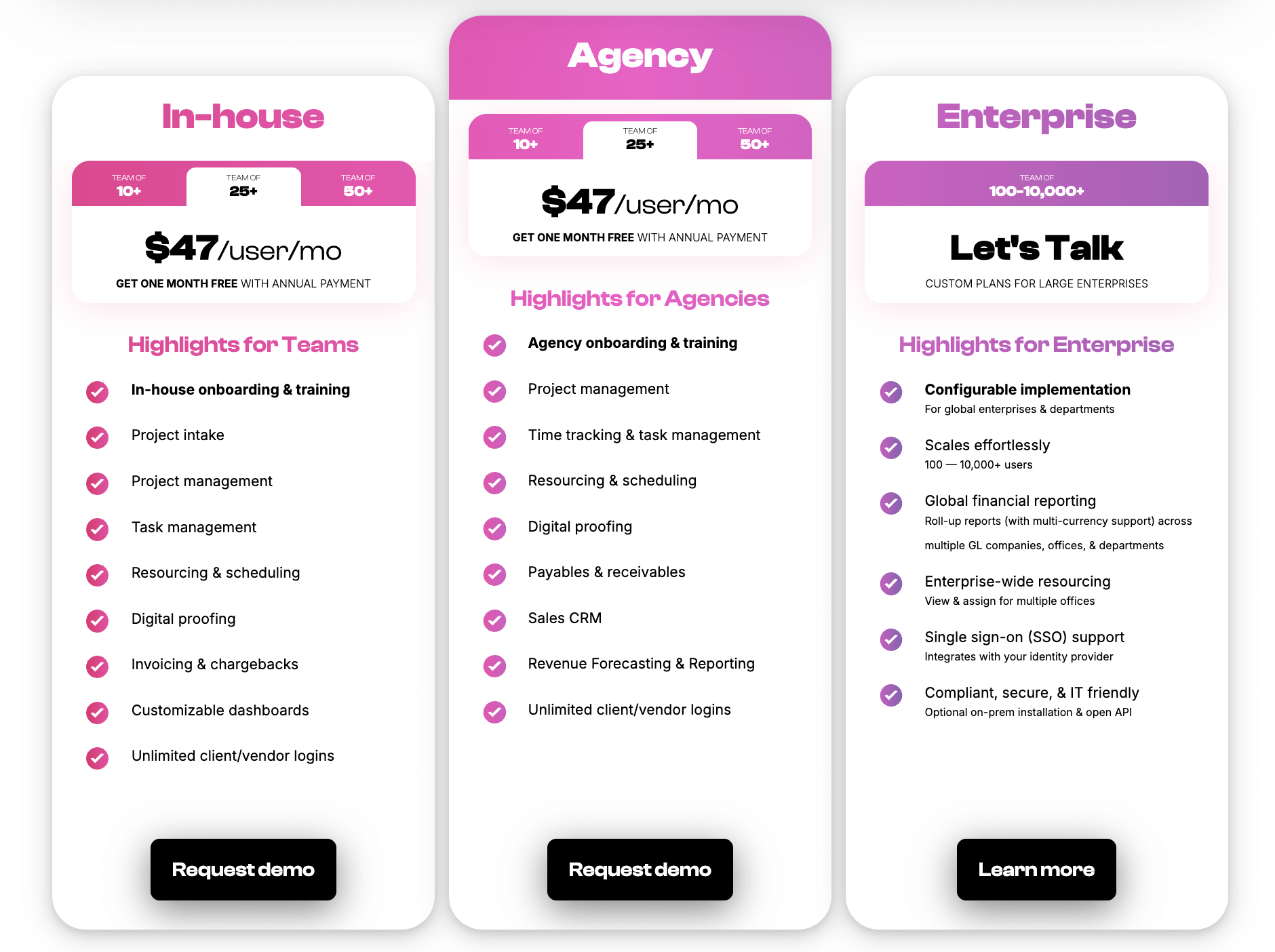
Our packages are designed by team size. All plans include all core features, and you only need to change plans to add users. Choosing between plans doesn’t involve any mental gymnastics.
-
You’re paired with a dedicated account manager who gameplans the whole set-up process with you, provides guided onboarding, and configures Workamajig to your specific agency requirements.
-
Your account manager also provides dedicated training to show you how each module works and answer any questions you have as you get started.
See how some of our advertising agency clients leverage Workamajig to streamline workflows and drive profitability below:
- Unlocking Coordination and Organization at Anderson Partners Advertising with Workamajig
- How Black Dog Advertising Streamlined Remote Collaboration with Workamajig
- How Ten Adams Uses Workamajig to Drive Business Insights & Profitability
In the following sections, we’ll briefly review Workamajig’s core features so you can see how they support all advertising agency workflows. For a closer look, please request a free demo here.
Project Management Suite
Workamajig’s creative project management software offers advanced features to build project plans, streamline workflows, and improve project profitability. This module includes:
-
Project templates — define workflows, tasks, dependencies, milestones, resources, and timelines for projects and campaigns to kick off work in a fraction of the time. Create and store unlimited templates to support your clients and creative initiatives.
-
Customizable project intake forms — tailor these to different clients, campaigns, or project types and make them available on your website or in client portals.
-
Task management — use your WBS to break key deliverables into manageable tasks; add details and objectives; set time allocations, start dates, due dates, and dependencies; assign team members.
-
Project estimates — our system can automatically calculate budget estimates as you build project plans and assign resources. Project managers can view these generated estimates, make adjustments, and share them with clients for final sign-off.
-
Change management — we offer tools to prevent scope creep and manage out-of-scope requests. Clients or project managers can submit change requests in Workamajig. Once all parties approve the changes, the new line items and costs are incorporated into the project plan and budget.
-
Project monitoring dashboards with budget trackers, real-time timelines, and customizable Gantt charts — visualize project progress and intervene before they experience overrun. Our system shows real-time status and notifies managers of projects at risk of exceeding budgets or timelines so they can course-correct.
Check out the dashboard below. Note how you can color-code charts to make the dashboard more visually appealing. Also, spot the yellow and red warnings in the Finance and Project Timeline columns, which highlight projects that require manager intervention.
![Workamajig dashboard: Projects and Project Status [GIF]](https://www.workamajig.com/hs-fs/hubfs/Workamajig%20-%20Projects%20and%20Project%20Status%20%5BGIF%5D.gif?width=1714&height=853&name=Workamajig%20-%20Projects%20and%20Project%20Status%20%5BGIF%5D.gif)
Read more: Best Creative Project Management Tools with Financial Tracking.
Our project management software also includes handy role-based Today dashboards to show users exactly what to work on and team collaboration tools so everyone can work together.
For example, a creative’s Today dashboard lists tasks they’re assigned to, in the order they should be completed, so everybody knows exactly where to focus their time. As you can see in the screenshot below, task cards outline key details for each team member, including due dates and expectations.
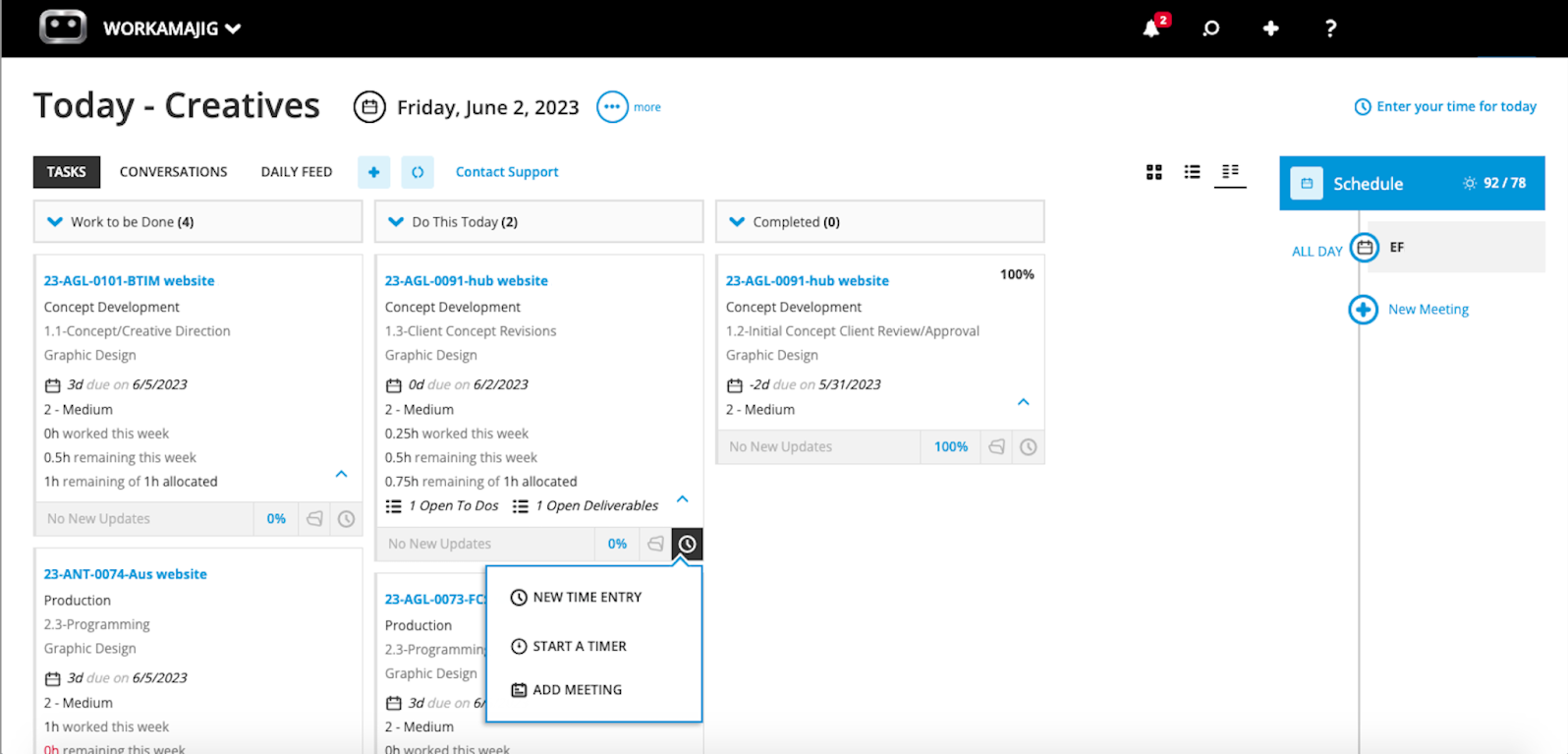
Creatives can access Workamajig’s collaboration tools within task cards, allowing users to:
- Comment and tag others in discussions, and view the entire comment history.
- Share files (images, videos, PDFs, docs, etc.), HTML, and website links for others to review.
- Annotate files to leave actionable feedback.
- Compare old and new file versions side by side.
- Track the version history of files to see how content evolved through feedback.
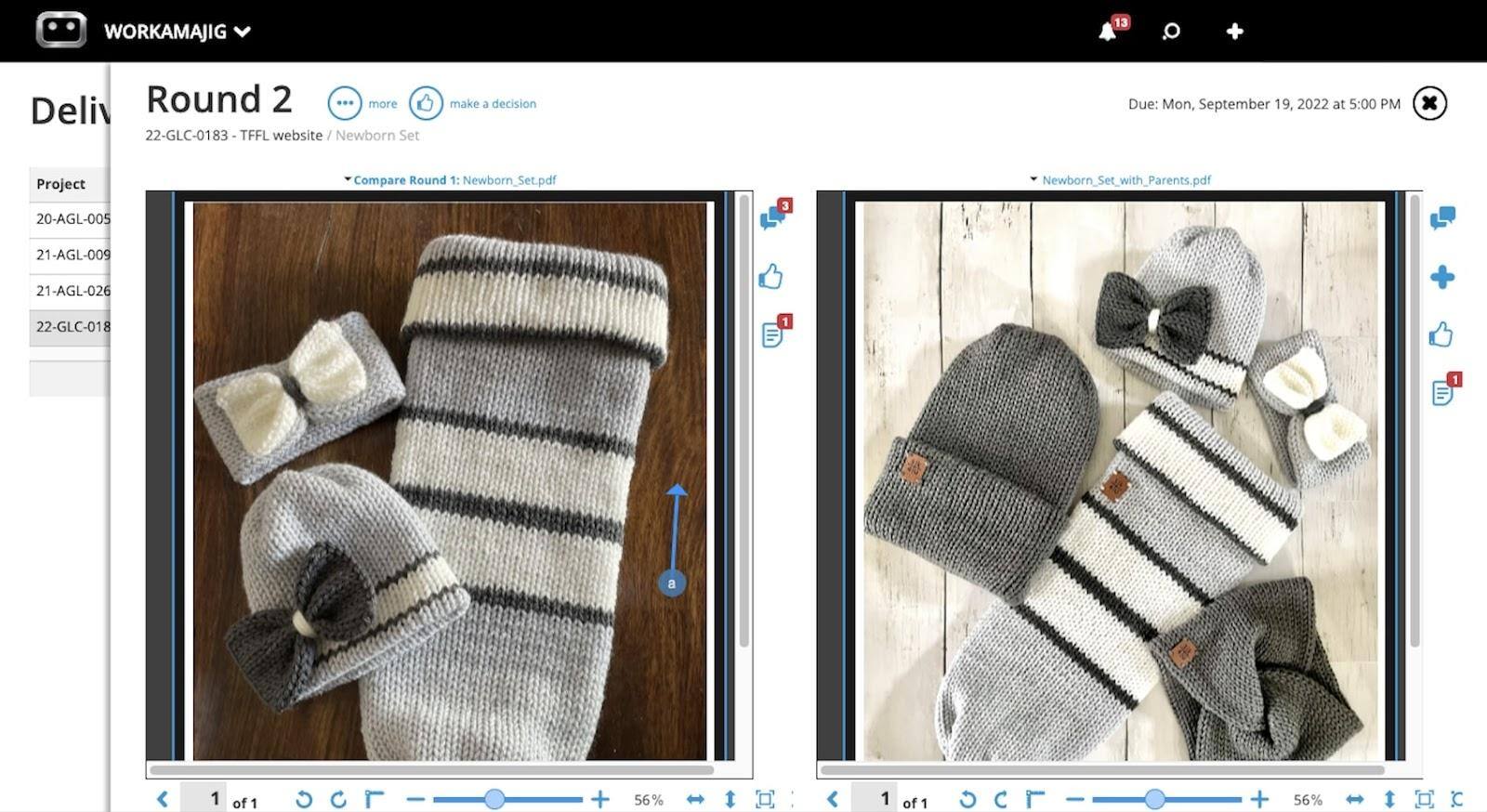
All stakeholders (managers, project teams, freelancers, and clients) can join feedback discussions to reduce back-and-forth and deliver a finished product sooner.
Resource Management & Time Tracking
Workamajig includes staff scheduling tools directly on task cards. For broader planning, our dedicated staff scheduling dashboard lets you strategically allocate resources and double-check that all tasks are covered.
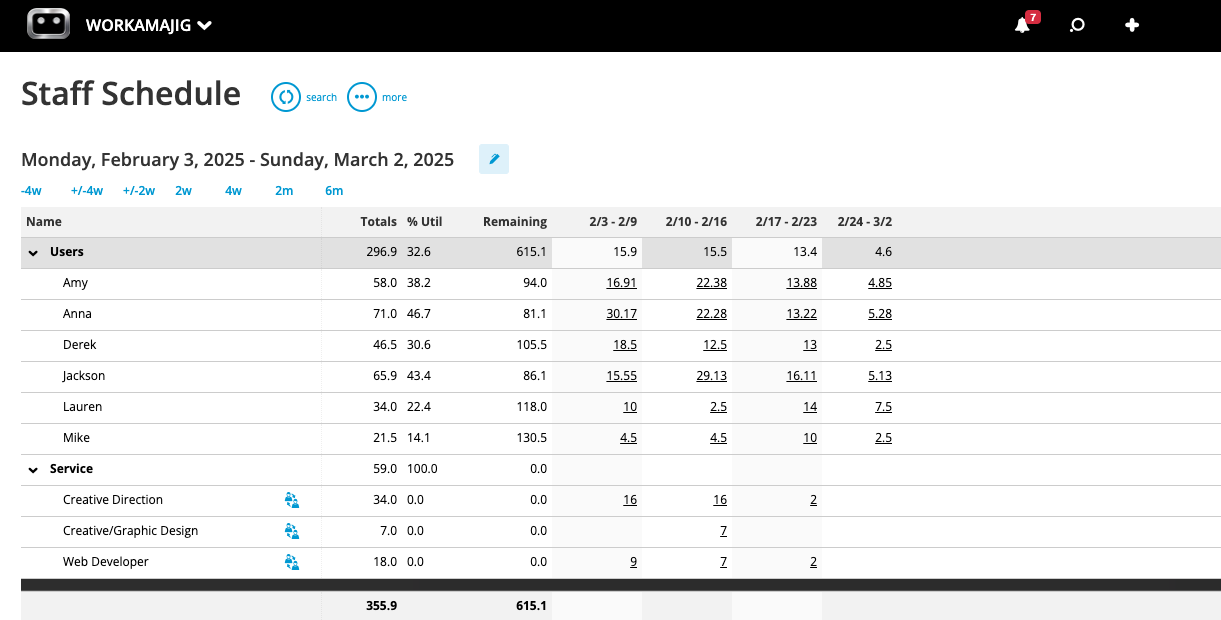
This dashboard displays a list of your staff members, their total bandwidth, current schedule, and the number of hours remaining to schedule. Then, you can select the “Service” tab to view unassigned tasks and begin scheduling work.
Each employee’s hours update as they’re assigned to tasks, so that you can see the most current usage and bandwidth. Then, you can reassign tasks or shift hours to better balance schedules and prevent issues that stem from employees feeling burnt out or rushed (such as poor-quality work, missed deadlines, and project delays).
Read more in our guides below:
- Creative Resource Management for Agencies: Software + FAQs
- Project Resource Scheduling for Agencies & Creatives
- 10 Steps to Optimize Resources in Agency Project Management
Workamajig includes native time tracking to support our scheduling tools and help managers understand where resources are being utilized.
Users can log hours and specify overtime directly on task cards, and managers can easily tie employee hours back to tasks and projects. Our system also saves employee rates to update project budgets as employees log labor hours.
There are three primary ways to track project hours:
-
They can use timers as they work and pause timers to take breaks or switch between tasks.
-
Workamajig integrates with Microsoft Exchange 365, Google Calendar, and iCal so employees can log hours from calendar events (e.g., project meetings or feedback discussions).
-
Users can manually input hours on task cards.
Note: Our calendar integrations also allow employees to share their availability, so managers know when they can schedule employees for work.
![Workamajig - Today - Creatives - Tasks - New Time Entry for Projects [GIF]](https://www.workamajig.com/hs-fs/hubfs/Workamajig%20-%20Today%20-%20Creatives%20-%20Tasks%20-%20New%20Time%20Entry%20for%20Projects%20%5BGIF%5D.gif?width=812&height=863&name=Workamajig%20-%20Today%20-%20Creatives%20-%20Tasks%20-%20New%20Time%20Entry%20for%20Projects%20%5BGIF%5D.gif)
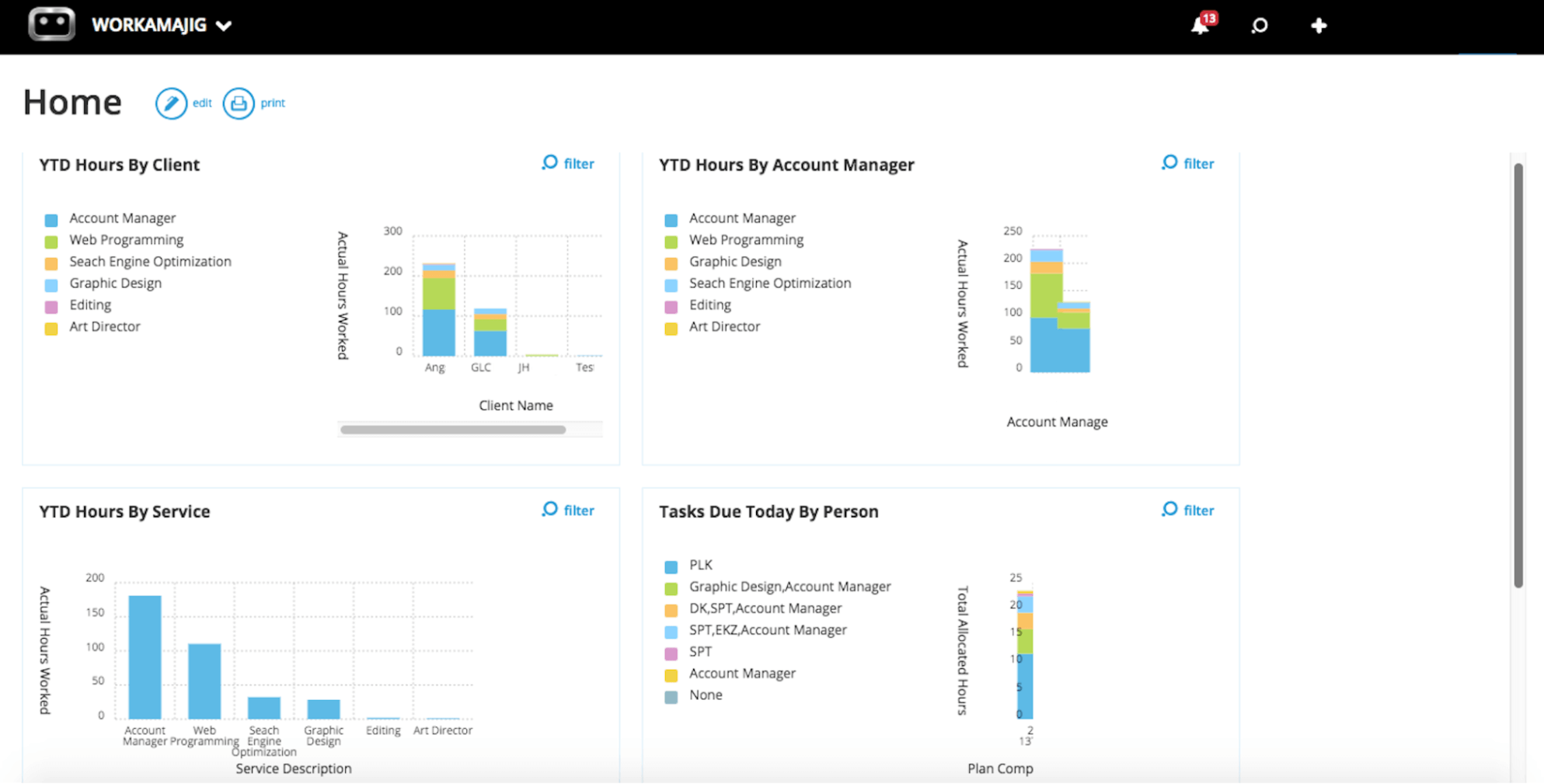
Workamajig’s resource management module also includes utilization reports to evaluate which clients and services require the most resources and where employees spend their time.
You can view year-to-date (YTD) hours across various categories and filter reports to analyze data in different ways. For example, you could compare non-billable and billable hours, identify ways to optimize resource usage, and create billable utilization plans to focus employees' hours on more profitable activities.
Read more: Best Agency Time Tracking Software for Creatives
Workamajig CRM
Workamajig includes a native CRM software to manage client information, qualify new leads, and work opportunities to close.
Our system stores names, email addresses, phone numbers, and business details so you can easily access client contact information.
The CRM also includes user-friendly Kanban boards that let you drag and drop opportunities through the sales funnel.
As sales teams nurture new opportunities, our system saves details from sales conversations so managers can pop into opportunities and get up to speed. Then, when a new opportunity is earned, sales teams can convert it to a new project. Our system streamlines project planning by copying all opportunity details (even costs and attachments like spec sheets) to new projects or campaigns.
![Workamajig: Sales Dashboard and Opportunities [GIF]](https://www.workamajig.com/hs-fs/hubfs/Workamajig%20Sales%20Dashboard%20and%20Opportunities%20%5BGIF%5D.gif?width=1920&height=1050&name=Workamajig%20Sales%20Dashboard%20and%20Opportunities%20%5BGIF%5D.gif)
The CRM also provides various reports to view opportunities by stage, review lost deals, measure your close rate, and improve your sales processes.
Client & Vendor Portals
Workamajig lets you create unlimited portals to manage your relationships with clients and vendors. Users can access these portals for free, with no cost for additional client logins.
Vendor Portals
Vendor portals allow managers to assign work to contractors and incorporate costs for outside resources in project plans. They also save all communications between vendors and managers, so users can conveniently review past work orders and their history together.
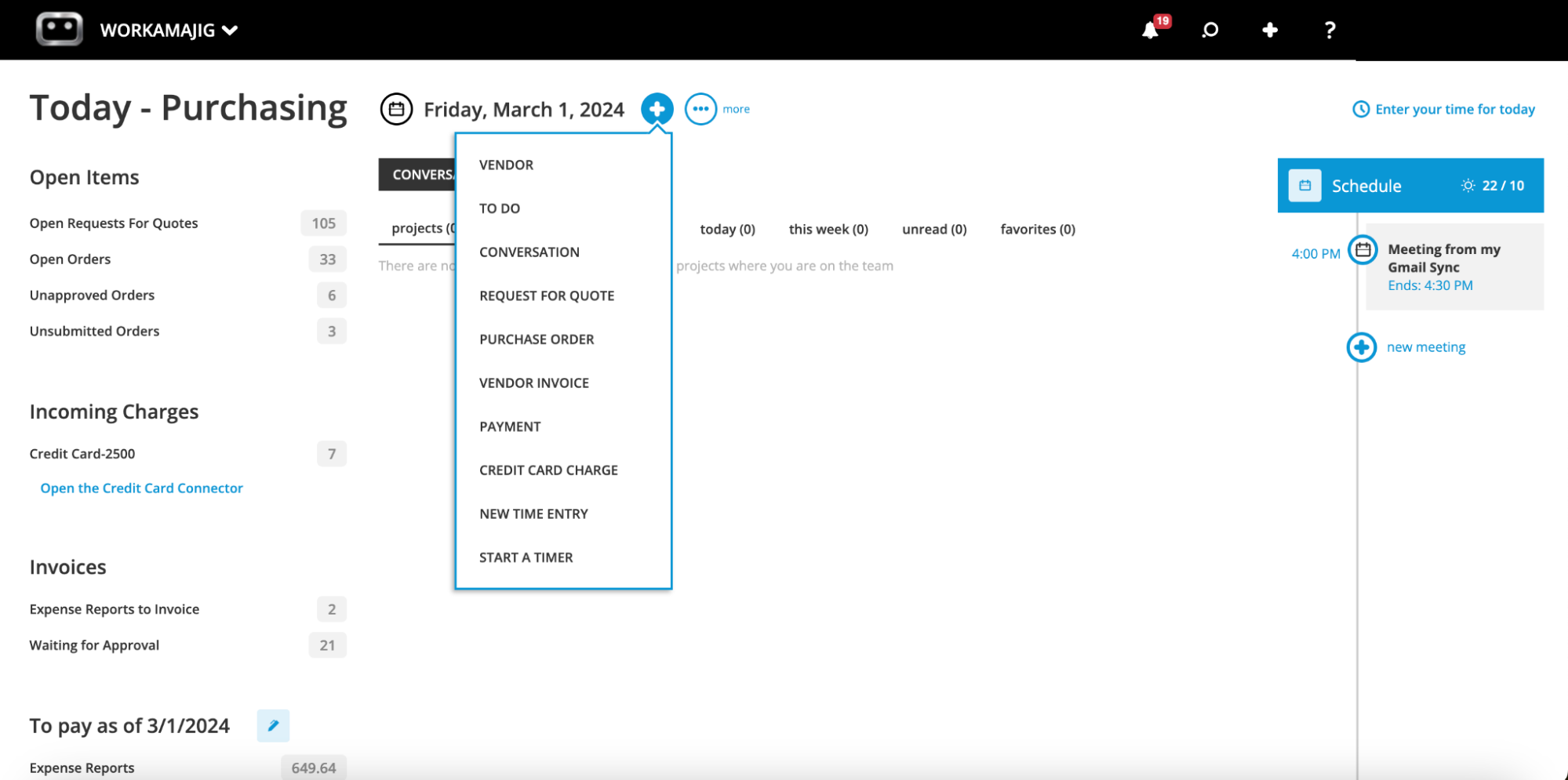
Managers can upload vendor invoices to portals, keeping them organized alongside related communications, and easily reconcile them within Workamajig’s accounting system. Our accounting system also lets you pay vendor invoices promptly.
Client Portals
Clients can access portals to request work, check project status, submit change requests, join feedback discussions, and approve and access deliverables.
Workamajig Accounting Software
Workamajig’s full GL accounting software supports all standard accounting processes and best practices and is GAAP-, GDPR-, and HMRC-compliant. It replaces standalone systems such as Xero, QuickBooks, and Microsoft Dynamics and supports local and global advertising agencies of all sizes.
|
When comparing advertising agency management tools, you'll notice that most lack this core module. Instead, they integrate with major accounting tools. We’ve built Workamajig with native accounting software because managing project finances in the workflow is critical to project success. If you store financial data in a separate system, you can’t track budgets in real time or prevent project overruns. You’re calculating costs after projects wrap — and often finding yourself over budget (as 91.5% of projects run over budget, over schedule, or both). You can learn more in our guides below: |
Our accounting system’s key features include:
- Connected accounts
- Billing & invoicing
- Vendor invoice management
- Receipt management
- Expense reports & reimbursement management
- Digital payments
Connected Accounts
Workamajig displays real-time balances from your integrated credit card and spending accounts. It also defers advanced revenues, so you can be confident the numbers are accurate and avoid accidental overspending.
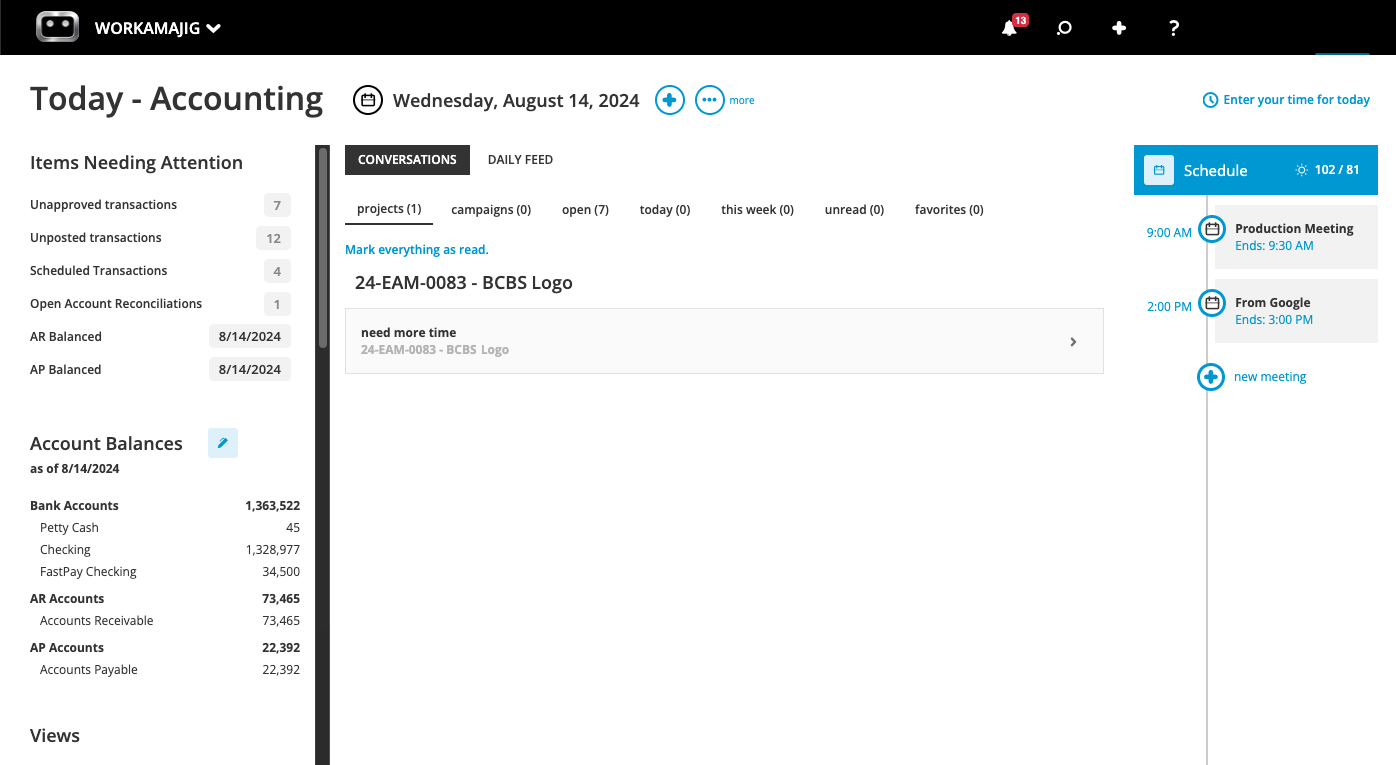
Note: Project managers can also pull in charges from connected accounts, analyze and map spending, and then tag project-related expenses. This allows teams to track project costs as they’re incurred (alongside labor hours), so managers can view the full scope of project expenses.
Billing & Invoicing
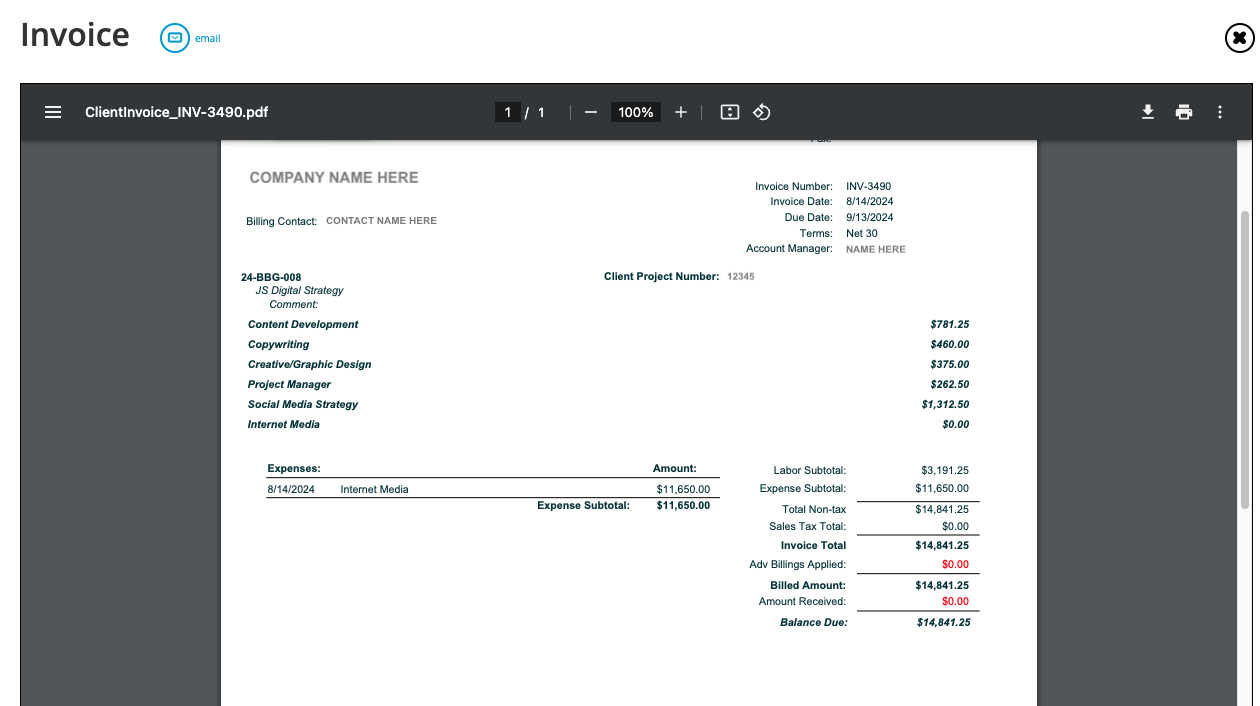
Workamajig supports all standard billing methods used by advertising agencies — time & materials, fixed fee, retainer, advanced billing, and media — so you can specify different methods for projects, campaigns, or clients.
After projects wrap up and receive final approval, managers can generate an electronic billing worksheet that includes project budgets, project-related transactions, and prior billing amounts, with the specified method. Managers can review these worksheets, make any necessary final changes (such as adjusting costs and editing line items), convert them to final invoices, and send them to clients.
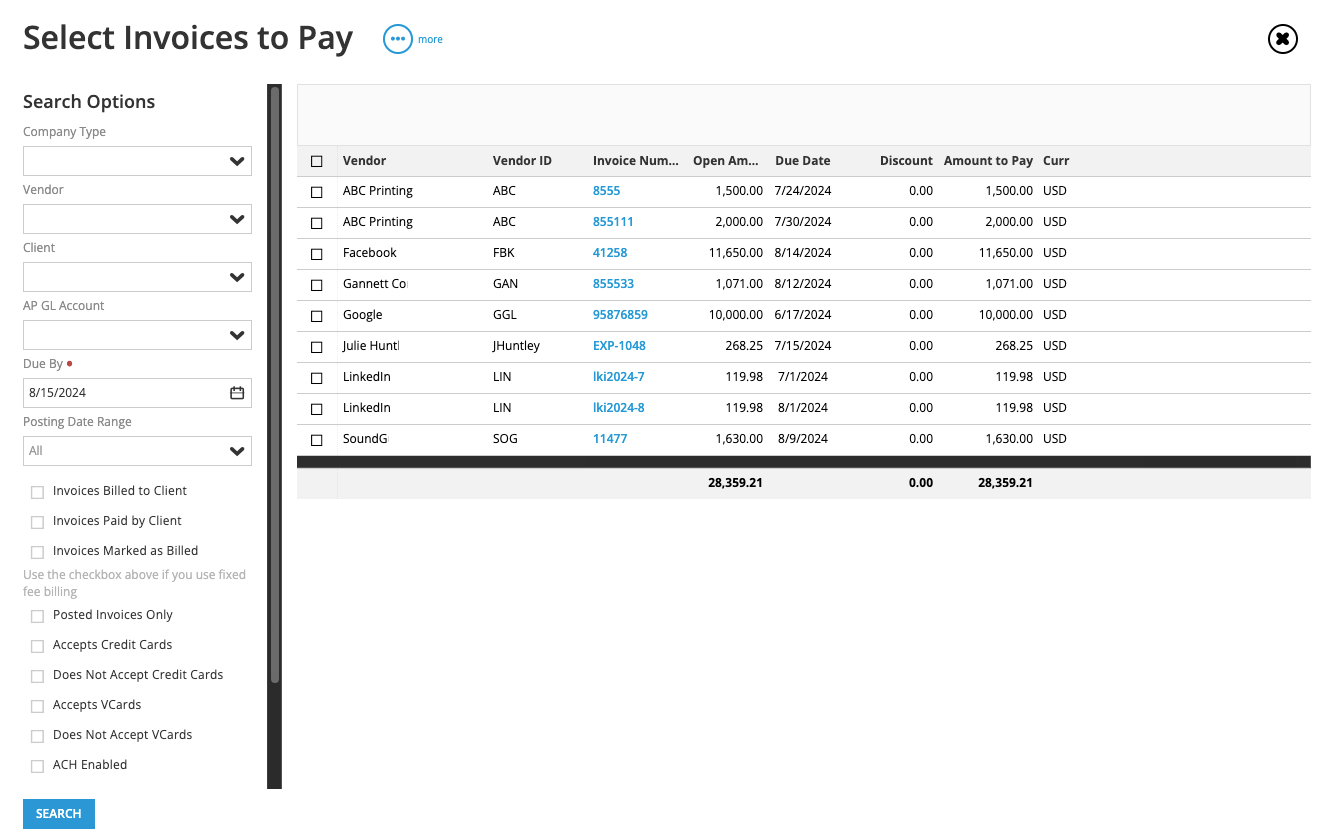
Vendor Invoice Management
As mentioned, you can easily store and manage vendor invoices in Workamajig, eliminating manual filekeeping. Workamajig also includes filters to review invoices in various ways and stay on top of payments.
When you upload new invoices, you can tie them back to projects or reconcile them against receipts. Then, you can dispatch digital payments through our system to speed up the process and make it more convenient — avoiding late fees and ensuring good standing with vendors.
Receipt Management
Store receipts digitally for all of your agency’s expenses to support invoice reconciliation and compliance.
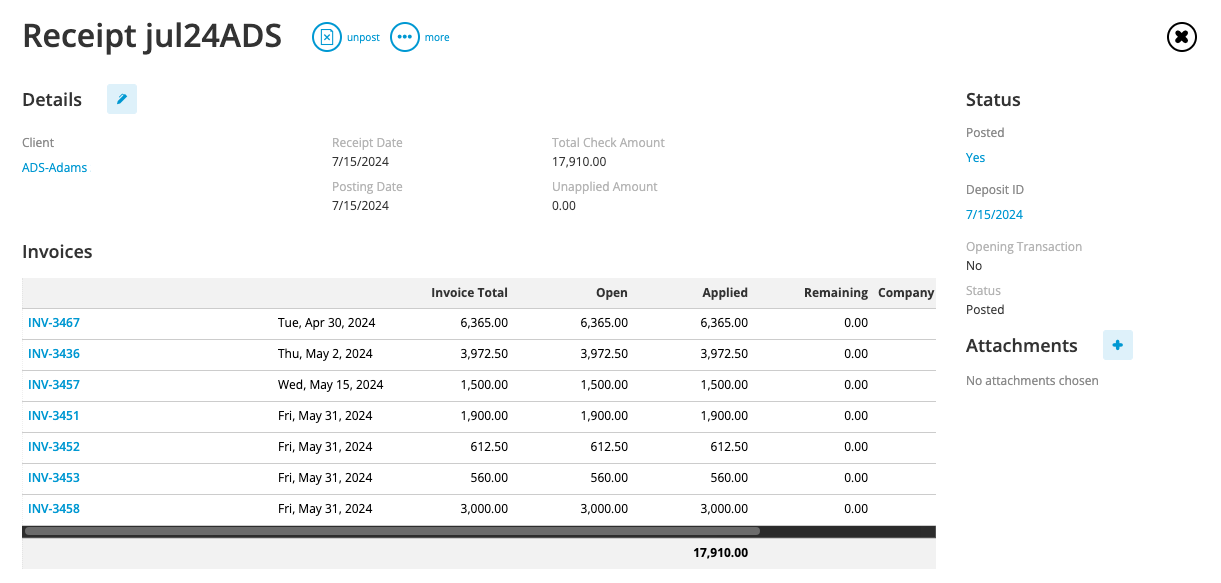
Expense Reports & Reimbursement Management
Users can track out-of-pocket business expenses and share expense reports in Workamajig. When submitting reports, users can specify which expenses are reimbursable and which are non-reimbursable, so managers can review them and take appropriate action.
.png?width=1392&height=461&name=Workamajig%20Expense%20Report%20(EXP-1048).png)
Users can also create expense reports via our credit card connector (see below).
Digital Payments
Send digital payments from Workamajig. Most agencies find their employees and vendors prefer online, quick payments vs. snail mail checks, making this a win for everyone involved.
Read more: 5 Best Media Accounting Software
Financial Reporting & Custom Reports
Workamajig also includes a financial reporting dashboard to evaluate profitability in various ways. Our system includes:
- Profit & loss reports — in several categories (project, campaign, or client, for example)
- General Ledger (GL) reports
- Cash projections
- Revenue forecasting
- Project budget drill-downs
- Billable summary reports
- Hourly realization rates
- Key metrics monitors
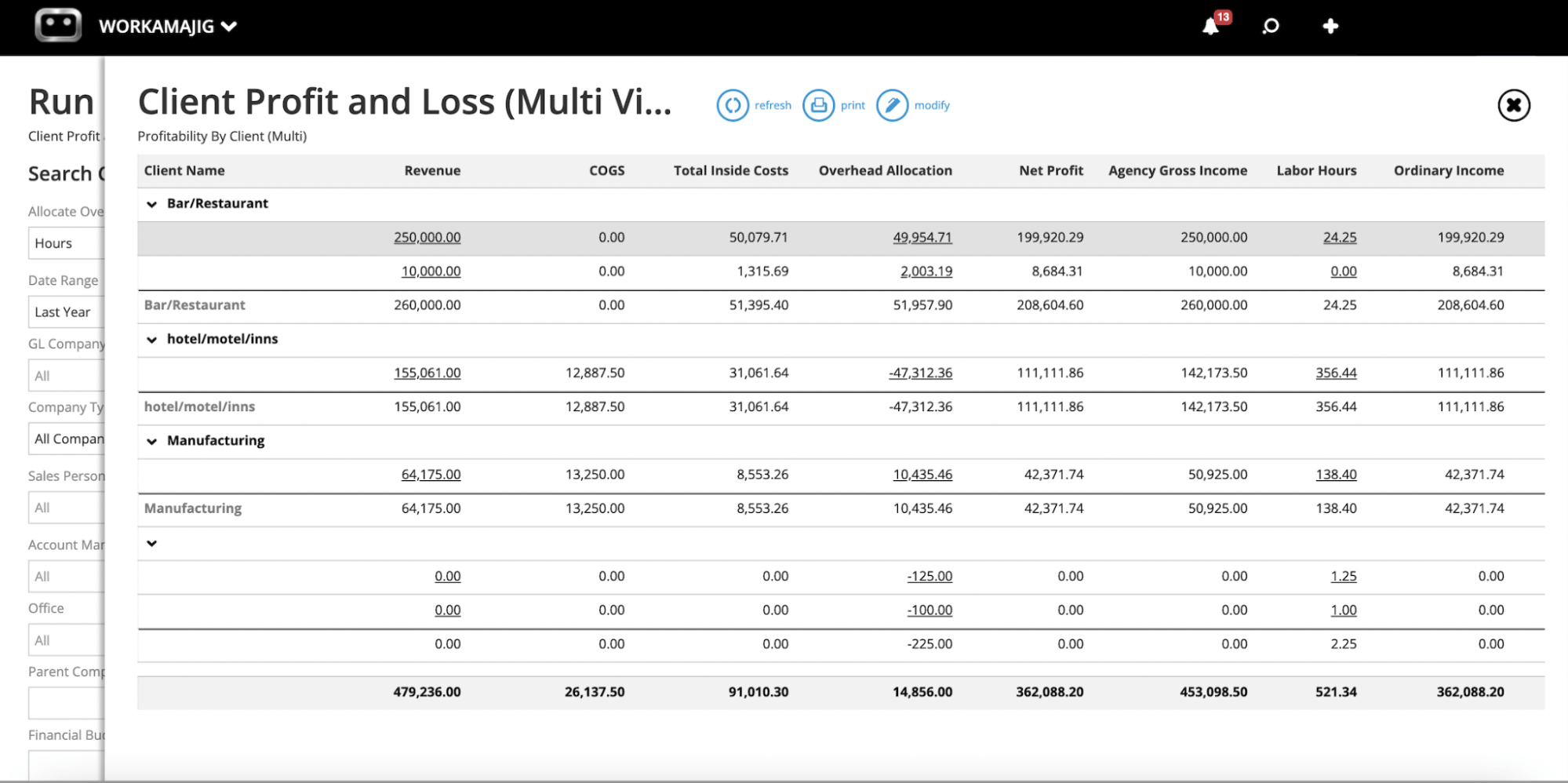
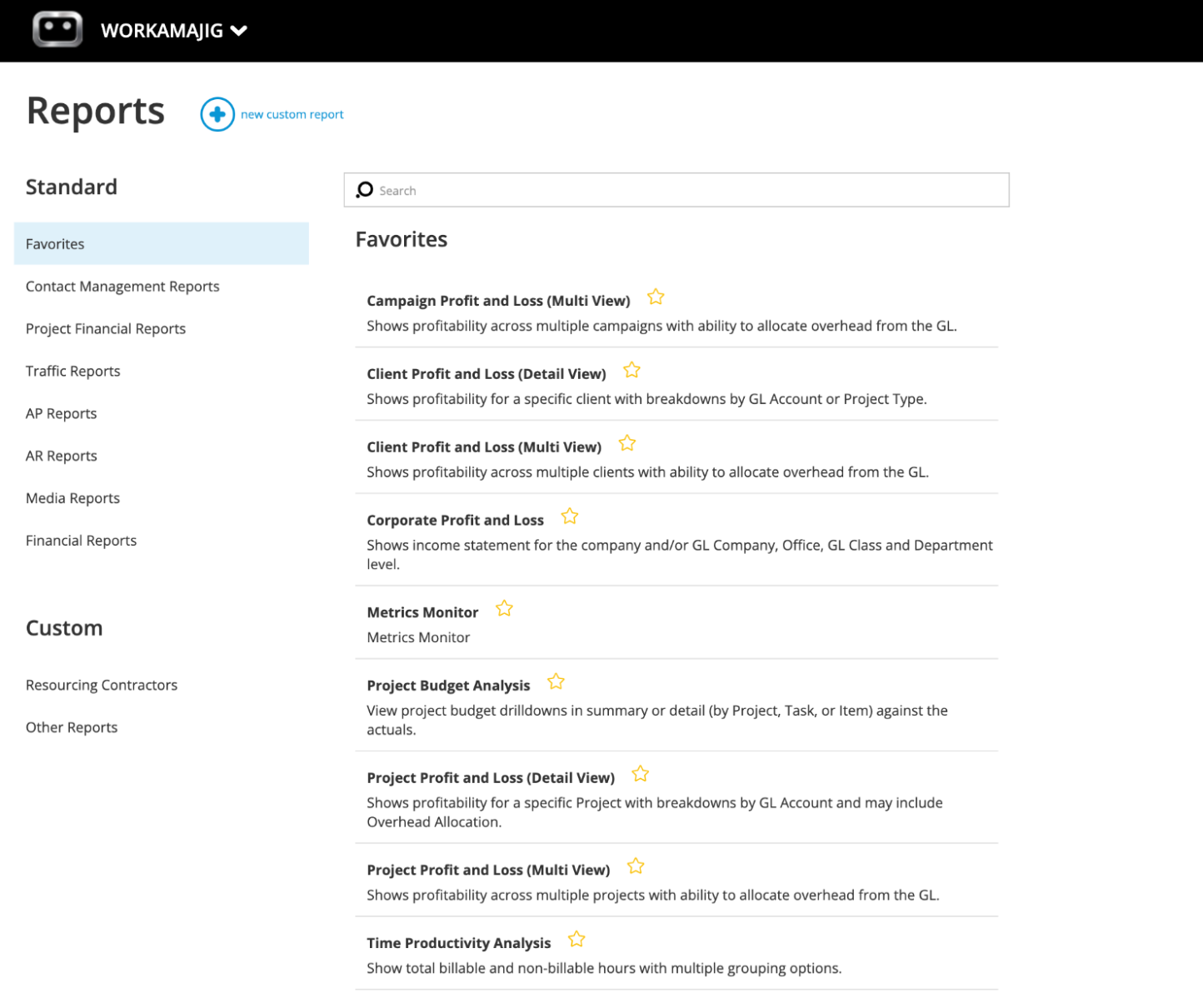
You can also create custom reports, and Workamajig’s “Favorites” feature lets you save your most commonly used reports to easily access the data most important to your agency.
Workamajig also integrates with Excel Financials and Google Sheets, so you can export our system’s financial reporting data and repurpose it in other spreadsheets or analytics tools.
Speaking of —
Integrations
Workamajig integrates with various systems to support our core functionality and creative initiatives. For example, our system includes a variety of accounting integrations:
-
Plaid credit card connector to integrate with credit card and spend accounts and import those charges to Workamajig. You can then map and tag project-related charges to update budgets and invoices (as mentioned above).
-
Digital payment solutions — clients can make payments directly from the invoice via CC or ACH, thanks to our integrations with PayFlowPro / Authorize.net. Meanwhile, our integrations with AvidXChange (formerly FastPay) and Edenred (formerly CSI) allow you to send vendor payments conveniently, on time, and online.
-
Avalara tax compliance solution to automatically calculate and add sales tax to client invoices.
Notably, for ad agencies, Workamajig integrates with various media buying systems — Strata/Freewheel, GaleForce Media, Mediaocean, and Bionic — to import data from your media buys. You can then add media buys and costs in estimates and apply data from insertion orders to final invoices.
You can view the complete list of integrations here.
Workamajig Packages & Getting Started
All Workamajig agency users have access to the same features and integrations.
Our clients also receive free guided onboarding and one-on-one training to streamline implementation.
Packages and rates are based on agency size, and pricing is per user, with custom plans available for enterprises (100+ users). Check out our rates below:
Request a free demo with our team to see how Workamajig’s all-in-one platform streamlines all your advertising agency workflows.
2. Advantage
.png?width=2000&height=878&name=Advantage%20Simpli.fi%20homepage%20(2024).png)
Advantage is another comprehensive agency management tool that’s popular with advertising agencies for its native media planning module via Simpli.fi. It has a toolset similar to Workamajig, with CRM and accounting software included in its core offerings.
Advantage is praised for its robust toolset, customizable UI, flexible integrations, and helpful customer support team. The platform offers all the necessary features to manage advertising agency operations, and the team configures the software to meet client specifications during implementation.
However, users warn of a learning curve and note usability issues. For example, you have to switch between interfaces to access different features. It’s also worth noting that while Advantage offers full GL accounting software, it’s not the best option for teams needing multi-company or multi-currency support.
Advantage is also one of the pricier options on our list — their team doesn’t share pricing online, but they provide custom quotes.
Read more Advantage reviews here.
Features
- Project management features — including project intake and project monitoring
- Task management
- Resource management
- Collaborative tools like proofing & reviews
- Time tracking
- Media planning & buying — including broadcast buying, digital buying & media reporting
- Risk analysis & burn rate tracking
- Media accounting software
- Billing & invoicing
- Estimates
- Budget Monitoring
- Financial reporting
- Revenue forecasting
- CRM
- Client management
- Reporting dashboard (to analyze project performance, financials, staff hours, etc.)
- Mobile app (for Android)
Pricing
Advantage offers custom quotes based on agency requirements.
Read more: Best Advantage Software Alternatives for Creative Teams
3. Function Point
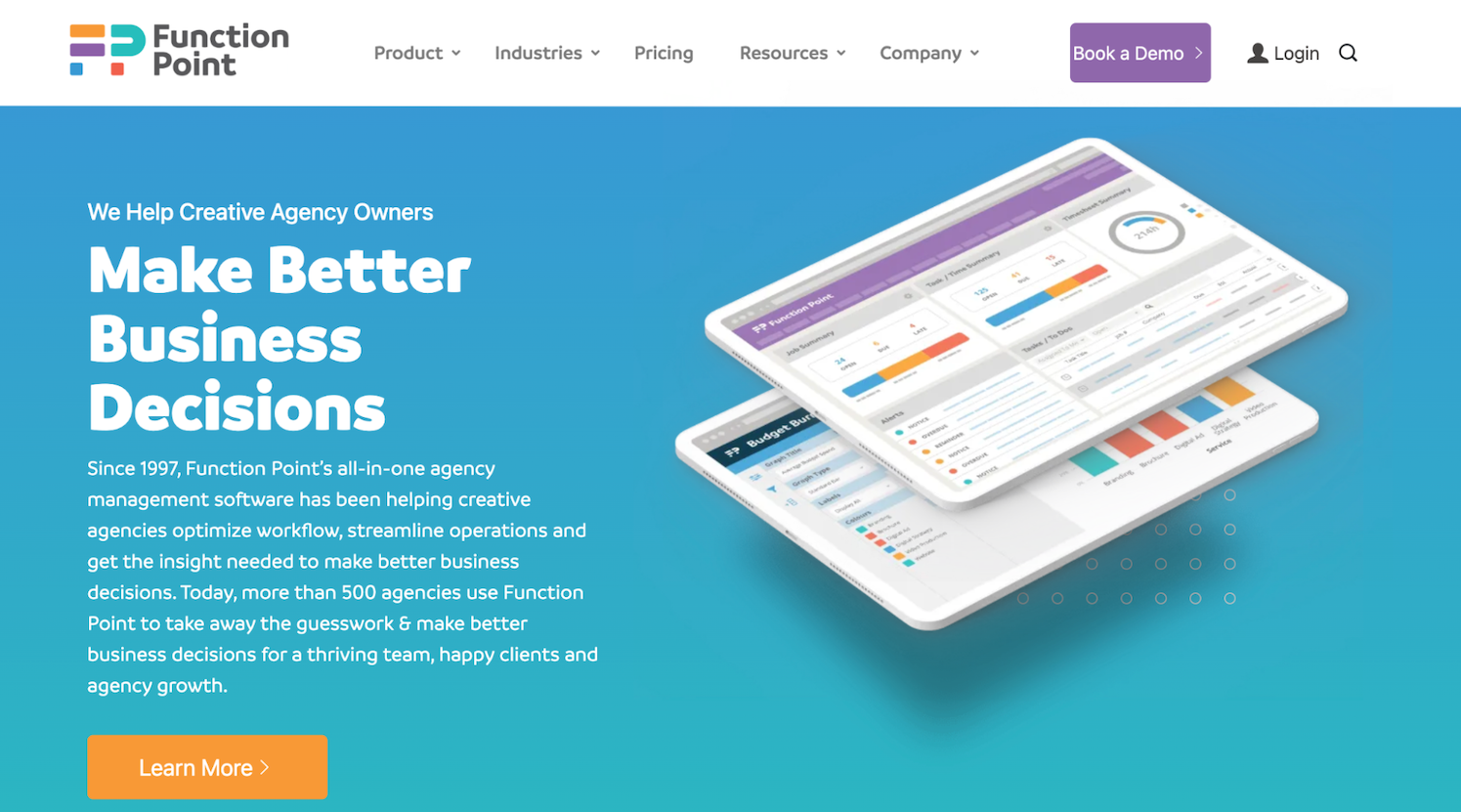
Function Point is a Canada-based brand popular with creative agencies in British Columbia, Alberta, Ontario, and Quebec — though it’s been around for 25+ years and has experience with agencies worldwide.
Function Point’s creative agency management software is slightly less comprehensive than our options above; it includes project, resource, and financial management, CRM software and client management tools, time tracking, budget monitoring, and team collaboration tools.
However, it does not include native accounting software, so you’d need to integrate Function Point with your accounting system to feed data back and forth. The platform also integrates with a variety of other business applications.
Users praise Function Point for its intuitive features and navigation; they say the platform is easy to use and brings everything into one convenient hub. They also praise the Function Point team for their helpfulness and responsiveness, and mention their readiness to develop custom solutions for specialized needs. However, users express limitations with certain features, such as time tracking and financial reporting.
Function Point’s packages are designed for small teams — the largest package supports 29 users — and they also offer custom enterprise plans. Their subscription costs put them on the pricier end of the spectrum.
Read more FunctionPoint reviews here.
Features
- Client management tools, including estimates and proposals, CRM, email integrations, change order and revision tracking, and job request portals
- Project templates
- Project management, with tools to manage several projects at once
- Project monitoring (choose Gantt charts or a Kanban board view)
- Team collaboration, including file sharing
- Resource management
- Time tracking
- Financial management, including expense tracking
- Business intelligence reports, including profitability reports and custom reporting
- Integrations with accounting systems like QuickBooks and other business applications (even other project management tools like Asana)
Pricing
Function Point offers packages for agencies at all growth stages; packages include all features, and you choose by agency size:
- Standardize: Supports 5–9 users and starts at $58/user/month.
- Optimize: Supports 10–29 users and starts at $68/user/month.
Function Point also offers custom solutions for agencies with over 29 users.
Read more: Function Point Reviews & Alternatives
4. Productive
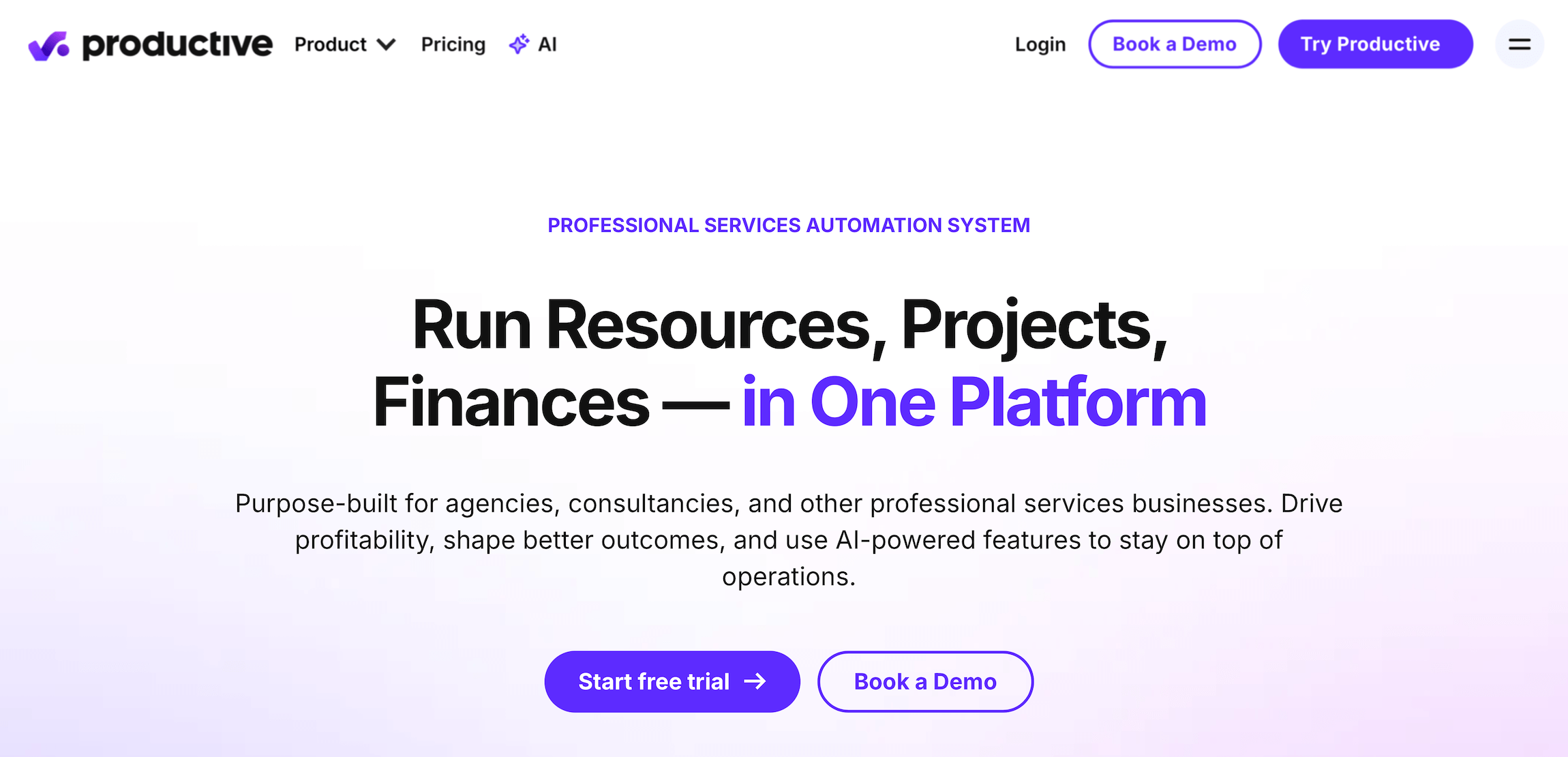
Productive's all-in-one management system for agencies includes project management, resource planning, time and budget tracking, team collaboration tools, a sales CRM, and automated billing and invoicing. It lacks accounting software but integrates with most major accounting systems and supports various other integrations.
Productive provides packages for agencies of all sizes and is preferred by smaller teams for its affordable pricing. However, choosing packages and pricing can be tricky here. Productive offers basic versions of its features in the Essential Plan and more advanced versions of the features in upgraded packages, so you typically have to book a demo to compare offerings.
Users choose Productive because it packs a lot into one system, saying it “shines in its range of features,” and they note the customer support team is easy to reach and helpful.
However, potential cons include limited flexibility (as users report limitations in customizing project templates) and buggy updates. Users also note that certain features could use improvement, such as multilingual tools and automated invoicing.
Read more Productive reviews here.
Features
- Project intake & sales CRM
- Project management
- Resource management
- Time tracking & timesheets
- Documents (to create shared docs & enable team collaboration)
- Financial management
- Billing & invoicing
- Budget & expense management
- Real-time profitability tracking
- Reporting
- Integrations with QuickBooks, Xero, Sage, SAP, Justworks, ADP, Slack, HubSpot, Google, Microsoft & Jira
- Open API
- Mobile apps for iOS & Android
Pricing
Productive offers three packages:
-
Essential: $11/month/user — offers basic feature access.
-
Professional: $28/month/user — provides access to more advanced versions of Productive’s toolset.
-
Ultimate: $39/month/user — offers complete platform and integration access.
For all plans, you must purchase at least three user seats. Productive also offers custom enterprise plans.
Read more: Best Productive Alternatives for Agencies
5. Scoro
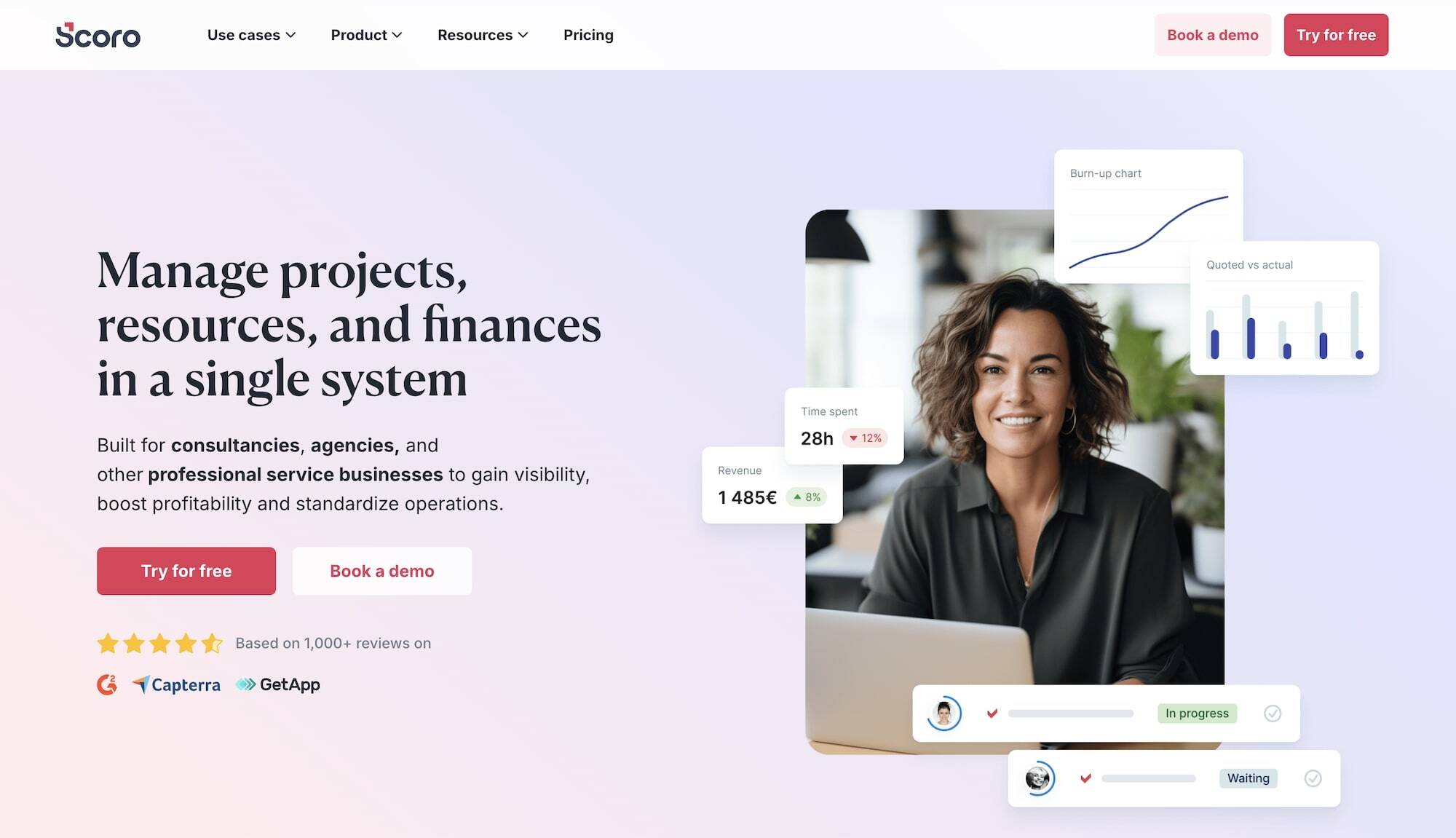
Scoro is similar to Productive and Function Point — it’s a robust work management tool with end-to-end automation that supports creative agency processes and projects. In addition to creative agencies, Scoro also works with IT and software developers, construction companies, architects, and engineering firms.
Scoro is popular for its range of tools; its feature set includes project management, resource planning, time tracking, budget monitoring, team collaboration tools, a sales CRM, and automated invoicing. It integrates with accounting systems and provides various other integrations to serve as a single source of truth.
The one common complaint is the confusing, restrictive, and expensive packages — teams usually must choose the top-tier plan or a custom enterprise package to access everything they need.
Features
- Project management
- Resource planning
- Time tracking
- Collaboration tools
- Quoting & budgeting tools
- Invoicing
- Cost management
- Retainers
- Sales CRM
- Reporting
Pricing
Scoro offers three packages and a free 14-day trial. However, Scoro’s pricing model is feature-based (rather than user-based) — agencies unlock the full suite of features only by subscribing to the highest plan.
-
Core: $23.90/user/month — this basic plan lacks several essential features, including project templates, subtasks, expenses, and the sales pipeline, across all modules.
-
Growth: $38.90/user/month — this plan includes scheduled invoicing & bills, revenue recognition & forecasting, timesheet views, and more.
-
Performance: $59.90/user/month — Scoro’s recommended package for agencies, featuring its full business management suite and essential agency capabilities, including performance reporting, sales pipelines and reports, revenue recognition, and more.
Scoro also offers custom enterprise plans for teams with specialized requirements.
Read more: Scoro Alternatives for Agencies
6. Teamwork
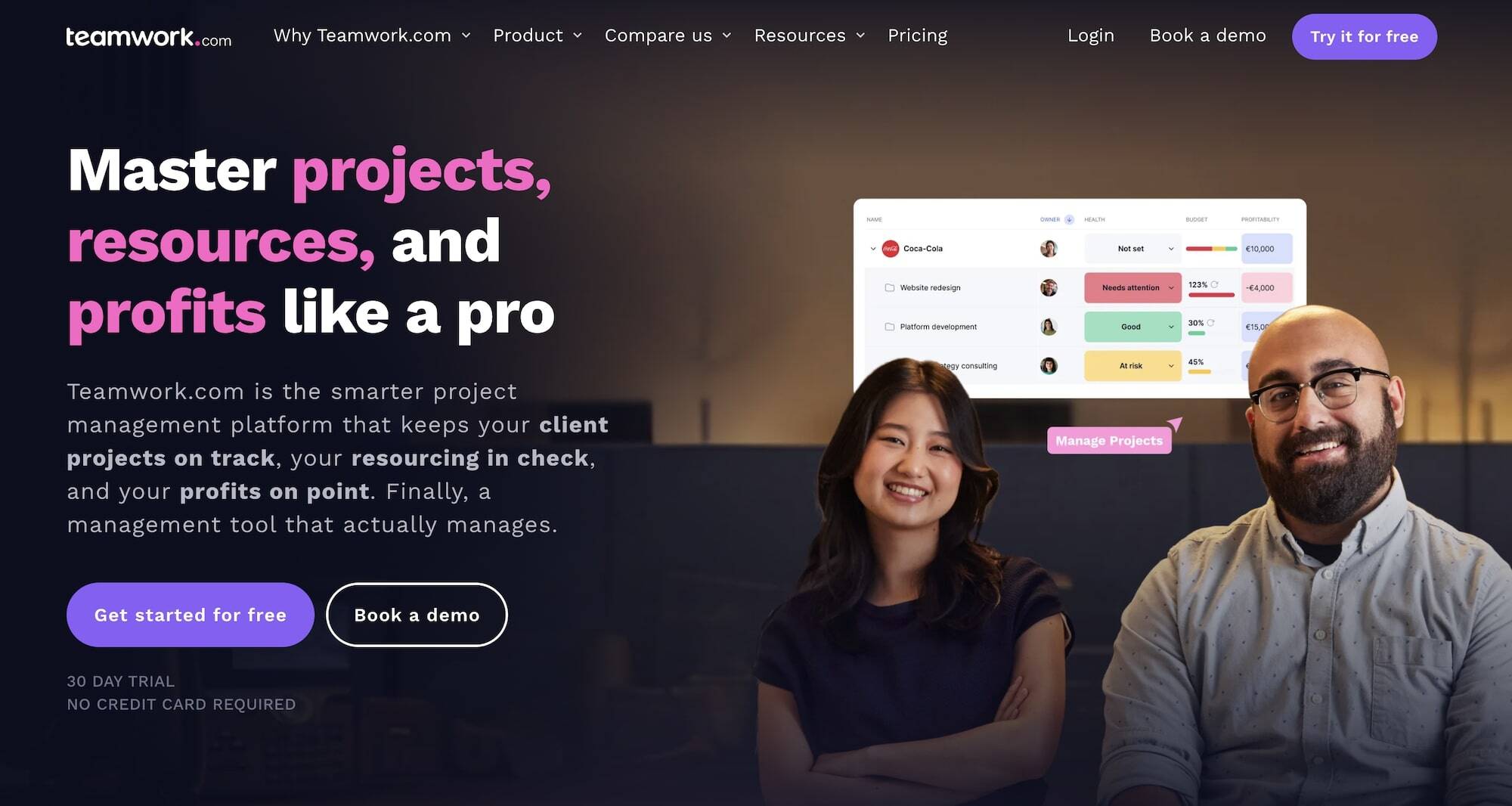
Teamwork offers capabilities similar to Scoro, including project, resource, and client relationship management tools. Many users praise its ease of use and intuitive interface, noting they can quickly get started with project management and CRM tools without training. Its modules are laid out in a clear structure, and the communication tools help different teams collaborate effectively.
However, unlike truly unified systems, Teamwork relies on integrations (native APIs and custom connections) to support all agency operations. For example, its financial management and reporting features aren’t particularly robust, so many teams end up integrating Teamwork with standalone accounting software.
While some agencies appreciate Teamwork’s various integrations, which allow them to connect systems they already use, there are several downsides to this approach: users must set up and manage all these integrations, push data between multiple software applications, and pay for various software subscriptions. Agencies can’t really reduce costs without condensing their tech stack.
Additionally, using multiple systems means data is siloed across these tools. For example, you may want to track project costs in Teamwork, but operational and overhead expenses are logged only in QuickBooks or Xero. You won’t get a clear picture of the project’s overall costs and burn.
Despite its limitations, Teamwork is a respectable solution used by agencies of all sizes.
Read more Teamwork reviews here.
Features
- Project intake forms and project planning
- Project management
- Project monitoring
- Project portfolio management
- Campaign management
- Resource and workload management
- Time tracking
- Internal proofing and collaborative tools
- Workflow automation tools
- Client management
- Expense management
- Budget tracking
- Invoicing
- Reporting
- Integrations and API
- Mobile apps (for iOS & Android)
Pricing
Teamwork offers three standardized plans:
-
Deliver: $13.99/user/month — Teamwork’s basic plan that offers limited features.
-
Grow: $25.99/user/month — which unlocks advanced budgeting, time reminders, company timesheets, workload management, and custom reporting.
-
Scale: $69.99/user/month — Teamwork’s recommended package for agencies that provides access to the platform’s complete feature set.
Custom packages are available for enterprises. Interested users can also test the platform out through its free trial.
Read more: Best Teamwork Alternatives for Creatives & Agencies
7. Bonsai
Hello Bonsai is an agency management solution that offers project and task management, time tracking, CRM, and various client management tools (proposal, contract, and invoice management, etc.) in a single, integrated platform.
Many users appreciate Bonsai’s ease of use (including user-friendly time-tracking tools), advanced invoicing, proposal templates, and contract builders that enable teams to quickly draft formal agreements for their clients.
While agencies use the platform to support various workflows, Bonsai falls short in several areas: its CRM and project management modules are basic, and the system lacks dedicated accounting software or robust financial reporting.
Although Bonsai positions itself as an all-in-one solution, many agencies rely on integrations to support their complete workflows. Plus, unlike Teamwork, Bonsai lacks robust native integrations and instead directs users to Zapier.
Read more Bonsai reviews here.
Features
- Project and task management
- Project budget tracking and forecasting
- Resource allocation
- Resource planning with capacity and margin tracking
- Time tracking
- Client communication tools
- Expense management
- Invoicing
- Proposal tools and contract builders
- Meeting scheduling and calendar integrations
- Lightweight CRM
- Reporting
Pricing
Bonsai offers four standard plans tailored to freelancers and agencies of all sizes, including enterprises. However, it’s worth noting that only the Premium and Elite plans remove Bonsai’s branding, unlock integrations (Zapier, QuickBooks, Google, etc.), and offer advanced reporting. So the Basic and Essentials plans aren’t suitable for most agencies.
They are:
-
Basic: $15/user/month — including time tracking, project and task management, CRM, and unlimited clients.
-
Essentials: $25/user/month — unlocks Bonsai’s features for proposals & contracts, invoices & payments, expense & income tracking, forms & questionnaires, and client portals.
-
Premium: $35/user/month — unlocks project insights, workload management, custom fields, profit & productivity reports, and more.
-
Elite: $59/user/month — unlocks custom permissions, timesheet locking, Xero integration, custom data import, and allows users to add markup to expenses.
It’s also worth noting that many Bonsai users mention surprise fees from the vendor. Users report that Bonsai’s “updates” have removed core features and repackaged them as add-ons, while pricing plans have increased significantly. Bonsai also charges steep transaction fees for using its payment processing tool.
Read more: Bonsai Software Reviews & Alternatives: 2025 Buyer's Guide
8. Kantata

Kantata offers a professional services cloud with features to support creative agency operations, improve team productivity, and help agencies effectively scale.
The platform combines project, resource, and financial management with team collaboration tools and business intelligence reporting. By streamlining workflows and providing transparency throughout the project lifecycle, it can improve resource utilization, team efficiency, and project profitability.
On the whole, users like Kantata for its usability and user-friendliness; they also say the Kantata team is helpful when setting up and customizing the software.
Users specifically highlight the time-tracking feature, noting that it greatly improves budget management. They also note that the project management tools help develop solid project plans and keep projects on course.
However, when we compare Kantata to the other options on our list, it’s not the strongest contender because it lacks a native CRM and accounting software. That said, Kantata is a Salesforce partner, so the systems connect and work together seamlessly — and it also supports integrations with mainstream accounting systems.
Aside from CRM and accounting integrations, Kantata integrates with dozens of software solutions to unify your tech stack and automate other project-related workflows (such as invoicing and payment management). Users appreciate the wide variety of integrations, as Kantata typically works with the tools they already use.
Read more Kantata reviews here.
Features
- Project planning tools, like project estimation and forecasting
- Project monitoring
- Automated, real-time insights into projects — to guide next steps and prevent overruns
- Portfolio management
- Resource scheduling
- Resource forecasting and capacity planning
- Resource management tools, such as skills and vendor management, to source the best talent for projects
- Time tracking
- Budget tracking
- Project accounting — to track project costs, monitor project burn, and set financial goals
- Invoicing
- Revenue forecasting
- Feedback surveys for project teams and clients to report on satisfaction and overall project success
- Team collaboration and feedback tools, like file sharing and commenting
- Business intelligence reports, with 60+ service-centric reports
- Integrations
Pricing
Kantata does not publicly list pricing — they provide a form on the site for you to input details about your agency (such as the number of user seats you require, where you’re located, and contact info) and view suitable packages and pricing options.
9. Deltek Solutions (by PCI)
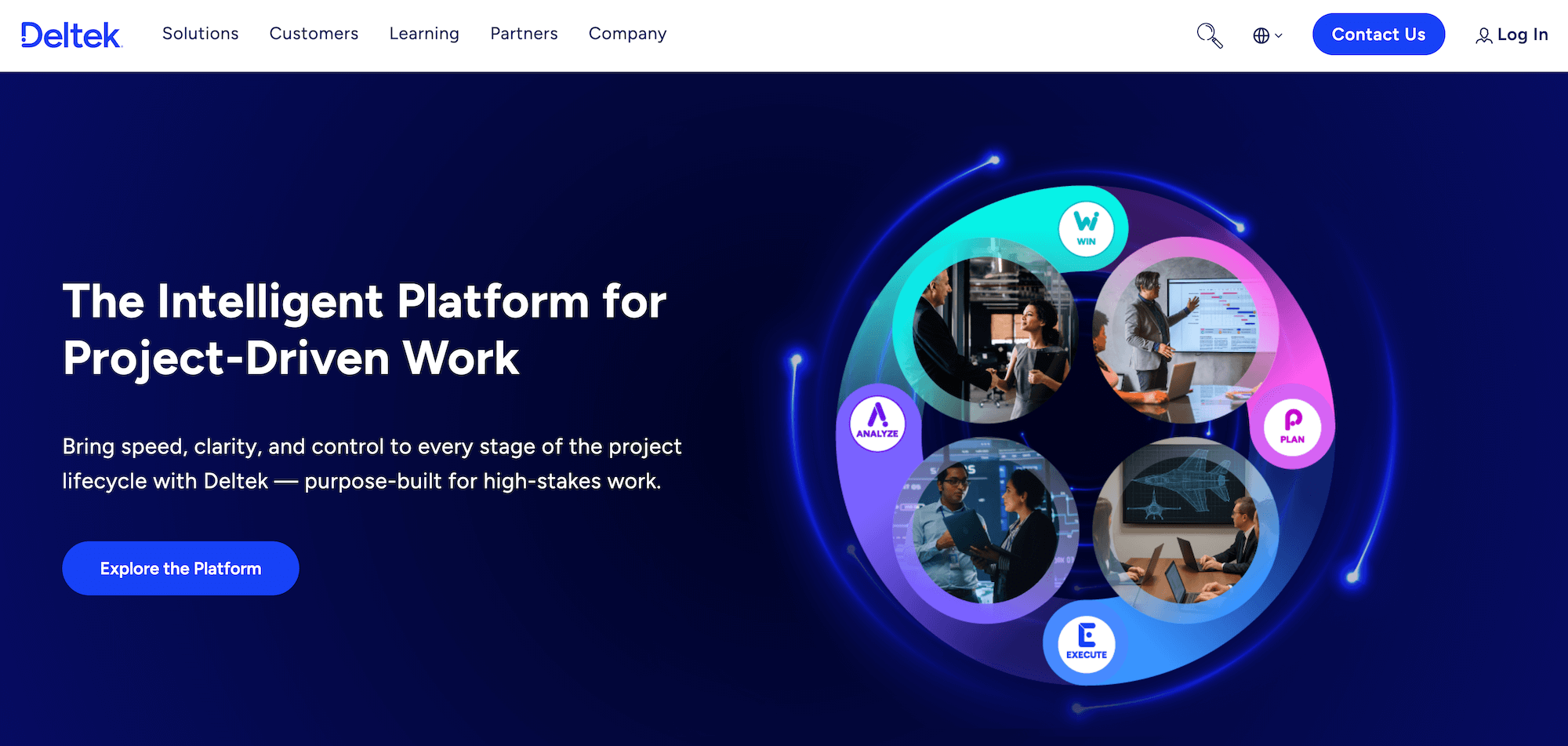
Deltek is a leading global provider of technology products tailored to the needs of various industries, including government contracting, consulting, professional services, manufacturing, aerospace & defence, and more.
For advertising agencies, Deltek offers:
-
Deltek Workbook — an agency management system that brings people, projects, and finances together in one place. While all plans include project management, you can mix and match the other modules with the following options: 1) standalone PM, 2) PM + CRM, 3) PM + finance and accounting, 4) full suite with all the mentioned features.
-
Deltek Maconomy — an ERP tailored to professional services companies. Maconomy is a more advanced solution for enterprise needs, featuring powerful reporting, multi-currency support, international compliance tools, and more. Its full suite of tools includes robust systems for managing accounting, finances, projects, resources, customers, and pipeline.
While users praise both Deltek Workbook and Maconomy for their robust feature sets and seamless integrations, some note their steep learning curves and lengthy implementation timelines.
To help address some implementation challenges, Deltek partners with Premier Consulting & Integration (PCI), which offers agencies onboarding, training, and support. PCI will tailor your chosen Deltek solution to your requirements and help you get started smoothly.
Read more Deltek Workbook reviews here & Deltek Maconomy reviews here.
Features
- Project management
- Project budgeting and cost tracking
- Project risk analysis
- Resource management
- Task management
- Payment processing
- Customizable invoices
- Inventory management and reporting
- Multi-entity accounting
- Budgeting and forecasting
- Out-of-the-box and custom reports
Pricing
Deltek and PCI don’t publicly list their prices for Deltek’s products, so you’ll need to contact either of them directly for a quote. The cost of Deltek Workbook depends on which modules you choose to include in your plan.
The Runner-Ups
In your search for advertising agency management software, you’ll come across many tools that we haven’t reviewed — like Wrike, Monday.com, and Asana. However, unlike the all-in-one systems we’ve covered, these standalone project management tools aren’t designed to support all advertising agency workflows — which is why they haven’t made our list.
These platforms require you to connect multiple systems using (potentially clunky) integrations and APIs to support all your agency operations. But as we’ve discussed above, using disparate systems leaves your data scattered, complicates user adoption, and increases tech costs. So, they’re not the ideal choice for advertising agencies.
Another type of system you might come across is enterprise resource planning (ERP) software, such as NetSuite. While these solutions can technically support creative agency workflows, they also charge premium rates, have long implementation times, and often include many features you won’t actually need (but may still have to pay for).
We strongly suggest advertising agencies choose a system that’s tailored for creative workflows.
Manage All Your Advertising Agency Workflows With One System
As we’ve discussed above, a robust agency management software provides everything advertising agencies need to run a successful operation — including:
- A sales CRM to support customer acquisition and help you manage your sales pipeline.
- Project management tools for project intake, planning, and monitoring.
- Resource management, with staff scheduling, time tracking, and utilization reports.
- Robust team collaboration, including file sharing, internal proofing (for internal and external users), and version history.
- Financial management, including budget tracking and financial reporting.
- A full accounting software to manage project finances in the project workflow in real time.
- Vendor management and client portals.
- Integrations with media buying systems and other business applications.
However, while many providers position themselves as all-in-one solutions, a closer look at their plans and features often tells a different story.
Many rely on third-party integrations to support all workflows; others lock essential features behind confusing pricing structures; and some providers offer modules with limited capabilities.
Choosing the wrong system means spending time and effort maintaining integrations, paying for multiple subscriptions, and dealing with long implementation times.
A fully integrated system like Workamajig offers a better way forward by providing everything you need in one place, under one subscription. Your dedicated account manager will also help streamline Workamajig’s implementation and ensure your whole team feels empowered to use it.
Request a free personalized demo with our team to see how Workamajig can support your advertising agency!
Related reads: