

Monday.com is a popular, top-rated project management tool that appeals to professionals across various industries. It has a broad range of functionalities, including task management, time tracking, staff scheduling, team collaboration, and powerful automation.
However, Monday is what we call a "universal" project management tool — it isn’t tailored to any specific audience’s workflows, so it may not be the best fit for teams with specialized workflows, such as agencies and creatives. Monday’s main focus is on task tracking and workflow management; it doesn’t offer the most in-depth tools in other areas, such as project financial management, which is critical for agencies.
To be fair, Monday does offer workarounds to make up for its limitations. For example, to manage project finances, Monday lets you set up custom number columns to log expenses and track budget burn. Or you can integrate your accounting software to manage financials during project workflows.
But even then, you're still relying on integrations, duplicated configurations, or data moving between separate systems. These workarounds can make it difficult to maintain an accurate view of profitability while the project is underway. They also don’t pull expenses from their source systems or reflect activity on the accounting side (e.g., whether you’ve paid vendor invoices or clients have paid theirs).
That’s why fully integrated agency management software is the best solution here. It’s developed around the way agencies actually work — specifically designed to overcome the limitations of generic project management software — with everything agencies need under one roof: project management, resource planning, CRM, accounting software, budget and financial management, and business intelligence reporting.
Our solution, Workamajig, falls into this software category, along with other names such as Function Point, Productive, e-Silent Partner, Advantage, and Teamwork.
Our guide reviews each of these agency management solutions, listing features and pricing information so that you can compare all of the top Monday alternatives for agencies in one place.
Note: Other Monday.com alternatives like Zoho Projects, ClickUp, Asana, Airtable, Notion, Basecamp, Jira, and Trello haven’t made our list because they fall into that “universal” project management bucket we explained above.
To learn more about Workamajig and how our solution expands upon Monday’s functionality, request a free demo with our team.
1. Workamajig
All-in-one agency management system for marketers & the creative industry
Workamajig is an all-in-one operating system for agencies, providing all the tools to manage projects, campaigns, people, and finances in one system. We’ve been working with agencies for over 35 years, learning about their challenges with typical project management software and what they specifically need to manage all their moving parts, and have designed Workamajig around that experience. It includes:
- CRM software: To capture lead information, manage your sales pipeline, and convert awarded opportunities to new projects. Our CRM also provides reporting tools to measure close rates and refine acquisition strategies.
- Project management: With all the essential tools offered by Monday.com (and more) — templates, estimating, customizable project intake forms, task management, change management, real-time project monitoring, project portfolio management, and detailed project reports.
- Resource management hub: Including centralized staff scheduling and capacity planning to optimize resource allocation.
- Vendor management module: To request quotes, compare bids, generate purchase orders, share task assignments, and track vendor reliability over time.
- Time and expense tracking: To log hours and expenses at the project level, ensuring they’re accurately captured in project monitoring, billing, and reporting.
- Collaboration tools: So internal users and external contributors alike can collaborate seamlessly in one place. External users can join discussions for free, with no additional licenses required. Teams can share content, streamline feedback processes, compare file versions, and track version histories.
- Full GL accounting software: Our native accounting software is one of the biggest reasons to consider Workamajig over universal PM systems like Monday. It lets you manage finances within your project workflows, so you can capture expenses, track real-time project budgets, streamline reconciliation, and accurately evaluate profitability from multiple perspectives.
- Financial reporting dashboard: Thanks to our native accounting software, Workamajig offers more than project-level reporting. Our system offers profit & loss reports across various categories, general ledger (GL) reports, cash projections, revenue forecasts, and key metric tracking. You can also create custom reports with all the data that’s most important to your agency.
- Integrations: With calendar systems, credit card connectors, and media-buying systems to connect your external accounts and support pre- and post-project workflows.
- AI MCP: Leverage the Workamajig MCP (Model Context Protocol) server to connect an AI assistant directly to our system. Once connected, your AI assistant can query data, create and update records, log time, manage opportunities, and automate multi-step business workflows entirely through natural language.
Our goal is for Workamajig to be your one-stop shop, so you don’t have to manage a large, disconnected tech stack or try to stitch together some custom solution while paying for several software subscriptions.
We provide all of the onboarding support needed, including:
- Straightforward packages and pricing. All teams receive full feature access, and you choose your package by the number of seats you require (and can add or remove users at any time).
- Personalized onboarding and training. Our team configures Workamajig to your workflows and shows you how to make the most of the platform.
- A dedicated account manager. Your account manager will not only guide you through onboarding and training but will also be your primary support for all things Workamajig.
In the following sections, we’ll review our platform’s key features.
To see exactly how Workamajig can work for your agency, request a free demo with our team.
Workamajig CRM & Client Management
Workamajig offers a native agency CRM as part of its core feature set to support client acquisition and manage new leads through the sales pipeline.
Our CRM features:
- Lead capture tools. Pull in new inquiries as leads by connecting your “Contact Us” form. You can also add leads from other CRM tools, like HubSpot, and import complete lists as .csv files. Our CRM creates a marketing qualified lead (MQL) record that tracks all relevant information, including names, email addresses, and details from sales conversations, so your sales team can see the whole picture.
- User-friendly Kanban boards for managing the sales pipeline. Each stage of your sales process is customizable so you can see the pipeline by stage in a Kanban-style board. As reps develop opportunities, they can drag and drop them through funnel stages, so the pipeline view always reflects what’s happening on the ground.
- Tools to develop opportunities. Workamajig’s CRM includes several tools to help reps engage and qualify opportunities at each stage. They can automatically generate accurate estimates for their proposals, forecast resource demand for upcoming projects, and reference big-picture details (such as age, timeline, and potential profit) to make strategic calls about which opportunities to prioritize.
- Sales dashboards. Our system gives sales users two dashboards for planning out their work, tracking engagements, and viewing real-time pipeline performance. They can pull up all active opportunities and deal stages, filter for opportunities or leads that haven’t been engaged in a specified period, view the revenue closed so far, and much more.
- CRM reporting suite. Workamajig offers a range of out-of-the-box and custom reports to analyze sales performance, including our popular Win/Loss Analysis, Quarterly Performance Comparisons, and Sales Rep Activity Summaries.
![Workamajig: Sales Dashboard and Opportunities [GIF]](https://www.workamajig.com/hs-fs/hubfs/Workamajig%20Sales%20Dashboard%20and%20Opportunities%20%5BGIF%5D.gif?width=1920&height=1050&name=Workamajig%20Sales%20Dashboard%20and%20Opportunities%20%5BGIF%5D.gif)
Read more: Best Agency CRM Software: Reviews & How to Choose
Note: Monday also offers a dedicated CRM to support its project management software, but it is priced separately. Agencies that want both solutions may need subscriptions to both products.
Client Portals
Workamajig maintains a consistent record for each contact, storing essential information such as their name, title, contact details, source, owner, and complete interaction history, including files and notes. So when a deal is closed, all that contact data still lives in the client record for project teams to easily reference.
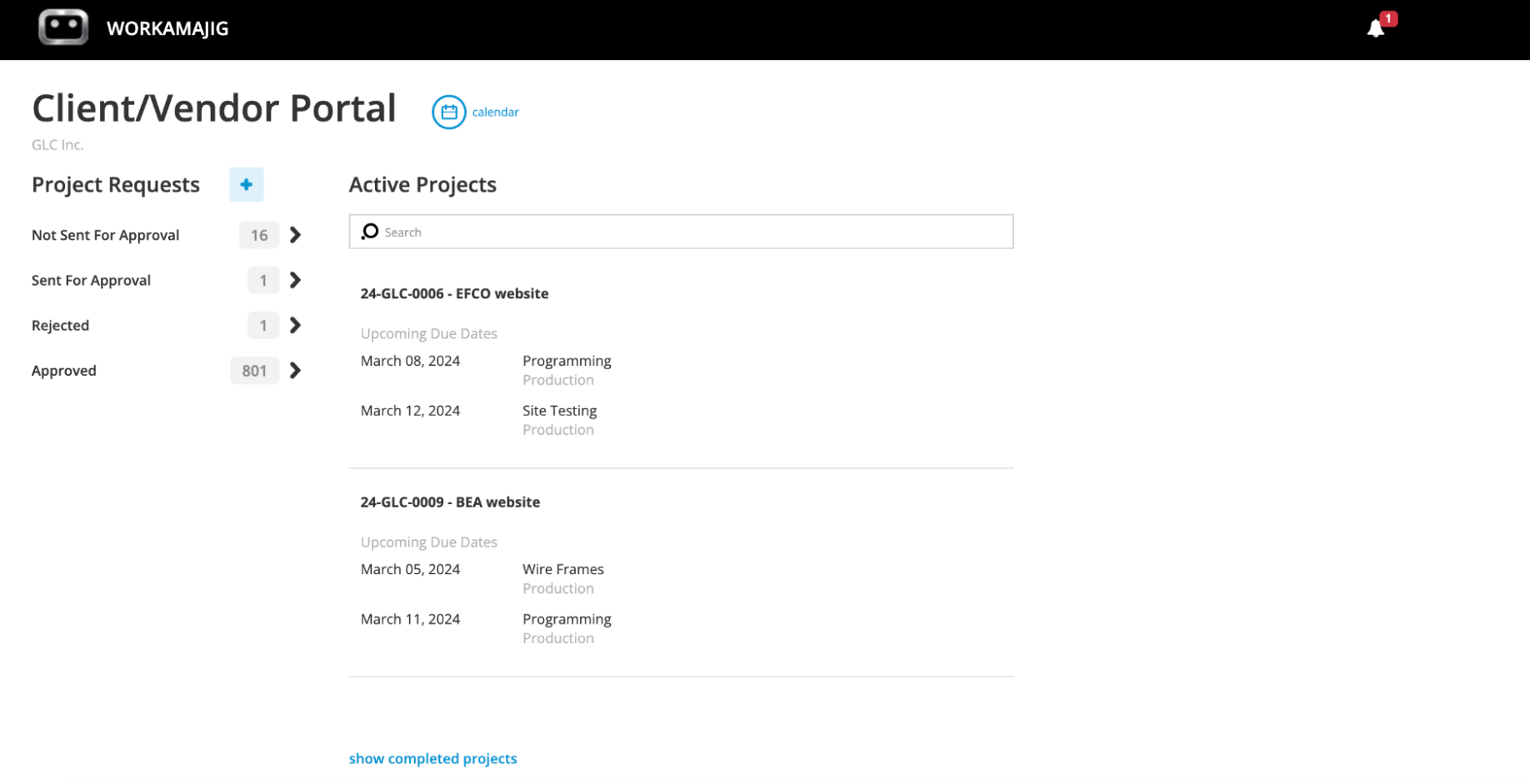
You can also create dedicated portals for all the clients you work with (we don’t cap client portals or charge extra for them) to simplify communications and improve project collaboration. Within portals, clients can:
- Submit new work requests.
- Track the status of all their projects.
- Share feedback with project stakeholders.
- Access files and final project deliverables.
Workamajig Project Management Module
Workamajig includes full project management software to support project planning, real-time project monitoring, and reporting on ROI and outcomes.
Project Intake & Planning Tools
Workamajig offers three handy tools to keep project intake as smooth and structured as possible:
- Templates. Agencies love templates because they can define standardized project workflows with the required resources, provide structure, and significantly reduce planning times. Our system lets you create unlimited templates and customize them however you like.
- CRM that converts awarded opportunities to new projects. Workamajig CRM conveniently stores sales conversations (with all details and attachments) and allows reps to convert won opportunities into new projects with a few clicks. Our system then automatically transfers everything that project managers need to take over planning.
- Customizable project intake forms. These are popular with in-house teams that field requests from different departments, but agencies also use them to manage new work requests from their existing clients. Managers can tailor these forms and add custom fields.
Our handy intake tools ensure managers have all the information they need to kick off new projects, without having to chase clients or sales reps up for details. Then, they can review everything, make any necessary changes, and finalize the details using our project planning tools:
- Automated estimating. Workamajig automatically calculates estimates as PMs build out project plans and assign resources. Managers can view labor and expense costs and apply contingency percentages when needed.
- Task management. Managers can tweak the project details, time allotments (for first rounds and revisions), start and due dates, task dependencies, and milestones, and specify the number of allowed revisions per task, among other things.
- Resource and capacity planning. PMs can assign the best-fit resources to tasks while considering their bandwidth, skill sets, and availability. Newly assigned tasks appear in team members’ dashboards, allowing them to view all details and plan their work schedules.
- Vendor management. Our vendor management module lets PMs account for vendor costs during the planning process and ensure they’re accurately tracked against project budgets. More on our resource planning and vendor management tools below.
Staff Scheduling & Resource Management
Workamajig provides a staff scheduling dashboard to help managers balance workloads and improve resource utilization.
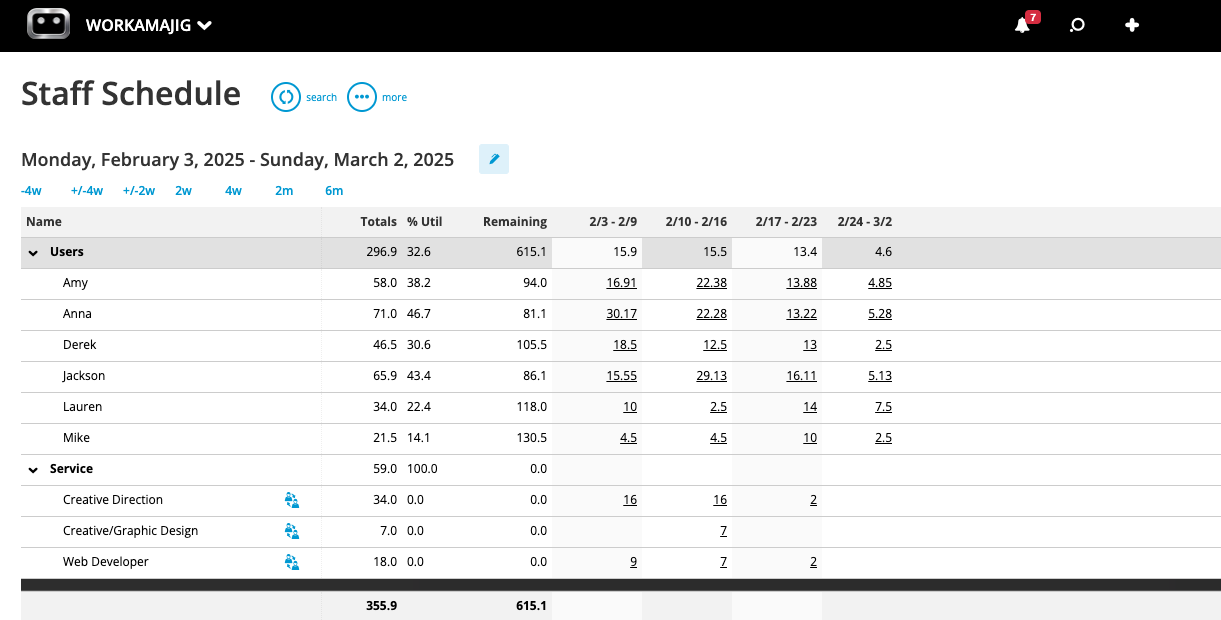
This dashboard lists all team members, along with their total bandwidth, current schedules, and remaining hours. It also lists unassigned tasks (by Service), so managers can ensure all tasks are covered before kickoff.
Managers can toggle the dashboard to display assignments alongside each resource’s schedule, so they can be more strategic in managing allocations and workloads. For example, if a senior role with a high hourly rate is booked out on account management tasks, a manager might adjust their schedule and assign them more billable hours.
Vendor Management
As mentioned above, Workamajig includes vendor management tools so you can bring outside collaborators into project workflows and assign them work:
- First, you can source production vendors or freelancers. Our system lets you request quotes, receive and compare bids, and assign work, so you can incorporate these vendor costs into estimates and ensure they’re captured in the project budget.
- Then, you can give freelancers access to work items so they can complete tasks and collaborate in the system. So long as you have a dedicated vendor portal, they can access Workamajig (for free), view assigned tasks and all their details, and mark tasks complete when finished.
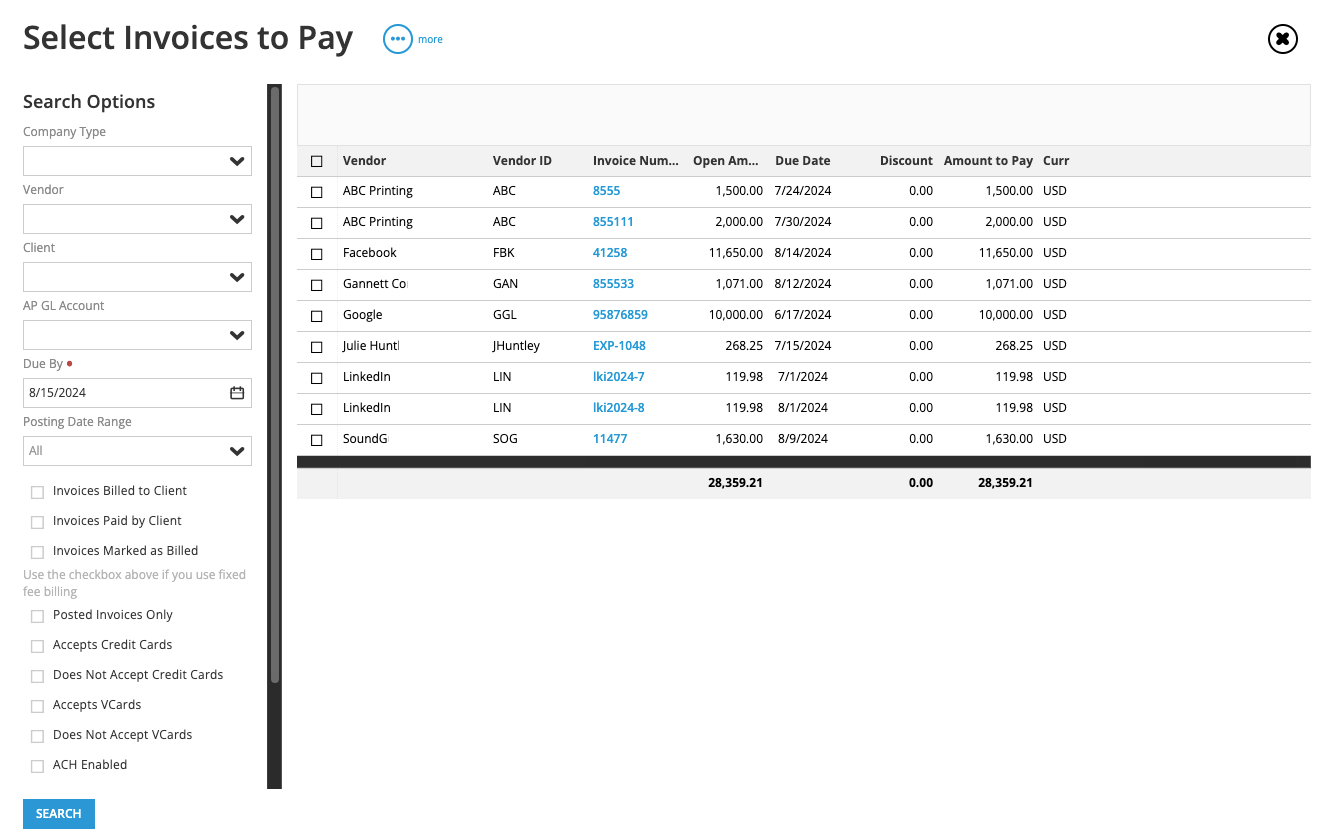
- Finally, you can manage reconciliation and payments. Workamajig lets you match purchase and work orders to invoices, handle overages, and send payments online.
Read more: Creative Resource Management for Agencies: Software + FAQs
Time Tracking & Productivity Reports
Our agency management system also includes native time tracking, allowing users to record project hours directly on task cards. This makes it easier for creatives, as they don’t have to jump to a separate time-tracking tool to log hours, and it allows managers to quickly, clearly, and accurately tie labor hours back to specific project activities.
Users can track time by:
- Recording hours as they work using our automated timers.
- Directly entering time into task cards.
- Connecting their calendars to Workamajig and pulling hours in from meetings and events.
Entering hours manually into grid-style timesheets.
![Workamajig - Today - Creatives - Tasks - New Time Entry for Projects [GIF]](https://www.workamajig.com/hs-fs/hubfs/Workamajig%20-%20Today%20-%20Creatives%20-%20Tasks%20-%20New%20Time%20Entry%20for%20Projects%20%5BGIF%5D.gif?width=612&height=650&name=Workamajig%20-%20Today%20-%20Creatives%20-%20Tasks%20-%20New%20Time%20Entry%20for%20Projects%20%5BGIF%5D.gif)
As people submit their hours, Workamajig dynamically updates project schedules and budgets to accurately reflect actual start dates, completion dates, and labor costs.
Managers can then approve timesheets or flag them with comments (which sends them back for corrections). All approved hours and billable labor rates are pushed into our billing worksheets and reports, ensuring these details are accurately captured on client invoices and reflected in profit and loss (P&L) breakdowns.
Read more: Best Agency Time Tracking Software for Creatives
Hourly Reports
Workamajig also includes productivity reports that show employee hours across categories — you can see which clients, services, or projects require the most resources and where employees spend the most time.
You can also analyze these insights alongside profitability reports to measure the relationship between your team’s effort and its impact on your bottom line. For example, let’s say the hours-by-client report reveals that one of your biggest accounts — a client you'd assume is a flagship win given the revenue it brings in — is taking up a third of your team's total capacity.
On paper, that just looks like a busy, important account.
But after referencing the Client P&L, you may find that labor gross exceeds revenue (or is very close), meaning the account is either barely profitable — or not at all. In such a case, it’s important to make strategic changes, such as renegotiating scope or rates, capping the number of revisions, or swapping in a mix of lower-cost resources on the account.
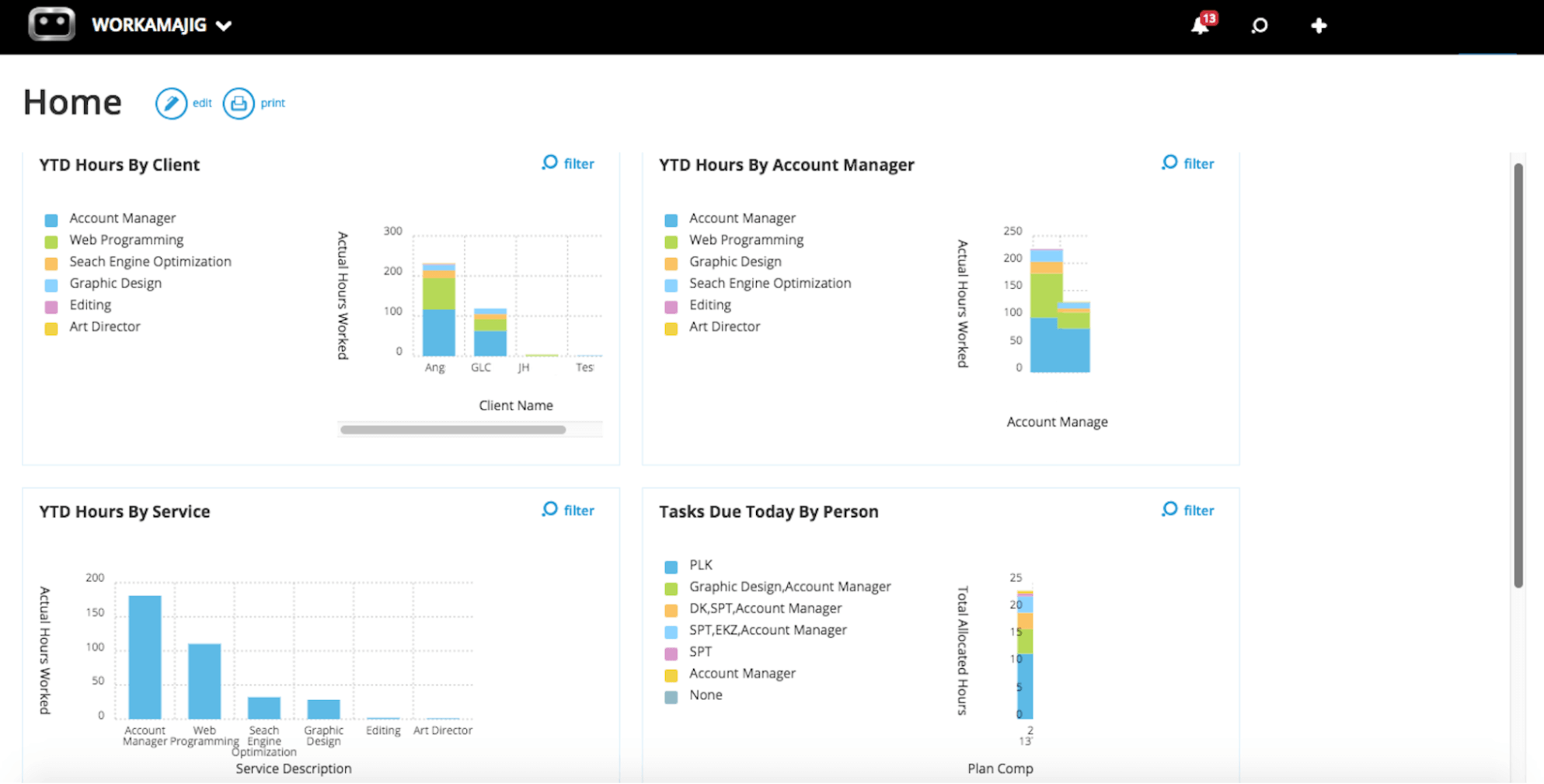
These reports also show what employees are scheduled for during the day and week ahead so managers can make last-minute adjustments.
Time Productivity Analysis
A busy employee isn’t always a profitable one. Someone could be clocking in 40 hours a week but operating on razor-thin margins, negatively impacting your bottom line. For example, this can happen when senior resources do too much internal work instead of being billed out to clients.
The Time Productivity Analysis report is designed to identify these issues by linking resource utilization to profitability, so you can see how much profit each resource generates. The report breaks down each person’s billable and non-billable time alongside their gross hours, the cost to your agency, and the overall profit margin (in both absolute numbers and as a percentage).
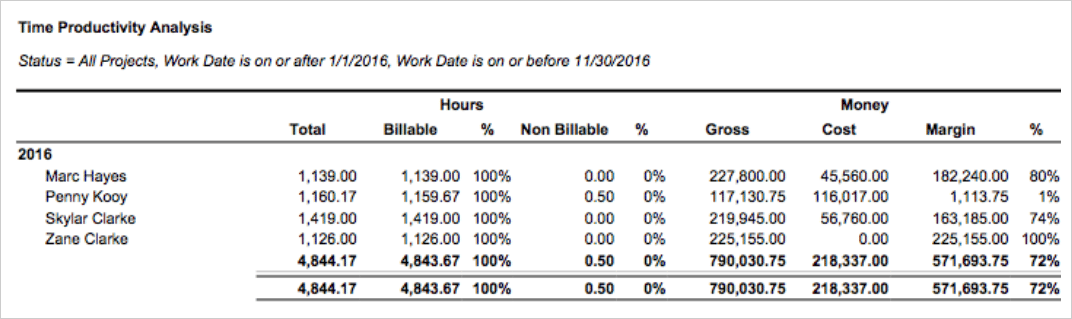
For example, in the report above, every employee spent 100% of their time on billable work, but their gross, cost, and margin figures differ. Penny Kooy’s margin is only 1%, indicating minimal bottom-line contribution, while Skylar Clarke and Marc Hayes have margins of 74% and 80%, respectively.
Chargeability Report
The Chargeability Summary report tracks the billable hours that actually make it onto the client invoice — after write-offs, cost transfers, and any lost hours due to mistakes or rework. The report displays planned vs. actual chargeable hours, non-chargeable hours, and total hours with a breakdown by department and role.
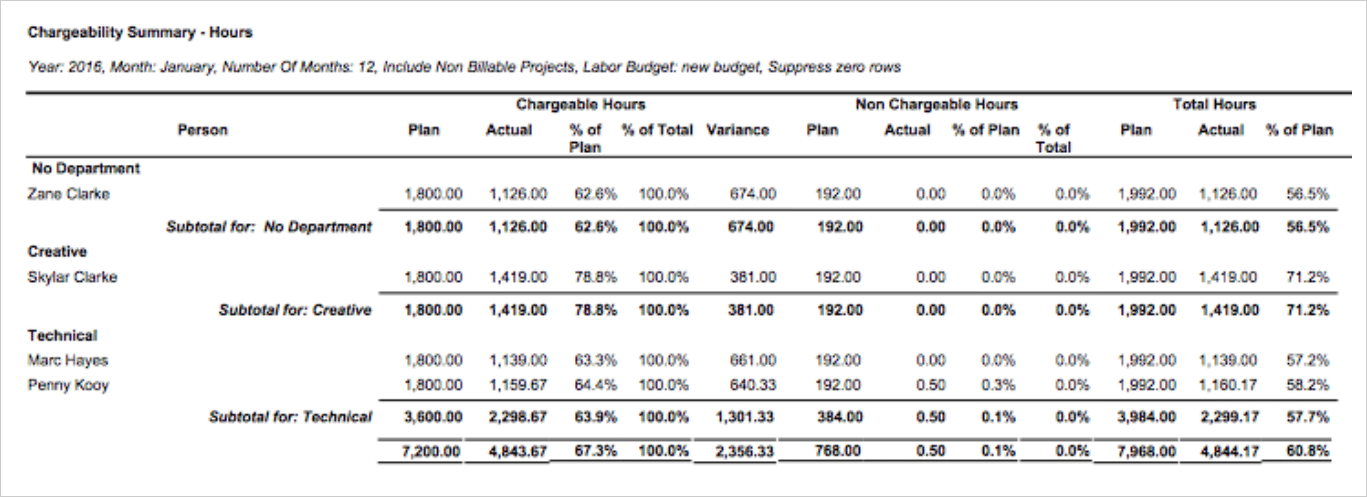
Forecasting chargeability can be difficult because you can’t always predict which initially billable hours will later be written off or excluded from an invoice. Our report bridges this gap by allowing you to track and compare chargeability over specific periods, providing a consistent reference point. For example, you can compare who’s running close to their chargeable target and who’s falling short each quarter, or even compare department-to-department performance.
Project Expense Tracking
Earlier, we mentioned that Monday is pretty limited for managing project financials — and that extends to project expense tracking. You have to use numeric columns and templates to create expense categories and track budgets. And even after customizing the whole setup, there’s loads of manual work involved in maintaining things and mitigating errors.
Workamajig simplifies this whole process with native tools to pull in different types of expenses, tag them to projects, manage reconciliation, and ensure costs are accurately captured in the final client invoice.
Our system includes:
- Credit card connector. You can link credit card accounts to Workamajig (via Plaid) and monitor and import charges. After connecting cards, users can map and tag project-related charges.
- Expense reports. Users can generate expense reports (even from mobile devices!) and request reimbursements. Managers can review, approve, and send reimbursements via Workamajig’s digital payment integrations.
- Receipt management. Staff can upload receipts from credit card expenses to share them with accounting teams through the system. This beats carrying around and keeping track of paper receipts and lets users share them instantly.
- Media planning and buying integrations. You can connect Workamajig to Strata/Freewheel, GaleForce Media, Mediaocean, and Bionic to feed data from media buying tools back into Workamajig. Then, you can incorporate those costs into client invoices, review budgets vs. actuals for media production and placement, and plan for them in future projects.
- Vendor invoice management. Managers can add copies of vendor invoices to Workamajig, match and compare invoices to purchase orders, and close out invoices using one of our payment methods. They can even pay vendors online through our integrations with Edenred Pay and AvidXchange.
Real-Time Project Monitoring
After kickoff, managers can track project progress in Workamajig’s project monitoring dashboard. Take a look at our project-monitoring dashboard below:
![Workamajig dashboard: Projects and Project Status [GIF]](https://www.workamajig.com/hs-fs/hubfs/Workamajig%20-%20Projects%20and%20Project%20Status%20%5BGIF%5D.gif?width=1714&height=853&name=Workamajig%20-%20Projects%20and%20Project%20Status%20%5BGIF%5D.gif)
Our advanced dashboard helps managers work more strategically with:
- Real-time budgets and project timelines. Our system tracks real-time labor costs and calculates projected end dates as users import hours and complete tasks. This helps managers communicate accurate timelines and schedule new work.
- Customizable Gantt charts and views. You can color-code project phases on our Gantt charts to visualize progress at a glance, while black progress bars show how far along each one is. The monitoring dashboard can support various project management methodologies — such as Agile, Critical Path, and Waterfall.
- Project health indicators. Workamajig’s project monitoring dashboard features color-coded icons across the “Financial Status,” “Project Timeline,” and “% Complete” columns — indicating the status and health of each project. Green means everything’s on track, yellow signals the project’s at risk of overruns (either budget or timeline-wise), and red means the project has been delayed, exceeded its budget, or both.
- Notifications about projects at risk of exceeding budgets or timelines. Workamajig alerts managers when a project’s health enters the yellow territory, so they can intervene early and bring it back on track. Our system highlights the specific issue (whether budget- or timeline-related), so managers know where to begin troubleshooting.
Then, after projects wrap and receive final sign-off, managers can review project details, including actuals vs. estimates, and measure project profitability.Was the project ultimately successful, or are there areas for improvement?
Change Management Tools
Workamajig includes change management features to ensure new client requests are handled in a structured way and that the project’s plan, schedule, and budget are updated accordingly.This is important because scope creep and out-of-scope requests are common reasons projects go off course.
Managers can create dedicated change request forms with fields to capture the necessary details, so requesters must provide the right amount of context up front. These requests can be submitted by (i) clients, through their portals, and (ii) internal team members, through the Workamajig project dashboard.
After submission, new requests are routed to whoever’s responsible for approvals. That’s usually the project manager, but some workflows include multiple approvers (you can easily create a customized process in Workamajig).
Then, after a change request is approved, Workamajig:
- Stores the updated project details and deliverable specs as the new default.
- Maintains the full version history of previous spec sheets, so managers can always reference what was asked for, when, and by whom.
- Links the costs from approved requests to the original estimates and updates the project budget.
Project Collaboration Features
Workamajig provides a role-based Today dashboard for all users, listing exactly what to work on and what’s on the schedule for the days ahead. It even lists tasks in order of priority so users can plan out their week and ensure they complete tasks on time. This gives everyone a clear to-do list so employees aren’t left to manage schedules independently.
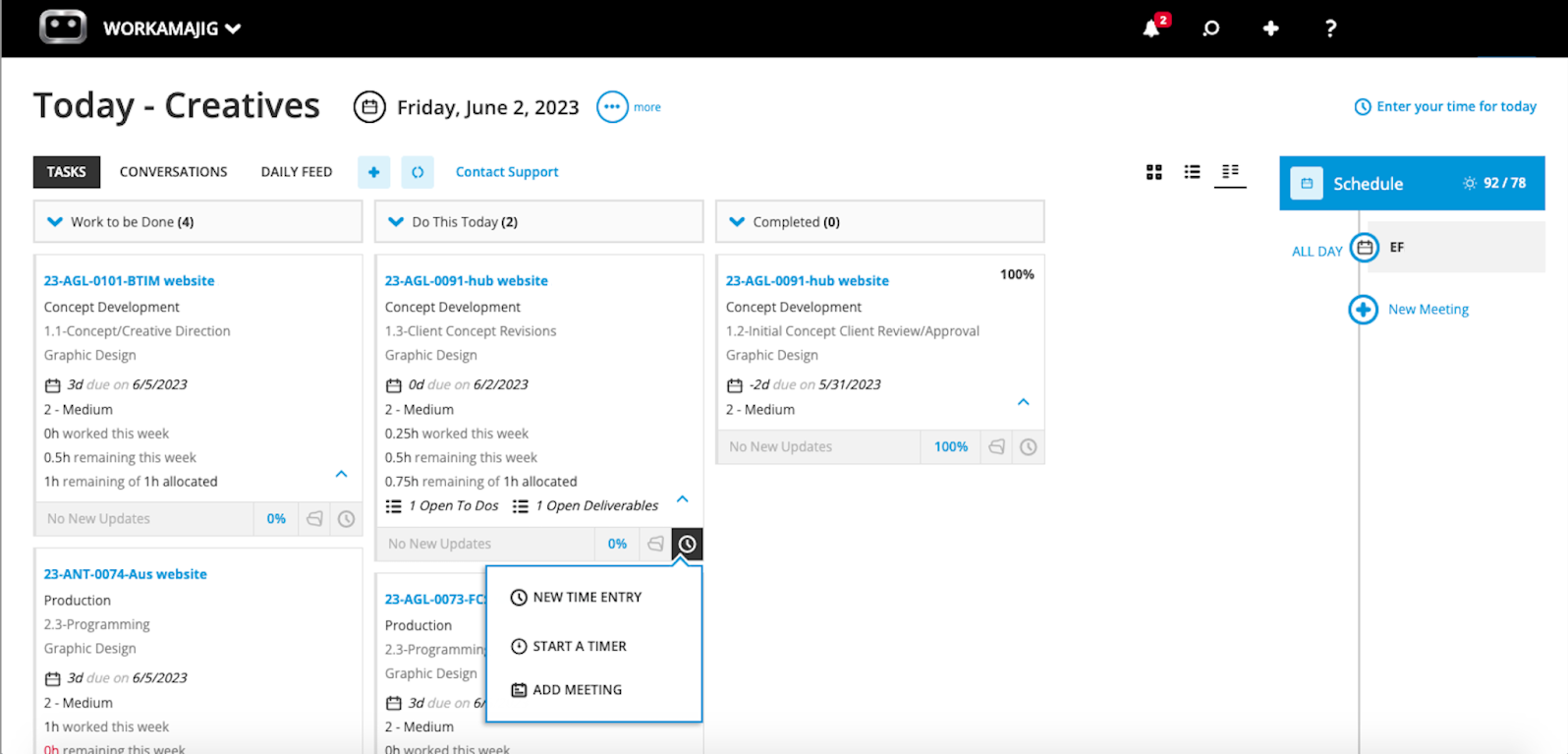
Then, Workamajig offers several collaboration tools on task cards, so all project stakeholders can participate in feedback processes and work together toward a final product. Here’s how this looks:
- Users can share files and mark tasks complete when they’ve finished working. Workamajig accepts various file types (documents, images, videos, PDFs, HTML, etc.) as well as website links.
- Managers can see tasks to review and push files around to other reviewers (internal or external).
- Other reviewers can preview files and request changes via Workamajig internal proofing. This tool maintains a history of all comments and file versions, allowing users to see how the content evolved in response to feedback. Our system also allows users to compare different file versions side by side and view new changes.
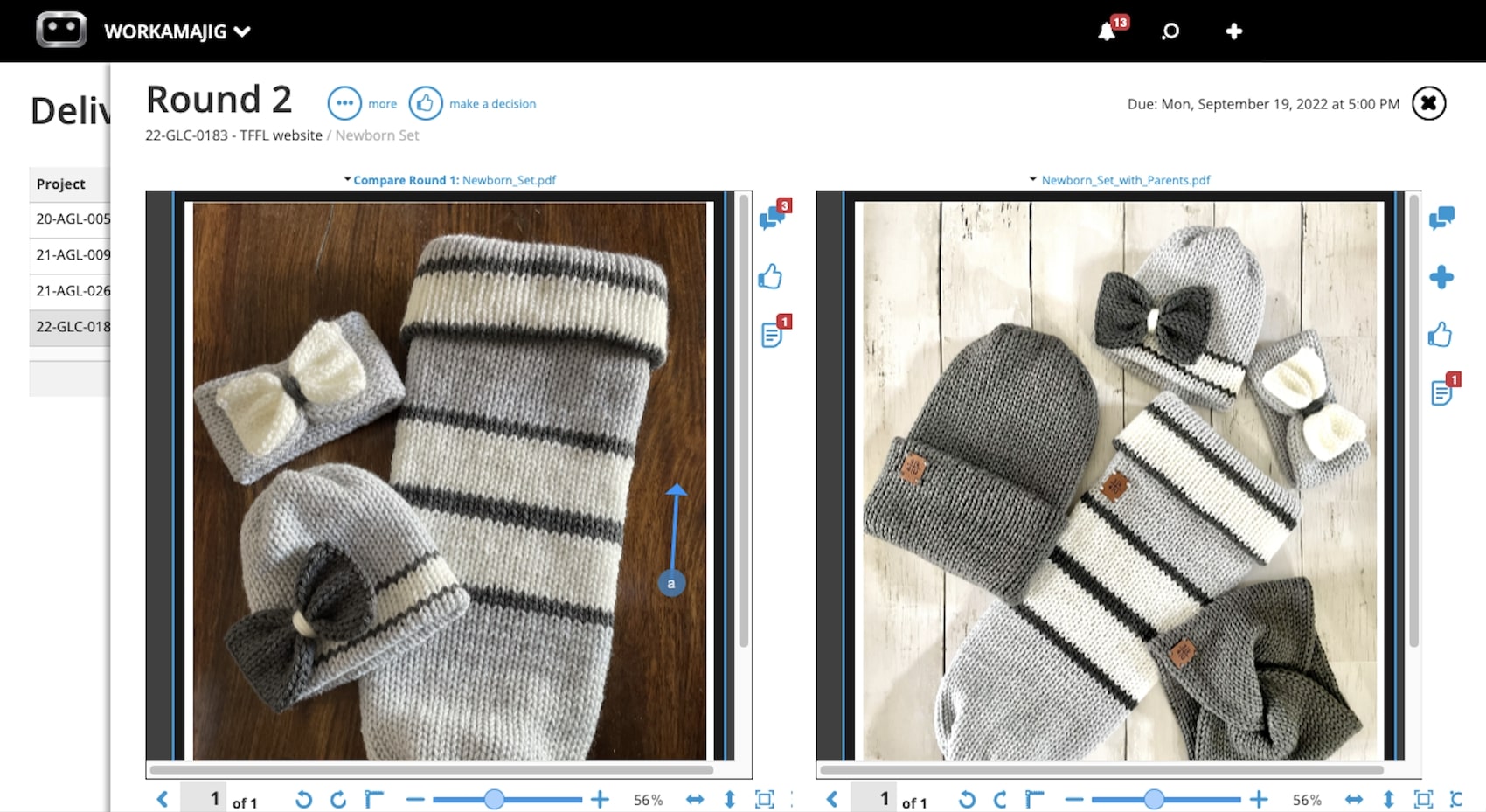
Our system also keeps the review process moving with real-time notifications; managers and other internal users receive messages in the Workamajig dashboard, while clients and other external users receive updates via email, so they can conveniently review files and reply in the thread.
Project Portfolio Management
Bringing multiple related projects together under a portfolio is helpful for streamlining operations, reducing headaches, and improving collaboration. But Monday and many of its alternatives typically lock portfolio management behind their highest-tier plans or enterprise packages, so you have to pay a premium to get it.
Workamajig, on the other hand, offers portfolio management across all our plans, so every team has access to it. With Workamajig’s portfolio management features (called Campaigns), you can:
- Create shared file repositories accessible to all stakeholders across the portfolio. This means users only have to share things once, and people working on multiple projects don’t have to sort through individual threads to find what they need.
- Unify budget tracking. Generate an accurate estimate for your entire portfolio, then track cost burn in real-time using our campaign burn chart. Workamajig lets you create a centralized portfolio budget either by using each linked project’s budget or by referencing your service costs.
- Track schedules and edit tasks in one place. Workamajig’s centralized campaign scheduling dashboard provides a visual overview of the overall portfolio schedule and how each project contributes to the bigger picture. From here, you can also drill into or make changes to any tasks across the entire portfolio.
- Simplify billing and invoicing. You can easily create a single invoice for the entire portfolio or use our mass billing feature to generate individual invoices for each project.
Read more: Best Campaign Management Software for Agencies & Creatives
Project Reporting Suite
Workamajig’s project reporting suite offers a variety of post-mortem reports to compare each project’s performance against your plans, identify issues, and evaluate profitability from multiple perspectives. The reports all draw from the same time, cost, and project data that already lives inside Workamajig.
Project Recap Analysis
The recap brief compares approved estimates with what happened across budgets, hours, and due dates, with results columns for easy variance assessment. The report groups tasks by phase (general development, production, account management, and so on) with subtotals rolled up per project.
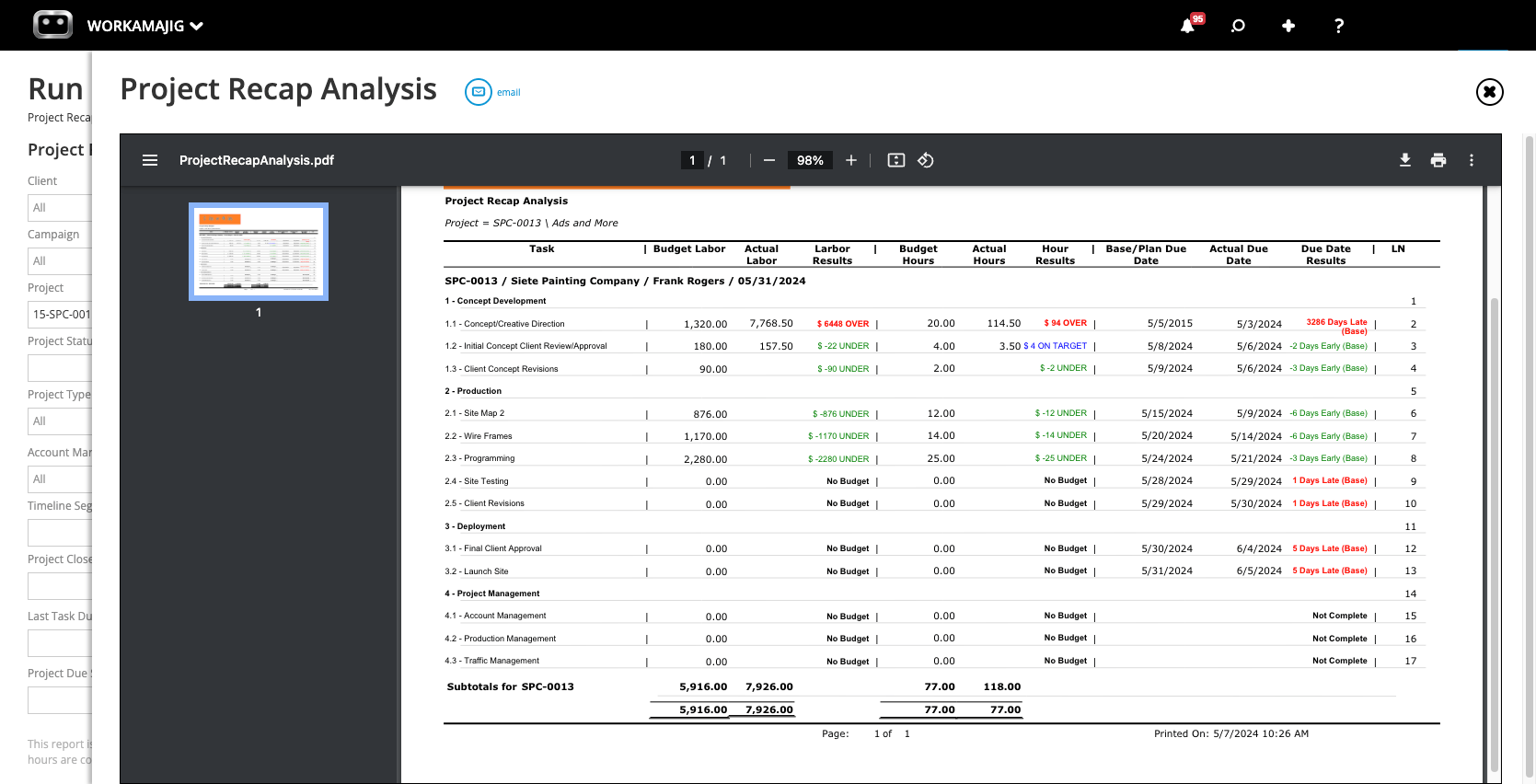
The results columns are color-coded to immediately bring your attention to any differences — red when you're over or late, green when you're on target. In the sample "Ads and More" project, for instance, you’ll notice that things didn’t go as planned; roughly $5,910 in budgeted labor against $7,926 in actual labor, and 77 budgeted hours against 116 logged.
Project Budget Analysis
While the recap offers a task-by-task autopsy of a single project, this is the live budget-vs.-actuals view across multiple projects at once. It lays out your current total budget alongside actual hours, labor gross, outside costs, open orders net, and amount billed, with everything grouped by client and subtotaled per client.
It defaults to the project's full history, but you can adjust the date range, and it pulls by transaction date, counting both approved and unapproved entries.
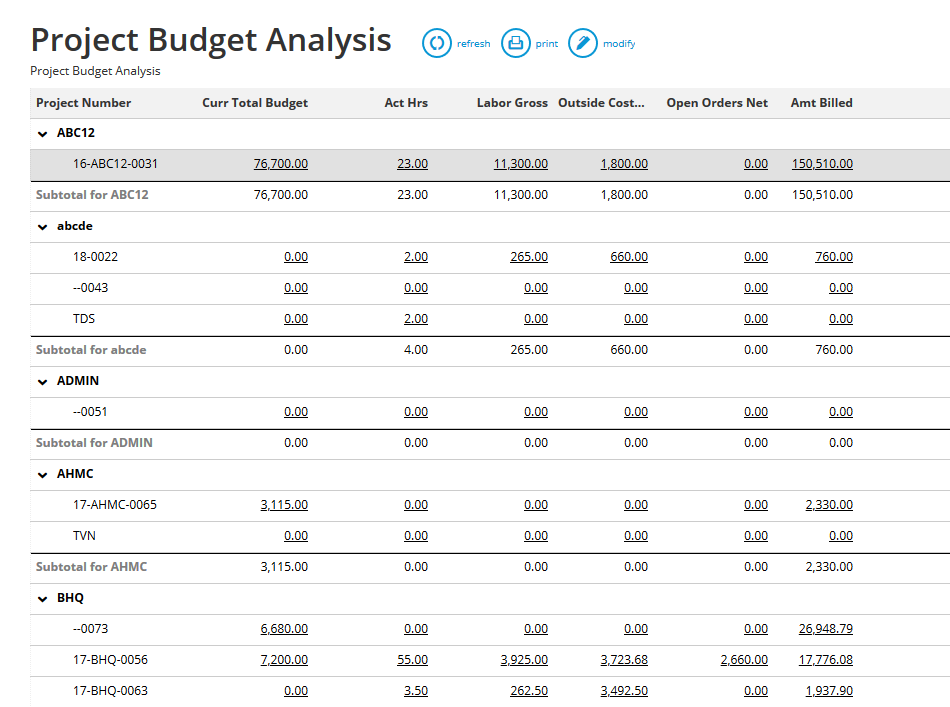
Then you can click any underlined entry to drill into the individual transactions behind the number. The report also features an at-risk filter that sorts projects where actuals have hit 80% or more of the total budget, so you can catch and analyze those with lower margins.
The whole report is super customizable; you can pick which columns appear, build layouts that match how your team calculates things like gross profit and labor net, and save them to reuse.
Project & Campaign P&Ls
One of the many advantages of having native accounting software in Workamajig is that it offers a complete financial picture of profitability. While comparing estimates and actuals at the project level is valuable, these reports don’t tell you if the project is profitable after factoring in all your organization’s overhead.
Our P&L reports offer greater clarity here by pulling data from posted GL transactions, ensuring overhead is accounted for. You can also choose how to allocate the overhead:
- By labor hours — distributed proportionally based on the total approved hours on timesheets charged to the client or project, divided by the total approved hours for the selected date range. So, a project that uses 25% of your resources is allocated 25% of the total overhead.
- By labor cost — distributed proportionally to total labor dollars.
- By total billing — distributed proportionally to revenue.
- None — generate a P&L without overhead allocation.
We offer various types of P&L reports, including for projects, campaigns, services, clients, and the organization overall (corporate P&L) — and you can allocate overhead across all of them. For projects and portfolios, our out-of-the-box P&Ls include:
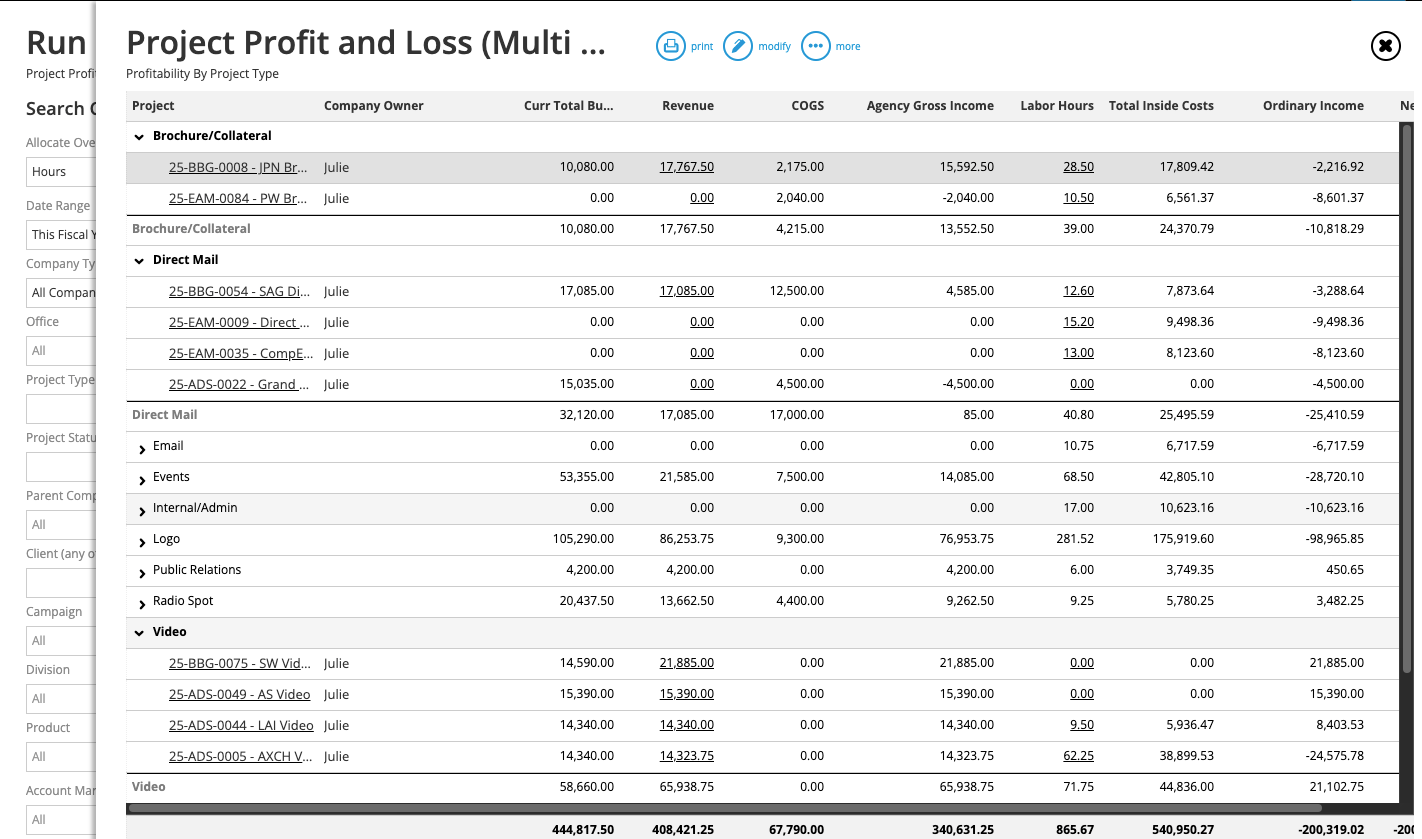
- Project P&L (Multi-View). Offers a snapshot of the profitability of multiple projects in a single view, with the option to sort results by project type, client, account manager, or status.
- Project P&L (Detail View). Get a detailed breakdown of an individual project’s profitability by GL account — revenue, COGS, agency gross income, expenses, and allocated overhead. Useful for drilling down into any issues that set a project’s budget off course.
- Campaign P&L (Multi-View). Evaluate the profitability of all the projects under a given campaign (portfolio).
Workamajig Accounting Software
As we’ve covered above, Workamajig differentiates itself from Monday — and even other agency management systems — by offering built-in accounting software.
Our complete GL accounting system supports all standard accounting processes and best practices — including project expense tracking, vendor invoice management, project billing, client invoicing, retainer management, cost controls, financial reporting, and more.
It fully replaces tools like Xero or QuickBooks and works for both small and large teams, meeting GAAP, GDPR, and HMRC compliance requirements.
Here’s a quick overview of our accounting system’s primary features:
- Chart of Accounts: Accounting teams will have a full GL Chart of Accounts (ex., spending, AR, and AP accounts) in Workamajig to track balances and cash flow, reconcile charges with bank statements, and improve cost management.
- Project billing and client invoicing: Workamajig creates billing worksheets that come pre-filled with project details and follow the specified billing method (time and materials, fixed fee, media, retainer). The system automatically generates billing worksheets and routes these to managers so managers can quickly review, make any final adjustments, and generate invoices to send to clients in a fraction of the time. We also provide customization options; managers can change invoice formats and add personalized messaging or brand logos.
- Online payment collection.Clients can also send payments via CC or ACH thanks to Workamajig’s integrations with PayFlowPro / Authorize.net.
- Sales tax automation. Workamajig’s Avalara lets teams automatically generate sales tax rates and add them to client invoices, reducing errors and saving time.
- Revenue recognition. Our system comes with handy tools for when your income period differs from the period in which the work is delivered, ensuring revenue and costs are matched to the same period for accurate forecasting and P&L reporting. Workamajig supports advanced billing, media prebilling, and work-in-progress (WIP) posting.
- Multi-currency support. Workamajig lets you operate in any currency in which you do business (whether that’s with clients, vendors, or maintaining multiple office locations) while reporting in your home currency.You set your home currency once, and every transaction gets stored in both the original and home currency, so your GL always balances on both sides. Our system also automatically calculates exchange rates, handles realized gains/losses when payments settle at a different rate, and calculates unrealized gains/losses on demand when you run reports.
- Multi-entity support. Easily manage finances for multiple offices or legal entities by creating separate GL companies, each within its own books and self-contained financials. Workamajig segments transactions posted to the GL by company, puts hard rules on what each entity can pay for and be paid for, and lets users optionally enable and manage intercompany transactions.
Financial Reporting
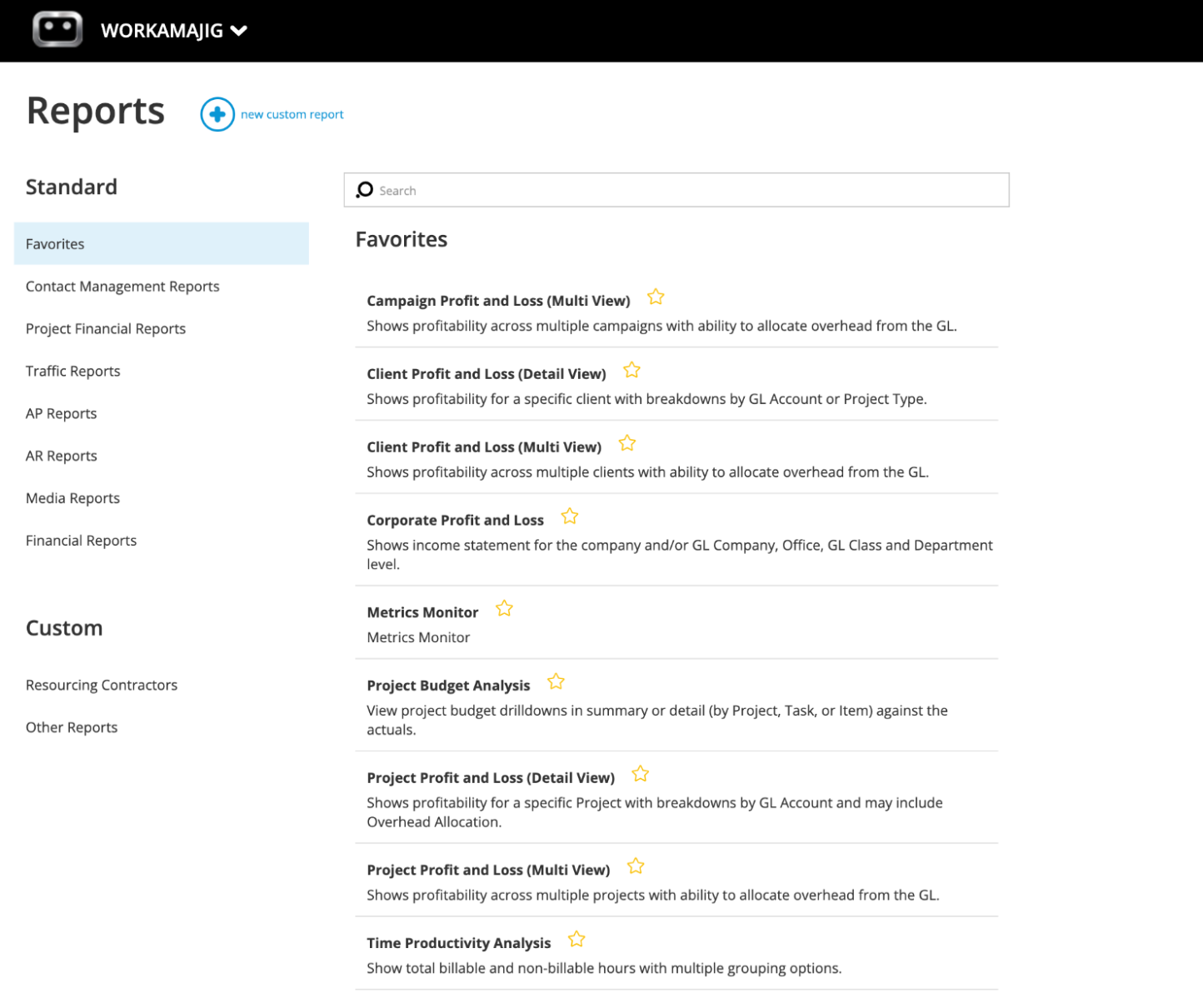
Workamajig also offers a financial reporting dashboard to support our accounting software and cost management tools. This dashboard comes packed with dozens of reports across various categories (project and agency financials, AR, and AP), and you can create custom reports to monitor the key performance indicators (KPIs) most important to your agency's goals.
Our system includes various reports beyond the project and resource ones that we covered above, including corporate and client P&Ls, a key metrics monitor, GL reports, cash projections, revenue forecasting, and more.
You can favorite the reports you often use to create a personalized reporting dashboard. Check out some of the popular reports below:
You can also export Workamajig reporting data to other business intelligence tools or spreadsheet systems (including Excel Financials, Google Financials, and Google Sheets).
Read more: Best Creative Project Management Tools with Financial Tracking
Packages & Getting Started
As mentioned above, Workamajig packages and pricing are straightforward. We provide tailored solutions for agencies and in-house teams; pricing is based on team size and user count. You’ll select your use case and the number of seats you require.
Check out our packages below:
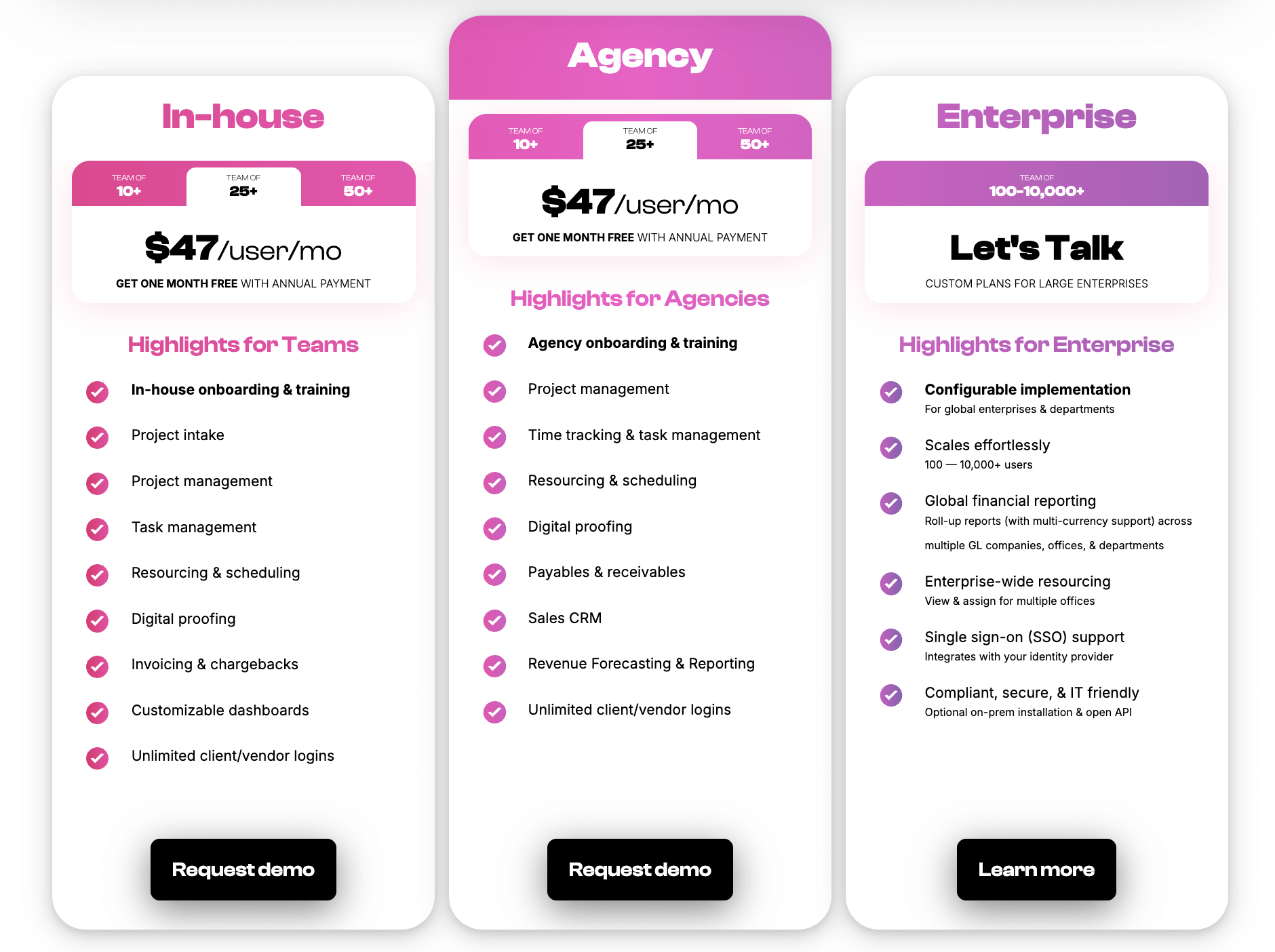
We also offer custom enterprise packages that can support unlimited users, so Workamajig can evolve with your agency no matter how far you scale.
All packages include personalized onboarding and guided training to get you up and running swiftly. Your account manager will configure Workamajig to your requirements and show you its advanced features to minimize the learning curve and streamline adoption.
Of course, our team is always available to answer questions or help you adjust Workamajig settings to your evolving needs.
Request a free demo to learn more about how Workamajig compares to Monday.com.
2. Advantage
.png?width=2000&height=878&name=Advantage%20Simpli.fi%20homepage%20(2024).png)
Advantage is a recommended Monday alternative for full-service, advertising, and media planning agencies because it offers agency management software and media planning and buying software via Simpli.fi.
The platform supports project management, resource management, time tracking, client management, media management, financial management, accounting processes (with full accounting software), and agency reporting. It brings everything agencies require under one roof to improve transparency, collaboration, and profitability.
While many agencies praise Advantage for its centralized solution, it’s worth noting that it has a steep learning curve and doesn’t score highly in usability. Its features are spread across multiple dashboards, so learning to navigate the system and use the tools takes time. That said, Advantage’s team offers guided onboarding and training to offset early hurdles and help agencies acclimate to their system.
Advantage is one of the more comprehensive agency management tools on our list, but it’s also one of the most expensive options. For this reason, Advantage primarily works with enterprises and fast-growing agencies.
Read more Advantage reviews here.
Features
- Project management features — including project intake and project monitoring
- Task management
- Resource management
- Collaborative tools like proofing and reviews
- Time tracking
- Media planning and buying — including broadcast buying, digital buying, and media reporting
- Risk analysis and burn rate tracking
- Media accounting software
- Billing and invoicing
- Estimates
- Budget monitoring
- Financial reporting
- Revenue forecasting
- CRM
- Client management
- Reporting dashboard (to analyze project performance, financials, staff hours, etc.)
- Mobile app (for Android)
Pricing
Advantage offers custom quotes per agency. Contact their team to learn more.
Read more: Best Advantage Software Alternatives for Creative Teams
3. e-Silent Partner

e-Silent Partner is a more comprehensive Monday alternative with a toolset comparable to Workamajig; it includes project management, resource planning, time tracking, CRM and client management, financial management and accounting software, and business intelligence reports. It also appeals to advertising and media agencies with media planning tools and Strata integrations.
The system includes all the features to support creative workflows, and e-Silent Partner has experience with advertising agencies, marketing teams, and media buying agencies. They also work with IT professionals, legal firms, consulting and staffing agencies, architects, and engineers.
e-Silent Partner offers cloud-based and on-premises hosting, along with an array of customization options to tailor the system to your agency's processes and terminology. While the system requires longer implementation times, e-Silent Partner offers guided onboarding and ongoing support to streamline training and keep you running smoothly. (And user reviews praise their customer service team for providing responsive, helpful support.)
Find more e-Silent Partner reviews here.
Features
- Project management
- CRM and client management
- Resource planning and utilization reports
- Team collaboration tools, like file sharing, commenting, and version history
- Time tracking
- Budget tracking
- Media management dashboard
- Integrations with Strata media buying software
- Accounting software
- Financial management
- Billing and invoicing
- Business intelligence reporting — including key metrics monitors and customizable reports
- Process automation
- Mobile app (for iOS and Android)
Pricing
e-Silent Partner doesn’t publicly share pricing; contact their team for a demo to learn more.
4. Function Point
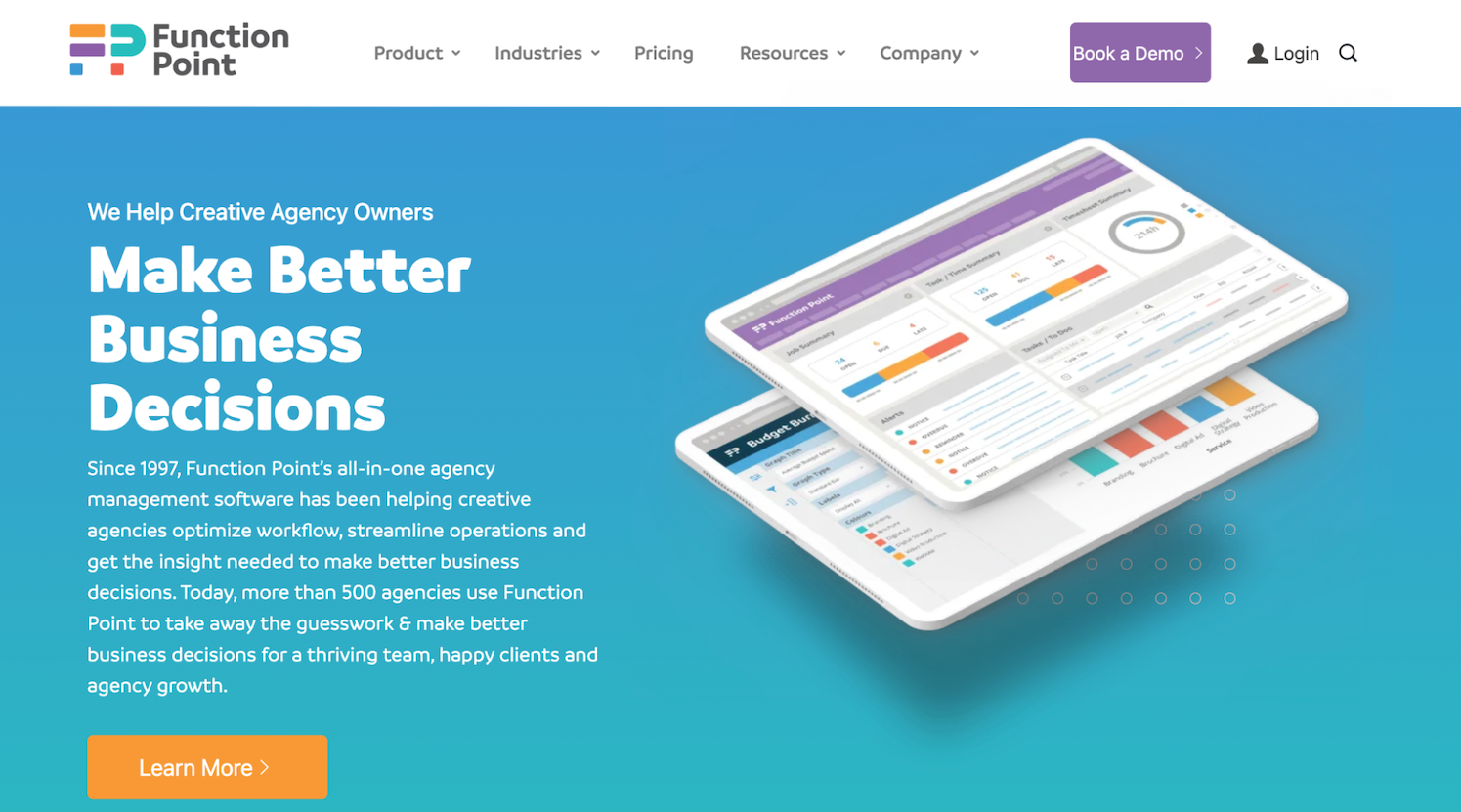
Function Point is a popular Monday.com alternative for agencies because it offers a more comprehensive toolset to:
- Support client intake and client management.
- Create more accurate project plans, speed up planning, and track progress in real time.
- Track and control costs within project workflows.
- Improve resource allocation and utilization.
- Enable productive collaboration with all project stakeholders.
- Report on project outcomes and measure agency profitability.
This toolset allows agencies to oversee all areas of operations in an organized, centralized hub. All stakeholders, including project teams, clients, freelancers, and other vendors, can work from the same system and collaborate easily. This is not only convenient, but also reduces software costs.
Function Point has decades of experience in the creative industry, serving agencies worldwide and supporting teams of all sizes. The primary drawbacks are that Function Point does not include accounting software like Workamajig (it integrates with most major accounting systems), and its pricing is more expensive than that of comparable competitors.
Check out more Function Point reviews here.
Features
- Client management tools, including estimates, proposals, change orders, revision tracking, and job request portals
- CRM and email integrations
- Project templates
- Project management dashboards
- Project tracking (choose Gantt charts or a Kanban board view)
- Timeline views
- Team collaboration, including file sharing and commenting
- Resource management
- Time tracking
- Financial management, including expense tracking
- Billing and invoicing
- Advanced reporting, including profitability reports and custom reporting
- Integrations with accounting systems like QuickBooks and other business applications
Pricing
Function Point offers two standard packages that include access to the complete project, resource, financial, and client management suite. We recommend the higher tier — Optimize — because it includes the QuickBooks integration (essential for supporting accounting workflows) and Business Intelligence reporting.
- Standardize: $58/user/month.
- Optimize: $68/user/month.
Read more: Function Point Reviews & Alternatives
5. Ravetree
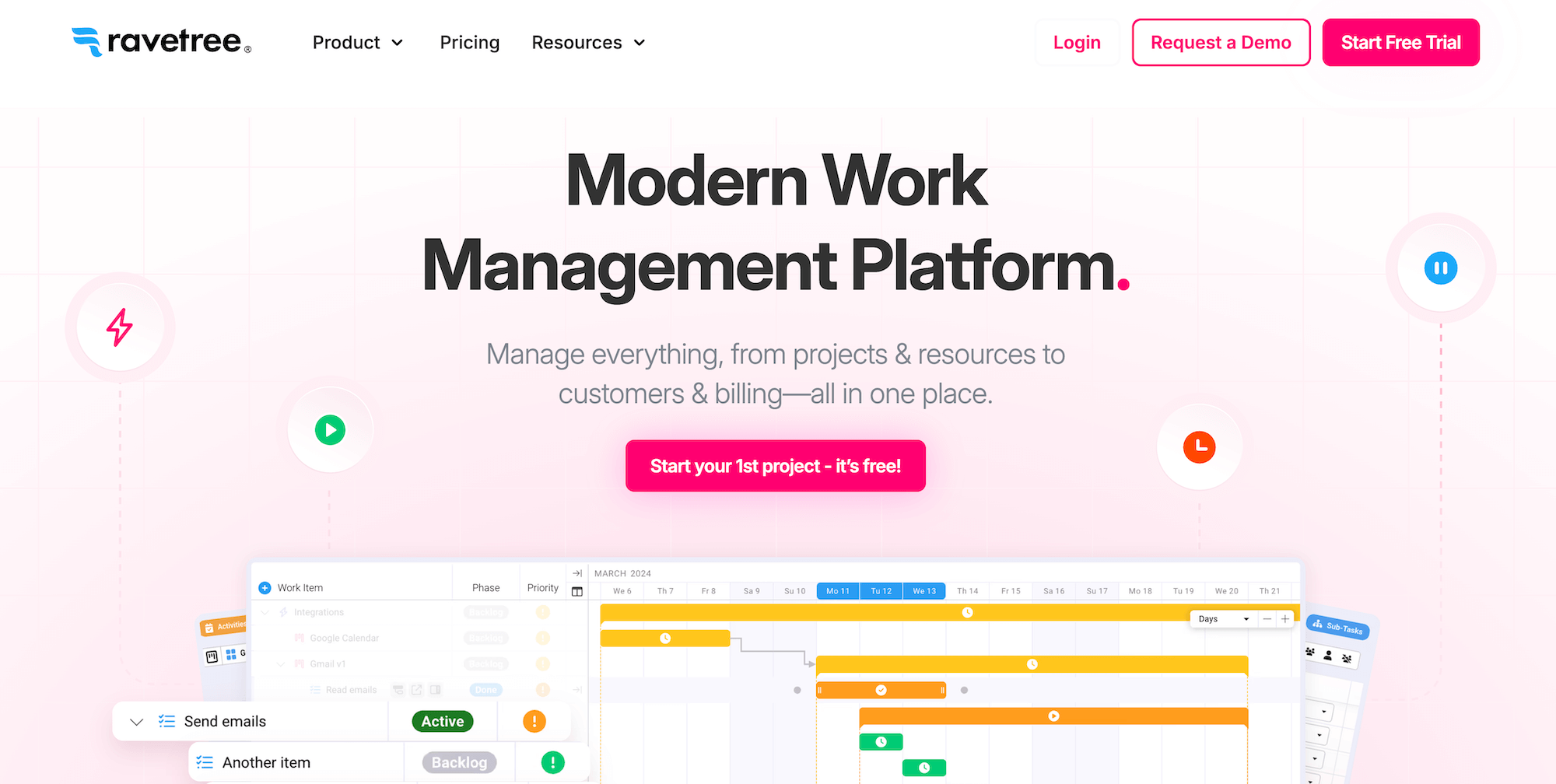
Ravetree offers a more comprehensive, fully integrated platform than Monday, featuring project management, resource planning, time off management, expense management, budget tracking, retainer management, CRM, client collaboration, and reporting.
The main reasons to consider Ravetree over Monday are:
- Simple plans with predictable costs. Its entire suite of tools is available across all plans. The only difference is how much you pay, with longer commitments offering higher discounts.
- Powerful financial management tools. You can use Ravetree to manage expenses, mark them up, connect them to purchases, apply them to retainer budgets, flag them as reimbursements, and approve them. The system also lets you track budgets in real time and automatically generate accurate invoices.
- Integrated client management. Ravetree bakes client collaboration into the project workflow with unlimited client access available at no extra cost to your plan.
Users frequently praise these Ravetree capabilities. For example, according to one reviewer:
“The project budgeting features in Ravetree are the best I've ever seen. Specifically, we needed to set budgets for each project phase and then have those roll up to the project. We also needed the ability to invoice for each of these phases — sometimes as a percentage. Ravetree allows for all of this.”
However, some users mention that they’d appreciate a full, native GL accounting system in Ravetree. The platform is also generally less intuitive than Monday and comes with a steeper learning curve.
See Ravetree’s feature-by-feature comparison with Monday.
Read more Ravetree reviews here.
Features
- Project management module — including customizable request forms, templates, project calendars, project views (timeline, Kanban, table, and calendar views), advanced task management tools (with subtasks and dependencies), daily checklists, budget tracking, and portfolio management
- Resource planning and utilization tracking
- Time tracking
- Collaboration features — file sharing, document management, approvals, versioning, and Teams (where you can organize employees into groups and create custom workflows and Kanban boards, then plan sprints)
- Financial management tools like expense tracking
- Advanced billing tools — estimating, invoicing, vendor invoice management, and retainer management
- CRM
- Client portals
- Integrations with Google, Outlook, and QuickBooks
Pricing
Ravetree offers a single subscription that includes its entire agency management system plus free onboarding, training, and support. The only thing that varies is how much you pay, which depends on whether you commit to a monthly, quarterly, or yearly plan.
- Monthly: $39/user/month
- Quarterly: $34/user/month
- Yearly: $29/user/month
Read more: Best Ravetree Alternatives for Agencies & Creatives
6. Scoro
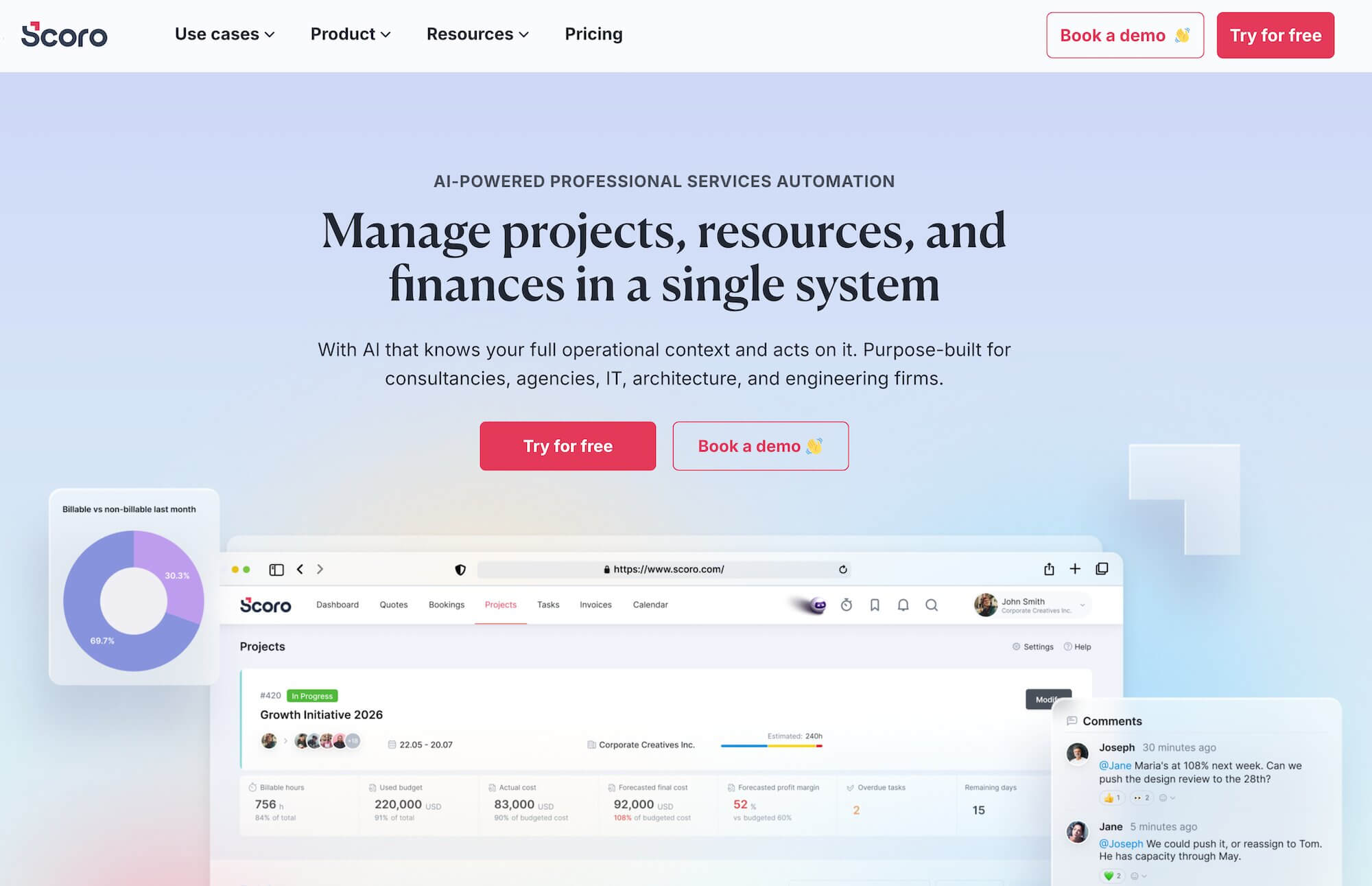
Scoro is a professional services automation (PSA) system used by services companies (including consultancies and agencies) to manage their projects, resources, and profitability in one place.
The full platform includes project management, resource and capacity planning, quoting and budgeting, retainer management, time tracking, expense management, cost controls, team collaboration, CRM, and agency reporting features.
Users switching from Monday to Scoro appreciate its:
- Advanced resource management features. Scoro offers heatmaps that display real-time resource utilization across all projects, roles, and teams in a single view. These heatmaps let managers visualize capacity from different perspectives while they plan out schedules and assign work.
- Robust project budget management features. Scoro lets users track planned vs. actual expenses in real time, with a visual breakdown by category (including labor, materials, and third-party services). The system also includes a Budget Health tab that visually displays actual vs. forecasted burn, with a breakdown of these forecasts by role or service, so you can identify exactly which resources or deliverables are contributing to overruns.
- Support for the full client lifecycle. The system includes all the tools you need to engage clients at each stage. You can generate quotes, choose the most profitable ones using the quotation estimation matrix, collaborate with clients inside project workflows, and generate the final invoice when everything’s delivered.
While Scoro offers a lot more features than Monday overall, they don’t come cheaply. The more advanced financial, CRM, and resource management features are limited to Scoro’s top standard plan and enterprise packages, and multiple tools are sold separately as add-ons.
Plus, aside from the cost, Scoro isn’t the friendliest for smaller teams. All packages have a 5-user minimum, and the vendor offers personalized onboarding only to teams with 50+ users.
Features
- Project management
- Resource planning
- Time tracking
- Collaboration tools
- Quoting & budgeting tools
- Invoicing
- Cost management
- Retainers
- Sales CRM
- Reporting & custom dashboards
Pricing
Scoro offers four paid plans (each with a 5-user minimum limit):
- Core ($23.90/user/month): While this plan includes core project management tools, it lacks project templates, budgets, recurring tasks, role-based labor costs, and more.
- Growth ($38.90/user/month): Unlocks Scoro’s core project, resource, and financial management tools, but offers limited CRM access (contact management only) and lacks supplier management.
- Performance ($59.90/user/month): Scoro’s recommended package that unlocks all essential features (except for a few paid add-ons), including sales pipelines and reports, cost and profit forecasts, revenue recognition, price lists, and more.
- Enterprise (Custom pricing): Everything in Performance plus advanced features such as multi-account reporting, time-locking, company budgets & forecasts, permissions, and more.
Read more: Best Scoro Alternatives for Agencies
7. Accelo
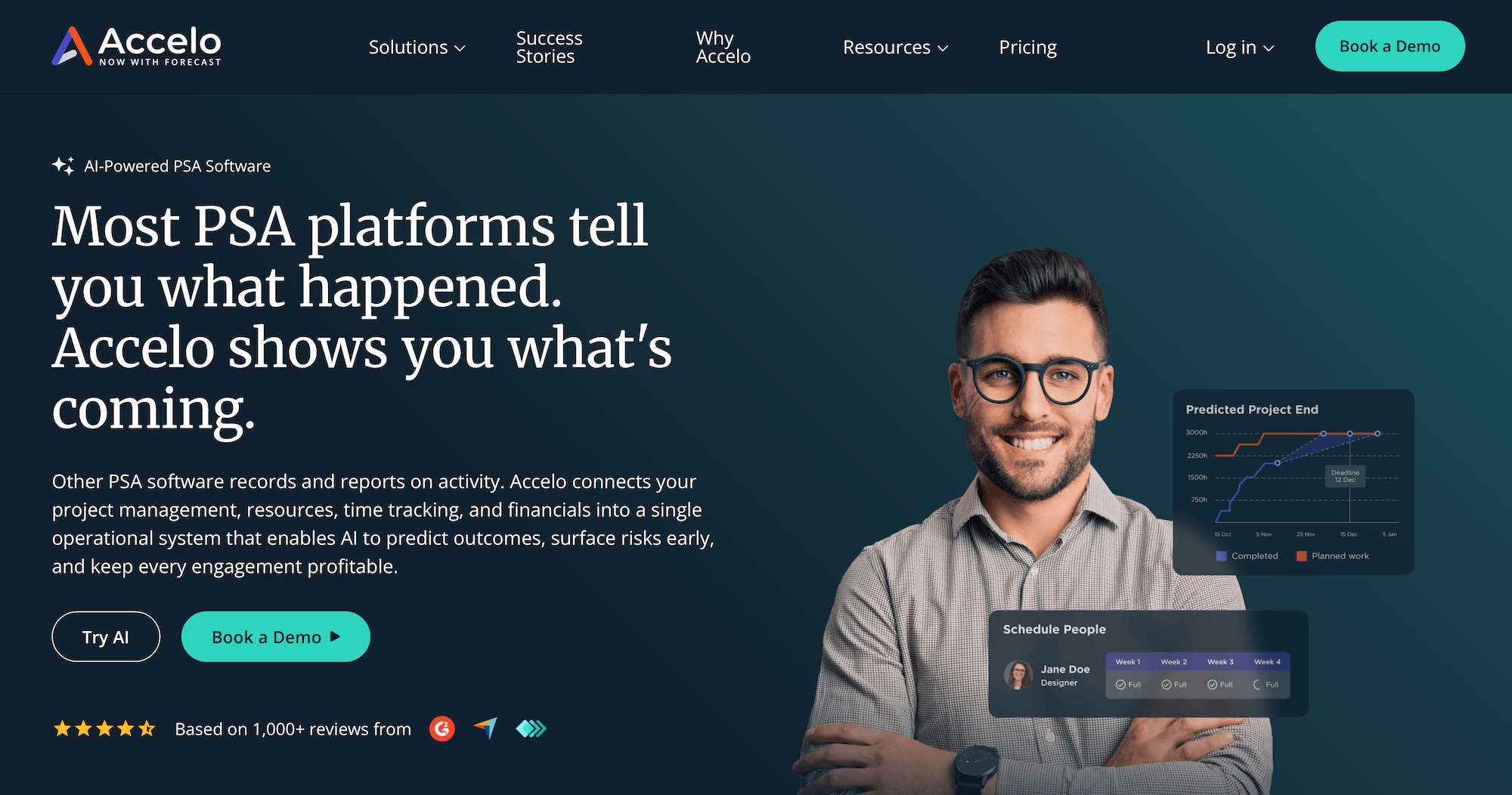
Accelo is a PSA platform that offers a feature set similar to Scoro's, enabling service businesses to manage all their projects, resources, clients, and finances in a fully integrated system. The main difference is that Accelo has baked AI into all the modules across its platform, so it works across the project lifecycle, assisting with proactive risk alerts, scenario planning, resource optimization, and forecasting.
Accelo’s project and financial forecasting tools are especially handy for planning profitable projects, offering deeper financial controls and more context than Monday does. First, managers can kick off new projects using templates or by converting approved quotes, then plan scenarios and optimize resource allocations using AI-powered insights.
Then, as the scope or priorities change, Accelo automatically updates timelines and assists in reshuffling resource plans. Managers can compare planned vs. actual performance in real time as the project progresses, catch overruns before they snowball, and make changes (to project or resource plans) with full financial context.
While users still praise Accelo’s extensive feature set, there has been an uptick in negative user sentiment around the platform since its acquisition in 2024. Some reviewers mention that:
- Accelo doesn’t provide the best support for MSPs specifically, and they say the quality of customer support significantly decreased post-acquisition.
- Accelo’s contract terms are less flexible, with some users mentioning annual lock-ins with no monthly payment options.
Check out more Accelo reviews here.
Features
- Project management
- Client relationship management (CRM)
- Resource management & scheduling
- Time tracking, including timers, billable hours vs. non-billable, manual time entry, email time capture & meeting time capture
- Business intelligence tools, including real-time budget monitoring, project health indicators, planned vs. actual comparisons, automated notifications & profitability forecasts
- Retainers
- Billing & invoicing
- Integrations with accounting & expense management systems
Pricing
Accelo offers custom quotes per agency.
8. Productive
Productive offers another all-in-one agency management software, combining project management software, a sales CRM, resource management, time tracking, budgeting and financial management, invoicing, and agency analytics. It also offers an AI-powered Docs feature to streamline content creation, enable real-time collaboration (for project teams and clients), and reduce feedback loops.
We suggest Productive vs. Monday for agencies because its features are centered around improving productivity and profitability. It offers an advanced resource planning dashboard, detailed utilization reports, proactive cost controls, and robust financial reporting.
Productive supports agencies at every stage of growth. Despite its broader toolset, it offers pricing comparable to Monday, potentially providing better value for agencies.
Productive and Monday receive similar ratings for ease of use and customer support, so users can generally expect comparable onboarding experiences.
Find more Productive reviews here.
Features
- Project intake and sales CRM
- Project management
- Resource management
- Time tracking and timesheets
- Documents (to create shared docs and enable team collaboration)
- Financial management
- Billing and invoicing
- Budget and expense management
- Real-time profitability tracking
- Reporting
- Integrations with QuickBooks, Xero, Sage, SAP, Justworks, ADP, Slack, HubSpot, Google, Microsoft, and Jira
- Open API
- Mobile app (for iOS and Android)
Pricing
Productive offers three packages and custom enterprise plans:
- Essential ($12/month/user): Offers access to basic versions of Productive’s toolset.
- Professional plan ($28/user/month): Provides more advanced versions of its project management tools and time-tracking module.
- Ultimate (Custom quote): Provides access to all of Productive’s features and integrations.
We should note that choosing among Productive’s plans can be confusing because the plans include different tool versions, with the starter plan offering the most basic functionality. We suggest contacting Productive’s team to learn more about the differences between packages and find the right option for your agency.
Read more: Best Productive.io Alternatives for Agencies
9. Teamwork
Teamwork is another popular alternative to Monday’s project management platform — offering more robust work management software for agencies. In addition to creatives, Teamwork’s platform appeals to IT professionals and software developers, architects, engineers, consultants, accounting and financial advisors, and law firms.
Teamwork is less comprehensive than many of the alternatives on our list because it lacks native accounting and CRM software (though it integrates with popular tools like QuickBooks and Salesforce). However, it still makes our list because it offers stronger client management, time tracking, and financial reporting than Monday.com does — all of which are important for agency operations.
Also, while it’s less robust than the other alternatives we’ve covered, users praise its simple, intuitive interface, and the platform includes many AI features to assist with day-to-day workflows.
Read more Teamwork reviews here.
Features
- Project intake forms and project planning
- Project management
- Project monitoring
- Resource and workload management
- Time tracking
- Internal proofing and collaborative tools
- Workflow automation tools
- Client management
- Expense management
- Budget tracking
- Invoicing
- Reporting
- Integrations and API
- Mobile apps for iOS and Android
Pricing
Teamwork offers three packages:
- Basics ($13.99/user/month): The most basic package with limited feature access. For example, it includes time tracking but not resource scheduling or financial reporting.
- Accelerate ($29.99/user/month): The most similar to Monday’s offerings.
- Ultimate (Custom quote): Grants full platform access and is Teamwork’s recommended package.
Teamwork also offers custom packages for enterprise agencies.
10. Bonsai
Bonsai is a Monday alternative used by freelancers, remote teams, solo entrepreneurs, and small service businesses, featuring project management, resource planning, time tracking, meeting scheduling, client management, and financial management tools.
Some of its standout tools include:
- Branded client portals. Use these to share invoices and agreements and to provide secure access to projects.
- Contracts and proposals. Use Bonsai’s dedicated tools to build these agreements out while pulling in relevant data (such as client information or project estimates) from the rest of the system.
- Extensive billing and invoicing tools. Bonsai lets you create regular, subscription, and retainer invoices. It also supports multiple currencies.
Many reviewers praise Bonsai’s sleek, user-friendly interface, ease of setup, and lower price relative to many competitors. It can be a good choice for smaller teams that want a cost-friendly Monday alternative with tightly integrated client management tools and budget tracking.
However, it’s worth noting that Bonsai is considerably less comprehensive than the systems we’ve covered above. As one user notes:
“The ‘jack of all trades, master of none’ figure of speech applies to Bonsai's feature sets sometimes. It might be a thing that is missing or a feature that exists, but doesn't quite do what I want it to do for a particular need.”
For example, the system lacks tools for engaging sales opportunities, measuring sales performance, and managing teams. Also, its lower-tier plans lack advanced features such as timesheet locking, custom roles, custom data imports, and Xero integration.
Read more Bonsai reviews here.
Features
- CRM
- Client management features, including communication tools & portals
- Project management module
- Task management
- Templates
- Team & client collaboration features
- Resource planning
- Estimating
- Time tracking
- Financial management
- Budget tracking
- Invoicing
- Integrations
- Automation
- Reporting
Pricing
Bonsai offers four standard packages (with discounts on annual plans and teams with 30+ users):
- Basic ($15/user/month): Limited access to all modules, including the CRM, project management, and time tracking.
- Essentials ($25/user/month): Unlocks more advanced features (especially financial tools), including project templates, client portals, scheduling, expense tracking, proposals, contracts, invoices, payments, and more.
- Premium ($39/user/month): Bonsai’s most popular plan that unlocks access to integrations, reporting, workload management, and more.
- Elite ($59/user/month): Includes complete platform access and dedicated support.
Read more: Bonsai Software Reviews & Alternatives
How to Choose the Right Monday.com Alternative for Your Needs
If you’re an agency looking for an alternative to Monday.com or moving off the system, the five main things to consider are:
- The workflows you need to support. Are you just looking for task management, project views, and collaboration tools? Or do you need project expense tracking, client invoicing, financial reporting, and client management tools?
Some users prefer all-in-one systems that bring everything in one place, while others make do by stitching different apps together. Think long-term about the setup you want and prioritize those features in a Monday alternative. - Your reporting needs. The reporting tools for most universal project management solutions are typically limited to evaluating project performance and resource utilization — they don’t really offer deeper financial analysis. Work management systems that integrate financial management solutions (or, even better, accounting software) offer deeper insights into profitability and performance.
- Collaborating with outside stakeholders. If you need to manage vendor and client relationships, look for systems that not only offer dedicated tools but alsotreat third parties (production vendors, freelancers, clients) as part of the project workflow. So they should include features such as vendor and client portals, project collaboration tools, feedback management, and approval workflows.
- Your budget. Most Monday alternatives offer tiered plans with different feature mixes, so comparing them and choosing the right package can be confusing. Worse yet, many tools also sell features separately as add-ons, which isn’t always clear from the pricing page. So make sure you do your homework about how much the tool will cost in total to support all your workflows.
- Support options. Many Monday alternatives offer tiered support structures, reserving the most hands-on options (personalized onboarding, priority support) for top plans or enterprise packages. If you’re looking to adopt a fairly robust system, it’s best to prioritize a vendor that includes comprehensive support with your plan.
FAQs about Monday.com Alternatives
What are the best alternatives to Monday for project management?
It depends on the types of project workflows you plan to support and how integrated they need to be with other aspects of the business (such as project expense tracking, client invoicing, or client collaboration).
First, you’ve got the “direct” Monday alternatives like ClickUp and Asana. They’re robust, universal project management solutions with their standout features — e.g., ClickUp has a much broader set of features, while many users describe Asana as more flexible and intuitive than Monday, with superior reporting. But these systems fall short for managing finances within project workflows and collaborating with third-party stakeholders (vendors, clients).
Then, there are project management tools that pack in native financial management features, such as Teamwork and ProProfs Projects. They’re a step up from Monday if you specifically need to track project budgets in real-time, accurately evaluate profitability, and manage third-party relationships.
Finally, we have agency management systems that integrate project, resource, client, and financial management, allowing agencies to manage everything in one place. The best systems in this category offer native accounting software, so you can pull project expenses in, manage reconciliation, pay vendors, track budgets in real-time, push costs into client invoices, allocate overhead, and accurately evaluate project profitability.
Learn more about these options in our buyer’s guide: Top-Rated Project Management Tools
What are some user-friendly alternatives to Monday.com for task management?
Here are some popular, user-friendly alternatives to Monday for task management:
- Basecamp — A deliberately simple task and project management tool that offers to-do lists, file sharing, team collaboration, calendars, and message boards in a single, user-friendly interface. It’s not the best option for more complex projects because it lacks many advanced features, such as task dependencies, resource management, and project analytics.
Read about Basecamp and its alternatives here.
- Trello — Another simple tool that lets you manage tasks and projects through a Kanban-style board interface. Trello is more focused on task management and doesn’t include the kind of communication tools that come with Basecamp, but its entry-level plans are more affordable.
Check out Trello reviews here.
- Asana — Offers very similar project management capabilities to Monday with a visual, user-friendly interface. Asana also has a massive community forum where users discuss ways to configure the platform to their specific workflows.
Read about Asana and its alternatives here.
Are there free alternatives to Monday for small teams?
Yes, many Monday alternatives offer (limited) free plans to support small teams, and you can also self-host open-source project management software for free.
- Freedcamp — Offers one of the most generous free tiers around, with unlimited tasks, projects, storage, and users at no cost. It includes core boards, task lists, and collaboration tools.
- Trello — The forever-free plan is great for visual, Kanban-style work, with unlimited cards and Power-Ups, but has a cap of 10 boards and 10 collaborators per Workspace. Automation is limited to 250 runs per month and attachments to 10 MB per file.
- ClickUp — The Free Forever plan includes unlimited tasks and members, but attachment storage is limited to 100 MB, and Custom Fields are limited to 60 uses.
- GoodDay — A strong middle ground for small teams, with a free plan for up to 15 users, unlimited projects and tasks, dashboards, custom workflows, templates, and integrations, plus 1 GB of storage.
- Asana — Its free Personal plan supports up to two users, but you can create unlimited tasks and projects.
Are there any good alternatives to Monday.com for CRM?
Yes, there are lots of good alternatives to Monday’s CRM:
- Workamajig agency CRM — A top choice for agencies looking for a CRM that’s fully integrated with a broader agency management suite. Workamajig CRM supports the entire sales pipeline, from lead capture through deal closure and client intake.
- Insightly — A CRM and project management system that fully replaces Monday CRM while also offering native PM tools.
- Pipedrive — Designed by sales teams, for sales teams, with minimal technical setup and cost-friendly plans.
- HubSpot CRM — A powerful, feature-rich CRM that integrates natively with HubSpot’s various other business tools.
- Salesforce CRM — The best-known enterprise CRM that integrates with the most popular project management tools.
Getting Started
Workamajig is a more comprehensive system than Monday’s project management solution — including additional software solutions (like CRM and accounting software) and more advanced financial management tools. It allows agencies to bring everyone under one roof, manage the success of the most complex projects, and consolidate their tech stack in the process.
We configure each Workamajig instance according to client requirements, and our system scales with your teams, processes, and goals.
Request a free demo to learn how Workamajig can support your agency’s success.
Related reads:
- Best Project Management Tools for Creative Agencies
- Best Marketing Operations Management Software
- Project Management for Graphic Design: Strategies & Software